

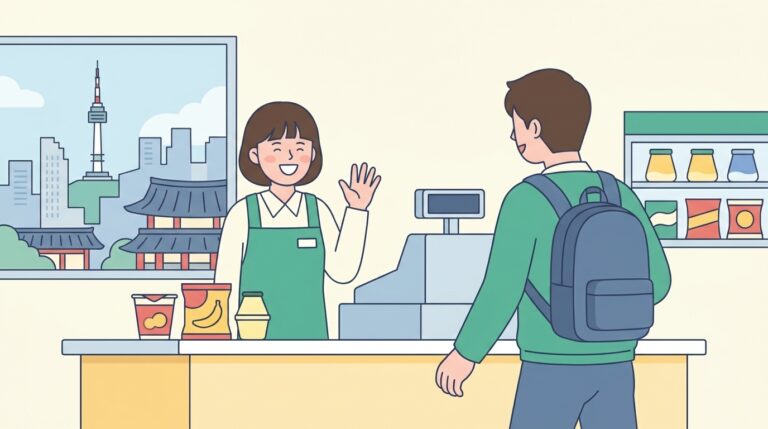
Say Goodbye to Part-Time Job Panic! Welcoming Korean Customers Like a Pro
Phase 1: Empathy (Welcome to the Counter!)
안녕하세요! (Annyeonghaseyo!) I’m your chief editor at Daily Hangul, your trusty local culture navigator.
Picture this: You just landed a dream part-time job—or as Koreans call it, an 알바 (Alba)—at a trendy cafe in Hongdae or a cozy convenience store in Seoul. The aesthetic is perfect, the K-pop background music is vibey, and you are wearing your neat apron. Suddenly, the door bell rings: ddallang~ (딸랑~).
A customer walks in, makes eye contact, and… your mind goes completely blank! You want to sound friendly, polite, and natural, but standard textbook phrases feel too stiff, and your tongue is tied.
Don’t panic! This is the ultimate rite of passage for every beginner in Korea. In this guide, we will transform that initial panic into pure confidence. Based on real-world experiences of foreign students working in Korea, we have curated the most practical, natural phrases that will make you sound like a seasoned local clerk from day one. Let’s dive in!
Phase 2: Key Expressions Deep Dive
1. 어서 오세요 (Eoseo oseyo)
- Pronunciation: Uh-suh oh-seh-yo (Sounds like “Awesome” without the ‘m’, followed by “oh-say-yo” with a soft ‘s’).
- Meaning: Welcome! / Come on in!
- K-Culture Moment: You hear this in every single K-Drama whenever a character walks into a convenience store, local tavern (Sool-jib), or fried chicken shop. It is often sung in a friendly, high-pitched tone!
- Editor’s Insight: This is the golden standard of customer service. It literally translates to “Please come in quickly,” but it carries a warm, welcoming vibe.
- Situation Spectrum: Casual 🚫 | Semi-formal ✅ | Formal ✅
- 🤔 Think About It: In many Western cultures, a simple “Hi” or “How are you?” is common. Why do you think Korean service language focuses heavily on welcoming the action of “entering” the space?
2. 봉투 필요하세요? (Bongtu piryohaseyo?)
- Pronunciation: Bong-too pee-ryoh-hah-seh-yo? (Think of a musical “Bong-too” followed by “peer-yo-ha-say-yo”).
- Meaning: Do you need a bag?
- K-Culture Moment: In Korea, eco-friendly laws mean stores charge a few cents for plastic or paper bags. Clerks will always ask this right before payment.
- Editor’s Insight: “봉투” (Bongtu) means bag/envelope. Instead of long, complex sentences, this short question is all you need to keep transactions smooth.
- Situation Spectrum: Casual 🚫 | Semi-formal ✅ | Formal ⚠️
- 🤔 Think About It: How does your home country handle eco-bags at checkout compared to Korea’s active questioning?
3. 감사합니다. 또 오세요! (Gamsahabnida. Tto oseyo!)
- Pronunciation: Gam-sa-ham-nee-da. Ttoh oh-seh-yo! (Make sure to double the ‘t’ sound in “Tto”—it should sound crisp, like “t-toe”).
- Meaning: Thank you. Please come again!
- K-Culture Moment: Usually said with a polite bow as the customer leaves, signaling a warm goodbye.
- Editor’s Insight: “또” (Tto) means “again.” Adding “또 오세요” makes you sound incredibly friendly and wishing for their return, rather than just saying a cold “goodbye.”
- Situation Spectrum: Casual 🚫 | Semi-formal ✅ | Formal ✅
- 🤔 Think About It: How does wishing someone to “come again” shift the energy of a business transaction into a relationship?
Phase 3: Textbook Korean vs. Real-World Korean
Situation 1: Welcoming a Customer
- 📖 Textbook Korean: 안녕하십니까? (Annyeonghasimnikka? – “How are you doing?” in ultra-formal style)
- 🗣️ 진짜 (Real) Korean: 어서 오세요~! (Eoseo oseyo! – “Welcome!”)
- 💡 Why the difference? Unless you are working at a five-star luxury hotel lobby or a high-end department store, saying Annyeonghasimnikka? at a regular cafe or convenience store sounds overly robotic, stiff, and slightly awkward. Eoseo oseyo is bright, energetic, and perfectly appropriate!
Situation 2: Asking about a bag
- 📖 Textbook Korean: 비닐봉지를 드릴까요? (Binilbongjireul deurilkkayo? – “Shall I offer you a plastic bag?”)
- 🗣️ 진짜 (Real) Korean: 봉투 필요하세요? (Bongtu piryohaseyo? – “Do you need a bag?”)
- 💡 Why the difference? While the textbook version is grammatically flawless, it is too long and formal for a fast-paced checkout. Real-world retail is all about speed and clarity. “봉투 필요하세요?” gets straight to the point gracefully.
Phase 4: K-Culture Deep Dive & Non-Verbal Manners
4-1. The Art of “Nunchi” (눈치) and Body Language
In Korean customer service, non-verbal cues speak louder than words. Keep these three physical rules in mind to earn instant respect:
1. The 15-Degree Bow: When saying Eoseo oseyo, do not just stand stiffly. Give a slight, polite tilt of your head and upper body (about 15 degrees). It shows readiness to serve.
2. The Two-Handed Hand-off (양손): Never hand back a receipt, credit card, or change with only one hand. Hold the card with both hands, or support your right wrist/forearm with your left hand. This is a crucial sign of respect in Korea.
4-2. The Convenience Store (편의점) Aesthetic
Korean convenience stores (like CU, GS25, and 7-Eleven) are lifestyle hubs. You are not just scanning barcodes; you are part of a cozy community. Keep your tone cheerful and rhythmic to match the lively city energy!
Phase 5: Real-World Roleplay Scenario
Setting: A warm, busy convenience store near a subway station in Seoul.
Characters:
* Staff (You): An enthusiastic rookie part-timer.
* Min-jun (민준): A friendly regular customer buying late-night snacks.
1. Staff (You): 🎭 (Bowing slightly with a smile)
   어서 오세요!
   (Eoseo oseyo!)
   "Welcome!"

2. Min-jun: 안녕하세요! 혹시 삼각김밥 어디 있어요?
   (Annyeonghaseyo! Hoksi samgakgimbap eodi isseyo?)
   "Hello! By any chance, where are the triangle gimbap?"

3. Staff (You): 🎭 (Pointing gently with an open palm toward the fridge)
   저기 냉장고에 있어요.
   (Jeogi naengjanggo-e isseyo.)
   "They are over there in the refrigerator."

4. Min-jun: 아, 찾았어요! 감사합니다. 이거 계산해 주세요.
   (Ah, chajasseoyo! Gamsahabnida. Igeo gyesanhae juseyo.)
   "Ah, found them! Thank you. Please ring this up."

5. Staff (You): 네, 알겠습니다. 🎭 (Scanning the item) 봉투 필요하세요?
   (Ne, algetseubnida. Bongtu piryohaseyo?)
   "Yes, understood. Do you need a bag?"

6. Min-jun: 아니요, 괜찮아요. 카드로 결제할게요.
   (Aniyo, gwenchanayo. Kadeuro gyeoljehalgeyo.)
   "No, it's okay. I'll pay by card."

7. Staff (You): 🎭 (Receiving and inserting the card with both hands)
   네, 결제 도와드릴게요.
   (Ne, gyeolje dowadeurilgeyo.)
   "Yes, let me help you with the payment."

8. Min-jun: 감사합니다! 수고하세요.
   (Gamsahabnida! Sugohaseyo.)
   "Thank you! Keep up the good work."

9. Staff (You): 🎭 (Bowing slightly as they walk away)
   감사합니다. 또 오세요!
   (Gamsahabnida. Tto oseyo!)
   "Thank you. Please come again!"
🔀 Interactive Choice Points
If the customer asks: “따뜻한 음료는 어디에 있나요?” (Where are the hot drinks?), how will you respond?
- Option A: Point with one finger and say “저기요” (Jeogiyo).
- Feedback (Risk): Pointing with a single finger can feel blunt or rude. Saying “저기요” is used to call someone, not point out directions. Better to use an open hand!
- Option B: Smile, gesture with your whole hand open, and say “저기 온음료 코너에 있습니다” (Jeogi on-eumryo koneo-e itseubnida).
- Feedback (Best): Perfect! Polite, clear, and makes the customer feel well-guided.
- Option C: Shrug and say “잘 몰라요” (Jal mollayo).
- Feedback (Bad): Even if you are new, saying “I don’t know” without trying to help will make the manager sweat! Try to find another staff member or point to the warm beverage cabinet.
Phase 6: 10-Second Emotion Shadowing Drill
To sound natural, you need the right rhythm and emotion! Practice these with the guidance below:
- [😊 Bright & Singing tone]
어서 / 오세요~!
(Uh-suh / oh-seh-yoo~)
Tip: Raise the pitch slightly at the end to sound energetic! -
[🤔 Short & Polite inquiry]
봉투 / 필요하세요?
(Bong-too / pee-ryo-ha-seh-yo?)
Tip: Keep the pause clean and raise the end like a friendly question. -
[💖 Warm & Grateful goodbye]
감사합니다. / 또 / 오세요!
(Gam-sa-ham-nee-da. / Tto / oh-seh-yo!)
Tip: Put a gentle emphasis on “Tto” (again) to sound genuine.
Phase 7: K-Culture Mini Dictionary
- 알바 (Alba) | Short for ‘Arbeit’ (German for work). It refers to any part-time job in Korea.
- 편의점 (Pyeonuijeom) | Convenience Store. Famous for 24/7 access, delicious street foods, and cozy dining tables.
- 계산 (Gyesan) | Calculation / Checkout. Use “계산 도와드릴게요” (Let me help you with the bill) when customers approach.
- 영수증 (Yeongsujeung) | Receipt. Usually asked as “영수증 필요하세요?” (Do you need a receipt?).
Phase 8: Traveler’s Survival Kit
Survival Expressions for Temporary Clerks / Visitors
- 카드로 하실 건가요? (Kadeuro hasil geongayo?)
- Meaning: Will you be paying by card?
- Pro Tip: Korea is almost entirely cashless. Asking this first speeds up checkout!
- 잠시만요 (Jamsimanyo)
- Meaning: Just a moment, please.
- Pro Tip: Use this when you need to search for a product or ask another staff member for help.
- 이거 2+1 행사 상품이에요! (Igeo 2 plus 1 haengsa sangpum-ieyo!)
- Meaning: This is a buy-2-get-1-free promotion item!
- Pro Tip: Korean convenience stores love “1+1” or “2+1” deals. Customers will love you if you remind them to grab their free item!
📌 Editor’s Travel Note:
To find your way around retail locations or look up locations for top part-time hubs, make sure to download the Naver Map App or use the local job searching portals. Note: Store promotions and operation policies may vary depending on location and season.
Phase 9: One Step Deeper (Thinking Points)
In Korean culture, the boundary between customer and employee is built on mutual respect and public etiquette. While western countries favor friendly small talk (“How’s your day?”), Korean service culture values promptness, neatness, and linguistic respect (using high-level Honorifics). It reflects a society that respects boundaries while maintaining warm care (정 – Jeong) through careful phrasing.
💬 Your Turn: Have you ever noticed the differences in service speed and style between your country and Korea? Let us know in the comments below!
Phase 10: FAQ & Common Mistakes
FAQ
Q: What should I say if I do not understand what the customer said?
A: Don’t panic! Simply bow your head slightly and say: “죄송합니다, 다시 한번 말씀해 주시겠어요?” (Joesonghabnida, dasi hanbeon malsseumhae jusigesseoyo? – I’m sorry, could you say that once more?). Koreans are very understanding towards learners!
Q: Is it okay to say “안녕” (Annyeong) to a young customer?
A: No, even if the customer looks much younger than you, always maintain polite language (존댓말) behind the counter. It keeps the business atmosphere professional and avoids any potential misunderstandings.
Q: Can I use “고마워” (Gomawo) when saying thank you?
A: “고마워” is casual panmal. You must use the polite “감사합니다” (Gamsahabnida) or “고맙습니다” (Gomapseubnida) to all customers.
🚨 Common Mistakes Alert (The Part-timer’s Caution Board)
- Mistake 1: Handing cards with one hand.
- Correct Action: Always hold the card or receipt with both hands.
- Mistake 2: Keeping a flat, silent expression.
- Correct Action: Keep a soft smile and use vocal tones to show welcome.
- Mistake 3: Saying “Welcome” only when they look at you.
- Correct Action: Say “어서 오세요” as soon as you hear the door chime!
Phase 11: Action Mission!
- 🥉 Bronze Mission: Record yourself saying “어서 오세요!” three times in front of the mirror with a polite 15-degree nod.
- 🥈 Silver Mission: Write down the phrase “봉투 필요하세요?” on a sticky note and practice reading it with natural speed under 3 seconds.
- 🥇 Gold Mission: Next time you visit a local Korean store or cafe, carefully listen to the clerk’s welcome and thank them using “감사합니다, 수고하세요!”
-
🎮 K-Culture Mission: Watch a convenience store scene in a K-Drama (e.g., Backstreet Rookie or My Mister) and count how many times they say “어서 오세요!”
Phase 12: Interactive Quiz Challenge
Test your rookie part-timer knowledge!
1. Situation Quiz
A customer hands you a item to purchase. What is the most natural way to ask if they need a bag?
* A) 가방 줄까요?
* B) 봉투 필요하세요?
* C) 비닐팩 필요해요?
Reveal Answer & Explanation
Correct Answer: B) 봉투 필요하세요?
Explanation: ‘봉투’ is the standard word used in retail for any checkout bags (paper or plastic). Option A uses ‘가방’ which means personal backpack/bag, and Option C is unnatural.
2. Fill-in-the-Blank
Complete the perfect closing phrase for a departing customer:
“감사합니다. ______ 오세요!”
Reveal Answer & Explanation
Correct Answer: 또 (Tto)
Explanation: ‘또’ means ‘again’. Together it forms ‘또 오세요’ which warmly translates to ‘Please come again!’
3. True or False
True or False: It is completely fine to throw change or slide the card across the table back to the customer.
Reveal Answer & Explanation
Correct Answer: False
Explanation: Sliding or tossing cards/change is considered highly disrespectful in Korea. You should always hand cards or money directly to the customer’s hands using both hands.







