

Master Movie Night: How to Pick the Best Seats in a Korean Cinema Like a Local
Phase 1: Empathy (Your Cinema Bestie is Here!)
안녕하세요! (An-nyeong-ha-se-yo!) I’m your Daily Hangul editor, and today, I’m taking you to one of my absolute favorite places in Korea: the movie theater (영화관 – yeong-hwa-gwan)!
Picture this: You are standing in front of a giant, glowing ticket kiosk at CGV in Hongdae. The screen is flashing, the smell of sweet caramel popcorn is in the air, and you want to book seats for the latest hit K-Movie. Suddenly, you freeze. Which seat should you pick? How do you ask the staff for a middle seat without sounding like a textbook robot?
Don’t worry! Choosing a seat in a foreign language can feel stressful, but today, we are going to master this in just 5 minutes. This guide is based on real-life feedback from A1 beginners who went from “pointing and sweating” to “confident and seated.” Let’s dive in!
Phase 2: 3 Core Expressions for Perfect Seat Selection
Here are the three golden phrases you need to know. Keep them in your pocket!
1. 여기 자리 있어요? (Yeo-gi ja-ri i-sseo-yo?)
- Pronunciation: Yuh-gi jah-ri ee-ssuh-yo? (Rhymes with “Yo-gi, is buddy here-yo?”)
- Meaning: “Is this seat taken?” (Literally: “Is there a seat here?”)
- K-Culture Moment: You walk into a crowded premium cinema hall and see a jacket on the seat next to your friend. You ask the person nearby to make sure you aren’t stealing their spot.
- Editor’s Insight: This is a magic phrase. You can use it in cafes, buses, and cinemas alike!
- Situation Spectrum:
- Casual: ⚠️ (Use “여기 자리 있어?” with close friends)
- Semi-formal: ✅ (Perfect for talking to friendly strangers)
- Formal: 🚫 (Too casual for a grand business meeting)
- 🤔 Think About It: In Korea, leaving a personal item (like a bag or phone) on a chair is a universal sign that the seat is reserved. Have you noticed how safe Korea is when people leave their laptops unattended?
2. 가운데 자리로 주세요. (Ga-un-de ja-ri-ro ju-se-yo.)
- Pronunciation: Gah-oon-deh jah-ri-ro joo-seh-yo.
- Meaning: “Please give me a middle seat.”
- K-Culture Moment: You are booking tickets at the counter and want the absolute best view of the screen for an IMAX film.
- Editor’s Insight: Ga-un-de means “middle.” Adding -ro ju-se-yo is the politest beginner way to ask for anything in Korea.
- Situation Spectrum:
- Casual: 🚫
- Semi-formal: ✅ (Perfect for ticket booth staff)
- Formal: ✅
- 🤔 Think About It: Why do Koreans love the middle seats so much? We call it the “Golden Zone” where the sound and screen alignment are mathematically perfect for your eyes!
3. 통로 쪽 자리로 할게요. (Tong-ro jjok ja-ri-ro hal-ge-yo.)
- Pronunciation: Tong-noh jjok jah-ri-ro hal-geh-yo. (Sounds like “Tong-lo choke jah-ri…”)
- Meaning: “I will take the aisle seat.”
- K-Culture Moment: You know you’ll need a bathroom break mid-movie, so you want easy access without disturbing anyone.
- Editor’s Insight: Tong-ro means “aisle/passage,” and jjok means “side.” Hal-ge-yo means “I will do/choose.”
- Situation Spectrum:
- Casual: 🚫
- Semi-formal: ✅
- Formal: ✅
Phase 3: Textbook Korean vs. Real-Life Korean
Let’s look at how textbooks teach this versus how real Koreans actually talk!
Situation 1: Choosing a seat at the ticket booth
- 📖 Textbook style: “어느 좌석을 원하십니까?” (Which seat do you desire?)
- 🗣️ Real-Life style: “자리 어디로 해 드릴까요?” (Where should I set your seats?)
- 💡 Why the difference? Textbooks love the formal word “좌석” (jwa-seok – seat), but in daily life, Koreans almost always use the friendlier word “자리” (ja-ri).
Situation 2: Checking if a seat is free
- 📖 Textbook style: “이 좌석은 비어 있는 상태입니까?” (Is this seat in an empty state?)
- 🗣️ Real-Life style: “여기 앉아도 돼요?” (Can I sit here?)
- 💡 Why the difference? Real Korean is short and action-oriented. Asking “Can I sit?” is much more natural than asking about the “state of the seat.”
Phase 4: K-Culture Deep Dive & Non-verbal Manners
4-1. The “Excuse Me” Squeeze (Bi-myeo-ga-gi)
When walking past people already seated in your row, do not just walk normally!
* The Gesture: Lower your head slightly, put your hands together in a soft “prayer” position or hold them near your chest, and say softly: “죄송합니다” (Joe-song-ham-ni-da – Sorry) or “지나갈게요” (Ji-na-gal-ge-yo – Passing through). This shows great Nunchi (social wit and manners).
4-2. Premium K-Cinema Culture
Korean movie theaters are next-level. CGV offers “Sweetbox” seats (premium sofas for couples) and even Tempur Cinema (where you lie on luxury mattresses!). If you want to impress your date, ask for: “스위트박스 자리 있어요?” (Sweetbox ja-ri i-sseo-yo? – Are there Sweetbox seats available?)
Phase 5: Real-Life Roleplay Scenario
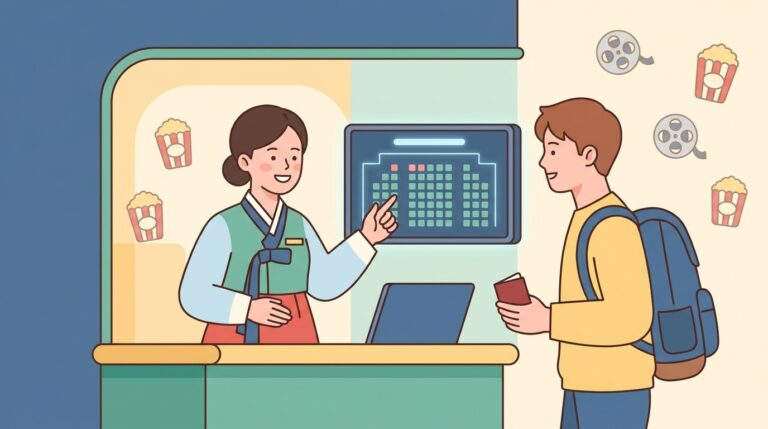
Setting: CGV Yongsan I-Park Mall. You (Minwoo) are buying two tickets for a movie from the friendly staff member (Ji-su).
- 지수 (Staff): 어서 오세요! 어떤 영화 보세요?
(Eo-seo o-se-yo! Eo-tteon yeong-hwa bo-se-yo?)
🎭 [Smiles warmly at the counter]
“Welcome! What movie are you watching?” -
민우 (You): 기생충 두 명요.
(Gi-saeng-chung du myeong-yo.)
🎭 [Points to the movie poster]
“Parasite, for two people, please.” -
지수 (Staff): 네, 두 시 영화 맞으세요? 자리는 어디로 해 드릴까요?
(Ne, du si yeong-hwa ma-jeu-se-yo? Ja-ri-reun eo-di-ro hae deu-ril-kka-yo?)
🎭 [Taps on the screen to show the seating chart]
“Okay, the 2:00 PM movie, correct? Where would you like your seats?” -
민우 (You): 가운데 자리 있어요?
(Ga-un-de ja-ri i-sseo-yo?)
🎭 [Leans in to look at the screen]
“Are there middle seats?” -
지수 (Staff): 아, 가운데는 앞 줄만 남았어요. 뒤쪽은 통로 자리만 있어요.
(Ah, ga-un-de-neun ap jul-man na-ma-sseo-yo. Dwi-jjok-eun tong-ro ja-ri-man i-sseo-yo.)
🎭 [Points to the red occupied seats]
“Ah, for the middle, only the front rows are left. In the back, only aisle seats are available.” -
민우 (You): 그럼 뒤에 통로 자리로 할게요.
(Geu-reom dwi-e tong-ro ja-ri-ro hal-ge-yo.)
🎭 [Nods in agreement]
“Then, I will take the aisle seats in the back.” -
지수 (Staff): 네, 여기 카드로 결제해 주세요.
(Ne, yeo-gi ka-deu-ro gyeol-je-hae ju-se-yo.)
🎭 [Points to the card reader]
“Great, please pay with your card here.” -
민우 (You): 감사합니다!
(Gam-sa-ham-ni-da!)
🎭 [Hands over the card with both hands as a sign of respect]
“Thank you!”
🔀 Choose Your Adventure!
What would you say if you wanted to change your seat at the last minute?
* A) “자리 바꿔 주세요!” (Ja-ri ba-kweo ju-se-yo!)
* Editor’s Feedback: Best! Direct, polite, and very clear.
* B) “여기 싫어요!” (Yeo-gi si-reo-yo!)
* Editor’s Feedback: Bad! This means “I hate it here!” and sounds way too aggressive for an A1 learner.
* C) “다시 하세요.” (Da-si ha-se-yo.)
* Editor’s Feedback: Risk! This means “Do it again” as a command. The staff might feel shocked by the sudden bossy tone!
Phase 6: 10-Second Shadowing Drill
Let’s practice speaking with real emotion! Follow the slashes / for pauses.
- [😊 Politely & Hopeful]
가운데 / 자리 / 있어요?
(Ga-un-de / ja-ri / i-sseo-yo?) -
[🥺 Slightly disappointed but making a choice]
그럼 / 통로 자리로 / 할게요.
(Geu-reom / tong-ro ja-ri-ro / hal-ge-yo.)
Phase 7: K-Culture Mini Dictionary
- 매진 (Mae-jin) | Sold Out | Used when all seats for a movie are gone. If you see “매진” in red letters, it’s time to find another movie!
- 상영관 (Sang-yeong-gwan) | Theater Hall | The actual room number (e.g., 상영관 5 = Hall 5) printed on your ticket.
- 팝콘 (Pap-kon) | Popcorn | Essential! Korean theaters are famous for Sweet (달콤 – dal-kom) and Garlic (갈릭 – gal-lik) double-flavored popcorn.
- 포토티켓 (Po-to-ti-ket) | Photo Ticket | A plastic card ticket you can customize with your own photos using the cinema app. Super popular souvenir!
Phase 8: Survival Kit for Travelers
Survival Expressions TOP 3:
- 화장실 어디예요? (Hwa-jang-sil eo-di-yeo-yo?) – Where is the restroom?
- 자막 있어요? (Ja-mak i-sseo-yo?) – Are there subtitles? (Crucial if you are watching a Hollywood film and want English/Korean subs!)
- 주차 등록해 주세요. (Ju-cha deung-rok-hae ju-se-yo.) – Please register my parking. (Useful if you drove to the mall cinema.)
💡 Editor’s Travel Note: To find theaters and book easily, make sure to use Naver Maps instead of Google Maps, as Google Maps doesn’t update transit and location layouts well in Korea.
Phase 9: “Going Deeper” (Thinking Corner)
In many Western countries, people don’t mind sitting in the very front row if the theater is full. However, in Korea, sitting in the front row is widely avoided because of “눈 피로” (eye fatigue). Koreans value comfort and personal space, which is why the middle-back rows always sell out first. Next time you book, watch the screen—you’ll see the back half fill up like a perfect wave!
💬 Your Turn: Do you prefer the aisle seat or the middle seat when you watch movies in your home country? Let me know in the comments below!
Phase 10: FAQ & Common Mistakes
Q: Can I bring my own snacks into a Korean movie theater?
A: Yes! Unlike many Western countries, Korean cinemas allow external food as long as it doesn’t have a strong smell (like hot stew or fast food).
Q: What does “상영 중” mean?
A: It means “Now Showing” or “Movie in Progress.”
Q: Can I change my seat after entering the cinema hall?
A: Legally, no. Korean seats are strictly assigned. Moving to an empty seat might cause trouble if the ticket owner arrives late.
🚨 Common Mistakes Warning Board
- Mistake 1: Saying “좌석 주세요” (Jwa-seok ju-se-yo) to staff.
- Correct Action: Say “자리 주세요” (Ja-ri ju-se-yo). “좌석” sounds too formal, like a train announcement.
- Mistake 2: Entering the hall late without using phone flashlight.
- Correct Action: Korean theaters get extremely dark. Use your phone light pointed downwards so you don’t trip or blind others.
Phase 11: Action Mission!
- 🥉 Bronze Mission: Say “가운데 자리” out loud 3 times in front of your mirror.
- 🥈 Silver Mission: Share this post on your Instagram Story and tag @DailyHangul with your favorite movie emoji!
- 🥇 Gold Mission: Walk into a local Korean theater (or practice online) and successfully select an aisle seat using “통로 자리로 할게요!”
Phase 12: Interactive Quiz Challenge
Q1. What does “가운데” (ga-un-de) mean?
1) Aisle
2) Middle
3) Front Row
👉 Click to reveal the Answer!
Answer: 2) Middle
Explanation: “가운데” means middle. Excellent job! 🎉
Q2. True or False: You should walk upright and loudly past people to get to your seat.
👉 Click to reveal the Answer!
Answer: False
Explanation: You should bow slightly, say “지나갈게요” (passing through), and squeeze past politely!







