

Plan Your Perfect Korean Day Off: How to Check and Ask About Public Holidays Like a Local!
Phase 1: Empathy (The “Closed Gates” Dilemma)
안녕하세요! (An-nyeong-ha-se-yo!) Hello, it’s your Daily Hangul editor and your personal cultural guide.
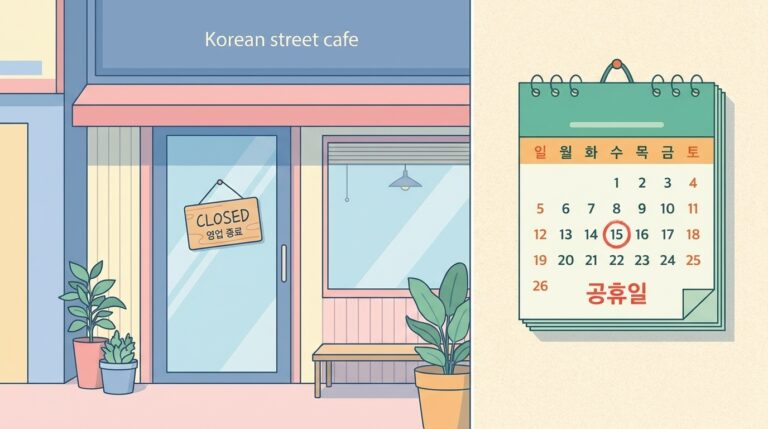
Imagine this: You’ve planned the perfect day in Seoul. You wake up early, put on your aesthetic outfit, and take the subway to that famous Hanok cafe in Bukchon Hanok Village you saw on Instagram. But when you arrive… the lights are off, the door is locked, and there’s a small sign on the door. You look around and notice the streets are unusually quiet.
“Wait, is today a holiday?” you wonder.
Living or traveling in Korea is an absolute dream, but missing a “Red Day” (public holiday) can completely derail your plans! From banks and post offices to local restaurants and cafes, business hours change drastically during national holidays.
Don’t worry! Today, we are going to learn how to ask about holidays in natural, everyday Korean so you never get caught off guard. Let’s make sure your next adventure goes smoothly!
Phase 2: Core 3 Expressions Deep Dive
Here are the three most essential expressions you need to know to check holidays.
1. 빨간 날 (Ppal-gan nal)
- Pronunciation: Ppal-gan nal (Sounds like “pal-gahn nahl” — roll the ‘l’ sound gently on the roof of your mouth).
- Meaning: Literally “Red Day” (colloquial for Public Holiday).
- K-Culture Moment: You’ll hear this constantly in K-Dramas! When office workers are looking at their calendars, they don’t say “national holiday”—they excitedly count the “Red Days” (빨간 날).
- Editor’s Insight: Why red? Because on Korean calendars, Sundays and official national holidays are printed in bright red! It’s the ultimate friendly, casual word for a day off.
- Situation Spectrum: Casual (✅) / Semi-formal (⚠️) / Formal (🚫)
- 🤔 Think About It: Does your culture use a specific color to represent holidays or special days on the calendar?
2. 내일 쉬는 날이에요? (Nae-il swi-neun na-ri-e-yo?)
- Pronunciation: Nae-il swee-neun nah-ree-ay-yo?
- Meaning: “Is tomorrow a day off?” / “Are you closed tomorrow?”
- K-Culture Moment: Use this when talking to a local barista or shop owner before a holiday to double-check if they will be open.
- Editor’s Insight: “쉬는 날” (swi-neun nal) means “resting day.” It is incredibly polite yet natural for daily conversations.
- Situation Spectrum: Casual (✅) / Semi-formal (✅) / Formal (⚠️)
- 🤔 Think About It: How do you ask if a business is closed in your country? Do you ask about the “holiday” or if they are simply “resting”?
3. 연휴 (Yeon-hyu)
- Pronunciation: Yeon-hyu (Sounds like “yuhn-hyoo”).
- Meaning: Consecutive holidays / Long weekend.
- K-Culture Moment: Before major holidays like Chuseok (Thanksgiving) or Lunar New Year, Koreans excitedly talk about the upcoming “연휴” and plan trips.
- Editor’s Insight: If you hear “황금연휴” (hwang-geum-yeon-hyu), it means “Golden Holiday”—a super long weekend!
- Situation Spectrum: Casual (✅) / Semi-formal (✅) / Formal (✅)
- 🤔 Think About It: How do you prepare for a long weekend in your hometown?
Phase 3: Textbook Korean vs. Real Korean
Let’s compare what you find in standard textbooks with what Koreans actually say!
Situation 1: Asking if a shop is open on a holiday
- 📖 Textbook: 공휴일에 영업합니까? (Gong-hyu-ir-e yeong-eob-ham-ni-ka? – “Do you operate on public holidays?”)
- 🗣️ Real Korean: 빨간 날에도 문 열어요? (Ppal-gan na-re-do mun yeor-eo-yo? – “Are you open even on Red Days?”)
- 💡 Why the difference? The textbook version is too robotic and formal. Locals use “문 열다” (to open the door) to mean “open for business.”
Situation 2: Asking if tomorrow is a holiday
- 📖 Textbook: 내일은 공휴일입니까? (Nae-ir-eun gong-hyu-ir-im-ni-ka? – “Is tomorrow a public holiday?”)
- 🗣️ Real Korean: 내일 빨간 날이에요? (Nae-il ppal-gan na-ri-e-yo? – “Is tomorrow a Red Day?”)
- 💡 Why the difference? In daily conversations, “빨간 날” is much warmer and more natural than the cold, official word “공휴일.”
Phase 4: K-Culture Deep Dive & Non-Verbal Manners
4-1. 눈치 (Nunchi) & Gestures
When checking if a shop is closed, Koreans use a very specific body language. If a shop owner sees you looking through the window of a closed store, they might make an “X” shape with their arms or index fingers. This is the universal Korean gesture for “No,” “Closed,” or “Not allowed.”
If you want to politely ask if they are closing early, tilt your head slightly forward to show respect, point politely to the clock, and ask: “오늘 일찍 닫아요?” (O-neul il-jjik dad-a-yo? – “Do you close early today?”)
4-2. The Ghost Town Phenomenon: Seollal & Chuseok
During the two biggest holidays—Seollal (Lunar New Year) and Chuseok (Korean Thanksgiving)—Seoul undergoes a massive transformation. Millions of people travel back to their hometowns in what we call “Gwi-seong-gil” (귀성길 – homecoming rush).
Because of this, major districts in Seoul like Gangnam or Myeongdong can feel like ghost towns, and many local restaurants close for 3 to 4 days. Always check ahead!
Phase 5: Real-Life Roleplay Scenario
Meet Min-ho, a friendly barista at a cozy cafe near Hongdae. Chuseok is coming up next week, and you want to know if the cafe will be open!
- Scenario: Checking the cafe’s holiday hours before a long weekend.
Cafe Barista: Min-ho (민호)
You: Korean Learner (A2)
- Min-ho: 어서 오세요! 어떤 것 도와드릴까요?
(Eo-seo o-se-yo! Eo-tteon geot do-wa-deu-ril-kka-yo?)
「🎭 Smiling warmly behind the counter」
“Welcome! How can I help you?” -
You: 저기… 다음 주가 추석 연휴잖아요.
(Jeo-gi… da-eum ju-ga chu-seok yeon-hyu-ja-na-yo.)
「🎭 Pointing gently to the calendar on your phone」
“Um… next week is the Chuseok holiday, right?” -
Min-ho: 네, 맞아요! 다음 주 월요일부터 수요일까지 쉬는 날이에요.
(Ne, ma-ja-yo! Da-eum ju wol-yo-il-bu-teo su-yo-il-kka-ji swi-neun na-ri-e-yo.)
「🎭 Nodding in agreement」
“Yes, that’s right! We are resting from next Monday to Wednesday.” -
You: 아, 그럼 카페도 빨간 날에 문 닫아요?
(A, geu-reom ka-pe-do ppal-gan na-re mun dad-a-yo?)
「🎭 Looking slightly curious」
“Ah, then does the cafe close on the Red Days too?” -
Min-ho: 월요일하고 화요일은 쉬고, 수요일에는 문 열어요!
(Wol-yo-il-ha-go hwa-yo-il-eun swi-go, su-yo-il-e-neun mun yeor-eo-yo!)
「🎭 Showing two fingers for the closed days」
“We rest on Monday and Tuesday, but we open on Wednesday!” -
You: 다행이네요! 수요일에 올게요.
(Da-haeng-i-ne-yo! Su-yo-il-e ol-ge-yo.)
「🎭 Smiling with relief」
“What a relief! I will come on Wednesday.” -
Min-ho: 네! 수요일에 만나요. 감사합니다!
(Ne! Su-yo-il-e man-na-yo. Gam-sa-ham-ni-da!)
「🎭 Waving politely」
“Yes! See you on Wednesday. Thank you!”
🔀 Interactive Choice Point!
How would you reply to Min-ho to confirm the Wednesday opening time?
* Choice A: “그럼 수요일 몇 시에 열어요?” (Geu-reom su-yo-il myeot si-e yeor-eo-yo? – “Then what time do you open on Wednesday?”)
* Choice B: “수요일에 왜 일해요?” (Su-yo-il-e wae il-hae-yo? – “Why are you working on Wednesday?”)
* Choice C: “빨간 날 싫어요.” (Ppal-gan nal sir-eo-yo. – “I hate Red Days.”)
Feedback:
- Choice A (Best!): ⭐⭐⭐ Perfect! Asking for the specific opening time is super practical since holiday operating hours are often shorter.
- Choice B (Risk!): ⚠️ This sounds a bit too personal or accusatory (“Why are you working?”) in Korean culture.
- Choice C (Bad!): 🚫 This sounds very negative and unrelated to your cafe visit!
Phase 6: 10-Second Emotional Shadowing Drill
Let’s practice speaking with the real emotion of a tired worker longing for a holiday!
- Sentence: 아, / 다음 주에 / 빨간 날 / 있어서 / 너무 좋아요!
- Pronunciation: Ah, / da-eum ju-e / ppal-gan nal / it-seo-seo / neo-mu jo-ha-yo!
- Emotional Guide:
[😊 Brightly, with a huge sigh of relief and excitement] - English Meaning: “Ah, I’m so happy because there is a Red Day next week!”
Phase 7: K-Culture Mini Dictionary
- 대체 공휴일 (Dae-che gong-hyu-il) | Substitute Holiday
If a national holiday falls on a weekend, the government makes the following Monday a “substitute” day off! - 황금연휴 (Hwang-geum-yeon-hyu) | Golden Long Weekend
A magical period when holidays line up with weekends to create a 4-to-5-day vacation. - 징검다리 휴일 (Jing-geom-da-ri hyu-il) | “Stepping Stone” Holiday
If Tuesday is a holiday, Monday is the “stepping stone” (sandwich day). Many Koreans take a day off on Monday to enjoy a long vacation! - 연차 (Yeon-cha) | Annual Paid Leave
The holy grail of Korean office workers, used strategically to connect stepping stone holidays.
Phase 8: Traveler’s Survival Kit
Survival Expressions TOP 3
- 오늘 영업해요? (O-neul yeong-eob-hae-yo?)
- “Are you open today?”
- 쉬는 날이 언제예요? (Swi-neun na-ri eon-je-yeo-yo?)
- “When is your day off?”
- 연휴에 문 열어요? (Yeon-hyu-e mun yeor-eo-yo?)
- “Are you open during the holiday weekend?”
📝 Editor’s Travel Note
- Pro Tip: Don’t trust Google Maps hours during Korean holidays! It is highly recommended to download the Naver Map App (네이버 지도 앱) or KakaoMaps. Local businesses update their holiday operating hours on Naver in real-time.
- Disclaimer: Holiday operating hours are subject to change by individual store owners.
Phase 9: One Step Deeper (Korean “Yorabel” Culture)
Historically, South Korea was famous for long work hours. However, in recent years, the concept of “워라밸” (Wo-ra-bael – Work-Life Balance) has taken over the younger generation.
Because of this shift, Koreans cherish their “빨간 날” (Red Days) deeply. Asking a colleague about their plans for a holiday is a great icebreaker and shows you respect their personal time.
💬 Your Turn: Leave a comment below! What is the most important national holiday in your country, and what do you usually do on that day?
Phase 10: FAQ & Avoiding Mistakes (FAQ Schema)
Q: Is everything in Seoul closed during Red Days?
A: No! Major department stores, modern shopping malls (like Starfield), convenience stores, and franchises in big tourist areas stay open. However, independent local cafes, traditional markets, and public offices (banks, post offices) will definitely close.
Q: What is the best way to ask a small restaurant owner if they are open?
A: Simply smile and ask, “오늘 영업하나요?” (O-neul yeong-eob-ha-na-yo? – “Are you operating today?”) or “오늘 문 열었어요?” (O-neul mun yeor-eot-seo-yo? – “Are you open today?”).
Q: Does public transportation run on holidays?
A: Yes! Buses and subways run normally, but they may operate on a slightly reduced weekend schedule. High-speed trains (KTX) will be completely sold out months in advance due to holiday travelers.
🚨 Common Mistakes Board
- Calling a regular day off “공휴일” (Gong-hyu-il):
- Mistake: “저 내일 공휴일이에요.” (My personal day off is a national holiday.)
- Correct Action: Use 쉬는 날 (swi-neun nal) for personal days off. “저 내일 쉬는 날이에요.”
- Expecting banks to open on “대체 공휴일” (Substitute Holidays):
- Mistake: Going to exchange money on a Monday substitute holiday.
- Correct Action: Banks treat substitute holidays exactly like normal holidays. They will be closed!
- Asking formal questions to a young barista:
- Mistake: “귀사는 공휴일에 휴무하십니까?”
- Correct Action: Keep it warm and simple: “빨간 날에 쉬어요?”
Phase 11: Action Mission
- 🥉 Bronze Mission: Open your calendar app and find the next “빨간 날” (Red Day) in Korea!
- 🥈 Silver Mission: Write a comment below using the phrase: “저는 [Your Favorite Activity]을/를 좋아해서 빨간 날이 너무 좋아요!”
- 🥇 Gold Mission: Next time you visit a Korean restaurant or grocery store, ask the staff: “내일 쉬는 날이에요?”
-
🎮 K-Culture Mission: Watch a clip of your favorite Korean drama and listen closely—can you hear the characters talking about a “빨간 날” (Red Day) or “연휴” (holiday)?
Phase 12: Interactive Quiz Challenge
Test your knowledge with these fun mini-questions!
Q1. What does “빨간 날” (Ppal-gan nal) literally mean?
- A) Hot Pepper Day
- B) Red Day (Public Holiday)
- C) Sunny Day
Q2. Fill in the blank: “내일 ____ 날이에요?” (Is tomorrow a day off?)
- A) 일하는 (working)
- B) 쉬는 (resting)
- C) 예쁜 (pretty)
Q3. True or False: Banks and Post Offices are open on substitute holidays (대체 공휴일).
- A) True
- B) False
🎉 Click here to check the answers and explanations!
- Q1 Answer: B) Red Day. Because holidays are printed in red on Korean calendars!
- Q2 Answer: B) 쉬는. “쉬는 날” translates directly to “resting day” (day off).
- Q3 Answer: B) False. Substitute holidays are treated as official public holidays, so public offices are strictly closed!







