

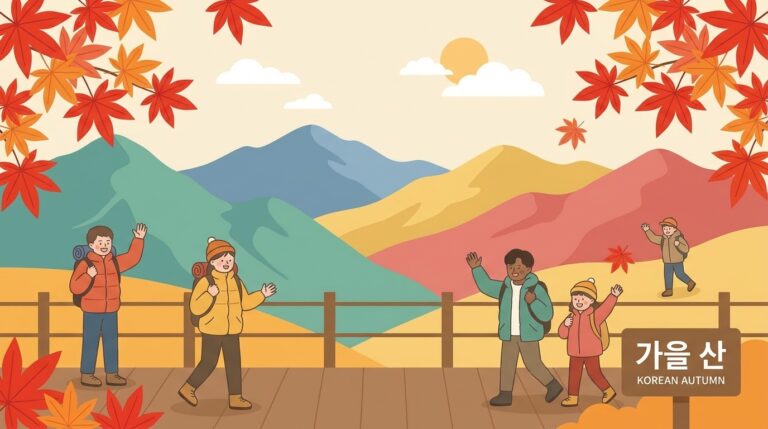
Survived the Foliage Rush! 🍁 How to Navigate Korea’s Autumn Crowds Like a Local
Phase 1: Empathy (Welcome to the Golden Wave!)
안녕하세요! It’s your friendly neighborhood Korean editor from Daily Hangul (매일한글). 🍂
Imagine this: The crisp autumn air brushes against your cheeks, and the mountains surrounding Seoul are blazing with vibrant shades of ruby red, burnt orange, and golden yellow. You’ve packed your camera, put on your comfiest shoes, and headed to Bukhansan or Seoraksan to experience Korea’s famous 단풍놀이 (Danpung-nori / Autumn foliage viewing).
But as soon as you step off the subway or arrive at the trail entrance, your jaw drops. Instead of a tranquil forest, you are greeted by an ocean of hikers dressed in dazzling, neon-colored outdoor gear (등산복 – deungsanbok). You’re squeezed like kimbap ingredients on a narrow trail, wondering, “How do I politely ask someone to let me pass?” or “How do I express how crazy packed this is without sounding rude?”
Don’t worry! Navigating the peak foliage crowds (단풍놀이 인파 – danpung-nori inpa) is a true Korean rite of passage. Today, we’re going to master the exact real-life phrases, cultural manners, and survival hacks you need to turn a crowded mountain trail into a heartwarming local experience. Let’s dive in!
Phase 2: Three Core Expressions Deep-Dive
To confidently navigate the foliage rush, let’s master these three golden expressions. They will help you sound natural, polite, and instantly relatable to the locals around you!
1. 사람이 엄청 많네요! (Saram-i eomcheong man-neyo!)
- Pronunciation: Sah-rahm-ee eom-cheong mahn-neh-yo! (Sounds like: “om-chong” [extremely] + “man-neh-yo” [there is/are a lot!])
- Meaning: “Wow, there are so many people!” or “It is incredibly packed!”
- K-Culture Moment: You reach the scenic peak or the cable car ticket booth and realize the queue is a mile long. You catch the eye of the person next to you, sigh softly with a smile, and say this phrase.
- Editor’s Insight: While textbook Korean teaches “사람이 아주 많습니다” (very formal and stiff), real Koreans use 엄청 (eomcheong – extremely/super) to add emotion. The grammar ending -네요 (-neyo) expresses surprise and invites the other person to agree with you. It’s the ultimate icebreaker!
- Situation Spectrum:
- Casual: 사람이 엄청 많네! (✅ with friends)
- Semi-formal: 사람이 엄청 많네요! (✅ perfect for strangers/older hikers on the mountain)
- Formal: 사람이 아주 많습니다. (⚠️ too textbook; sounds like a news reporter)
- 🤔 Think About It: Why do you think commenting on shared inconveniences (like a huge crowd) is such an easy way to connect with strangers in Korea?
2. 먼저 지나갈게요. (Meon-jeo ji-na-gal-ge-yo.)
- Pronunciation: Muhn-juh jee-nah-gahl-geh-yo. (Sounds like: “mun-juh” [first/ahead] + “jee-nah-gal-geh-yo” [I will pass])
- Meaning: “I will pass by first.” / “Excuse me, let me squeeze past.”
- K-Culture Moment: You are hiking up a narrow wooden staircase on Mount Naejangsan, and a group of slower hikers is enjoying the view. You want to gently overtake them without being disruptive.
- Editor’s Insight: English speakers often try to translate “Excuse me” directly to “실례합니다” (sillyehamnida). However, in a crowded outdoor setting, “실례합니다” sounds overly dramatic—almost like you’ve stepped on someone’s foot. “먼저 지나갈게요” is the gold standard for polite spatial navigation.
- Situation Spectrum:
- Casual: 먼저 지나갈게. (✅ with close friends)
- Semi-formal: 먼저 지나갈게요. (✅ the most natural, polite standard)
- Formal: 먼저 지나가겠습니다. (⚠️ slightly stiff, but acceptable)
- 🤔 Think About It: By stating your action (“I will pass first”) instead of asking for permission, how does this expression keep things quick and efficient on a busy trail?
3. 줄이 진짜 기네요. (Jur-i jinjja gi-neyo.)
- Pronunciation: Jool-ee jeen-jjah gee-neh-yo. (Sounds like: “jul-ee” [the line] + “jeen-jah” [really] + “gee-neh-yo” [is long!])
- Meaning: “The line is really long!”
- K-Culture Moment: Standing in line for hot autumn street foods like hotteok (sweet filled pancake) or waiting for the shuttle bus at the mountain entrance.
- Editor’s Insight: Using 진짜 (jinjja) instead of “매우” (maeu) instantly makes you sound like a natural Korean speaker. Just like Expression 1, the -네요 ending turns a simple observation into an inviting social comment.
- Situation Spectrum:
- Casual: 줄 진짜 길다. (✅)
- Semi-formal: 줄이 진짜 기네요. (✅ perfect for daily life)
- Formal: 대기 줄이 매우 깁니다. (⚠️ sounds like an official announcement)
- 🤔 Think About It: How does sharing a light complaint about a queue help build a sense of community (“we are in this together”)?
Phase 3: Textbook Korean vs. Real-Life Korean
Let’s compare what the textbooks tell you to say versus what native speakers actually say when navigating autumn crowds.
Scenario 1: Asking someone to move aside on a crowded pathway
- 📖 Textbook: 비켜 주세요. (Bikyeo juseyo.) – “Please move aside.”
- 🗣️ Real-Life: 잠시만 지나갈게요~ (Jamsiman jinagalgeyo~)
- 💡 Why the difference? “비켜 주세요” can sound incredibly demanding, almost like “Get out of my way!” To keep the peace on a beautiful autumn day, use 잠시만 지나갈게요 (Just a moment, I will pass through) with a soft, rising tone at the end. It sounds infinitely warmer!
Scenario 2: Expressing that a place is overwhelmingly packed
- 📖 Textbook: 인파가 아주 많습니다. (Inpaga aju man-seumnida.) – “The crowd is very numerous.”
- 🗣️ Real-Life: 오늘 사람에 치이네요! (Oneul sarame chi-i-neyo!)
- 💡 Why the difference? The textbook version is grammatically correct but sounds like a written news headline. Native speakers love sensory and vivid verbs. 사람에 치이다 literally means “to be bumped/run over by people.” Saying this with a gentle laugh captures the humorous reality of peak foliage season!
Phase 4: K-Culture Deep-Dive & Non-Verbal Manners
4-1. The Art of “Nunchi” (눈치) on the Trail
When hiking in Korea during autumn, non-verbal cues are just as important as spoken words.
* The Head Nod: When squeezing past someone on a narrow trail, make quick eye contact, give a tiny, respectful head nod, and say “감사합니다” (gam-sa-ham-ni-da) or “죄송합니다” (joe-song-ham-ni-da).
* Yielding to Elders: You will see many incredibly fit older Korean hikers (often referred to as 어르신들 – eoreusindeul). Yielding the path to them is highly appreciated and shows excellent manners!
4-2. The “K-Mountain” Culture Code 🥾🍶
For Koreans, Danpung-nori isn’t just about looking at leaves—it’s a holistic sensory experience.
1. Color Feast: The hills are alive with bright, high-end outdoor brands. Wearing casual clothes is fine, but joining in with some colorful gear makes you feel like part of the clan!
2. The Post-Hike Feast: The real highlight of any autumn hike is what happens at the base of the mountain. Hikers gather at rustic restaurants to feast on 파전 (pajeon – green onion pancake) and cold 막걸리 (makgeolli – sweet rice wine). It’s the ultimate reward for surviving the crowd!
Phase 5: Real-Life Roleplay Scenario
Setting: You (Alex) are at Bukhansan National Park. The trail is stunning but packed with people. You are hiking near Yumi, a friendly local Korean hiker.
Characters:
- Yumi: A warm, energetic local hiker in bright orange gear.
- Alex (You): An enthusiastic intermediate learner exploring Korean autumn.
🎭 Dialogue:
- Yumi: (Wiping sweat, smiling) 와, 오늘 날씨 진짜 좋죠?
(Wa, oneul nalssi jinjja joj-jyo?)
“Wow, the weather is amazing today, right?” -
Alex: (Nodding eagerly) 네! 그런데 사람이 엄청 많네요!
(Ne! Geureonde saram-i eomcheong man-neyo!)
“Yes! But wow, there are so many people!” -
Yumi: (Laughs heartily) 맞아요, 오늘 단풍이 절정이라 그래요. 정상까지 가실 거예요?
(Maj-ayo, oneul danpung-i jeoljeong-ira geuraeyo. Jeong-sang-kkaji gasil geoyeyo?)
“True, it’s because the foliage is at its peak today. Are you going all the way to the peak?” -
Alex: (Pointing up) 네, 가고 싶어요. 그런데 저기 계단에 줄이 진짜 기네요.
(Ne, gago sipeoyo. Geureonde jeogi gyedane jur-i jinjja gi-neyo.)
“Yes, I want to. But look, the line on those stairs over there is really long.” -
Yumi: (Stepping aside as a group approaches from behind) 아, 뒷사람들 오네요. 옆으로 살짝 비켜서 쉴까요?
(Ah, dwit-saram-deul oneyo. Yeop-euro saljjak bikyeoseo swil-kkayo?)
“Ah, hikers are coming from behind. Shall we step aside slightly and rest?” -
Alex: (Moving to the side, letting a group pass) 네, 좋은 생각이에요. (To the passing hikers) 먼저 지나갈게요가 맞나요?
(Ne, joeun saeng-gak-ieyo. Meon-jeo ji-na-gal-ge-yo-ga mannayo?)
“Yes, good idea. (Whispering to Yumi) Is it correct to say ‘Meon-jeo ji-na-gal-ge-yo’?” -
Yumi: (Gently correcting) 아! 지나는 사람이 말할 때는 “먼저 지나갈게요”가 맞고, 비켜줄 때는 “먼저 가세요”라고 하시면 돼요!
(Ah! Jinaneun saram-i malhal ttae-neun ‘meon-jeo ji-na-gal-ge-yo’ga matgo, bikyeojul ttae-neun ‘meon-jeo gaseyo’rago hasimyeon dwaeyo!)
“Ah! When passing, say ‘먼저 지나갈게요’. But when you let them pass, say ‘먼저 가세요’ (Please go first)!” -
Alex: (Smiling warmly at the passing hikers) 아하! 먼저 가세요! 🎒
(Aha! Meon-jeo gaseyo!)
“Aha! Please go ahead!”
🔀 Interactive Choice Point!
Now, you are stuck on a very narrow ledge and a fast-moving hiking club wants to pass you. What do you do?
- Choice A: Stand perfectly still, block the path, and yell “실례합니다!” (Sillyehamnida!)
- Choice B: Step carefully toward the mountain wall, smile, and say “먼저 지나가세요~” (Meon-jeo jinagaseyo~)
- Choice C: Push past them quickly while shouting “비켜 주세요!” (Bikyeo juseyo!)
💡 Feedback:
- Choice A (Risk): Sillyehamnida is polite, but blocking the path while saying it will confuse locals. They might think you are hurt or angry!
- Choice B (Best): Excellent! Stepping aside and inviting them to go first (Meon-jeo jinagaseyo) shows supreme Korean trail etiquette. You might even get offered a slice of sweet pear or a cup of warm tea!
- Choice C (Bad): Yelling “비켜 주세요” will make you look impatient and rude. Definitely avoid this on a peaceful nature walk!
Phase 6: 10-Second Emotion Shadowing Drill
Let’s practice speaking with real Korean emotion! Pay attention to the pauses (/) and the emotional cues in the brackets.
- [😊 Expressing awe & mild exhaustion]
“와 / 오늘 / 사람이 / 엄청 / 많네요!”
(Wa / oneul / saram-i / eomcheong / man-neyo!) -
[😌 Polite, soft, and cooperative]
“죄송한데 / 잠시만 / 지나갈게요~”
(Joesong-hande / jamsiman / jinagalgeyo~) -
[🤝 Warmly letting others pass first]
“길이 좁으니까 / 먼저 / 가세요!”
(Gir-i job-eunikka / meon-jeo / gaseyo!)
Phase 7: K-Culture Mini Dictionary
- 단풍 (Danpung) | Autumn Foliage / Maple Leaves
- Usage: Refer to the changing colors of leaves. “단풍이 예쁘다” (The autumn foliage is beautiful).
- 인파 (Inpa) | A Crowd / Surge of People
- Usage: Often used in autumn news reports or when describing busy hot spots. “단풍 인파” (Foliage crowds).
- 등산복 (Deungsanbok) | Hiking / Outdoor Wear
- Usage: The colorful, highly functional clothing worn by older Koreans. A staple of Korean outdoor culture.
- 뒷풀이 (Dwitpuri) | After-party / Post-event gathering
- Usage: The feast of savory pancakes and rice wine you enjoy after finishing a long, crowded hike.
Phase 8: Traveler’s Survival Kit
🚨 Survival Expressions TOP 3
- 조심하세요! (Jo-sim-ha-se-yo!)
- Meaning: “Watch out!” / “Be careful!”
- Pro Tip: Use this on slippery leaf-covered trails to warn others.
- 사진 좀 찍어 주시겠어요? (Sa-jin jom jjig-eo ju-si-gess-eo-yo?)
- Meaning: “Could you take a photo of me, please?”
- Pro Tip: Hand over your phone with a smile. Koreans are famous for taking incredibly high-quality photos for strangers!
- 감사합니다, 좋은 하루 되세요! (Gam-sa-ham-ni-da, jo-eun ha-ru doe-se-yo!)
- Meaning: “Thank you, have a great day!”
- Pro Tip: The perfect way to wrap up an interaction with a helpful fellow hiker.
🗺️ Editor’s Travel Note
Before heading out to see the autumn colors, make sure to download the Naver Map app rather than relying on Google Maps, which doesn’t update trail paths in detail for Korea. Also, try to visit popular spots like Bukhansan or Namsan on a Tuesday or Wednesday morning to avoid the worst of the weekend crowds! (Note: National Park shuttle schedules and cable car fees may vary seasonally.)
Phase 9: “One Step Deeper” (Cultural Reflection)
In many Western cultures, a massive crowd on a nature trail might be seen as a negative element that ruins the peaceful outdoor experience. In Korea, however, there is a unique collective sentiment known as 정 (Jeong – affection/bonding) mixed with 흥 (Heung – collective energy). Sharing a crowded space, laughing off the long queues together, and wishing strangers a safe hike (“안전산행 하세요!”) turns a potentially stressful situation into a warm, shared community memory. Navigating the crowds is not just about physical space; it’s about sharing the beautiful season of life together.
💬 Your Turn: How do people in your home country behave when a famous nature spot gets super crowded? Let us know in the comments below!
Phase 10: FAQ & Common Mistakes
Q: Is it rude to pass people on a narrow hiking trail?
A: Not at all! Just make sure to say “먼저 지나갈게요” (I’ll pass first) in a soft, polite tone. Never push past silently, as it can startle people on steep steps.
Q: Can I wear casual clothes like jeans for autumn hikes in Korea?
A: For gentle walks like Namsan, yes! But for major national parks like Seoraksan, trails are steep and rocky. Wearing proper footwear and layers is highly recommended for safety.
Q: Why do hiking clubs play music on their speakers?
A: Some older hikers enjoy listening to upbeat trot music to boost their energy. While some locals find it slightly noisy, it is generally accepted as part of the lively “K-mountain” atmosphere.
🚨 Common Mistakes Warning Board
| What you might do (Mistake) | Why it’s a problem | Correct Action (Do this instead!) |
|---|---|---|
| Saying “비켜 주세요” (Bikyeo juseyo) | Sounds like a rude command: “Move!” | Say “잠시만 지나갈게요~” (Jamsiman jinagalgeyo~) |
| Hiking in thin canvas sneakers | Korean trails are very rocky and slippery with dry leaves | Wear sturdy trail shoes or hiking boots |
| Trying to push through quietly | Startles other hikers on narrow ledges | Say “먼저 지나갈게요” loudly and clearly before passing |
Phase 11: Action Mission & Participation
Put your learning into action with today’s 3-level challenge!
- 🥉 Bronze Mission: Read our 3 core expressions out loud 5 times using the shadowing guide.
- 🥈 Silver Mission: Share this post on your social media with the hashtag
#DailyHanguland tell us which Korean mountain you want to visit this autumn! - 🥇 Gold Mission: Next time you are in a crowded spot (even a subway or cafe!), practice saying “잠시만 지나갈게요” to someone politely.
🎮 K-Culture Mission: Watch a clip of a Korean travel vlog (like Workman or a cozy hiking vlog) and try to spot a hiker wearing neon Deungsanbok or someone eating Pajeon at the bottom of a mountain!
Phase 12: Interactive Quiz Challenge
Let’s test your autumn crowd survival skills!
1. Which expression is the most polite and natural way to ask to pass someone on a trail?
- A) 비켜라! (Bikyeora!)
- B) 잠시만 지나갈게요. (Jamsiman jinagalgeyo.)
- C) 저기요, 비키세요. (Jeogiyo, bikiseyo.)
🔍 Click here to check the Answer!
Correct Answer: B
Explanation: “잠시만 지나갈게요” is the softest, most polite way to say “Excuse me, let me pass for a moment.” Option A is an impolite command, and Option C is quite aggressive.
2. True or False: Saying “실례합니다” (Sillyehamnida) is the best and most common way to squeeze through a crowd on a mountain.
- A) True
- B) False
🔍 Click here to check the Answer!
Correct Answer: B (False)
Explanation: While grammatically correct, “실례합니다” sounds too formal or dramatic for trail navigation. “먼저 지나갈게요” or “잠시만요” is much more natural!
3. What does “단풍놀이” (Danpung-nori) mean?
- A) Mountain climbing gear
- B) Autumn foliage viewing trip
- C) Drinking rice wine in the mountains
🔍 Click here to check the Answer!
Correct Answer: B
Explanation: “단풍” means autumn foliage, and “놀이” means play or outing. Combined, it refers to the beautiful tradition of going to see the autumn leaves!
See you in the next lesson! 안전하고 즐거운 단풍놀이 다녀오세요! (Have a safe and enjoyable foliage trip!) 🍁🎒







