

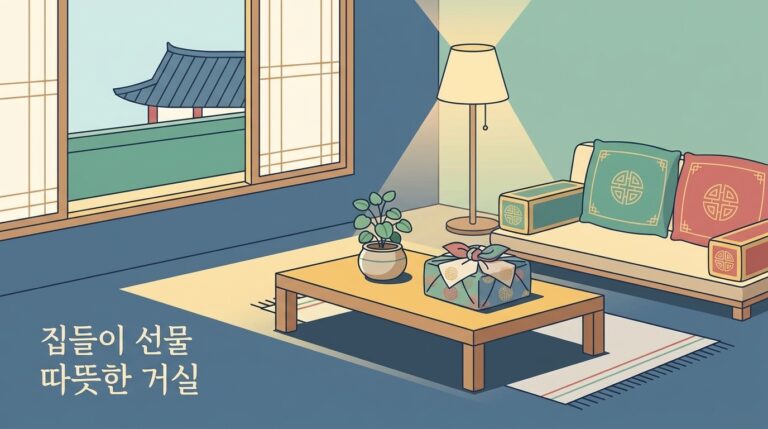
Congratulations on Your New Home! Mastering the Art of Korean Jipdeuri (집들이)
안녕하세요! Your favorite Korean learning editor from Daily Hangul (매일한글) is here! Have you ever been invited to a Korean friend’s new apartment and felt a sudden wave of panic? You want to congratulate them, but simple “축하해요” (Congratulations) feels a bit too dry, and you’re not sure if bringing a roll of toilet paper as a gift is a myth or actual reality.
Don’t worry! Today, we are diving deep into the warm, bubbly, and incredibly cozy world of 집들이 (Jip-deuri – Housewarming Party). This guide is tailored for B1 (Intermediate-Low) learners who want to move beyond textbook stiffness and deliver compliments that make their hosts feel genuinely touched. Let’s learn how to bring warmth to a new home!
Phase 2: Core Expressions Deep Dive
Here are three essential expressions you need when walking through that brand-new doorway.
1. 새집에서 좋은 일만 가득하길 바랄게요! (Sae-jip-eseo joeun il-man gadeuk-hagil baral-geyo!)
- Pronunciation Analogy: Sae-jeep-eh-seo jo-eun eel-mahn gah-deuk-hah-gheel bah-ral-geh-yo!
- Meaning: I hope only good things fill up your new home!
- K-Culture Moment: This is the ultimate “blessing” phrase. In modern K-dramas, you’ll hear friends say this as they toast with craft beer in a newly decorated cozy rooftop room or a modern officetel.
- Editor’s Insight: The word 가득하다 (gadeuk-hada) means “to be filled to the brim.” Wishing someone’s home to be filled only with good events shows deep, warm empathy.
- Situation Spectrum: Casual (⚠️ use 바랄게), Semi-formal (✅), Formal (✅ use 바랍니다)
- 🤔 Think About It: In your culture, do you focus on “good luck” or “happiness” when someone moves? How does the imagery of “filling” a house compare to your language?
2. 이거 작은 선물이에요. 집들이 선물로 준비했어요. (I-geo jageun seon-mul-i-eyo. Jip-deuri seon-mul-lo jun-bi-haess-euyo.)
- Pronunciation Analogy: Ee-goh jah-geun sun-mool-ee-yeh-yo. Jeep-deu-ree sun-mool-lo joon-bee-haess-uh-yo.
- Meaning: This is a small gift. I prepared it as a housewarming gift.
- K-Culture Moment: Handing over a beautifully wrapped box of premium soap, scented candles, or the classic giant pack of toilet paper at the entrance.
- Editor’s Insight: Culturally, Koreans practice humility. Even if you bought an expensive designer diffuser, calling it a 작은 선물 (small gift) shows elegant modesty.
- Situation Spectrum: Casual (⚠️ use 선물이야/준비했어), Semi-formal (✅), Formal (✅)
- 🤔 Think About It: Why do you think Korean culture values minimizing the size or cost of a gift when presenting it?
3. 집이 정말 아늑하고 예뻐요! (Jip-i jeong-mal a-neuk-ha-go ye-ppeo-yo!)
- Pronunciation Analogy: Jeep-ee jung-mahl ah-neuk-hah-go yeh-ppuh-yo!
- Meaning: Your home is so incredibly cozy and beautiful!
- K-Culture Moment: Walking into a neatly organized living room with soft lighting, warm wooden accents, and small potted plants.
- Editor’s Insight: 아늑하다 (a-neuk-hada) translates to cozy, snug, or comfortable. It is the highest compliment for a Korean home because it emphasizes emotional comfort over sheer physical size.
- Situation Spectrum: Casual (✅ use 아늑하고 예쁘다), Semi-formal (✅), Formal (⚠️ use 아늑하고 예쁩니다)
- 🤔 Think About It: How does your culture define a “good home”? Is it spaciousness, or is it coziness?
Phase 3: Textbook Korean vs. Real Native Korean
Let’s compare the dry, stiff textbook phrases with what real Koreans actually say.
Situation 1: Presenting the Gift
- 📖 Textbook: “이 선물을 받으십시오.” (Please accept this gift.) – Too robotic and overly formal!
- 🗣️ Real Native: “휴지처럼 일이 술술 풀리길 바라는 마음으로 준비했어요!” (I prepared this hoping your life unravels smoothly like toilet paper!)
- 💡 Why the difference? Modern Koreans love wordplay and cultural metaphors. Linking the gift (toilet paper) directly to a blessing (unraveling smoothly) shows incredible wit and cultural fluency.
Situation 2: Complimenting the Decor
- 📖 Textbook: “인테리어가 매우 아름답습니다.” (The interior design is very beautiful.) – Sounds like an architectural review!
- 🗣️ Real Native: “와, 집 진짜 잘 꾸며놓으셨네요! 완전 감성 넘쳐요!” (Wow, you decorated the house so well! It is totally aesthetic/full of vibes!)
- 💡 Why the difference? B1 learners should master the ending -네요 to express immediate, genuine surprise, and use trendy words like 감성 (gam-seong – vibe/aesthetic).
Phase 4: K-Culture Deep Dive & Non-verbal Manners
4-1. Nunchi (눈치) & Essential Gestures
- The Two-Hand Rule: Always hand over your housewarming gift using both hands (두 손으로 주기). It shows respect and sincerity.
- The Entryway Shuffle: When entering, take off your shoes immediately at the 현관 (hyeongwan – entryway). Turn your shoes around so the toes face the door—this makes it easier to step into them when leaving and keeps the entryway looking neat!
4-2. The Logic Behind the Toilet Paper & Detergent
Have you ever wondered why Koreans gift toilet paper (두루마리 휴지) and laundry detergent (세제) for housewarmings?
* Toilet Paper: Because it unrolls easily, it symbolizes that all your future business and personal affairs will unroll smoothly (술술 풀리다).
* Detergent: The rising bubbles represent wealth and prosperity bubbling up rapidly!
Phase 5: Real-Life Roleplay Scenario
Meet 민준 (Min-jun), your Korean friend who just moved into a cute studio apartment in Seoul. You are visiting his house for the first time!
- Min-jun (Host): (Opens the door with a bright smile) “어, 소피아! 어서 와. 들어와, 들어와!”
- Sophia (You): “우와, 민준 씨! 새집 입주 진짜 축하해요! 이거 작은 집들이 선물이에요.” (🎭 Handing him a big roll of toilet paper with both hands)
- Min-jun (Host): “아이고, 뭘 이런 걸 다! 휴지 진짜 딱 필요했는데 고마워.”
- Sophia (You): “집이 정말 아늑하고 예뻐요! 인테리어가 완전 제 스타일이에요.”
- Min-jun (Host): “그렇게 말해줘서 고마워. 아직 정리가 다 안 됐지만, 편하게 앉아.”
- Sophia (You): “새집에서 좋은 일만 가득하길 바랄게요. 대박 나세요!”
- Min-jun (Host): “고마워, 소피아! 맛있는 요리 많이 해놨으니까 배불리 먹고 가!”
🔀 Your Turn: Interactive Choice
How would you reply to Min-jun’s hospitality? Choose your path:
* A: “오래 살고 부자 되세요!” (Live long and get rich!)
* B: “휴지처럼 모든 일이 술술 풀리길 바라요!” (Hope everything unrolls smoothly like toilet paper!)
* C: “선물이 마음에 안 들면 영수증 줄 테니까 바꾸세요.” (If you don’t like the gift, I’ll give you the receipt so you can exchange it.)
Feedback:
- Choice A (Bad): While nice, this sounds a bit like a traditional Lunar New Year blessing for grandparents. A bit too old-fashioned for a young friend’s housewarming!
- Choice B (Best!): Perfect! It connects the cultural meaning of the toilet paper with a warm, witty blessing.
- Choice C (Risk): Too blunt unless you are absolute best friends of 10 years. It ruins the warm aesthetic vibe of the moment!
Phase 6: 10-Second Emotion Shadowing Drill
Let’s practice your rhythm and intonation. Pay attention to the pauses (/) and the emotional cues!
[😊 Excited & Joyful]“새집에서 / 좋은 일만 / 가득하길 바랄게요!”[🥰 Shy but Warm]“이거 / 작은 선물이에요. / 집들이 선물로 / 준비했어요.”
Phase 7: K-Culture Mini Dictionary
- 집들이 (Jip-deuri): Housewarming party. Literally means “entering the house.”
- 술술 풀리다 (Sulsul pullida): To resolve smoothly and effortlessly.
- 대박 (Daebak): Great success, jackpot, or “awesome.”
- 집꾸미기 (Jip-kkumigi): Home styling/decorating, which is currently a massive trend among young Koreans.
Phase 8: Traveler’s Survival Kit
Top 3 Survival Phrases
- “실례합니다, 신발은 어디에 둘까요?” (Excuse me, where should I leave my shoes?)
- “화장실 좀 써도 될까요?” (May I use the restroom?)
- “집이 너무 따뜻해요!” (The house is so warm! – Complimenting the hospitality)
Editor’s Travel Note: When navigating to your friend’s new place, use Naver Map instead of Google Maps, as Google Maps is not fully optimized for Korea. Enter the apartment building number (동 – dong) and room number (호 – ho) carefully, as Korean complexes can be huge!
Phase 9: One Step Deeper
Historically, Koreans gifted matches or candles because the “rising fire” symbolized the rapid growth of wealth. Today, that has shifted to laundry detergent and toilet paper, reflecting Korea’s rapid post-war urbanization and modernization. It shows how language, culture, and daily life items evolve together to maintain the core value of wishing success to neighbors.
💬 Your Turn: What do people usually gift for a housewarming in your home country? Leave a comment below! Let’s compare!
Phase 10: FAQ & Mistake Prevention
Q: Is toilet paper really considered a polite gift in Korea?
A: Yes! It is incredibly practical and culturally symbolic. However, if you are visiting a very formal acquaintance, pairing it with a nice diffuser or plant is highly recommended.
Q: Can I wear indoor slippers inside a Korean house?
A: If the host provides slippers at the entryway, wear them! If not, going barefoot or in clean socks is perfectly fine.
Q: What should I avoid saying?
A: Avoid asking “How much is this house?” (이 집 얼마예요?). It is considered overly intrusive and impolite during a celebratory event.
🚨 Common Mistakes Board
- Mistake 1: Stepping on the wooden door threshold (문턱) of older apartments. -> Correct: Step over it gracefully, as old myths say stepping on it brings bad luck.
- Mistake 2: Saying “싸게 샀어요” (I bought it cheap). -> Correct: Use “작은 선물이에요” (It’s a small gift) to keep the tone humble.
Phase 11: Action Mission
- Bronze Medal: Read the core expressions aloud 3 times with the emotional cues.
- Silver Medal: Write “새집에서 좋은 일만 가득하길 바랄게요!” in the comments below.
- Gold Medal: Use this phrase on a card next time you visit a Korean friend or send a congratulatory message!
Phase 12: Interactive Quiz Challenge
1. Which gift symbolizes things unrolling smoothly?
* A) Candle
* B) Toilet Paper
* C) Potted Plant
Reveal Answer
💡 Answer: B) Toilet Paper. The physical act of unrolling paper is metaphorically linked to life’s affairs opening up smoothly!
2. True or False: You should use both hands when presenting a gift.
Reveal Answer
💡 Answer: True! Using both hands shows deep respect and sincerity in Korean culture.







