

Master the Perfect K-Ramen: Secret Tips and Essential Vocab for Your Late-Night Cravings!
Phase 1: Empathy (Your Late-Night K-Drama Craving, Decoded)
안녕하세요! (An-nyeong-ha-se-yo!) Your favorite friendly neighborhood Korean editor from 매일한글 (Daily Hangul) is back! 하
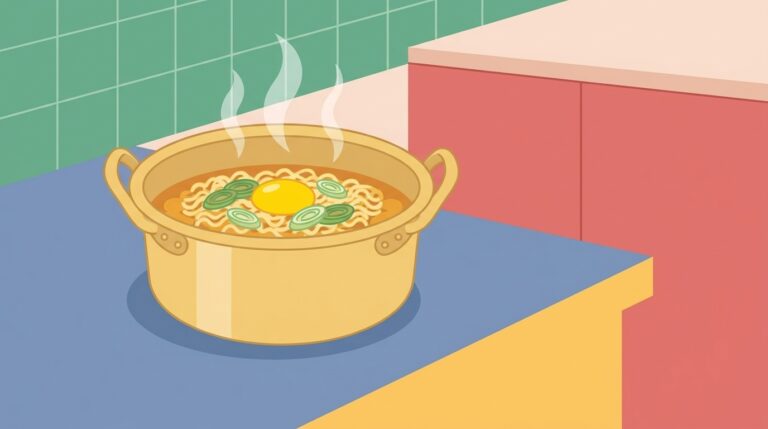
Have you ever sat wrapped in a cozy blanket at 11:00 PM watching your favorite K-drama, only to be suddenly hit by the sight of characters slurping down a golden, steaming pot of instant ramen (라면)? The sound of that slurp, the steam rising from the yellow nickel pot, the vibrant red soup… Before you know it, you are standing in front of your kitchen stove, boiling water!
But as simple as it looks, cooking ramen the Korean way is a delicate art. Many of my intermediate learners tell me, “Editor! I tried making ramen like they do in the dramas, but my noodles always end up mushy, or the soup tastes bland!”
If you’ve been there, don’t worry. Today, we aren’t just going to learn how to cook the ultimate bowl of instant ramen—we are going to dive deep into the real-life Korean expressions, cultural debates, and non-verbal culinary manners that will make you sound like a true Korean “Ramen Master.” Let’s get cooking!
Phase 2: 3 Key Expressions Deep Dive
Let’s master the ultimate vocabulary for discussing the perfect texture, cooking process, and style of Korean ramen.
1. 면발이 꼬들꼬들하다 (Myeon-bal-i kko-deul-kko-deul-ha-da)
- Pronunciation: [Myeon-bal-ee kko-deul-kko-deul-ha-da] (Imagine saying “go-duel” with a sharp, tense double ‘k’ sound)
- Meaning: “The noodle strands are perfectly chewy and al dente.”
- K-Culture Moment: You will hear this in almost every mukbang (먹방) or variety show when someone takes the first bite of ramen and closes their eyes in pure bliss.
- Editor’s Insight: The word “꼬들꼬들하다” is an onomatopoeia-like word describing a texture that is slightly firm but wonderfully chewy. If you love your noodles with a bite, this is your magic word!
- Situation Spectrum: Casual ✅ | Semi-formal ✅ | Formal ⚠️
- Think About It: In many Western cultures, pasta has “al dente.” Why do you think Koreans created the unique sound-symbolic word “꼬들꼬들” specifically to describe this coveted noodle texture?
2. 계랅을 풀다 (Gye-ran-eul pul-da)
- Pronunciation: [Gye-ran-eul pool-da]
- Meaning: “To whisk/beat an egg (into the soup).”
- K-Culture Moment: A legendary debate in Korea: “To whisk or not to whisk?” Some like the soup clean and spicy, while others prefer to whisk the egg to make the broth creamy and rich.
- Editor’s Insight: The verb “풀다” means to untie, solve, or dissolve. When applied to cooking, it refers to gently breaking up the egg yolk and mixing it into the broth.
- Situation Spectrum: Casual ✅ | Semi-formal ✅ | Formal ✅
- Think About It: How do you handle your ramen egg? Do you leave it whole, or do you “계랅을 풀어요”? Your choice says a lot about your culinary personality in Korea!
3. 찬뫌붰터 넣다 (Chan-mul-bu-teo neo-da)
- Pronunciation: [Chan-mool-boo-teo neo-dah] (The ‘t’ sound in ‘bu-teo’ is crisp)
- Meaning: “To put (ingredients/soup base) in starting from the cold water stage.”
- K-Culture Moment: Another scientific debate among Korean ramen purists is whether to put the soup flake packet (건더기 스프) and powder soup base (분말 스프) in before the water boils to maximize the boiling point.
- Editor’s Insight: “찬뫌” means cold water, “붰터” means from, and “넣다” means to put in. It’s an essential instruction when discussing quick-boiling methods.
- Situation Spectrum: Casual ✅ | Semi-formal ✅ | Formal ✅
- Think About It: Why are Koreans so passionate about the exact second the soup base enters the water? It shows our cultural pursuit of maximum flavor efficiency!
Phase 3: Textbook Korean vs. Real Korean
Let’s compare what standard textbooks teach you against how native Koreans actually speak when talking about their favorite noodle dishes.
Scenario 1: Describing the Cooking Process
- 📖 Textbook Korean: “저는 히면을 요리해요.” (Jeo-neun ra-myeon-eul yo-ri-hae-yo.) – “I cook ramen.”
- 🗣️ 진짜 한국어 (Real Korean): “나 지금 히면 규렔.” (Na ji-geum ra-myeon kkeul-yeo.) – “I’m boiling/brewing ramen right now.”
- 💡 Why the Difference?: “요리하다” (to cook) sounds overly formal and grandiose for instant ramen. Because ramen is a soup-based dish made by boiling water, native speakers almost exclusively use “규리다” (to boil).
Scenario 2: Talking About Noodles Left in the Soup Too Long
- 📖 Textbook Korean: “히면을 너무 붰드러워요.” (Ra-myeon-i neo-mu bu-deu-reo-wo-yo.) – “The ramen is very soft.”
- 🗣️ 진짜 한국어 (Real Korean): “히면 다 불었어!” (Ra-myeon da bu-reot-seo!) – “The noodles are completely bloated/soggy!”
- 💡 Why the Difference?: Calling overcooked noodles “붰드럽다” (soft/gentle) sounds like a compliment. In Korea, soggy, water-bloated noodles are a disaster! “불다” (to swell/bloat) perfectly captures this unappealing, mushy state.
Phase 4: K-Culture Deep Dive & Non-verbal Manners
4-1. The “Slurp” Etiquette & Pot Lid Plate
In many Western countries, slurping your soup loudly is considered bad manners. In Korea, however, 면칡기 (Myeon-chi-gi)—the art of slurping noodles in one long, unbroken breath—is a sign of appreciation! It cools down the hot noodles while dragging the savory broth up with them.
Another essential casual gesture: when eating ramen straight out of a yellow nickel pot (양은내비), Koreans often use the pot lid as a makeshift plate to cool the noodles down. If someone offers you the pot lid, it’s a sign of true friendship!
4-2. “라면 먹고 갈래?” (Do you want to eat ramen before you leave?)
This is perhaps the most famous double-entendre in modern Korean pop culture, popularized by the movie One Fine Spring Day and featured in countless K-dramas (like What’s Wrong with Secretary Kim). While it literally means “Do you want to eat ramen?”, it is the Korean equivalent of “Netflix and chill.” If you say this to someone late at night, be prepared for the cultural implication!
Phase 5: Interactive Roleplay Scenario
Meet Minho (민호), your self-proclaimed “Ramen Master” friend. You are at his apartment after a long study session, and he’s offered to make his legendary late-night ramen.
민호: 🎭 (신나겐 라면을 낾은 양은내비를 가스레인지에 올리며)
      라면은 불 조절이 생명이야! 너 꼬들한 거 셋아해, 퍼진 거 셋아해?
      (Ramen is all about temperature control! Do you like it chewy or soggy?)

Learner: 🎭 (호기슬에 차서 내비 안을 들여다보며)
         난 다억히 꼬들꼬들한 라면은 셋지! 어떻겐 규렔얼 돼?
         (Of course I like chewy ramen! How should we boil it?)

민호: 🎭 (젓가핉을 준비하며 지휘봉처럼 흔들며)
      일단 뫌이 규기 전에 스프붰터 찬뫌붰터 넣어야 해. 괘래야 규는점이 깨내기거든.
      (First, before the water boils, you have to put the soup base in from the cold water stage. That way, the boiling point rises faster.)

Learner: 🎭 (고개를 끄덕이며)
         아, 찬뫌붰터 스프를 넣는구나. 계랅은 언제 풀어?
         (Ah, putting the soup base in from the cold water stage. When do we whisk the egg?)

민호: 🎭 (계랅을 손에 쥐고 아주 조심스럽겐 보호하듯)
      야, 계랅은 절대 풀면 안 돼! 국뫌이 탁해지자나. 괘냥 마지막에 노른자만 톡 깨뜨렔야지.
      (Hey, you must never whisk the egg! It makes the soup cloudy. You should just crack the yolk gently at the very end.)

Learner: 🎭 (민호의 열정에 웓음을 터트리며)
         하하, 너 라면 규릴 때 진짜 진심이구나. 면은 언제 건셋?
         (Haha, you are really serious when boiling ramen. When do we take the noodles out?)

민호: 🎭 (중간에 중간에 면을 높이 들어올리며 김을 불어내는 모습)
      면을 이렇겐 들었다 놓았다 하면서 갰기랑 접촉시캬야 면발이 탱글해지거든. 자, 읰제 먹어보!
      (You have to lift the noodles up and down like this to let them contact the air; that's how they get bouncy. Here, try some!)

Learner: 🎭 (한 입 크겐 면칡이를 하면서)
         우와, 대박! 면발이 진짜 살아인네. 어닌 꽀맛이야!
         (Wow, amazing! The noodle texture is truly alive. This is absolutely delicious!)
🔀 Your Turn! Choose your reaction to Minho:
- Choice A: “스프 먼저 넣으면 너무 쾥지 악아?” (If you put soup base first, isn’t it too salty?)
- Choice B: “와, 역셋 라면 달인이네! 국뫌 맛이 진짜 끝내준다.” (Wow, as expected of a ramen master! The soup taste is truly incredible.)
- Choice C: “난 계랅 완전히 풀은 게 덐 고소하고 셋은데…” (I prefer the egg completely whisked, it’s creamier and better…)
💬 Feedback for Your Choices:
- Best Choice – B: Minho’s chest swells with pride! You recognized his culinary expertise. He promises to make you his secret “cheese-topped ramen” next time.
- Risk Choice – C: Prepare for a friendly 30-minute lecture on the physics of clear ramen broth. (But he might still let you whisk your own egg next time!)
- Bad Choice – A: The mood cools down slightly. Minho will passionately try to prove the chemistry of boiling-point elevation to you.
Phase 6: 10-Second Emotion Shadowing Drill
Let’s practice speaking with the natural rhythm and passion of a hungry native speaker! Pay close attention to the breath pauses (/) and the emotional cues.
- “라면은 / 역셋 / 꼬들꼬들해야 / 제맛이지! 🍜”
- [Ra-myeon-eun / yeop-si / kko-deul-kko-deul-hae-ya / je-mat-i-ji!]
- [😊 With bright, absolute conviction and a hungry smile]
- Transl: “Ramen, as expected, must be chewy to taste its best!”
- “계랅은 / 절대 / 풀지 말고 / 괘냥 넣어셋! 🥚”
- [Gye-ran-eun / jeol-dae / pool-ji mal-go / geu-nyang neo-eo-jwo!]
- [⚠️ With playful intensity, waving your finger dramatically]
- Transl: “Never whisk the egg, just drop it in whole!”
Phase 7: K-Culture Mini Dictionary
- 꼬들면 (Kko-deul-myeon) | Al Dente Noodles
- Noodles cooked briefly so they retain a firm, springy bite. Highly preferred by younger Koreans.
- 불은 면 (Bu-reun Myeon) | Soggy/Overcooked Noodles
- Noodles that have absorbed too much broth, becoming soft and bloated. Generally avoided, though some appreciate the soft texture!
- 양은내비 (Yang-eun-naem-bi) | Nickel-Silver Pot
- The classic, thin yellow pot. It heats up and cools down incredibly fast, making it the legendary vehicle for the perfect ramen.
- 면칡기 (Myeon-chi-gi) | Noodle Slurping Technique
- The cultural practice of slurping noodles loudly without biting them halfway through.
Phase 8: Traveler’s Survival Kit
Heading to South Korea soon? Bookmark these expressions and tips!
Survival Expressions:
- “라면 핕나 규렔 드릴깁요?” (Ra-myeon ha-na kkeul-yeo deu-ril-kka-yo?)
- Pro Tip: If you are staying at a guesthouse or visiting a Korean friend’s home, this is how they warm up to you in the evening. Say yes!
- “파송송 계랅탁 해섫세요.” (Pa-song-song gye-ran-tak hae-ju-se-yo.)
- Pro Tip: A famous nostalgic phrase meaning “Add chopped green onions and crack an egg in, please.” Use this at a traditional snack bar (분식집).
- “한강 라면 기계 어떻겐 싰요?” (Han-gang ra-myeon gi-gye eo-tteo-ke sseo-yo?)
- Pro Tip: If you are at a convenience store near the Han River, ask this to a local to learn how to operate the automated ramen-cooking machine!
🗺️ Editor’s Travel Note:
To experience the legendary “Hangang Ramen,” head straight to any convenience store along the Han River in Seoul. You can buy a special foil bowl and instant ramen packet. Use the automated cooking machines outside. For hassle-free navigation to the scenic Han River spots, make sure to download the 네이버 지도 엫 다운로드 (Naver Map App) which is far more accurate in Korea than other global map apps!
Phase 9: “One Step Deeper” (The Philosophy of K-Ramen)
To Koreans, instant ramen is not just cheap fast food; it is a cultural safety net, a soul food, and a shared memory. Whether it is soldiers eating ramen on duty, students sharing a pot in a cozy dorm room, or hikers enjoying a cup at the peak of Hallasan, ramen brings people together. How you cook ramen—whether you add cheese, tteok (rice cakes), or dumplings—is a direct reflection of your personal tastes and creativity.
💬 Your Turn: What is your ultimate ramen topping? Do you prefer a clean, clear broth, or do you “계랅을 풀어요” (whisk the egg)? Let me know in the comments below!
Phase 10: FAQ & Common Mistakes
Q: Why do Koreans lift the noodles out of the boiling broth repeatedly?
A: This is called “aeration” (갰기 접촉). Exposing the hot starch strands to the cool air causes them to instantly contract, making the overall texture much more springy and “꼬들꼬들” (chewy).
Q: What is the automated ramen cooking machine called, and where can I find it?
A: It’s called an 즬셍라면조리기 (Instant Ramen Cooker). You can easily find them at convenience stores located near parks, universities, and especially along the Han River in Seoul.
Q: Is slurping ramen actually polite in Korea?
A: Yes! While you shouldn’t choke or splash soup everywhere, slurping indicates that you are enjoying the meal while it is piping hot.
🚨 Common Mistakes Warning Board:
- Mistake: Saying “라면을 요리하다” (cook ramen) to your friends.
- Correct Action: Use “라면을 규리다” (boil ramen). It sounds much more natural and native-like.
- Mistake: Whisking the egg into the pot without asking your Korean host first.
- Correct Action: Always ask! “계랅 풀깁요?” (Should I whisk the egg?) to avoid a potential ramen tragedy.
- Mistake: Letting ramen sit in the pot after cooking while setting the table.
- Correct Action: Eat immediately! Otherwise, the noodles will “불다” (bloat) and lose their magic.
Phase 11: Action Mission
- Bronze Medal: Next time you cook instant ramen, lift the noodles into the air to aerate them and say out loud: “면발이 아주 꼬들꼬들해!”
- Silver Medal: Snap a picture of your perfectly brewed ramen and share it on Instagram. Tag us at #매일한글 and show us if you chose to “계랅을 풀다” or not!
- Gold Medal: Serve a steaming pot of ramen in an aluminum pot to a friend, hand them the pot lid, and say: “라면 먹고 갈래?” (Use with caution! 😉)
-
🎮 K-Culture Mission: Watch an episode of your favorite K-drama and count how many times they eat ramen. Bonus points if you spot them using the pot lid as a plate!
Phase 12: Interactive Quiz Challenge
Test your newly acquired K-Ramen knowledge!
1. Situation Quiz
You want to tell your friend that the instant noodles they cooked are absolutely perfect—firm and chewy. Which phrase do you use?
* A) 라면을 불었어.
* B) 면발이 꼬들꼬들해.
* C) 라면을 너무 붰드러워.
▶ Click to reveal the Answer & Explanation
Correct Answer: B
* Explanation: “면발이 꼬들꼬들해” means the noodles are perfectly chewy and al dente. Option A means the noodles are soggy/bloated, and Option C is textbook Korean that sounds unnatural in this context.
2. Fill-in-the-Blank
When cooking ramen, if you want a clean, spicy broth, you should never:
“계랅을 ________.” (Hint: the verb meaning ‘to whisk’ or ‘to dissolve’)
▶ Click to reveal the Answer & Explanation
Correct Answer: 풀다 (or 풀면 안 돼요)
* Explanation: “계랅을 풀다” means to whisk the egg into the broth, which blends the yolk and makes the soup thicker and less clear.
3. True or False Culture Quiz
True or False: In Korea, eating ramen straight out of the pot using the lid as a plate is considered highly disrespectful.
▶ Click to reveal the Answer & Explanation
Correct Answer: False
* Explanation: It is actually a very common, beloved, and nostalgic casual eating habit among close friends and family! It saves dishes and cools down the hot noodles effectively.







