

Warm Spoons and Mountain Tunes: Decoding the Friendly Charm of Gangwon Dialect Endings
안녕하세요! Welcome back to another cozy session with Daily Hangul. I’m your senior editor and local culture navigator!
Have you ever ventured outside of Seoul, perhaps to the breathtaking beaches of Gangneung or the misty mountain trails of Seoraksan, only to feel like your intermediate-level Korean suddenly evaporated? You hear the locals chatting over steaming bowls of potato pancakes, and while the words sound familiar, the sentence endings have this singing, rhythmic flow that you never saw in your standard university textbooks.
Don’t worry! This is the beautiful, comforting world of the Gangwon-do Dialect (강원도 사투리). Today, we are going to crack the code of the most iconic Gangwon-do verb endings so you can connect with locals on a whole new level. Let’s dive in!
Phase 2: Three Core Gangwon Endings Deep Dive
1. ~드래요 (Han-geul: ~드래요 / ~래요)
- Pronunciation: [deu-rae-yo] (Sounds like do-ray-yo, but with a very soft, relaxed “eu” sound at the start)
- Meaning: “They say…” / “It is…” (In standard Seoul Korean, ~래요 is used for indirect quotations. However, in Gangwon-do, it simply replaces the standard polite ending ~아요/어요 to make a friendly declarative statement!)
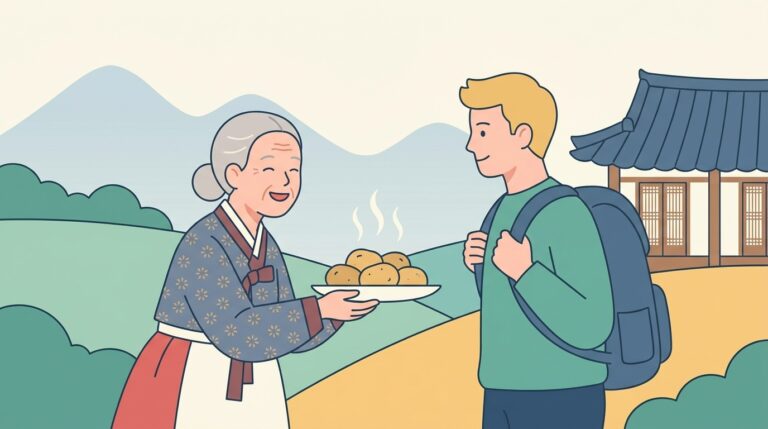
- K-Culture Moment: Picture a sweet grandmother running a small mountain cabin restaurant in Pyeongchang. She places a steaming plate of potato pancakes on your table and says: “이게 바로 우리 강원도 감자드래요.” (This right here is our Gangwon-do potato!)
- Editor’s Insight: Using ~드래요 immediately softens your tone. It takes away the cold, modern edge of standard city Korean and wraps your words in rustic warmth.
- Situation Spectrum: Casual ✅ / Semi-formal ✅ / Formal ⚠️
- 🤔 Think About It: How does the physical geography of a place—like towering mountains—influence the rhythm and speed of the language spoken there?
2. ~나이 (Han-geul: ~나이 / ~까이)
- Pronunciation: [na-ee] / [kka-ee] (Rhymes with the English word high, but with a shorter, softer drop at the end)
- Meaning: “Are you…?” / “Is it…?” (This replaces the standard questioning endings like ~나요? or ~가요?)
- K-Culture Moment: You are strolling through the famous Sokcho Tourist & Fishery Market, eye-ing some delicious squid sundae (오징어순대). The vendor smiles warmly and asks: “이거 한번 먹어봤나이?” (Have you tried this before?)
- Editor’s Insight: Standard questions can sometimes feel a bit direct or interrogative. The ~나이 ending turns a simple question into a gentle, melodic invitation.
- Situation Spectrum: Casual ✅ / Semi-formal ⚠️ / Formal 🚫
- 🤔 Think About It: In your native language, is there a specific regional ending that instantly makes a question sound warmer or more caring?
3. ~했제 (Han-geul: ~했제 / ~이정)
- Pronunciation: [haet-je] (Rhymes with fetch but ends with a soft ‘j’ sound) / [ee-jeong] (Sounds like e-jung)
- Meaning: “Right?” / “You did, didn’t you?” (The Gangwon equivalent of the standard agreement-seeking ~했지? or ~이지?)
- K-Culture Moment: You are standing on the white sands of Anmok Beach in Gangneung. Your local friend looks out at the deep blue sea and sighs happily: “바다가 참 파랗제?” (The sea is really blue, right?)
- Editor’s Insight: While ~제 is also famous in the Gyeongsang dialect, the Gangwon version is delivered with a slow, rising-then-falling wave intonation that mimics the local landscape.
- Situation Spectrum: Casual ✅ / Semi-formal ✅ / Formal 🚫
- 🤔 Think About It: Why do you think establishing shared agreement (seeking “right?”) is so deeply embedded in regional community cultures in Korea?
Phase 3: Textbook Korean vs. Real Gangwon Korean
Let’s compare the stiff textbook phrases with the lively local alternatives you’ll actually hear on the road!
Situation 1: Asking someone if they have eaten
- 📖 Textbook Korean: 점심 먹었어요? (Jeomsim meogeosseoyo? – Did you eat lunch?)
- 🗣️ Real Gangwon Korean: 밥 먹었나이? (Bap meogeonnai?)
- 💡 Why it’s different: While the textbook version is polite, the regional version instantly lowers social barriers and expresses cozy, neighborhood affection.
Situation 2: Explaining where you came from
- 📖 Textbook Korean: 저는 서울에서 왔어요. (Jeoneun seoureseo wasseoyo. – I came from Seoul.)
- 🗣️ Real Gangwon Korean: 서울서 왔드래요. (Seoul-seo watdeuraeyo.)
- 💡 Why it’s different: Dropping the “에” from “서울에서” to make it “서울서” and ending with “~왔드래요” signals to your listener that you appreciate and respect their local heritage.
Phase 4: K-Culture Deep Dive & Non-verbal Manners
4-1. The
Frequently Asked Questions (FAQ)
Q: What does "~드래요 (Han-geul: ~드래요 / ~래요)" mean in Korean and how do you pronounce it?
A: In Korean, "~드래요 (Han-geul: ~드래요 / ~래요)" is pronounced [deu-rae-yo] and means: "They say..." / "It is..." (In standard Seoul Korean, ~래요 is used for indirect quotations. However, in Gangwon-do, it simply replaces the standard polite ending ~아요/어요 to make a friendly declarative statement!)
Q: What does "~나이 (Han-geul: ~나이 / ~까이)" mean in Korean and how do you pronounce it?
A: In Korean, "~나이 (Han-geul: ~나이 / ~까이)" is pronounced [na-ee] and means: "Are you...?" / "Is it...?" (This replaces the standard questioning endings like ~나요? or ~가요?)
Q: What does "~했제 (Han-geul: ~했제 / ~이정)" mean in Korean and how do you pronounce it?
A: In Korean, "~했제 (Han-geul: ~했제 / ~이정)" is pronounced [haet-je] and means: "Right?" / "You did, didn't you?" (The Gangwon equivalent of the standard agreement-seeking ~했지? or ~이지?)







