

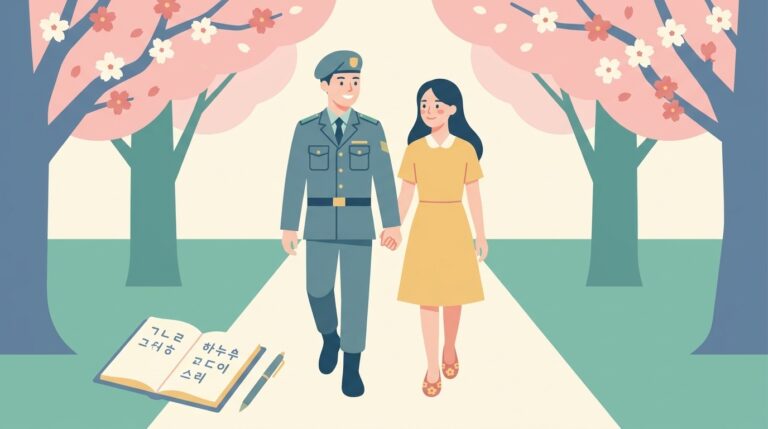
Waiting for Your Soldier: Mastering Korea’s Unique ‘Gomsin’ Culture
안녕하세요! (Annyeonghaseyo!) It’s your favorite Korean best friend and editor from Daily Hangul. Have you ever watched a K-Drama where a heartbroken couple hugs tightly at a train station because the boyfriend is enlisting in the military?
In Korea, military service is a major life chapter for almost every young man—and consequently, for their partners. Today, we are diving deep into the beautiful, emotional, and highly unique world of 곰신 (Gomsin). Whether you are waiting for your own real-life Korean soldier, supporting an enlisted K-Pop idol, or simply trying to understand this deep cultural phenomenon, this guide is designed just for you at the B1 intermediate level!
Phase 2: Core Expressions Deep Dive
1. 곰신 (Gomsin) / 꽃신 (Kkotshin)
- Pronunciation: [gom-shin] / [kkot-shin] (Sounds like ‘goh-m-sheen’ / ‘kkoh-t-sheen’)
- Meaning: Waiting Girlfriend (Rubber Shoes) / Flower Shoes (given upon discharge)
- K-Culture Moment: In K-Dramas, you’ll see friends asking a girl, “Are you really going to wear gomsin?” meaning, “Are you going to wait for him?”
- Editor’s Insight: ‘Gomsin’ is short for ‘Gomusin’ (traditional rubber shoes). Historically, if a girl cheated while her boyfriend was away, people said she “put on her rubber shoes backward” (고무신을 거꾸로 신다). If she successfully waits the full 18 months, her boyfriend rewards her by gifting her “flower shoes” (꽃신), symbolizing a path of happiness ahead!
- Situation Spectrum: Casual ✅ | Semi-formal ⚠️ | Formal 🚫
- 🤔 Think About It: In your culture, is there a specific, widely used slang term for someone waiting for their partner in the military? Why do you think Koreans created such symbolic terms?
2. 전역하다 (Jeon-yeokhada)
- Pronunciation: [jeon-yeok-ha-da] (Sounds like ‘jun-yuck-hah-dah’)
- Meaning: To be discharged from military service (Literally: leaving the service)
- K-Culture Moment: When a K-Pop idol finishes their service, fans hold banners saying “축 전역” (Congratulations on your discharge!).
- Editor’s Insight: Don’t confuse this with 제대하다 (jedaehada), which is also common, but “전역” is the official administrative term you’ll see in news articles and formal announcements.
- Situation Spectrum: Casual ✅ | Semi-formal ✅ | Formal ✅
- 🤔 Think About It: How does the feeling of “discharging” differ from simply “quitting” or “finishing” a job in your native language?
3. 수고했어 (Sugohaesseo)
- Pronunciation: [su-go-haet-seo] (Sounds like ‘soo-goh-het-suh’)
- Meaning: You worked hard / You did a great job.
- K-Culture Moment: This is the absolute first thing a Gomsin says to her boyfriend the moment he steps out of the military base gates on his discharge day.
- Editor’s Insight: This phrase carries immense comfort and recognition of struggle. Adding “~오늘도” (oneul-do – today as well) makes it a perfect daily text to send after a hard day of training.
- Situation Spectrum: Casual ✅ | Semi-formal ⚠️ (Use ‘수고하셨습니다’) | Formal 🚫
- 🤔 Think About It: Why is acknowledging someone’s hard work so central to building trust and closeness in Korean relationships?
Phase 3: Textbook Korean vs. Real Korean
Let’s compare the stiff expressions found in standard dictionaries with what real Korean couples actually say to each other.
Situation 1: Saying goodbye before enlistment
- 📖 Textbook Korean: “군대 생활을 건강하게 잘 마치기를 바랍니다.” (I hope you finish your military life healthily.)
- 🗣️ Real Korean: “몸조심하고 아프지 마! 나 꼭 기다릴게.” (Take care of yourself and don’t get sick! I’ll definitely wait.)
- 💡 Why is it different? Textbook Korean is too formal and detached. Real couples focus heavily on health (아프지 마) and reassurance (꼭 기다릴게) to ease the soldier’s anxiety.
Situation 2: Asking for regular phone calls
- 📖 Textbook Korean: “자주 전화해 주십시오.” (Please call me often.)
- 🗣️ Real Korean: “시간 날 때 꼭 전화해! 목소리 듣고 싶어.” (Make sure to call when you have time! I want to hear your voice.)
- 💡 Why is it different? Soldiers have limited phone time. Saying “시간 날 때” (when you have time) shows empathy for their busy schedule, while adding “목소리 듣고 싶어” expresses affection without being overly demanding.
Phase 4: K-Culture Deep Dive & Non-verbal Manners
4-1. Nunchi (눈치) & Gestures
- The Saluting Rule: When taking photos together during his vacation (휴가), do not mockingly salute. A proper salute (경례) is a serious military protocol. If you want to do it playfully, make sure he guides your hand angle so it looks respectful!
- Handwritten Letters (손편지): In Korea, digital messages are great, but handwritten letters sent to the boot camp (훈련소) are the gold standard. Decorating the envelope with cute drawings or stickers is a classic Gomsin non-verbal way of showing love.
4-2. The “Gundae-pago” (Care Package) Culture
K-Drama fans might have seen characters assembling massive boxes of snacks, band-aids, customized insoles, and hand warmers. This is called 군대 택배 (military delivery). Gomsins often prepare enough snacks for her boyfriend’s entire squad to help him gain social points with his superiors. It’s the ultimate show of Korean communal care!
Phase 5: Interactive Roleplay Scenario
- Setting: A quiet cafe near the military base. Ji-woo is about to return to his base after a short 3-day vacation (휴가), looking slightly sad and anxious. Chloe (You) is trying to cheer him up.
The Conversation
- Ji-woo: 🎭 sighing softly “내일 복귀해야 된다니 믿기지 않아. 들어가기 싫다…”
(I can’t believe I have to go back tomorrow. I don’t want to go in…) - Chloe (You): “시간 진짜 빠르다, 그치? 그래도 이번 휴가 때 같이 있어서 너무 행복했어.”
(Time really flies, right? Still, I was so happy to be together during this vacation.) - Ji-woo: 🎭 looking at you with worried eyes “너 기다리는 거 많이 힘들지? 내가 매일 연락도 못 해줘서 미안해.”
(Is waiting for me really hard? I’m sorry I can’t contact you every day.) - Chloe (You): “걱정하지 마! 나 씩씩한 곰신이잖아. 우리 금방 다시 만날 거야.”
(Don’t worry! I’m a brave Gomsin, you know. We’ll meet again very soon.) - Ji-woo: 🎭 smiling weakly, holding your hand “고마워. 전역하면 진짜 예쁜 꽃신 꼭 신겨 줄게.”
(Thank you. When I get discharged, I promise I’ll put beautiful flower shoes on you.) - Chloe (You): “약속했다! 들어가서 다치지 말고, 건강하게만 지내.”
(You promised! Don’t get hurt in there, and just stay healthy.)
🔀 Your Next Move: How do you respond when Ji-woo asks if waiting is too hard?
- Option A: “당연히 힘들지! 그러니까 휴가 자주 나와야 돼.”
- (Of course it’s hard! So you have to come out on vacation often.)
- Option B: “조금 외롭긴 한데, 우리 미래를 생각하면서 참을 수 있어!”
- (It’s a bit lonely, but thinking about our future, I can endure it!)
- Option C: “하나도 안 힘들어! 나 혼자 있는 시간 좋아해서 괜찮아.”
- (It’s not hard at all! I like my alone time, so it’s fine.)
💡 Feedback on Your Choice:
- Best Choice: Option B! It honestly acknowledges your feelings (외롭긴 한데) but quickly reassures him with a positive outlook on your shared future. This builds immense trust.
- Risk Choice: Option A. While honest, putting pressure on him to “get more vacations” can make him feel guilty, as vacation days are highly regulated by commanders.
- Bad Choice: Option C. Saying “it’s not hard at all because I love alone time” might make him feel unimportant or easily replaceable.
Phase 6: 10-Second Shadowing Drill
Practice speaking with the correct pauses (/) and emotional tone.
[🥺 아쉽고 애교 섞어서 - With sweet sadness]- “들어가기 싫다… / 하루만 더 / 같이 있으면 좋겠어.”
- Deul-eo-ga-gi sil-da… / ha-ru-man deo / ga-chi is-seu-myeon jo-ket-seo.
- (I don’t want to go back… / Just one more day / I wish we could be together.)
[😊 씩씩하고 밝게 - Cheerful and reassuring]- “몸 건강히 / 잘 다녀와! / 내가 여기서 / 든든하게 기다릴게!”
- Mom geon-gang-hi / jal da-nyeo-wa! / nae-ga yeo-gi-seo / deun-deun-ha-ge gi-da-ril-ke!
- (Go and come back in good health! I will wait for you reliably right here!)
Phase 7: K-Culture Mini Dictionary
- 인편 (Inpyeon) | Internet Letter: Short for ‘인터넷 편지’. Letters written online by friends and family that are printed out and handed to soldiers during boot camp.
- 훈련소 (Huryeonso) | Boot Camp: The initial 5-week intense training camp where recruits cannot use personal phones.
- 일말상초 (Il-mal-sang-cho) | Danger Zone Period: A slang combination meaning “End of Corporal / Start of Sergeant” rank, historically known as the time most military couples break up.
- 휴가 (Hyuga) | Military Leave: Official vacation days. Soldiers count down the seconds to their next scheduled leave.
Phase 8: Traveler’s & Expat’s Survival Kit
Top 3 Survival Expressions for Gomsins
- “전화 끊기 전에 사랑한다고 해줘.” [jeon-hwa kkeun-ki jeon-e sa-rang-han-da-go hae-jwo]
- Pro Tip: Say this when they have 10 seconds left on their payphone call. It’s incredibly romantic!
- “택배 보냈으니까 상병님들이랑 나눠 먹어!” [taek-bae bo-naet-seu-ni-kka sang-byeong-nim-deul-i-rang na-nyeo meok-eo]
- Pro Tip: Let him know you sent snacks to share with his seniors to secure his good reputation.
- “전역일 계산기 어플 다운로드 받았어.” [jeon-yeok-il gye-san-gi eo-peul da-un-ro-deu bat-as-seo]
- Pro Tip: Let him know you downloaded the D-day discharge tracker app.
Editor’s Travel Note
If you want to support a soldier or look up their military boot camp address, use the official Korean Military portal site. We highly recommend downloading 더캠프 공식 앱 다운로드 (The Camp App) to write digital letters directly to your soldier during their 5-week basic training. Note: App interface and military regulations are subject to change over time.
Phase 9: “One Step Deeper” (Cultural Reflection)
In many Western cultures, long-distance relationships are managed individually. However, in Korea, the Gomsin community is a massive collective subculture. There are dedicated online forums, shared diary apps, and specialized shopping malls just for military care packages. This collective waiting culture reflects the strong Korean societal value of Jeong (정 – deep attachment) and shared community. Waiting isn’t just an individual hardship; it’s a shared milestone that tests and strengthens the social fabric of young Korean couples.
💬 Your Turn: Would you be willing to wait 18 months for someone with highly restricted communication? Let us know in the comments below!
Phase 10: FAQ & Common Mistakes
Q: Can foreign Gomsins send care packages to Korean military bases?
A: Yes, you can! However, check with your partner first. Some bases restrict certain items (like electronics, medicine, or excessive glass containers) for security reasons. Always write the exact unit address (우편번호) clearly.
Q: What is the most common reason military couples break up?
A: It is usually due to the lack of immediate communication and the feeling of living in “different worlds.” While the soldier is locked in a rigid routine, the Gomsin’s life continues outside, creating a mental gap if they don’t share daily details.
Q: How often do soldiers get vacations (휴가)?
A: It depends on their performance and branch of service, but generally, they receive a reward vacation every few months, alongside their basic official leaves.
🚨 Common Mistakes Warning Panel
- Mistake 1: Complaining about the lack of replies during training.
- Correct Action: Understand that they do not have access to smartphones during training hours. Leave warm messages they can read during evening personal hours.
- Mistake 2: Sending perishable foods in care packages.
- Correct Action: Only send tightly sealed, shelf-stable snacks. Packages can sit in the base mailroom for days.
- Mistake 3: Not knowing his military rank (계급).
- Correct Action: Keep track of his promotions (이병 -> 일병 -> 상병 -> 병장) to show you are genuinely interested in his military life!
Phase 11: Action Mission
- 🥉 Bronze Mission: Write a 1-sentence supportive message using “몸조심하고” (Take care of yourself) in the comments.
- 🥈 Silver Mission: Share this post on your SNS tagging your soldier friend with the hashtag
#DailyHangul_Gomsin. - 🥇 Gold Mission: Write a short handwritten letter in Korean using at least two words from our K-Culture Mini Dictionary, snap a photo, and send it to your partner!
- 🎮 K-Culture Mission: Watch an episode of a military-themed K-Drama (like D.P. or Descendants of the Sun) and spot three non-verbal military gestures!
Phase 12: Interactive Quiz Challenge
Test your knowledge of Gomsin culture!
1. What does a soldier gift his girlfriend when he successfully gets discharged?
- A) Silver Ring
- B) Flower Shoes (꽃신)
- C) Rubber Shoes (고무신)
Reveal Answer
Correct Answer: B) Flower Shoes (꽃신)
Gifting flower shoes symbolizes stepping into a beautiful, flowery future together after enduring the long wait in rubber shoes!
2. True or False: “인편” (Inpyeon) can be written on a smartphone and printed out at the boot camp.
- A) True
- B) False
Reveal Answer
Correct Answer: A) True
Yes! Unit commanders print out these internet letters daily and hand them to recruits, which is a massive source of happiness.
3. Fill in the blank: “아프지 말고 건강하게 잘 ______!”
- A) 먹어 (meok-eo)
- B) 다녀와 (da-nyeo-wa)
- C) 자라 (ja-ra)
Reveal Answer
Correct Answer: B) 다녀와 (da-nyeo-wa)
This translates to “Go and come back safely!”, which is the standard, warm farewell phrase for enlisting soldiers.







