

Phase 1: Empathy (스토리 몰입형 오프닝)
안녕하세요! (Annyeonghaseyo!) Welcome back to Daily Hangul, your friendly neighborhood Korean language and culture guide.
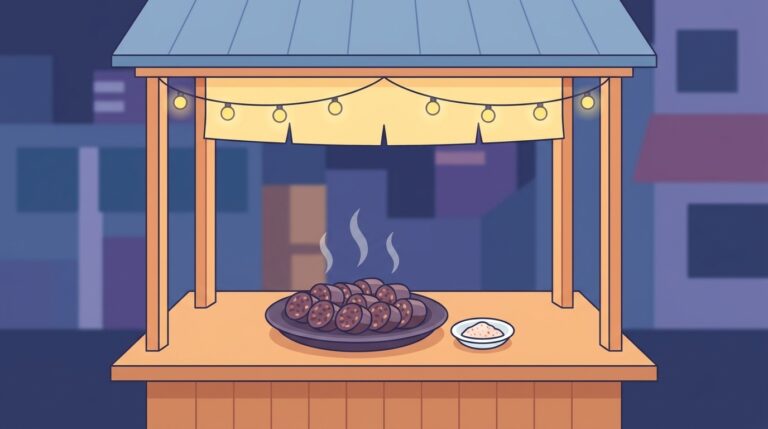
Imagine this: It is a chilly evening in Seoul. You are walking down a neon-lit street when a warm, steamy aroma catches your attention. You follow your nose to a cozy, orange-tented street food cart—a Pojangmacha (포장마차). Inside, steam rises from a giant metal tray holding a dark, coiled delicacy: Soondae (순대), Korean blood sausage.
You order a portion, and the friendly owner (whom locals warmly call Imo or ‘Auntie’) slices it up fresh and hands it to you with a tiny toothpick and a small dish of salt. You hesitate. “Do I just eat it plain? Do I dip it?”
Don’t worry! Today, we are going to learn how to order and eat Soondae like a seasoned local. By the end of this guide, you will be able to order confidently in Korean and navigate the rich, surprising regional dipping cultures of Korea! Let\’s dive in.
Phase 2: Key Expressions (핵심 표현 3선 심층 분석)
Let\’s learn the three most important phrases you\’ll need at a street food stall.
1. 소금에 찍어 드세요 (Sogeume jjigeo deuseyo)
- Pronunciation: Soh-geum-eh jjee-guh deu-seh-yo (Think of the “jjee” as a tense “jee” sound, like the ‘g’ in ‘jeep’ but tighter)
- Meaning: “Please dip it in salt and eat it.”
- K-Culture Moment: You will hear this constantly from Pojangmacha owners when they serve your hot plate of Soondae. They want to make sure you get the perfect balance of savory sausage and salty, peppery seasoning.
- Editor\’s Insight: 찍다 (jjik-da) means “to dip.” Combined with 드세요 (deuseyo) (the polite way to say “please eat”), it is a warm, hospitable recommendation.
- Situation Spectrum: Casual ⚠️ | Semi-formal ✅ | Formal ✅
- 🤔 Think About It: In your home country, what is the default seasoning or sauce for savory snacks? How does it compare to a simple pinch of salt?
2. 내장도 섞어 주세요 (Naejangdo seokkeo juseyo)
- Pronunciation: Nae-jang-doh suhk-kuh joo-seh-yo (Suhk-kuh rhymes with “suck-uh”)
- Meaning: “Please mix in the organ meats (innards) too.”
- K-Culture Moment: When ordering Soondae, the owner will almost always ask if you want liver (간 – gan) and lung (허파 – heopa). Saying yes makes you look like a true foodie!
- Editor\’s Insight: 내장 (naejang) means “organs/innards,” and 섞다 (seokk-da) means “to mix.” If you only want the sausage, you can say “순대만 주세요” (Sundaeman juseyo).
- Situation Spectrum: Casual ✅ | Semi-formal ✅ | Formal ⚠️
- 🤔 Think About It: Trying offal/organ meat can be intimidating. Do you have similar dishes in your culture, or is this a completely new culinary adventure for you?
3. 소금만 주세요 (Sogeumman juseyo)
- Pronunciation: Soh-geum-man joo-seh-yo
- Meaning: “Just salt, please.”
- K-Culture Moment: If you travel outside Seoul, local vendors might automatically serve Soondae with ssamjang (savory soybean paste) or soy sauce. If you prefer the classic Seoul style, use this phrase!
- Editor\’s Insight: Adding -만 (-man) to a noun limits it to “only” or “just.” It is a short, polite way to state your preference.
- Situation Spectrum: Casual ✅ | Semi-formal ✅ | Formal ✅
- 🤔 Think About It: How does changing the sauce completely alter the identity of a dish?
Phase 3: Textbook vs. Real Korean (교과서 한국어 vs 진짜 한국어)
Let\’s compare stiff textbook phrases with the warm, natural language spoken on the streets.
Situation 1: Declaring your love for Soondae with salt
- 📖 Textbook: 순대를 소금에 찍어 먹습니다. (Sundaereul sogeume jjigeo meokseumnida.)
- “I eat Soondae dipped in salt.”
- 🗣️ Real Korean: 순대는 소금이죠! (Sundaeneun sogeum-ijyo!)
- “Soondae is all about the salt!” (Or “Salt is the absolute best for Soondae!”)
- 💡 Why the difference? The ending -이죠 (-ijyo) is used to state a friendly, undeniable truth. It builds instant rapport with the stall owner!
Situation 2: Asking for a single portion
- 📖 Textbook: 순대를 주십시오. (Sundaereul jusipsio.)
- “Please give me Soondae.” (Too formal and robotic for a street cart!)
- 🗣️ Real Korean: 순대 일 인분 주세요. (Sundae il-inbun juseyo.)
- “One portion of Soondae, please.”
- 💡 Why the difference? On the street, specifying the portion size using 일 인분 (il-inbun – one portion) is much more natural and helps the vendor prepare your food quickly.
Phase 4: K-Culture Deep Dive & Non-verbal Manners (비언어적 매너)
4-1. Nunchi (눈치) & Table Manners
When eating at a busy Pojangmacha, space is limited. Here are some golden rules:
* The One-Dip Rule: Never double-dip your Soondae into the shared salt dish if you are sharing with friends. Dip lightly once!
* Use the Toothpicks: Street vendors rarely give out metal chopsticks. Use the wooden toothpicks provided to pierce the sausage firmly so it doesn\’t fall apart.
4-2. The Great Regional Dipping Debate!
Did you know that how you dip your Soondae depends entirely on where you are in Korea? This is a popular topic of debate on Korean variety shows and K-Dramas:
* Seoul & Gyeonggi: Salt mixed with ground black pepper and a pinch of red pepper (소금).
* Busan & Gyeongsang: Savory, thick orange Ssamjang (쌈장 – seasoned soybean paste).
* Gwangju & Jeolla: Sweet and tangy Chochujang (초고추장 – vinegared red chili paste).
* Jeju Island: Savory soy sauce (간장) or salted shrimp (새우젓).
Phase 5: Real-Life Roleplay Scenario (실전 롤플레이)
Setting: A warm, bustling street stall at night. The air smells of spicy tteokbokki and steamed Soondae. You walk up to the counter.
NPC: Imo (이모) – A friendly, energetic auntie wearing a red apron.
- Imo: 어서 와요! 뭐 줄까?
(Eoseo wayo! Mwo julkka?)
“Welcome! What can I get you?” - You: 순대 일 인분 주세요.
(Sundae il-inbun juseyo.)
“One portion of Soondae, please.” - Imo: 🎭 [Chops the sausage skillfully] 내장도 섞어 줄까?
(Naejangdo seokkeo julkka?)
“Shall I mix in some organ meats too?” - You: 네, 내장도 같이 섞어 주세요.
(Ne, naejangdo gachi seokkeo juseyo.)
“Yes, please mix in the organs together too.” - Imo: 🎭 [Places a steaming plate in front of you with a small dish of red-tinted salt] 여기 있어요. 뜨거우니까 소금에 찍어 천천히 드세요!
(Yeogi isseoyo. Tteugeounikka sogeume jjigeo cheoncheonhi deuseyo!)
“Here you go. It\’s hot, so dip it in salt and eat slowly!” - You: 와, 감사합니다! 잘 먹겠습니다!
(Wa, gamsahabnida! Jal meokgessnida!)
“Wow, thank you! I will eat well!”
🔀 Your Next Move (Choose your response!):
- A) “이모, 소금 말고 쌈장도 있어요?” (Imo, sogeum malgo ssamjangdo isseoyo? – “Auntie, do you have ssamjang instead of salt?”)
- Feedback (Best/Fun): Imo will grin and say, “Are you from Busan?” She\’ll happily search her fridge for some ssamjang for you!
- B) “내장은 빼고 순대만 주세요.” (Naejang-eun ppaego sundaeman juseyo. – “Please take out the organs and just give me sausage.”)
- Feedback (Safe/Good): Imo will nod and pile up extra delicious, chewy glass-noodle sausage on your plate instead.
- **C) 🎭 [Grabbing the Soondae with your bare hands] **
- Feedback (Bad/Risk): Imo will gasp! “Omo! It\’s too hot! Use the toothpick!” (오모! 뜨거워요! 이쑤시개 쓰세요!)
Phase 6: 10-Second Shadowing Drill (10초 감정 섀도잉)
Practice these lines out loud with the correct pause points (/) and emotional tones!
- [😊 Bright & Hungry]
- 순대 / 일 인분 / 주세요!
- Sun-dae / il-in-bun / ju-se-yo!
- [🙂 Polite & Confident]
- 내장도 / 같이 / 섞어 주세요.
- Nae-jang-do / ga-chi / seok-keo ju-se-yo.
- [👩🍳 Warm & Recommending]
- 소금에 / 찍어서 / 드세요!
- So-geum-e / jji-geo-seo / deu-se-yo!
Phase 7: K-Culture Mini-Dictionary (미니 사전)
- 순대 (Soondae): Traditional Korean blood sausage made by stuffing pig intestines with glass noodles, barley, and pork blood.
- 내장 (Naejang): Organ meats. Commonly served with Soondae, including boiled pig liver (간) and heart/lung sections.
- 포장마차 (Pojangmacha): Tented street stalls selling popular late-night comfort foods and alcoholic drinks.
- 초장 (Chojang): A sweet, spicy, and tangy condiment made of gochujang, vinegar, and sugar.
Phase 8: Travel Survival Kit (여행자를 위한 생존 키트)
Top 3 Survival Phrases
- 이쑤시개 주세요 (Issusigae juseyo): “Please give me a toothpick.” (Use this if you accidentally drop yours!)
- 포장해 주세요 (Pojanghae juseyo): “To go, please.” (If you want to eat your Soondae back in your hotel room).
- 계산해 주세요 (Gyesanhae juseyo): “Please check me out / Bill, please.”
🗺️ Editor\’s Travel Note
Most traditional Pojangmacha stalls are small, cash-only operations, or they accept local bank transfers. When planning your street food adventure, make sure to carry some physical cash (around 5,000 to 10,000 KRW per dish). You can easily find the highest-rated street stalls near traditional markets using the Naver Map App.
Note: Street food operating hours and prices may vary depending on local weather conditions.
Phase 9: ” 한 발 더 깊이” (One Step Deeper)
In Korea, food is not just nourishment—it is a badge of regional pride. The debate over whether Soondae should be dipped in salt, ssamjang, or chojang is a lighthearted way Koreans express love for their hometowns. Sharing your preferred dipping sauce is a fantastic icebreaker when meeting Korean friends. It shows you don\’t just know the language; you truly understand the local culture!
💬 Your Turn: Which regional dipping style sounds the most delicious to you? Let us know in the comments below!
Phase 10: FAQ & Common Mistakes (자주 묻는 질문)
Q: Is Soondae gamey or smelly?
A: High-quality Soondae has almost no strong smell! It is very savory, mildly spiced, and has a wonderfully chewy texture due to the glass noodles (당면 – dangmyeon) inside.
Q: What is the pinkish powder in the salt dish?
A: It is roasted salt mixed with a tiny bit of red pepper powder, sesame seeds, and sometimes black pepper. It adds a smoky, savory kick to the rich sausage.
Q: Can I ask for more salt?
A: Absolutely! Just point to the dish and politely say, “소금 조금 더 주세요” (Sogeum jogeum deo juseyo – More salt, please).
🚨 Common Mistakes Alert!
- Mistake 1: Double-dipping in a communal salt bowl.
- Correct Action: Pour a little salt onto the corner of your personal paper plate first!
- Mistake 2: Calling a male vendor “Imo” (이모).
- Correct Action: “Imo” means maternal aunt. Use it only for female vendors. For male vendors, say “사장님” (Sajangnim – Boss/Owner).
Phase 11: Action Missions (액션 미션)
- Bronze Medal 🥉: Practice saying “소금에 찍어 드세요” three times in front of the mirror with a big smile!
- Silver Medal 🥈: Take a screenshot of this guide and share your favorite Korean street food on Instagram, tagging #DailyHangul.
- Gold Medal 🥇: Visit a local Korean supermarket or street vendor, order Soondae, and confidently say: “내장도 섞어 주세요!”
🎬 K-Culture Bonus Mission: Watch Episode 3 of your favorite street-food documentary or variety show and spot which dipping sauce the hosts use for their Soondae!
Phase 12: Interactive Quiz Challenge (퀴즈 챌린지)
1. What does “내장도 섞어 주세요” mean?
Click to reveal the answer!
Answer: “Please mix in the organ meats (innards) too.”
Feedback: Well done! If you prefer only the sausage, remember to say “순대만 주세요” (Sundaeman juseyo).
2. Fill in the blank: To ask for just salt, you say “소금____ 주세요.”
Click to reveal the answer!
Answer: 만 (man)
Feedback: Correct! “소금만 주세요” translates to “Just salt, please.”
3. True or False: In Busan, people traditionally dip Soondae in sweet vinegar paste (Chojang).
Click to reveal the answer!
Answer: False!
Feedback: Busan locals love dipping their Soondae in Ssamjang (savory soybean paste). Chojang is popular in the Jeolla province!







