

Oh No, My Button! How to Get Clothes Repaired at a Korean Dry Cleaner (세탁소)
안녕하세요! (An-nyeong-ha-se-yo!) I’m your Daily Hangul editor and your personal Korean cultural navigator.
Imagine this: You are walking down the vibrant streets of Hongdae, wearing your absolute favorite outfit. Suddenly, you look down and gasp—a button on your trench coat is dangling by a single thread, or worse, it has completely fallen off!
Don’t let a missing button ruin your exciting day in Korea. In Korea, neighborhood dry cleaners, known as 세탁소 (Se-tak-so), are absolute lifesavers. They are not just for washing clothes; they are magical repair shops run by neighborhood masters who can fix your clothes in a flash. Today, we will learn how to confidently ask for a button repair in Korean, even if you are a complete beginner (A1 level)!
Phase 2: Core Expressions Deep Dive
Here are the three magic sentences you need to save your outfit.
1. 단추가 떨어졌어요. (Dan-chu-ga tteol-eo-jyeot-eo-yo)
- Pronunciation: Dan-choo-gah tteol-uh-jyut-uh-yo (Think of “Dan-choo” like a cute nickname, and “tteol-eo” sounding like “tell-uh” with a very soft ‘t’ sound.)
- Meaning: The button fell off.
- K-Culture Moment: You’ve probably seen this in K-dramas! The clumsy but lovable main character loses a button, and the charming lead picks it up. In real life, you just need to say this to the dry cleaning master (사장님 – Sa-jang-nim).
- Editor’s Insight: ‘단추’ means button, and ‘떨어졌다’ means to fall or drop. Using the polite ending ‘-어요’ makes it friendly yet respectful.
- Situation Spectrum: Casual ✅ / Semi-formal ✅ / Formal ✅
- 🤔 Think About It: How do you handle minor clothing damage in your country? In Korea, fixing things immediately is part of keeping a neat, polished appearance!
2. 이거 달아주세요. (I-geo dal-a-ju-se-yo)
- Pronunciation: Ee-guh dahl-ah-joo-seh-yo (Think of “Ee-guh” like “eager” without the ‘r’, and “dal-a” like “doll-ah”.)
- Meaning: Please sew (attach) this on.
- K-Culture Moment: Handing over your coat along with the loose button you found in your pocket to the laundry shop master.
- Editor’s Insight: ‘이거’ means “this.” ‘달다’ means to attach, and adding ‘-아주세요’ (please do for me) turns it into a polite request. It’s short, simple, and incredibly effective!
- Situation Spectrum: Casual ✅ / Semi-formal ✅ / Formal ✅
3. 언제 찾을 수 있어요? (Eon-je chat-eul su its-eo-yo?)
- Pronunciation: Uhn-jeh-cha-jeul-soo-eet-suh-yo? (Think of “Uhn-jeh” like “engine” without the ‘ng’ sound.)
- Meaning: When can I pick it up?
- K-Culture Moment: Asking the master when you should return to get your freshly repaired clothes.
- Editor’s Insight: While ‘찾다’ normally means “to find” or “to search,” in the context of service shops (like dry cleaners, shoe repairs, or photo studios), it uniquely means “to pick up” or “to collect.”
- Situation Spectrum: Casual ✅ / Semi-formal ✅ / Formal ✅
Phase 3: Textbook Korean vs. Real Korean
Let’s compare textbook phrases with how real Koreans talk at the 세탁소!
- Situation 1: Requesting a button repair
- 📖 Textbook: “의복의 단추를 수선해 주십시오.” (Please repair the button of the garment.) – Too robotic and overly formal!
- 🗣️ Real Korean: “단추 좀 달아주세요.” (Please sew the button for me.)
- 💡 Why? Adding the word ‘좀’ (jom – literally “a little”) softens the request, making you sound extremely natural and polite.
- Situation 2: Asking for dry cleaning
- 📖 Textbook: “의류 세탁을 부탁합니다.” (I request the washing of clothes.)
- 🗣️ Real Korean: “이거 드라이해 주세요.” (Please dry-clean this.)
- 💡 Why? Koreans love using the Konglish term ‘드라이’ (Deu-ra-i) for dry cleaning. It’s short, simple, and understood instantly by everyone.
Phase 4: K-Culture Deep Dive & Non-verbal Manners
4-1. Nunchi (눈치) & Gestures
When you enter a Korean 세탁소, hand over your garment using both hands (두 손). This is a vital sign of respect in Korean culture. While saying “단추가 떨어졌어요,” gently point to the exact spot where the button is missing. If you managed to save the fallen button, hand it over carefully with both hands too!
4-2. The Cozy Neighborhood “세탁소”
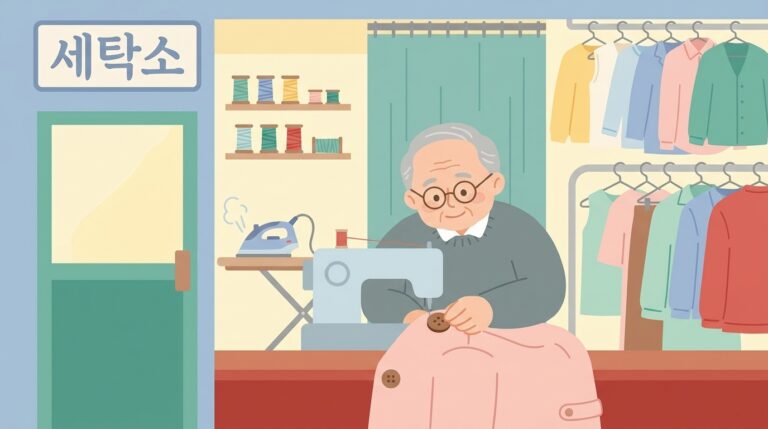
Unlike massive commercial dry-cleaning chains in some Western countries, Korean neighborhood dry cleaners are cozy, family-run spaces. The owner is usually a master tailor who has been working in the same spot for decades. They are often called 사장님 (Sa-jang-nim – Owner/Boss) or affectionately 이모님 (I-mo-nim – Auntie). Don’t be surprised if they offer you a small cup of sweet instant mix coffee while assessing your coat!
Phase 5: Real-world Roleplay Scenario
Let’s visit “Namsan Dry Cleaners” (남산 세탁소). You meet the friendly master, Mr. Kim.
[Setting: A cozy shop filled with the warm scent of steam irons and clean laundry. Mr. Kim is pressing a shirt.]

You: 안녕하세요, 사장님!
     (An-nyeong-ha-se-yo, sa-jang-nim!)
     "Hello, Boss!"

Mr. Kim: 🎭 [Smiling warmly] 어서 오세요! 뭐 도와드릴까요?
         (Eo-seo o-se-yo! Mwo do-wa-deu-ril-kka-yo?)
         "Welcome! How can I help you?"

You: 🎭 [Pointing at your jacket sleeve] 이거 단추가 떨어졌어요. 이거 달아주세요.
     (I-geo dan-chu-ga tteol-eo-jyeot-eo-yo. I-geo dal-a-ju-se-yo.)
     "The button fell off this. Please sew this on."

Mr. Kim: 🎭 [Looking closely at the button] 아, 네! 금방 해요. 지금 바로 해 줄게요.
         (Ah, ne! Geum-bang hae-yo. Ji-geum ba-ro hae jul-ge-yo.)
         "Ah, yes! It takes no time. I will do it for you right now."

You: 우와, 정말요? 감사합니다! 얼마예요?
     (U-wa, jeong-mal-yo? Gam-sa-ham-ni-da! Eol-ma-ye-yo?)
     "Wow, really? Thank you! How much is it?"

Mr. Kim: 이천 원이요.
         (I-cheon-won-i-yo.)
         "It is 2,000 won."
🔀 Interactive Choice!
What would you say next to finalize the interaction?
* A. “여기 있어요. 고맙습니다!” (Yeo-gi its-eo-yo. Go-map-seum-ni-da! – “Here it is. Thank you!”)
* B. “너무 비싸요!” (Neo-mu bi-ssa-yo! – “It’s too expensive!”)
* C. “깎아주세요!” (Kkak-a-ju-se-yo! – “Please give me a discount!”)
Check the feedback for your choice!
- A is the BEST Choice! Paying 2,000 KRW (approx. $1.50 USD) for instant master tailoring is incredibly cheap and respectful. Handing over the money with both hands makes you an absolute star student!
- B is a BAD Choice. 2,000 won is extremely cheap for manual sewing service. Saying this might hurt the owner’s feelings.
- C is a RISK Choice. While bargaining is sometimes done in traditional markets, asking to discount a tiny 2,000 won repair service is considered bad manners (실례).
Phase 6: 10-Second Emotion Shadowing Drill
Let’s practice speaking with real Korean emotions! Pause at the / marks.
- [🥺 Sad & Worried – Your favorite coat is ruined]
- 단추가 / 떨어졌어요…
- Dan-chu-ga / tteol-eo-jyeot-eo-yo…
- [😊 Politely & Hopefully – Requesting help]
- 이거 좀 / 달아주세요!
- I-geo jom / dal-a-ju-se-yo!
Phase 7: K-Culture Mini Dictionary
- 세탁소 (Se-tak-so): Neighborhood dry cleaners or laundromats.
- 단추 (Dan-chu): Buttons on clothes.
- 바느질 (Ba-neu-jil): Hand-sewing or needlework.
- 수선 (Su-seon): Clothing alterations/repairs. You will see “옷 수선” (Ot Su-seon) written on many shop windows.
Phase 8: Survival Kit for Travelers
Survival Phrases TOP 3
- 이거 드라이해 주세요. (I-geo deu-ra-i-hae ju-se-yo.) – Please dry-clean this.
- 얼룩 빼 주세요. (Eol-luk pae ju-se-yo.) – Please remove this stain.
- 지퍼가 고장 났어요. (Ji-peo-ga go-jang nat-eo-yo.) – The zipper is broken.
🗺️ Editor’s Travel Note
Need to find a dry cleaner near your accommodation? Open your Naver Map App for iOS or Android and type in “세탁소” (Se-tak-so). Small neighborhood shops often prefer cash or direct bank transfers for very small amounts under 5,000 won, so keeping some 1,000 won bills handy is always a smart idea!
Phase 9: “One Step Deeper” (Cultural Reflection)
Korean neighborhood dry cleaners are disappearing slowly due to 24-hour coin laundromats and mobile app laundry services. However, they hold a special place in the hearts of Koreans. They represent the warm, cozy neighborhood community spirit known as 정 (Jeong – deep connection and affection). Buying a coffee for the hard-working dry cleaner owner is a beautiful way to experience this warmth.
💬 Your Turn: Have you ever experienced a small neighborhood shop in Korea? What did you repair or buy? Let us know in the comments below!
Phase 10: FAQ & Common Mistakes
Q: Can they sew a button even if I lost the original button?
A: Yes! Most Korean 세탁소 masters have massive boxes filled with spare buttons of all shapes, sizes, and colors. If you say “단추 잃어버렸어요” (Dan-chu il-eo-beo-ryeot-eo-yo – I lost the button), they will find a matching one for you.
Q: How long does a simple repair take?
A: For a simple button repair, if they are not busy, they will often do it right on the spot (지금 바로) within 3 minutes!
Q: Can they repair shoes too?
A: No, dry cleaners only handle textiles and leather clothes. For shoes, look for tiny street booths that say “구두 수선” (Gu-du Su-seon – Shoe Repair).
🚨 Common Mistakes Warning!
- Mistake: Saying “단추 가 버렸어요” (Dan-chu ga beor-yeot-eo-yo) thinking it means “The button went away.”
- Correct Action: Say “단추가 떨어졌어요” (The button fell off) or “단추를 잃어버렸어요” (I lost the button).
Phase 11: Action Missions
- 🥉 Bronze: Practice saying “단추가 떨어졌어요” out loud 3 times in front of the mirror with a sad expression.
- 🥈 Silver: Take a picture of your favorite outfit, post it on Instagram, and tag us with the caption: “이거 제일 좋아하는 옷이에요!” (This is my favorite outfit!)
- 🥇 Gold: The next time you visit Korea, confidently step into a local 세탁소 and say “안녕하세요!”
Phase 12: Interactive Quiz Challenge
Q1. What is the correct word for “button” in Korean?
- A) 비누 (Bi-nu)
- B) 단추 (Dan-chu)
- C) 구두 (Gu-du)
Q2. True or False: You should point to the spot and hand over your clothes with one hand to show confidence.
- True / False
Click to see the Answers & Explanations!
- Q1 Answer: B) 단추 (Dan-chu). (A means soap, C means leather shoes!)
- Q2 Answer: False! Always hand over clothes and items with both hands in Korea to show politeness and respect to the elders and service workers.
Keep practicing your Korean, and we will see you in the next lesson! 다음에 또 만나요! (Dae-eum-e tto man-na-yo!)






