

Don’t Panic in Korea! How to Ask for the Restroom Password Like a Local
Phase 1: Empathy (Your Seoul Cafe Emergency!)
안녕하세요! (An-nyeong-ha-se-yo!) Hello! It’s your Daily Hangul editor and your Korean bestie. 😊
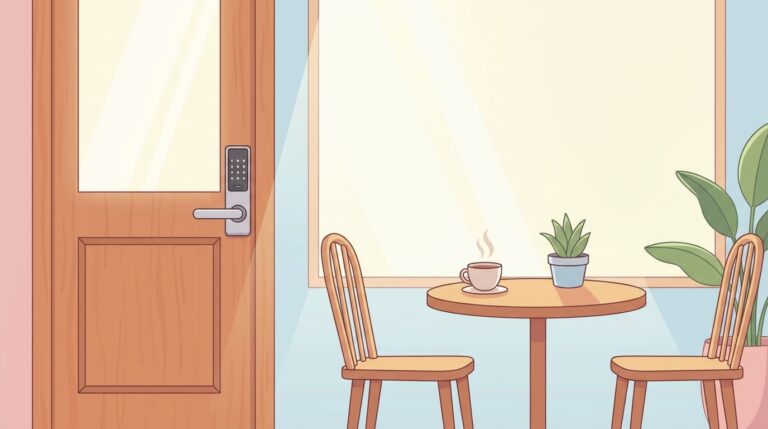
Picture this: You are sipping a gorgeous strawberry latte in a trendy cafe in Hongdae. Suddenly, nature calls. You confidently walk over to the restroom door, but wait—there is a digital keypad locking the door! 😱 You look around, feeling a bit lost. You see a sticky note with numbers next to the door, or maybe nothing at all. Your heart rate rises. How do you ask the barista for the code without sounding like a robot or resorting to wild hand gestures?
If you have felt this panic, you are definitely not alone. Many of our beginner students tell us this is one of their biggest “cultural shock” moments. In Korea, most public restrooms in cafes, restaurants, and shopping areas are secured with digital door locks to keep them clean and safe.
Learning just a few simple phrases will save your day (and your sanity!). Today, we are going to master how to ask for the restroom password in a natural, polite Korean way. Let’s dive in!
Phase 2: Key Expressions Deep Dive
Here are the top three expressions you need. They are super simple but incredibly powerful for an A2 learner!
1. 화장실 비밀번호가 뭐예요? (Hwajangsil bimilbeonhoga mwoyeyo?)
- Pronunciation: Hwa-jang-sil bee-meel-buhn-ho-gah mwo-yeh-yo?
- Sound Analogy: “Hwa” (like the start of “What”), “Jang” (like “Jahng”), “sil” (sounds like “sheel”). “Bee-meel” sounds like “be” + “meal”.
- Meaning: “What is the restroom password?”
- K-Culture Moment: This is the absolute classic. You will hear customers asking this at cafe counters all over Seoul.
- Editor’s Insight: “비밀번호” (bimilbeonho) is the formal word for “password.” It is polite and safe to use with any staff member.
- Situation Spectrum: Casual ⚠️ | Semi-formal ✅ | Formal 🚫
- 🤔 Think About It: In your country, are cafe restrooms usually locked? Why do you think Korea uses digital keypads so widely?
2. 화장실 어디에 있어요? (Hwajangsil eodie isseyo?)
- Pronunciation: Hwa-jang-sil uh-dee-eh ees-suh-yo?
- Sound Analogy: “Uh-dee” sounds like “a-dee” in “additive”. “Ees-suh-yo” sounds like “is-saw-yo”.
- Meaning: “Where is the restroom?”
- K-Culture Moment: Sometimes the restroom is outside the cafe in a shared building hallway. Asking this first helps you locate the door.
- Editor’s Insight: This is the most basic survival phrase. Even if you forget the word for password, starting with this will prompt the staff to guide you.
- Situation Spectrum: Casual ⚠️ | Semi-formal ✅ | Formal 🚫
3. 비밀번호 적혀 있어요? (Bimilbeonho jeokhyeo isseyo?)
- Pronunciation: Bee-meel-buhn-ho juhk-hyeo ees-suh-yo?
- Sound Analogy: “Juhk-hyeo” sounds like “juck” + “hyuh” (rhymes with “pure”).
- Meaning: “Is the password written down?”
- K-Culture Moment: Often, cafes print the restroom code at the bottom of your receipt or write it on a tiny whiteboard near the counter.
- Editor’s Insight: Asking this shows you are looking for written information (like on a receipt) before making them say it out loud.
- Situation Spectrum: Casual ⚠️ | Semi-formal ✅ | Formal 🚫
Phase 3: Textbook Korean vs. Real Korean
Let’s compare what boring grammar books teach you versus what real Koreans actually say in 2024!
Situation 1: Asking for the Password
- 📖 Textbook Korean: 화장실 비밀번호를 알려주실 수 있습니까? (Hwajangsil bimilbeonhoreul allyeojusil su isseumnikka? – “Could you please inform me of the restroom password?”)
- Why it’s stiff: This sounds like you are requesting government secrets! It’s way too formal for a cozy coffee shop.
- 🗣️ Real Korean: 화장실 비번이 뭐예요? (Hwajangsil bibeon-i mwoyeyo? – “What’s the restroom password?”)
- 💡 Why it’s better: 비번 (Bibeon) is the super popular slang/abbreviation of 비밀번호 (bimilbeonho). Using it makes you sound like a local who has lived in Seoul for years!
Situation 2: Asking if it’s on the receipt
- 📖 Textbook Korean: 영수증에 비밀번호가 인쇄되어 있습니까? (Yeongsujeunge bimilbeonhoga inswaedoeeo isseumnikka? – “Is the password printed on the receipt?”)
- Why it’s stiff: Nobody uses the word “인쇄 (printed)” in casual conversation.
- 🗣️ Real Korean: 영수증에 적혀 있어요? (Yeongsujeunge juhk-hyeo isseyo? – “Is it written on the receipt?”)
- 💡 Why it’s better: “적혀 있어요” (written/noted down) is much softer, natural, and friendly.
Phase 4: K-Culture Deep Dive & Non-verbal Manners
4-1. Eye Contact & Hand Gestures
When asking for the password, Koreans don’t just speak; they use gentle, polite gestures.
* The “Receipt Tap”: If you just ordered, hold up your receipt slightly. Tap it gently with your finger while asking, “영수증에 있어요?” (Is it on the receipt?). It immediately communicates your question visually!
* The Head Tilt: A polite head tilt shows you are being cautious and don’t want to disturb the busy barista.
4-2. Why are Korean Restrooms Locked?
In Korea, commercial space is premium, especially in busy hotspots like Gangnam or Hongdae. Cafes lock their restrooms to prevent non-customers from using them, ensuring their paying customers have a clean, supplied space. It’s a system built on mutual respect! Also, look out for the 휴지 (hyuji – toilet paper) near the counter. Sometimes you have to grab some before you head out!
Phase 5: Interactive Cafe Roleplay
Let’s practice! You are at a trendy cafe in Seoul. You need the restroom. The barista, Minji, is at the counter.
- Minji (Barista): 어서 오세요! 주문하신 음료 나왔습니다.
(Uh-suh oh-seh-yo! Ju-mun-ha-sin eum-ryo na-wat-seum-ni-da.)
“Welcome! Your drink is ready.” - You (A2 Learner): 🎭 [Politely smiling, holding the receipt] 저기요, 혹시 화장실 어디에 있어요?
(Juh-gee-yo, hok-si hwa-jang-sil uh-dee-eh ees-suh-yo?)
“Excuse me, by any chance, where is the restroom?” - Minji (Barista): 아, 건물 밖으로 나가셔서 왼쪽으로 가시면 돼요!
(Ah, guhn-mul bakk-eu-ro na-ga-syuh-suh wen-jokk-eu-ro ga-si-myun dway-yo!)
“Ah, just go outside the building and turn left!” - You (A2 Learner): 🎭 [Nodding] 아, 네! 혹시 비밀번호 있어요?
(Ah, neh! Hok-si bee-meel-buhn-ho ees-suh-yo?)
“Ah, yes! By any chance, is there a password?” - Minji (Barista): 네, 영수증 밑에 도어락 비밀번호 적혀 있어요!
(Neh, yeong-su-jeung meet-eh do-uh-rak bee-meel-buhn-ho juhk-hyeo ees-suh-yo!)
“Yes, the door lock password is written at the bottom of the receipt!” - You (A2 Learner): 아, 영수증에 있군요! 감사합니다!
(Ah, yeong-su-jeung-eh eet-gun-yo! Gam-sa-ham-ni-da!)
“Ah, it’s on the receipt! Thank you!”
🔀 Your Turn: Interactive Branching!
What do you say if you accidentally threw away the receipt? Choose your option:
* Option A: “비밀번호 그냥 말해 주세요.” (Just tell me the password.)
* Option B: “죄송한데, 비번 다시 알려주실 수 있어요?” (I’m sorry, but could you tell me the password again?)
* Option C: “비밀번호 없어요?” (Is there no password?)
Feedback:
- If you chose A (Bad): 🚫 A bit too demanding! It sounds like a direct order.
- If you chose B (Best): ✅ Perfect! “죄송한데” (I’m sorry, but…) softens the request, and “비번” makes it sound natural.
- If you chose C (Risk): ⚠️ This might confuse the barista because they already told you there is a password on the receipt.
Phase 6: 10-Second Emotion Shadowing Drill
Let’s practice speaking with real-life emotions! Use the pauses / to sound natural.
- [🥺 Urgent & Polite] 저기요, / 혹시 / 화장실 / 어디예요?
(Juh-gi-yo / hok-si / hwa-jang-sil / uh-di-yeh-yo?) - [😊 Relieved] 아, / 영수증에 / 적혀 있네요! / 감사합니다.
(Ah, / yeong-su-jeung-eh / juhk-hyeo eet-neh-yo! / gam-sa-ham-ni-da.)
Phase 7: K-Culture Mini Dictionary
- 비번 (Bibeon): Short for 비밀번호 (password). Used daily for Wi-Fi codes, door locks, and phones.
- 영수증 (Yeongsujeung): Receipt. Always keep your receipt in Korean cafes until you find the restroom code!
- 도어락 (Doeorak): Digital door lock. Korea is famous for using keypads instead of traditional keys.
- 휴지 (Hyuji): Toilet paper or tissues. Some older buildings require you to take tissues from the cafe counter.
Phase 8: Traveler’s Survival Kit
Top 3 Quick Expressions:
- 화장실 급해요! (Hwajangsil geup-hae-yo!) – “It’s a restroom emergency!” (Use only in extreme cases!)
- 비번 뭐예요? (Bibeon mwo-yeh-yo?) – “What’s the passcode?” (Quick and casual).
- 카드 열쇠 필요해요? (Kadeu yeol-swe pil-yo-hae-yo?) – “Do I need a key card?” (Some cafes hand out physical keycards).
Editor’s Travel Note:
Download Naver Maps or KakaoMap. They are much more accurate than Google Maps in Korea! They often list whether a building has a public restroom inside.
Phase 9: “한 발 더 깊이” (A Deeper Look)
In many Western countries, locked restrooms use physical keys or coins. In Korea, the absolute trust in digital keypads (“도어락”) reflects the country’s high-tech lifestyle and high level of social trust. Sharing a password with paying customers is a way of balancing safety, cleanliness, and convenience.
💬 Your Turn: Have you ever used a digital lock in your home country? Tell us in the comments below! We love reading your stories!
Phase 10: FAQ & Common Mistakes
Q: Can I use the restroom without ordering anything?
A: Generally, it is considered bad manners in Korea. You should buy at least a small drink or dessert before asking for the restroom code.
Q: What if the keypad has a star (*) or hash (#) symbol?
A: Yes! In Korea, after typing the numbers, you usually have to press * (star) or # (hash) to unlock the door. If the code is “1234”, try “1234*” or “1234#”!
Q: What if there is no password written on the receipt?
A: It might be written on a whiteboard, on the wall near the pickup station, or the door might be unlocked during daytime hours.
🚨 Common Mistakes Board:
- Mistake: Saying “Password?” loudly in English.
Correction: Use “비밀번호가 뭐예요?” to show polite effort. - Mistake: Throwing away the receipt immediately.
Correction: Look at the bottom first! Look for “화장실” or “W.C.” followed by numbers. - Mistake: Pulling the locked door handle too hard.
Correction: Look for the digital screen. Wake it up by touching it with your palm first, then type the code.
Phase 11: Action Mission
- Bronze Mission: Practice saying “화장실 비번이 뭐예요?” in front of your mirror 3 times.
- Silver Mission: Share this post on your Instagram Story and tag @DailyHangul with your favorite Korean word!
- Gold Mission: Next time you visit a Korean cafe or restaurant, look for the digital door lock and successfully find the password on the receipt!
Phase 12: Interactive Quiz Challenge
1. Which word is the cool slang for “password”?
- A) 영수증 (Yeongsujeung)
- B) 비번 (Bibeon)
- C) 도어락 (Doeorak)
2. True or False: You should always press a star (*) or hash (#) after entering the restroom passcode.
- A) True
- B) False
🎉 Check the Answers! (Click to expand)
- Answer: B) 비번 (Bibeon). It’s the short, natural way to say password!
- Answer: A) True. Most Korean digital locks require you to press
*or#to complete the unlocking process!







