

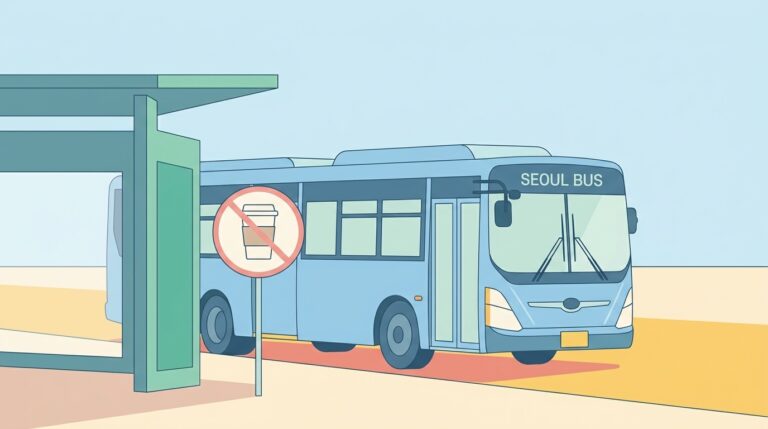
No Coffee on the Bus? Navigating Seoul’s Transit Etiquette Like a Local
Phase 1: Empathy (Your Korean Bestie’s Guide)
안녕하세요! (An-nyeong-ha-se-yo!) Daily Hangul’s Senior Editor here!
Imagine this: It is a scorching summer afternoon in Seoul. You’ve just grabbed a refreshing, sweating Iced Americano (affectionately called 아아 – Ah-Ah in Korea) to survive the heat. You see your bus approaching, step up the stairs, and… the bus driver politely but firmly shakes his head, pointing at your cup.
“Oh no, did I do something wrong?” You feel a wave of panic and embarrassment as other passengers wait behind you.
Don’t worry, my friend! You are not alone. This “coffee panic” is one of the most common experiences for travelers and expats in Korea. Since 2018, Seoul city buses have strictly banned open food and drinks to keep rides safe and clean.
By mastering a few simple phrases and understanding the heart behind this rule, you can step onto any Korean bus with absolute confidence. Let’s dive in!
Phase 2: Core Expressions Deep Dive
Here are the 3 most important expressions you need to know when navigating public transport with food or drinks.
1. 가지고 타시면 안 돼요 (Gaji-go tasimyeon an dwaeyo)
- Pronunciation: gah-jee-go tah-shee-myeohn ahn dweh-yo (Think of “go” as in English, and “dwae” rhyming with “wet” without the ‘t’).
- Meaning: “You cannot board with this.” (Literally: “If you carry it and board, it is not okay.”)
- K-Culture Moment: This is the exact phrase a bus driver or a helpful stranger will say to you if you attempt to board with an open beverage.
- Editor’s Insight: The grammar pattern -면 안 돼요 (-myeon an dwaeyo) is the standard, polite way to express prohibition in Korea. It’s firm but respectful.
- Situation Spectrum: Casual: ⚠️ | Semi-formal: ✅ | Formal: ✅
- 🤔 Think About It: How does your home country communicate rules politely? Is it as direct as this?
2. 다 마시고 타야 해요 (Da masigo taya haeyo)
- Pronunciation: dah mah-shee-go tah-yah hae-yo (Rhymes with “ah” and “yo”).
- Meaning: “You must finish drinking before you board.” (Literally: “Drink it all, then you must board.”)
- K-Culture Moment: A friend might say this to you outside the subway turnstiles or bus stop when they see you buying a sweet strawberry milk.
- Editor’s Insight: The ending -해야 해요 (-haeya haeyo) means “must” or “have to.” It sounds warm and advice-like when spoken with a friendly tone.
- Situation Spectrum: Casual: ✅ | Semi-formal: ✅ | Formal: ⚠️
- 🤔 Think About It: Notice how Korean connects two actions (drinking and boarding) into one smooth logical flow using -고 (-go).
3. 음료수 반입 금지입니다 (Eumryosu banip geumji-imnida)
- Pronunciation: eum-ryo-soo bah-neep geum-jee-eem-nee-dah (“Eum” is like the “um” in “yummy,” and “imnida” sounds like “im-nee-dah”).
- Meaning: “Beverages are prohibited.” (Highly formal sign language).
- K-Culture Moment: You will see this printed on stickers near the front doors of city buses and on posters inside subway stations.
- Editor’s Insight: This uses heavy Sino-Korean (Hanja) roots. 반입 (ban-ip) means “bringing in” and 금지 (geum-ji) means “prohibition.”
- Situation Spectrum: Casual: 🚫 | Semi-formal: ⚠️ | Formal: ✅
- 🤔 Think About It: Why do you think public transport authorities prefer Chinese-character-based words for signs instead of everyday spoken words?
Phase 3: Textbook Korean vs. Real-Life Korean
Let’s compare what you learn in dusty textbooks with how real Koreans actually talk at the bus stop!
Situation 1: Asking if you can bring a drink onboard
- 📖 Textbook style: “음료수를 가지고 버스에 타도 됩니까?” (Eumryosureul gajigo beoseue tado doemnikka? – “Am I permitted to board the bus carrying a beverage?”)
- 🗣️ Real-Life local style: “이거 들고 타도 돼요?” (Igeo deulgo tado dwaeyo? – “Can I hold this and get on?”)
- 💡 Why the difference? Real Koreans love efficiency! They swap the long word “음료수” (beverage) for a simple “이거” (this) while pointing at the cup, and use the natural verb “들다” (to hold) instead of “가지다” (to possess).
Situation 2: Warning a friend before the bus arrives
- 📖 Textbook style: “버스 안에서 음식을 먹으면 안 됩니다.” (Beoseu aneseo eumsigeul meogeumyeon an doemnida. – “Eating food inside the bus is prohibited.”)
- 🗣️ Real-Life local style: “버스에서 뭐 먹으면 안 돼.” (Beoseueseo mwo meogeumyeon an dwae. – “You can’t eat anything on the bus.”)
- 💡 Why the difference? In casual conversation, “음식” (food) becomes “뭐” (something/anything), and the polite sentence ending is dropped to friendly banmal (casual speech) for close friends.
Phase 4: K-Culture Deep Dive & Non-verbal Manners
4-1. The Magic “X” Gesture & Nunchi (눈치)
If you are holding a drink and aren’t sure if it’s allowed, practice Nunchi (눈치)—the Korean art of reading the room. Before boarding, catch the bus driver’s eye. If they look at your drink, you can make a small “X” sign with your index fingers while looking apologetic. If they shake their head, you know the answer!
4-2. The Cultural Value: Respecting the Shared Space
In Korea, public transport is seen as a collective clean zone. Because Seoul buses can brake suddenly, an open liquid is highly likely to spill on another passenger’s pristine shoes or outfit. By enforcing the “No Drinks” rule, Korean society actively protects the comfort of others. It’s all about harmony!
Phase 5: Real-Life Roleplay Scenario
Setting: A bustling bus stop in Hongdae. You are holding a delicious cup of bubble tea. Your Korean friend, Minjun, sees the bus arriving in 1 minute!
- Minjun: 🎭 (Points gently at your plastic cup) 저기요, 그 버블티 들고는 버스 못 타요! (Jeogiyo, geu beobeultei deulgoneun beoseu mot tayo!) [Uh, excuse me, you can’t get on the bus holding that bubble tea!]
- You: 🎭 (Surprised, eyes wide) 아, 정말요? 뚜껑이 있는데도 안 돼요? (Ah, jeongmallyo? Ttukkeongi inneundedo an dwaeyo?) [Ah, really? Even though it has a lid, is it not allowed?]
- Minjun: 🎭 (Nodding sympathetically) 네, 빨대가 꽂혀 있는 건 안 돼요. 기사님이 내리라고 하실 거예요. (Ne, ppaldaega kko-chyeo inneun geon an dwaeyo. Gisanim-i naerirago hasil geoyeo.) [Yes, anything with a straw inserted isn’t allowed. The driver will ask you to step off.]
- You: 🎭 (Looking around frantically) 헉, 그럼 이거 어떡하죠? 버스가 지금 오고 있어요! (Heok, geureom igeo eotteokajyo? Beoseuga jigeum ogo isseoyo!) [Oh my, then what do I do? The bus is arriving now!]
- Minjun: 🎭 (Pointing to a bin near the shelter) 저기 쓰레기통에 얼른 버리거나, 다음 버스를 타고 이걸 마셔요. 어떻게 할래요? (Jeogi sseuregitonge eolleun beorigeona, daeum beoseureul tago igeol masyeoyo. Eotteoke hallaeyo?) [Quickly throw it in that trash can over there, or take the next bus and finish drinking this. What do you want to do?]
🔀 Your Turn! Choose your reaction:
- A: “얼른 다 마실게요!” (I will drink it all super fast!)
- Feedback: Risk! Gulping down 500ml of sweet bubble tea in 30 seconds might give you a massive brain freeze or make you cough on the bus!
- B: “그냥 여기 버리고 탈게요.” (I’ll just throw it away here and get on.)
- Feedback: Best Choice! Toss the drink responsibly in the designated bin. It keeps your hands free, the bus clean, and lets you travel stress-free with Minjun.
- C: “가방에 몰래 숨겨서 탈래요.” (I’ll secretly hide it in my backpack.)
- Feedback: Bad Idea! If the cup leaks inside your bag during a sudden stop, your phone, passport, and wallet will be swimming in sweet syrup. Plus, the driver might spot it anyway!
Phase 6: 10-Second Emotion Shadowing Drill
Let’s practice speaking with real Korean feelings! Pay attention to the pauses (/) and the emotional cues.
- [🥺 Realizing your mistake with regret]
“아, / 진짜요? / 몰랐어요…”
(Ah, / jin-jja-yo? / mol-las-seo-yo…)
“Oh, really? I didn’t know…” -
[😊 Making a quick, cheerful compromise]
“그럼 / 얼른 / 다 마시고 / 탈게요!”
(Geureom / eol-reun / dah-ma-shi-go / tal-ge-yo!)
“Then, I will quickly drink it all and board!”
Phase 7: K-Culture Mini-Dictionary
- 테이크아웃 잔 (Te-i-keu-a-ut jan) | Disposable Takeout Cup | Koreans use the English word “Takeout” for disposable cups. These are strictly banned on buses.
- 밀폐용기 (Mil-pye-yong-gi) | Sealed Container | Termmoses or water bottles with tightly screwed caps that won’t spill even if dropped. These are 100% allowed!
- 기사님 (Gi-sa-nim) | Bus Driver | A highly respectful way to call a driver. If you need to apologize, say “기사님, 죄송합니다!” (Gisanim, joesonghamnida!).
- 피해 (Pi-hae) | Harm / Inconvenience | A core social concept in Korea. Avoiding giving “피해” to others is the golden rule of public behavior.
Phase 8: Traveler’s Survival Kit
Top 3 Phrases to Save Your Day
- “이거 갖고 타도 돼요?” (Igeo gat-go tado dwaeyo?) – “Can I board holding this?” (Ask while showing your drink to the driver).
- “죄송합니다, 버리고 탈게요!” (Joesonghamnida, beorigo talgeyo!) – “I’m sorry, I will discard it and board!”
- “텀블러는 괜찮죠?” (Teombeulreoneun gwaenchanjyo?) – “A tumbler is okay, right?” (Usually yes, if it is completely sealed!).
🧳 Editor’s Travel Note:
To avoid having to throw away your delicious drinks, check your transit times beforehand! Use the Naver Map App or KakaoMap App to see exactly how many minutes away your bus is. If it’s more than 10 minutes, enjoy your drink! If it’s 2 minutes, hold off on buying that sweet milk tea.
Disclaimer: Rules may be enforced slightly differently by local drivers outside Seoul, but keeping open drinks off public transits is always the safest bet!
Phase 9: “One Step Deeper” (A Heart-to-Heart on Community)
In Western countries, eating a quick sandwich or sipping a latte on the train is often seen as a normal, time-saving habit. However, Korean culture values the collective peace over individual convenience. Because public transport is heavily subsidized and clean, keeping it pristine is viewed as a civic duty. When you put your drink away, you aren’t just following a rule—you are showing beautiful respect for the elderly lady sitting next to you, the student studying on their commute, and the hard-working driver.
💬 Your Turn: Does your country have strict rules about food on buses or trains? Have you ever had an awkward transit moment abroad? Let us know in the comments below! We love hearing your stories!
Phase 10: FAQ & Common Mistakes
Q: Can I bring a cup of coffee if it has a plastic dome lid and a sleeve?
A: No. If it has a straw or a sipping hole where liquid can splash out when the bus bumps, it is not allowed.
Q: What about a closed bottle of Coca-Cola or water bought from a convenience store?
A: Yes! Sealed plastic bottles with screw-on caps, unopened cans of soda, and packaged groceries inside shopping bags are perfectly fine because they cannot spill easily.
Q: Does this rule apply to the Seoul Subway too?
A: Legally, there is no fine for holding drinks in the subway, but eating smelly hot food (like fried chicken or tteokbokki) inside subway cars is highly frowned upon.
🚨 The “Oops!” Board: Common Foreigner Mistakes
- Mistake 1: Trying to hide an iced coffee in a canvas tote bag.
- Correct Action: The driver will see it, or worse, it will tip over inside your bag. Finish it first!
- Mistake 2: Leaving empty cups on the window sill of the bus.
- Correct Action: Take your trash with you. Leaving cups behind is considered very rude.
- Mistake 3: Arguing with the driver that “it won’t spill.”
- Correct Action: Simply say “죄송합니다” (I’m sorry) and step off to finish it. Respect the driver’s authority.
Phase 11: Action Missions
- 🥉 Bronze Medal: Read the 3 Core Expressions out loud 5 times using the shadowing guide in Phase 6.
- 🥈 Silver Medal: Share this post with a friend who is traveling to Korea soon so they can avoid the “coffee panic.”
- 🥇 Gold Medal: Next time you are in Korea, spot the “No Food/Drink” sticker on a bus door, take a picture, and tag us on Instagram using the hashtag
#DailyHangulEtiquette!
Phase 12: Interactive Quiz Challenge
Test your transit survival skills!
- Which of the following can you bring onto a Seoul city bus?
- A) A fresh, open cup of boba milk tea with a straw.
- B) A sealed thermos flask containing hot tea.
- C) A cup of hot tteokbokki.
- Fill in the blank: “이거 가지고 타면 _____ 돼요.” (You cannot board with this.)
- A) 잘 (jal)
- B) 안 (an)
- C) 더 (deo)
- True or False: The subway has the exact same strict legal fines for holding takeout cups as buses do.
👀 Click here to see the Answers & Explanations!
- Answer: B
- Explanation: Fully sealed containers like thermoses or screw-cap bottles are allowed. Takeout cups and warm snacks are prohibited due to spill and odor risks.
- Answer: B
- Explanation: 안 돼요 (an dwaeyo) means “it is not okay / you must not.”
- Answer: False
- Explanation: Subways do not have strict legal fines for bringing drinks, though eating smelly food is socially discouraged.







