

Phase 1: Welcome to the Ultimate K-Beauty Experience! 💇♀️
안녕하세요! (Annyeonghaseyo! – Hello!) I’m your Daily Hangul editor and your personal Korean culture guide. Have you ever dreamed of getting that perfect, airy K-drama haircut or a trendy K-pop idol hair color in Seoul? Walking into a stylish hair salon in Hongdae or Gangnam is incredibly exciting, but we know it can also be a bit nerve-wracking.
Many of our learners tell us: “I booked my appointment online, but when I walked into the salon and the stylish staff greeted me, my mind went completely blank! I didn’t know how to say I had a reservation!”
Don’t worry! Today, we’re going to master the exact, natural phrases you need to confidently say, “I have a reservation,” the second you walk through those glass doors. By the end of this guide, you’ll sound like a local regular, not a stressed tourist. Let’s dive in!
Phase 2: The Big Three – Core Expressions 🌟
Here are the three most natural ways to check in at a Korean hair salon. Pick the one that feels most comfortable for you!
1. 예약하고 왔어요. (Yeyakhago wasseoyo.)
- Pronunciation: Yay-yak-ha-go wah-suh-yo (Think of saying “ye-yak” like “ye-yak” in a fast beat, followed by “was-suh-yo”).
- Meaning: I have a reservation. (Literally: “I made a reservation and came.”)
- K-Culture Moment: This is the universal gold-standard phrase. You will hear this in almost every lifestyle K-drama when a character walks into a café, restaurant, or clinic.
- Editor’s Insight: Why do Koreans say “and came” (wasseoyo)? In Korean culture, stating your purpose in connection with your physical arrival sounds polite and natural. It tells the receptionist exactly why you are standing in front of them.
- Situation Spectrum: Casual (⚠️) / Semi-formal (✅) / Formal (✅)
- 🤔 Think About It: In English, we simply say “I have a reservation.” Why do you think Korean specifically highlights the action of “coming” (왔어요)? It reflects how Korean verbs connect actions in a continuous flow of time!
2. [이름] 이름으로 예약했어요. ([Name] ireumeuro yeyakhaesseoyo.)
- Pronunciation: [Name] ee-rum-eu-ro yay-yak-hae-suh-yo (Flow the “m” sound in ireum smoothly into the “eu” sound: ee-ru-meu-ro).
- Meaning: I made a reservation under the name [Name].
- K-Culture Moment: Perfect when the salon is busy and the receptionist is already looking at their tablet screen to find your slot.
- Editor’s Insight: The particle “으로/로” (eu-ro/ro) means “by” or “under” in this context. If your name ends in a consonant (like Sam), say Sam-ireumeuro. If it ends in a vowel (like Emma), say Emma-ireumeuro.
- Situation Spectrum: Casual (⚠️) / Semi-formal (✅) / Formal (✅)
3. [시간]에 예약한 [이름]입니다. ([Time]e yeyakhan [Name]imnida.)
- Pronunciation: [Time]-ae yay-yak-han [Name]-im-nee-da.
- Meaning: I am [Name], booked for [Time]. (e.g., “두 시에 예약한 미나입니다.” – I’m Mina, booked for 2 o’clock.)
- K-Culture Moment: Used in high-end salons in Cheongdam-dong where schedule precision is highly valued.
- Editor’s Insight: This is the most polite and clear way to introduce yourself. It provides all the necessary information (Time + Name) in one go, saving the staff time.
- Situation Spectrum: Casual (🚫) / Semi-formal (✅) / Formal (✅)
Phase 3: Textbook Korean vs. Real-Life Korean 🗣️
Let’s compare what dusty old textbooks teach you versus how cool, modern Koreans actually speak at the salon!
Situation 1: Letting them know you have an appointment
- 📖 Textbook Korean: “저는 오늘 예약을 했습니다.” (Jeoneun oneul yeyageul haessseomnida. – I did a reservation today.)
- 🗣️ Real-Life Korean: “예약하고 왔어요.” (Yeyakhago wasseoyo. – I booked and came.)
- 💡 Why the difference? The textbook version is grammatically correct but sounds like a robotic military report. Real Koreans use the connecting verb form -고 (and) to sound fluid and natural.
Situation 2: Stating your appointment time
- 📖 Textbook Korean: “제 예약 시간은 두 시입니다.” (Je yeyak siganeun du siimnida. – My reservation time is 2 o’clock.)
- 🗣️ Real-Life Korean: “두 시 예약인데요.” (Du si yeyak-indeyo. – It’s [my] 2 o’clock reservation…)
- 💡 Why the difference? Ending a sentence with ~인데요 (~indeyo) softens the tone and invites the receptionist to respond. It sounds incredibly soft and polite, unlike the stiff “~입니다”.
Phase 4: K-Beauty Etiquette & “Nunchi” 🤫
To truly fit into a trendy Seoul salon, you need more than just words. You need to master Korean non-verbal manners (Nunchi – situational awareness).
4-1. The Greeting Bow & Handing Over Your Phone
- The “Mokrye” (목례 – Eye-contact Bow): When you walk in, the staff will greeted you loudly: “어서오세요!” (Welcome!). Instead of a deep 90-degree bow, simply make friendly eye contact, give a warm smile, and tilt your head about 15 degrees.
- The Phone Show-and-Tell: If you booked online (via Naver or Kakao Hairshop), have your reservation screen open on your phone. When you say “예약하고 왔어요,” lightly hold your phone with both hands and show them the screen. Showing your screen with two hands is a great sign of respect in Korea!
4-2. The Booking Culture (Naver Booking)
In Korea, walking into a popular salon without a booking is almost impossible. Most Koreans use Naver Booking (네이버 예약). When you arrive, the staff will check their Naver tablet immediately. Knowing this helps you understand why they might ask for your phone number if your English name is hard for them to read on their screen.
Phase 5: Live Salon Roleplay 🎭
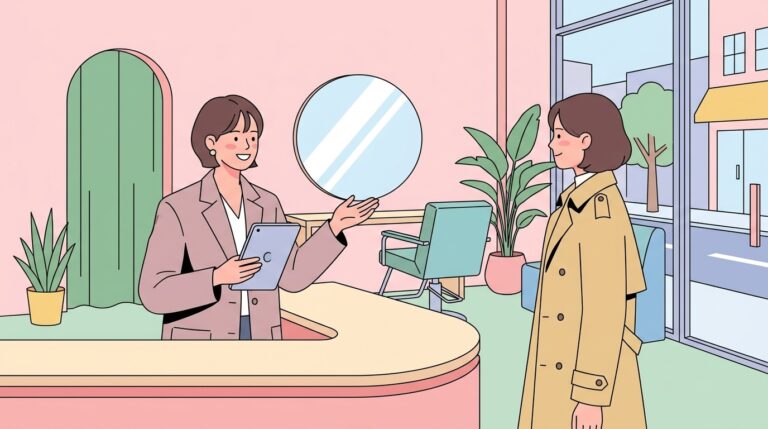
Let’s put you in the scene! You have just opened the door to “A-Concept Hair” in the heart of Hongdae. The scent of sweet shampoo and high-end styling products fills the air. A friendly receptionist, Min-ji, walks up to you with a tablet.
Scenario: Checking In at the Counter
- Min-ji (Receptionist): “어서오세요! 예약하고 오셨나요?”
(Eoseo-oseyo! Yeyakhago osyeonnayo?)
🎭 Bows slightly and smiles warmly.
“Welcome! Did you come with a reservation?” -
You: “네, 예약하고 왔어요.”
(Ne, yeyakhago wasseoyo.)
🎭 Nod politely and smile.
“Yes, I have a reservation.” -
Min-ji: “성함이 어떻게 되세요?”
(Seonghami eotteoke doeseyo?)
🎭 hovers her finger over the tablet screen.
“What is your name, please?” -
You: “에밀리 이름으로 예약했어요.”
(Emily ireumeuro yeyakhaesseoyo.)
🎭 Gently hand over your phone showing the booking screen.
“I booked under the name Emily.” -
Min-ji: “아, 에밀리 님! 두 시 예약 맞으시죠? 잠시만 대기석에서 기다려 주세요.”
(Ah, Emily-nim! Du si yeyak majeosijyo? Jamsiman daegiseogeseo gidaryeo juseyo.)
🎭 Gestures politely to a comfy leather sofa.
“Ah, Emily! 2 o’clock booking, correct? Please wait a moment in the waiting area.” -
You: “감사합니다!”
(Gamsahamnida!)
🎭 Sit on the sofa and feel like a proud local.
“Thank you!”
🔀 Interactive Choice Point!
What if Min-ji looks at her tablet and says: “죄송한데, 예약 명단에 이름이 없네요…” (Sorry, but your name is not on the reservation list…). What do you do?
- Choice A: Panick and walk out of the salon.
- Choice B: Show her your confirmation screen on Naver Map and say: “이거 확인해 주세요.” (Igeo hwaginhae juseyo. – Please check this.)
- Choice C: Shout loudly in English: “I BOOKED TODAY!”
💡 Feedback on Your Choice:
- Best Choice (B): Perfect! In Korea, showing the screen clears up spelling errors instantly. Using the polite phrase “이거 확인해 주세요” keeps the mood friendly and solves the problem.
- Bad Choice (C): Yikes! Raising your voice violates the peaceful salon etiquette. Let’s avoid this!
- Risk Choice (A): Oh no, don’t give up on your dream hair! It’s usually just a simple name spelling mix-up because of English letters.
Phase 6: 10-Second Emotional Shadowing 🗣️
Let’s practice speaking with the natural rhythm, pause, and emotion of a native. Follow the slash marks / to pause, and match the emotional guide in the brackets!
- [😊 Bright and Friendly]
“네, / 예약하고 / 왔어요!”
(Ne / yeyakhago / wasseoyo!)
Editor’s tip: Make the “ne” sound short and sweet, and lift your voice at “왔어요!” -
[😉 Confident and Calm]
“두 시에 예약한 / 에밀리입니다.”
(Du si-e yeyakhan / Emily-imnida.)
Editor’s tip: Pause briefly after the time to let the receptionist hear the name clearly.
Phase 7: K-Beauty Mini Dictionary 📖
| Word (Korean + Romanization) | English Meaning | How it’s actually used in a salon |
|---|---|---|
| 예약 (Yeyak) | Reservation / Booking | Crucial for checking in or requesting slots. |
| 디자이너 (Dijainoe) | Stylist / Designer | In Korea, hair stylists are called “Designers” (e.g., 민지 디자이너님). |
| 샴푸 (Syampu) | Shampoo / Wash | Refers both to the product and the relaxing hair-washing service. |
| 대기석 (Daegiseok) | Waiting Area | The cozy lounge where you sit before your hair journey begins. |
Phase 8: Travel Survival Kit 🧳
Survival Phrases TOP 3
- “사진 보여드릴게요.” (Sajin boyeodeurilgeyo.)
- Meaning: I’ll show you a picture.
- Pro Tip: If you can’t explain the haircut you want, just say this and show an Instagram picture!
- “커트만 할게요.” (Keoteuman halgeyo.)
- Meaning: I’ll just get a haircut.
- Pro Tip: Use this if they ask if you also want dye or perm services.
- “와이파이 비밀번호가 뭐예요?” (Waipai bimilbeonhoga mwoyeyo?)
- Meaning: What is the Wi-Fi password?
- Pro Tip: Essential because salon sessions in Korea can take hours!
🗺️ Editor’s Travel Note:
Before you head to your hair appointment, download the Naver Map app download to find your way through the winding streets of Seoul. Google Maps doesn’t work well in South Korea due to security laws! Also, remember that most premium salons accept foreign credit cards easily.
Phase 9: “One Step Deeper” – The Philosophy of “-고 왔어요” 🧠
Have you ever wondered why Koreans don’t just say “I have a reservation” (예약이 있어요) but instead say “I booked and came” (예약하고 왔어요)?
This reflects the action-oriented, relational nature of the Korean language. To Koreans, simply stating a fact (“I have a booking”) can sound slightly cold or detached. By adding “and came” (왔어요), you connect your past action (booking) with your present presence in their space. It makes the conversation feel collaborative and warm. Language is a mirror of culture!
💬 Your Turn: Have you ever noticed similar differences in your native language? Let us know in the comments below!
Phase 10: FAQ & Spotting Mistakes ❓
Q: What if they can’t find my name on the system?
A: Korean reservation systems usually list foreign names in English. If they struggle to find it, friendly offer to show your screen. You can also say: “전화번호로 확인해 주세요” (Jeonhwabeonhoro hwaginhae juseyo – Please check with my phone number).
Q: Is tipping required at Korean hair salons?
A: No! Tipping is strictly not a part of Korean culture. The price you see on the screen or menu is exactly what you pay. Giving a tip might actually make the staff feel confused or uncomfortable.
Q: Can I bring a reference picture of an idol?
A: Absolutely! In fact, designers love it. It’s the safest way to get the exact style you want. Just say, “이 머리로 해주세요” (I meoriro hae-juseyo – Please do my hair like this).
🚨 Common Mistakes Alert!
- Saying “예약 있어요” too stiffly: While correct, it can sound like you are demanding service. Stick to “예약하고 왔어요”.
- Using “너” (You) to address the stylist: Never use “너” (neo). Address them as “디자이너님” (Dijainoe-nim) to show respect.
- Staying silent when entering: Even if you are nervous, say “안녕하세요” loudly. It makes the vibe instantly warm!
Phase 11: Daily Action Missions 🏆
Ready to put this into practice? Try these three levels of challenges!
- 🥉 Bronze Mission: Record your voice saying “예약하고 왔어요” on your phone 3 times until it feels smooth.
- 🥈 Silver Mission: Go to Instagram, find a cool Korean hair salon account, and write a friendly comment: “나중에 꼭 예약하고 갈게요!” (I will definitely book and go later!)
- 🥇 Gold Mission: Walk into a real Korean hair salon (or even a Korean restaurant/cafe in your hometown) and check-in using today’s expressions!
🎮 K-Culture Bonus Mission: Watch a K-beauty vlog on YouTube and listen closely to the very first 2 minutes. Can you spot the moment they say “예약”? Write the timestamp in our comments!
Phase 12: Interactive Quiz Challenge! 🧠
Test your knowledge before your big hair makeover day!
Q1. Which phrase is the most natural way to say “I have a reservation” when entering a hair salon?
- A) 예약했습니다 (Yeyakhaessseomnida)
- B) 예약하고 왔어요 (Yeyakhago wasseoyo)
- C) 예약이 있습니다 (Yeyagi isssumnida)
🔍 Check the Answer & Explanation
Correct Answer: B
While all are grammatically correct, B (예약하고 왔어요) is the warmest, most natural, and most common phrase used by locals!
Q2. True or False: Tipping is a standard etiquette in Korean K-Beauty salons.
- A) True
- B) False
🔍 Check the Answer & Explanation
Correct Answer: B (False)
Tipping is not a practice in South Korea. The service charges are fully included in the bill!
Q3. How do you say “I booked under the name Sarah”?
- A) 사라 예약했어요 (Sarah yeyakhaesseoyo)
- B) 사라 이름으로 예약했어요 (Sarah ireumeuro yeyakhaesseoyo)
- C) 사라는 예약입니다 (Sarah-neun yeyagimnida)
🔍 Check the Answer & Explanation
Correct Answer: B
Adding “이름으로” (under the name of) makes the sentence clear, professional, and easy for the receptionist to search on their tablet!
Now you are fully prepared to visit any stylish salon in South Korea! Go get that dream makeover. 화이팅 (Hwaiting – Fighting)! See you in our next lesson!







