

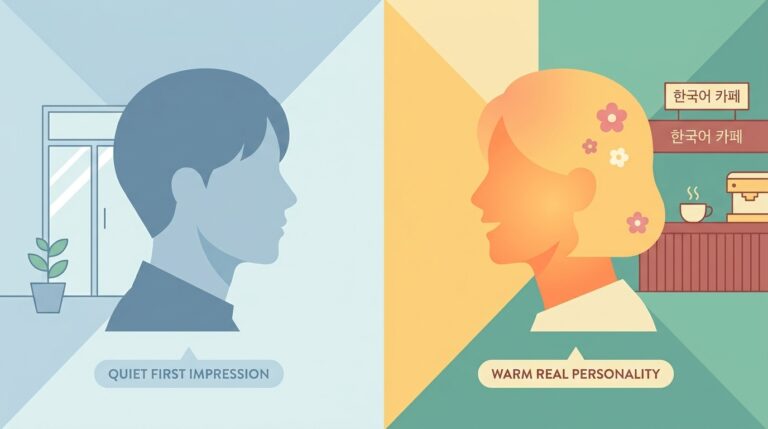
First Impressions vs. Real Personalities: Unlocking Korean MBTI Culture
안녕하세요! Welcome back to Daily Hangul, your premium Korean learning companion. I’m your native editor and culture navigator. Have you ever watched a K-Drama where the main lead seems cold and aloof at first, only to turn out to be the warmest, sweetest person alive? Think of characters like Ri Jeong-hyeok in Crash Landing on You or Baek Hyun-woo in Queen of Tears.
In Korea, we have a massive culture centered around dissecting these “first impressions” versus “real personalities”—and yes, we use MBTI (Myers-Briggs Type Indicator) as our ultimate social cheat code to do it!
Many of our intermediate (B2) learners tell me: “I want to describe my friends’ personalities beyond just saying ‘착해요’ (They are nice) or ‘재미있어요’ (They are fun).” Today, we are going to dive deep into the highly expressive, nuanced vocabulary Koreans use to describe the gap between how someone looks on the outside and who they truly are. Let’s get started!
Phase 2: Deep Dive into 3 Core Expressions
1. 겉차속따 (Geot-cha-sok-tta)
- Pronunciation: Geot-cha-sok-tta (Sounds like “gut-cha-sok-dda”)
- Meaning: Cold on the outside, warm on the inside.
- K-Culture Moment: This is the ultimate K-Drama male lead trope. When a character acts blunt but secretly leaves an umbrella for you in the rain, viewers immediately comment: “완전 겉차속따 대박!” (Total geot-cha-sok-tta, amazing!)
- Editor’s Insight: This is a modern four-character blend of 겉 (outside) + 차갑다 (cold) + 속 (inside) + 따뜻하다 (warm). It’s incredibly trendy and paints a vivid picture instantly.
- Situation Spectrum: Casual ✅ | Semi-formal ✅ | Formal ⚠️
- 🤔 Think About It: In English, we might say “softie underneath a gruff exterior.” How does compressing this entire personality type into four syllables reflect the fast-paced, highly expressive nature of modern Korean slang?
2. 낯을 가리다 (Nacheul garida)
- Pronunciation: Nacheul garida (Sounds like “nah-cheul gah-ree-dah”)
- Meaning: To be shy/slow to warm up around strangers (Literally: “to screen/filter faces”).
- K-Culture Moment: During a team dinner (hoesik), an introverted colleague might sit quietly. A friend might excuse them by saying, “민우 씨가 처음에 낯을 좀 가려서 그래요.” (Min-woo is just shy around new faces at first.)
- Editor’s Insight: This is not just “being shy” (부끄럽다). It refers specifically to the social boundary someone sets before they get to know you. Once that boundary melts, their true personality comes out!
- Situation Spectrum: Casual ✅ | Semi-formal ✅ | Formal ✅
- 🤔 Think About It: Why does Korean have a specific verb phrase for “screening faces” instead of just using a general adjective for “shy”? It highlights the cultural emphasis on relational boundaries.
3. 반전 매력 (Banjeon maeryeok)
- Pronunciation: Banjeon maeryeok (Sounds like “bahn-jeon mae-ryeok”)
- Meaning: Unexpected charm; a twist in one’s personality.
- K-Culture Moment: Think of a K-Pop idol who looks fierce, charismatic, and intimidating on stage, but during variety shows, they are clumsy, laugh easily, and love eating snacks. That is the epitome of banjeon maeryeok!
- Editor’s Insight: 반전 means “plot twist” or “reversal,” and 매력 means “charm.” Use this when someone’s real personality is a delightful surprise compared to their first impression.
- Situation Spectrum: Casual ✅ | Semi-formal ✅ | Formal ⚠️
- 🤔 Think About It: Why are we so drawn to people who have contrasting traits? In Korea, displaying a banjeon maeryeok makes someone highly relatable and lovable.
Phase 3: Textbook Korean vs. Real Korean
Let’s look at how classroom Korean differs from what you actually hear in a hip cafe in Yeonnam-dong.
Situation 1: Describing a quiet, introverted person
- 📖 Textbook Korean: “그 사람은 내성적인 성격입니다.” (He/She has an introverted personality.)
- 🗣️ Real Korean: “그분 완전 극 I(아이)예요.” (They are totally an extreme ‘I’.)
- 💡 Why the difference? Koreans are so obsessed with MBTI that we use “I” (Introvert) and “E” (Extrovert) as nouns. “극 I” means someone who is on the extreme end of introversion.
Situation 2: Describing someone who seemed cold but is actually funny
- 📖 Textbook Korean: “첫인상은 차가웠지만 실제로는 재미있습니다.” (Their first impression was cold, but they are actually fun.)
- 🗣️ Real Korean: “처음엔 시크해 보였는데, 알고 보면 완전 허당이에요!” (They looked chic at first, but if you get to know them, they are totally goofy/clumsy!)
- 💡 Why the difference? 허당 (Heodang) is a beloved colloquialism for someone who looks perfect or cold on the outside but makes adorable, clumsy mistakes. It’s much warmer and more natural than textbook phrasing.
Phase 4: K-Culture Deep Dive & Non-Verbal Manners
4-1. The Art of “Nunchi” and Shy Gestures
When meeting someone for the first time in Korea, if you want to signal that you are 낯을 가리다 (shy/slow to warm up) without sounding rude, pay attention to non-verbal cues. Koreans often scratch the back of their neck gently or offer a soft, polite laugh while slightly tilting their head. Keeping moderate eye contact but occasionally looking down conveys humility and respect.
4-2. Why Korea is Obsessed with MBTI
In many Western cultures, asking about someone’s MBTI might feel like a job interview question. But in Korea, “MBTI가 어떻게 되세요?” (What is your MBTI?) is the ultimate icebreaker! It has replaced blood types as the go-to method for understanding a person’s vibe. Discussing whether you are an “F” (Feeling) or a “T” (Thinking) helps bridge the gap between first impressions and deep, real connections instantly.
Phase 5: Real-Life Roleplay Scenario
Setting: A trendy cafe in Hongdae. You are meeting Ji-a (a quiet graphic designer, INFJ) through a mutual friend, Min-jun (an energetic ENFP).
- 민준 (ENFP): “지아 씨, 이쪽은 제가 말했던 제 외국인 친구예요!”
- 지아 (INFJ): (수줍게 웃으며) “안녕하세요… 김지아라고 합니다. 처음 뵙겠습니다.”
- You (B2 Learner): “안녕하세요! 만나서 반가워요. 지아 씨, 혹시 제가 너무 적극적이라 놀라신 건 아니죠?”
- 지아 (INFJ): “아니에요! 제가 원래 낯을 좀 많이 가려서 그래요…”
- 민준 (ENFP): (장난치며) “맞아, 지아 처음에만 이래. 친해지면 완전 반전 매력 있어. 진짜 웃겨!”
- 지아 (INFJ): (손사래를 치며) “아, 민준아! 무슨 소리야… 부끄럽게.”
- You (B2 Learner): “하하, 역시! 원래 진짜 매력적인 사람들은 겉차속따더라고요. 천천히 친해져요, 우리!”
🔀 Interactive Choice Point
How would you reply to Ji-a to make her feel more comfortable?
- Option A: “저도 MBTI가 ‘I’라서 그 마음 잘 알아요. 편하게 계셔도 돼요!” (I’m an ‘I’ too, so I understand. Please feel comfortable!)
- Option B: “왜 말을 안 하세요? 재미없으세요?” (Why aren’t you speaking? Are you bored?)
- Option C: “친해지면 진짜 성격 보여주실 거죠? 기대를 많이 할게요!” (You’ll show your real personality once we’re close, right? I have high expectations!)
Feedback on your choices:
- Option A (Best): Perfect! Empathizing with her introversion (“I”) builds immediate trust and relieves social pressure.
- Option B (Bad): Too direct. This might make an introverted Korean feel extremely put on the spot and uncomfortable.
- Option C (Risk): Playful, but might put unnecessary pressure on someone who is still 낯을 가리는 (screening faces).
Phase 6: 10-Second Emotion Shadowing Drill
Practice saying these lines with the correct emotional rhythm. / represents a natural pause.
[🥺 Shy & apologetic tone]
“저 사실은… / 낯을 많이 가려서 / 처음에 말을 못 걸었어요.”
(Jeo sa-sil-eun… / na-cheul man-i ga-ryeo-seo / cheo-eum-e mal-eul mot geol-eo-sseo-yo.)-
[😆 Excited & playful tone]
“와, 민우 씨! / 알고 보니까 / 완전 반전 매력 있으시네요!”
(Wa, Min-woo ssi! / al-go bo-ni-kka / wan-jeon ban-jeon mae-ryeok i-seu-si-ne-yo!)
Phase 7: K-Culture Mini Dictionary
- 겉바속촉 (Geot-ba-sok-chok) | Crispy on the outside, moist on the inside. Originally used for fried chicken, but now widely used to describe people who seem tough but are incredibly soft-hearted.
- 인싸 (In-ssa) | Insider. A social butterfly who is highly extroverted, trendy, and gets along with everyone.
- 아싸 (Ah-ssa) | Outsider. Someone who enjoys their alone time and prefers small, intimate gatherings over big parties.
- 친해지다 (Chinhaejida) | To become close with someone. A beautiful transition from being acquaintances to real friends.
Phase 8: Survival Kit for Travelers
Survival Expressions TOP 3
- “제가 낯을 좀 가리는 편이에요.” (I tend to be a bit shy around strangers.)
- Pro Tip: Use this at social gatherings to instantly set a comfortable boundary.
- “MBTI가 어떻게 되세요?” (What is your MBTI?)
- Pro Tip: The ultimate cheat code to start a conversation with any Korean peer.
- “생각했던 거랑 분위기가 완전 다르시네요!” (Your vibe is completely different from what I expected!)
- Pro Tip: Use this to compliment someone’s unexpected charm (반전 매력).
Editor’s Travel Note
When you travel to Seoul and want to meet friends, finding a cozy spot to talk is key. I highly recommend downloading the KakaoMap app for smooth navigation to search for “북카페” (book cafes) or quiet coffee shops in Hapjeong or Mangwon-dong. These spaces are perfect for deep conversations where you can slowly drop your social guard and get to know each other!
(Note: App features and interface are subject to updates by the developer.)
Phase 9: “One Step Deeper” (Reflective Question)
Historically, Korean society built connections based on 학연 (school ties) or 지연 (regional ties). Today, young Koreans use MBTI to find their “tribe.” It’s a fascinating shift from traditional, rigid social structures to a more psychological, playful way of forming communities. By sharing your MBTI, you are saying, “This is how I process the world, and this is how I want to be treated.”
💬 Your Turn: How would you describe your own first impression versus your real personality? Are you 겉차속따? Tell us your MBTI and your story in the comments below!
Phase 10: FAQ & Common Mistakes
Q: Is it rude to ask an older person their MBTI?
A: While it is extremely common among Gen Z and Millennials, older generations (like Gen X or Baby Boomers) might not know their MBTI or might find the question slightly confusing. It’s best to use this icebreaker with peers or younger colleagues.
Q: Can I use “겉바속촉” (crispy outside, moist inside) to describe my boss?
A: Only if you have a very close, casual relationship with them! Because it is a slang expression derived from food, using it in a highly formal business setting might sound too informal. Stick to “따뜻한 분” (a warm person) for formal situations.
Q: What is the difference between “내성적이다” and “낯을 가리다”?
A: “내성적이다” is a general personality trait (introversion). “낯을 가리다” is a situational behavior (being shy specifically around strangers). An extrovert can actually 낯을 가리다 too!
🚨 Common Mistakes Alert!
- Mistake 1: Saying “그 사람은 낯을 봐요” to mean they are shy.
- Correct Action: Always use the verb 가리다 (to screen). Say: “그 사람은 낯을 가려요.”
- Mistake 2: Using “겉차속따” in a highly formal email.
- Correct Action: Use: “겉은 차가워 보이지만 속은 따뜻한 분입니다.”
- Mistake 3: Saying “제 MBTI는 I입니다” and stopping there.
- Correct Action: Koreans usually state all four letters (e.g., “저는 INFJ예요”) or refer to themselves as “아이” (I) or “이” (E).
Phase 11: Action Mission & Engagement
- Bronze Medal: Write your MBTI in Korean in the comments (e.g., “저는 ENFP예요!”).
- Silver Medal: Try using the phrase “낯을 좀 가려요” the next time you meet a Korean speaker online or offline.
- Gold Medal: Share a story on Instagram about your favorite K-Drama character, tagging them as “겉차속따” or “반전 매력,” and tag us @DailyHangul!
🎮 K-Culture Mission: Watch the next episode of your favorite K-Drama. Write down one moment where a character displays a 반전 매력 (unexpected charm) and share it with us!
Phase 12: Interactive Quiz Challenge
Test your knowledge with these three quick questions!
1. Fill in the blank:
“처음에는 차가워 보였는데 친해지니까 진짜 잘해줘요. 그 사람은 완전 ( )예요.”
* A) 아싸
* B) 겉차속따
* C) 인싸
2. True or False:
“낯을 가리다” means you don’t like looking at people’s faces.
3. Translate to Korean:
“He looks chic, but actually has an unexpected charm (twist charm).”
🔍 Click here to reveal the answers and explanations!
- Answer: B) 겉차속따
- Explanation: The sentence describes someone who seemed cold at first but treats you very well once close. This is the exact definition of 겉차속따!
- Answer: False
- Explanation: It literally translates to “screening faces,” but idiomatically it means being shy or slow to warm up to strangers.
- Answer: “그 사람은 시크해 보이는데, 실제로는 반전 매력이 있어요.”
- Explanation: “시크해 보이다” means to look chic/cool, and “반전 매력” is the perfect term for that twist charm!
- Explanation: “시크해 보이다” means to look chic/cool, and “반전 매력” is the perfect term for that twist charm!







