

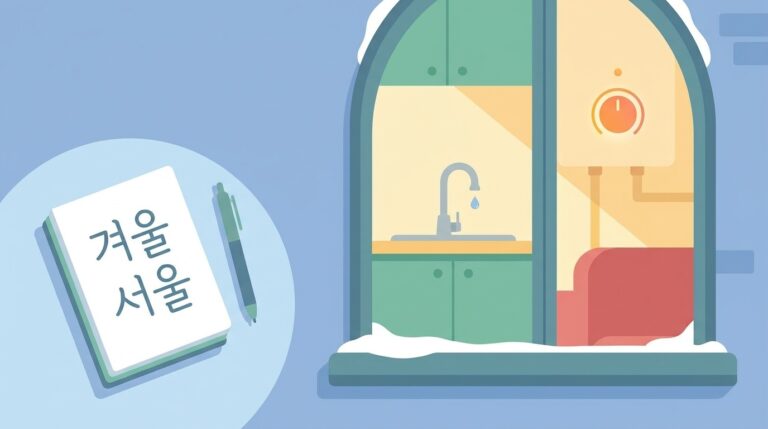
Stay Warm, Keep Flowing: How to Prevent Frozen Pipes in a Korean Winter
안녕하세요! Welcome back to another lifestyle and language guide from Daily Hangul. I’m your chief editor and resident cultural navigator.
Imagine this: It’s a gorgeous, snowy morning in Seoul. You wake up, excited to brew a hot cup of coffee, but when you turn on the tap—nothing. Not a single drop. You look outside, and it is a freezing -15°C (5°F). Welcome to a true Korean winter!
For many expats and international students living in studio apartments (오피스텔) or villas (빌라), the sudden drop in temperature brings a very unique household challenge: 수도관 동파 (sudogwan dongpa)—frozen and burst water pipes. Having experienced this nightmare myself during my first year living alone in Seoul, I’m here to make sure you never have to go through a cold shower emergency. Today, we’ll learn the essential Korean phrases and cultural habits to keep your home warm and your water flowing!
Phase 2: 3 Key Expressions for Winter Survival
Let’s dive into the three most critical expressions you need to know when the Siberian winds start hitting Korea.
1. 물 조금 틀어두세요 (Mul jogeum teureoduseyo)
- Pronunciation: Mool jo-geum teo-reo-doo-seh-yo (Sounds like “Mool” as in cool, “jogeum” like jo-gum)
- Meaning: “Please leave the water running a little bit.”
- K-Culture Moment: You will hear building managers (경비아저씨) repeating this over the apartment loudspeaker or see it written in bold red letters on the elevator notice board when a 한파 경보 (hanpa gyeongbo – cold wave warning) is issued.
- Editor’s Insight: The verb 틀다 (teulda) means “to turn on” (water, TV, or music). By adding -어 두다 (-eo duda), which means “to do something in advance for future use,” you are actively preventing a freeze.
- Situation Spectrum: Casual (⚠️ 물 조금 틀어놔) | Semi-formal (✅ 물 조금 틀어두세요) | Formal (✅ 물을 조금 틀어두시기 바랍니다)
- 🤔 Think About It: In your home country, do people leave the tap dripping during freezing temperatures, or is there another common winter hack you use?
2. 동파 예방 (Dongpa yebang)
- Pronunciation: Dong-pa yeh-bang (Rhymes with “song-pah yeh-bahng”)
- Meaning: “Prevention of winter freezing and bursting”
- K-Culture Moment: This is the ultimate winter keyword. Search “동파 예방” on any Korean search portal to find endless DIY tips, insulation covers, and local emergency hotlines.
- Editor’s Insight: 동 (dong) means freezing (as in 동하/winter), and 파 (pa) means breaking/bursting. Combined with 예방 (yebang – prevention), it is the standard administrative term for protecting utilities.
- Situation Spectrum: Casual (🚫) | Semi-formal (⚠️) | Formal (✅ 동파 예방에 유의해 주세요)
3. 보일러 외출 모드 (Boilleo oechul modeu)
- Pronunciation: Bo-il-leo weh-chool mo-deu (Like “Boiler” + “way-chool” + “mode”)
- Meaning: “Boiler ‘Out-of-Home’ / Away Mode”
- K-Culture Moment: When leaving your house in the winter, never turn your boiler completely off! Instead, press the 외출 (oechul – going out) button on your wall controller.
- Editor’s Insight: Turning the boiler off completely in winter will freeze the internal heating pipes under your floor (온돌). The “외출” mode keeps the water temperature just above freezing while saving electricity.
- Situation Spectrum: Casual (✅ 외출로 돌려놔) | Semi-formal (✅ 외출 모드로 설정하세요) | Formal (⚠️ 외출 모드로 가동해 주십시오)
Phase 3: Textbook Korean vs. Real-Life Korean
When you study from a textbook, the instructions can feel incredibly formal. Let’s look at how Koreans actually talk about this in real life.
Situation 1: Giving winter advice to a friend
- 📖 Textbook: “수도관이 얼지 않게 주의하십시오.” (Please be careful so that the water pipes do not freeze.)
- 🗣️ Real Korean: “물 약하게 틀어놔야 해요!” (You have to leave the water running slightly!)
- 💡 Why the difference? Textbooks use passive, formal warnings. Real-life friends use active, practical verbs like 틀어놓다 (teureonohda – to leave turned on) to tell you exactly what physical action to take.
Situation 2: Informing your landlord you are going on a trip
- 📖 Textbook: “장기 외출 시에는 난방을 끄지 마십시오.” (Do not turn off the heating during long-term absence.)
- 🗣️ Real Korean: “보일러 외출로 돌려놓고 갈게요.” (I’ll turn the boiler to ‘Away’ mode before I leave.)
- 💡 Why the difference? Instead of the cold, negative command “끄지 마십시오” (do not turn off), native speakers use the natural spatial transition 돌려놓고 가다 (to turn/switch and go).
Phase 4: K-Culture Deep Dive & Non-verbal Manners
4-1. The Art of “Nunchi” (눈치) on the Elevator
In Korean apartment buildings (아파트) and multi-unit villas, community cooperation is key. When a cold wave hits, landlords or building managers will paste urgent notices on the elevator walls.
Having good 눈치 (nunchi – situational quick-wittedness) means actively reading these notices. If you see a notice with red exclamation marks, it is polite to nod or acknowledge it if you run into your landlord or building manager, saying:
“아, 사장님! 물 살짝 틀어놨어요. 걱정 마세요!” (Ah, landlord! I left the water running a bit. Don’t worry!)
This small gesture builds incredible trust, showing you are a responsible tenant who cares about the building’s shared infrastructure.
4-2. Winter Warmth in K-Dramas
Have you ever noticed in K-Dramas how characters wear thick padded coats (롱패딩 – long padding) even inside older houses, or sleep on heated mats (전기매트)? Because traditional Korean heating runs through the floor (온돌 – ondol), heating the air can be expensive. To keep utility bills low while avoiding 동파, Koreans master the art of layering clothes indoors and targeting heat right where they sleep!
Phase 5: Live Roleplay – “The Freeze Warning”
Let’s practice! You are Alex, an expat living in a cozy villa. Your friendly building manager (경비아저씨 – Gyeongbi Ajeossi) spots you in the hallway as temperatures drop to -12°C.
Characters:
* 아저씨 (Ajeossi): The experienced building manager who treats all tenants like family.
* 알렉스 (Alex): A proactive expat determined to keep their apartment safe.
아저씨: 알렉스 씨! 오늘 밤부터 엄청 추워진대요. 영하 12도래요!
        (Alex! They say it's going to get super cold starting tonight. It's minus 12 degrees!)

알렉스: 🎭 (Anxious but eager to learn) 아, 정말요? 눈도 많이 왔던데요.
        (Ah, really? It snowed a lot too.)

아저씨: 맞아요. 그러니까 오늘 꼭 물 조금 틀어두고 자요! 안 그러면 수도관 동파돼요.
        (Exactly. So tonight, make sure to leave the water running a little bit before bed! Otherwise, the pipes will freeze and burst.)

알렉스: 🎭 (Nodding understandingly) 아, 온수랑 냉수 둘 다 살짝 틀어놓으면 되죠?
        (Ah, so I just leave both the hot and cold water running slightly, right?)

아저씨: 그렇지! 졸졸졸 흐를 정도로만 틀어놔요. 그리고 보일러는 외출 모드로 해두고요!
        (Exactly! Just enough so it trickles gently. And keep the boiler on 'Away' mode!)

알렉스: 🎭 (Smiling warmly) 네, 아저씨! 알려주셔서 정말 감사합니다! 퇴근길 조심하세요.
        (Yes, Ajeossi! Thank you so much for letting me know! Get home safely.)
🔀 Choose Your Next Move!
Your friend calls and asks if they should turn off their boiler completely during a 3-day weekend trip to Jeju Island to save money. What do you tell them?
- Option A: “응, 꺼도 돼. 요금 많이 나오니까 꼭 끄고 가!” (Yeah, you can turn it off. It costs a lot, so make sure to turn it off!)
- Option B: “아니, 절대 끄지 마! 외출 모드로 돌려놓고 가야 해. 안 그러면 동파돼!” (No, never turn it off! You have to leave it on ‘Away’ mode. Otherwise, it will freeze and burst!)
- Option C: “그냥 창문만 열어두고 보일러는 알아서 해.” (Just leave the windows open and do whatever with the boiler.)
🧐 Feedback on Your Choice:
- Best Choice (Option B): Excellent! You protected your friend’s deposit. If they turned it off, the pipes would freeze, costing thousands of dollars in repairs!
- Risk (Option A): Danger! This is a recipe for disaster. The landlord will hold your friend liable for the plumbing repairs.
- Bad Choice (Option C): Double disaster! Open windows will freeze the pipes even faster.
Phase 6: 10-Second Emotion Shadowing Drill
Speak with real Korean emotion! Follow the pauses (/) and pay attention to the emotional guides in the brackets.
- “오늘 밤에 / 물 꼭 / 조금 틀어놓으세요!”
- [🥺 Urgently and caringly—like an worried neighbor]
- o-neul bam-e / mool kkok / jo-geum teo-reo-noh-euseyo!
- “보일러 / 절대 끄지 말고 / 외출로 해두세요!”
- [🗣️ Strongly emphasizing—raising your index finger]
- bo-il-leo / jeol-dae kkeu-ji mal-go / weh-chool-lo hae-doo-seh-yo!
Phase 7: K-Culture Mini-Dictionary
- 동파 (Dongpa | Freezing & Bursting): Specifically refers to water meters or pipes breaking due to ice expansion.
- 한파 경보 (Hanpa Gyeongbo | Cold Wave Warning): Official meteorological warning when temperatures drop rapidly (usually below -15°C for two consecutive days).
- 계량기 (Gyeryanggi | Water Meter): The metal box outside your apartment door. This is ground zero for freezing. Locals pack it with old blankets to protect it.
- 헌 옷 (Heon ot | Old Clothes / Rags): The ultimate DIY insulation tool. Don’t throw away old sweaters; stuff them into your outside utility closet!
Phase 8: The Traveler’s & Expat’s Survival Kit
Survival Phrases TOP 3
- “뜨거운 물이 안 나와요.” (Tteu-geo-un mool-i an na-wa-yo)
- Pro Tip: Use this when cold water flows but hot water doesn’t. It means your boiler supply line is frozen.
- “수도관이 언 것 같아요.” (Su-do-gwan-i eon geot gat-ah-yo)
- Pro Tip: Use this to report a frozen pipe to your landlord.
- “설비 기사님 좀 불러주실 수 있나요?” (Seol-bi gi-sa-nim jom bool-leo-joo-sil soo in-na-yo?)
- Pro Tip: Ask your landlord or a helper to call a professional plumber.
📌 Editor’s Travel Note
If you are renting an Airbnb or officetel and face an emergency, download the KakaoMap app and search for “철물점” (cheolmuljeom – hardware store) or “설비” (seolbi – plumbing/facilities) nearby. If you are in Seoul, you can also call the 120 Dasan Call Center (press 9 for foreign languages) for free municipal translation and emergency assistance!
Phase 9: “Going Deeper” — Community Mindset
In Korea, housing units are closely connected. If the main water line in a building freezes, it doesn’t just affect one room—it can cut off water to the entire building. This is why “동파 예방” is viewed as a community duty. By taking care of your own boiler and taps, you are participating in Jeong (정)—the deep, mutual care for those sharing your living space. Taking 10 seconds to leave your tap dripping is an act of kindness for your neighbors!
💬 Your Turn: Have you ever experienced a household emergency in a foreign country? How did you handle it? Tell us in the comments below!
Phase 10: FAQ & Avoiding Common Mistakes
Q: Can I pour boiling water directly on a frozen pipe or meter to melt it?
A: Absolutely not! Pouring boiling water on freezing cold metal or glass will cause it to shatter instantly. Instead, wrap the pipe in warm towels and pour lukewarm water (미지근한 물) over it, or use a hair dryer from a safe distance.
Q: Do I need to keep the tap dripping cold water or warm water?
A: Warm water! You should turn the tap slightly toward the hot water side. This ensures that the warm water supply line of the boiler stays active and flowing.
Q: How much will my water bill increase if I leave the tap dripping?
A: Very little! Leaving it to drip at a rate of “졸졸졸” (a thin trickle) overnight costs less than a single cup of coffee, whereas repairing a burst pipe can cost hundreds of thousands of Won.
🚨 Common Mistakes Alert!
- Leaving the utility closet open: The metal closet outside your door containing your 계량기 (water meter) must be shut tight. If wind gets inside, it freezes instantly.
- Using a hair dryer unattended: Using a hair dryer to thaw pipes is great, but leaving it running unattended is a major fire hazard in enclosed spaces.
- Turning the boiler off during vacation: Even if you are gone for a week, keep it on 외출 (Away).
Phase 11: Action Mission!
- 🥉 Bronze Mission: Go check your boiler controller right now. Locate the 외출 (Away) button so you know exactly where it is.
- 🥈 Silver Mission: Check your outside corridor. Locate your water meter closet (수도 계량기함) and make sure it is packed with bubble wrap or old clothes.
- 🥇 Gold Mission: Next time you see a winter maintenance notice in your elevator, take a picture, translate the keywords, and leave your tap dripping accordingly!
Phase 12: Interactive Quiz Challenge!
Test your winter survival skills!
1. Situational Quiz
You are leaving your apartment for a 5-day trip during a heavy snowstorm. What should you do with your boiler controller?
* A) Turn it off entirely to save money.
* B) Set the temperature to a hot 25°C.
* C) Set the mode to ‘외출’ (Away/Out-of-home).
Reveal Answer & Explanation
Correct Answer: C
Setting it to ‘외출’ keeps the internal water system flowing just enough to prevent freezing without running up a massive heating bill!
2. Fill in the Blanks
When a cold wave hits, you should tell your roommates:
“오늘 밤에 꼭 물 조금 ________ (Please leave the water running a little bit).”
Reveal Answer & Explanation
Correct Answer: 틀어두세요 (or 틀어놓으세요)
This is the standard, friendly way to request action to prevent a freeze before sleeping.
3. True or False
True or False: If the water pipe freezes, you should immediately pour boiling water directly onto the frozen meter box to melt it quickly.
Reveal Answer & Explanation
Correct Answer: False
Extreme temperature changes will shatter the meter! Always use warm towels or lukewarm water first.







