

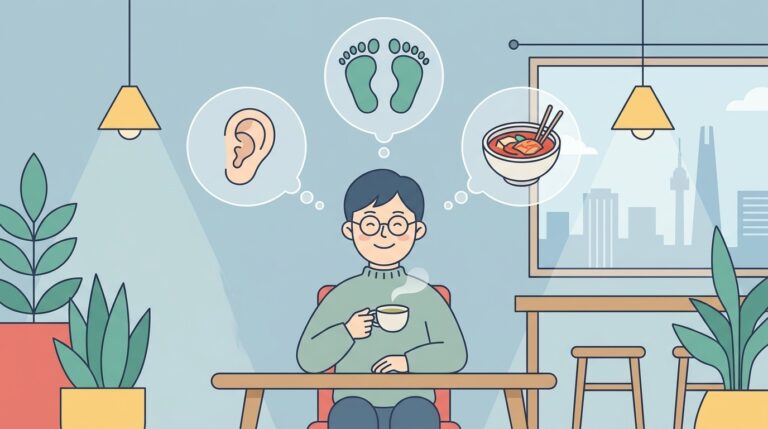
Master Tricky Korean Idioms Without Getting Lost in Translation
Phase 1: Hey, Bestie! Let’s Talk About Those ‘Wait, What?’ Moments
안녕하세요! (An-nyeong-ha-se-yo!) Your favorite Daily Hangul editor and local culture navigator is back!
Picture this: You are watching a heartwarming K-drama. The male lead is preparing a massive romantic proposal, planning the wedding, and naming their future children after just one successful coffee date. Suddenly, his best friend smacks him on the back and says, “야, 김칫국부터 마시지 마!” (Ya, gim-chit-guk-beo-teo ma-si-ja ma!).
Your translator subtitle says: “Hey, don’t drink kimchi soup first!”
You pause the screen. Kimchi soup? Why is he talking about soup during a proposal scene? Is he hungry?
If you have ever felt completely baffled by these literal translations, you are not alone! Korean is a language deeply rooted in context, history, and shared cultural experiences. When Koreans speak casually, they rarely use sterile, textbook sentences. Instead, they sprinkle their conversations with colorful idioms (관용구 – gwan-yong-gu) and four-character idioms (사자성어 – sa-ja-seong-eo).
As a B2 intermediate learner, mastering these expressions is your golden ticket to crossing the bridge from “someone who speaks Korean well” to “someone who gets the Korean soul.” Let’s dive into three of the most common, yet easily misunderstood, Korean idioms that will instantly boost your natural fluency!
Phase 2: Deep Dive into the Top 3 Tricky Idioms
1. 김칫국부터 마시다 (Gim-chit-guk-beo-teo ma-si-da)
- Pronunciation: gim-chit-guk-beo-teo ma-si-da (Sounds like: geem-cheet-gook-buh-tuh mah-she-dah)
- Literal Meaning: To drink kimchi soup first.
- Real Nuance: Counting your chickens before they hatch / Jumping the gun.
- K-Culture Moment: This is the ultimate line used in sitcoms and romantic comedies when a character assumes they got a job promotion or a date just because someone smiled at them.
- Editor’s Insight: Why kimchi soup? Historically, Koreans served spicy rice cakes (tteok) with a cold radish kimchi soup (dongchimi) to prevent choking. If you drink the soup before you are even offered the rice cake, you are anticipating a treat that might not even arrive!
- Situation Spectrum:
- Casual: ✅ (Perfect with friends)
- Semi-formal: ⚠️ (Use cautiously with close colleagues)
- Formal: 🚫 (Avoid in official business meetings)
- 🤔 Think About It: Does your native language use food to describe premature celebration? Why do you think Korean culture links food social etiquette with caution?
2. 귀가 얇다 (Gwi-ga yalp-da)
- Pronunciation: gwi-ga yalp-da (Sounds like: gwee-gah yahp-dah)
- Literal Meaning: To have thin ears.
- Real Nuance: To be easily swayed by others’ opinions / Gullible.
- K-Culture Moment: You will hear this in K-beauty and lifestyle vlogs. A creator might say, “I bought this expensive serum because of a TikTok trend… 제가 귀가 좀 얇거든요” (Je-ga gwi-ga jom yalp-geo-deun-yo – “My ears are a bit thin”).
- Editor’s Insight: Imagine thick, sturdy ears that block out useless gossip, versus “thin” ears that let every passing breeze of opinion blow straight into your head. If someone says you have “thin ears,” they are gently teasing you for being too trusting or indecisive.
- Situation Spectrum:
- Casual: ✅ (Very common)
- Semi-formal: ✅ (Often used in self-deprecating humor)
- Formal: ⚠️ (Use with caution when describing others)
- 🤔 Think About It: How do we describe gullibility in your language? Does it involve physical anatomy like ears, or something else?
3. 발이 넓다 (Bar-i neolp-da)
- Pronunciation: bar-i neolp-da (Sounds like: bahl-ee nuhl-dah)
- Literal Meaning: To have wide feet.
- Real Nuance: To have a wide social circle / To be well-connected.
- K-Culture Moment: Essential in K-dramas involving corporate networking, school politics, or socialites. A character who knows every shop owner in Hongdae is always described as having “wide feet.”
- Editor’s Insight: Having “wide feet” does not mean you wear a large shoe size! It means your footprint is stamped everywhere because you travel to so many social circles. In Korea’s relationship-oriented society, having wide feet is highly respected.
- Situation Spectrum:
- Casual: ✅
- Semi-formal: ✅
- Formal: ✅ (Used as a genuine compliment for social influence)
- 🤔 Think About It: In your culture, is being “well-connected” viewed positively, or does it sometimes carry a negative connotation of being superficial?
Phase 3: Textbook Korean vs. Real Korean
Let’s compare how a standard classroom textbook teaches these situations versus how real Seoulites actually speak.
Situation 1: Explaining that you are incredibly busy at work
- 📖 Textbook Korean: “요즘 일이 아주 많아서 정신이 없습니다.” (Yo-jeum il-i a-ju man-a-seo jeong-sin-i eop-seum-ni-da. – “I have a lot of work lately, so I have no spirit.”)
- 🗣️ 진짜 Korean: “요즘 정말 눈코 뜰 새 없이 바빠요!” (Yo-jeum jeong-mal nun-ko tteul sae eop-si ba-ppa-yo! – “Lately, I’m so busy I don’t even have time to open my eyes and nose!”)
- 💡 Why it matters: While the textbook version is grammatically flawless, “눈코 뜰 새 없다” vividly conveys the physical sensation of overwhelming rush. It builds instant empathy.
Situation 2: Telling someone that they can trust you to keep a secret
- 📖 Textbook Korean: “걱정하지 마세요. 비밀을 지키겠습니다.” (Geok-jeong-ha-ji ma-se-yo. bi-mil-eul ji-ki-get-seum-ni-da. – “Do not worry. I will keep the secret.”)
- 🗣️ 진짜 Korean: “걱정 마, 나 입 진짜 무거워.” (Geok-jeong ma, na ip jin-짜 mu-geo-wo. – “Don’t worry, my mouth is really heavy.”)
- 💡 Why it matters: Saying your mouth is “heavy” (입이 무겁다) sounds incredibly loyal and casual, whereas “비밀을 지키다” can sound a bit like a formal military oath.
Phase 4: K-Culture Deep Dive & Non-verbal Manners
4-1. The Art of “Nunchi” (눈치) & Gestures
When using idioms like 귀가 얇다 (thin ears) or 발이 넓다 (wide feet), non-verbal cues change the meaning entirely.
* The “Shy Hand” Gesture: When admitting your own ears are thin (제가 귀가 좀 얇아서…), slightly tilt your head and bring one hand behind your ear, brushing your hair or scratching your neck. This shows humility and prevents you from sounding defensive.
* The Knowing Nod: When someone calls someone else 발이 넓다, Koreans often nod slowly while widening their eyes slightly. It signals respect for that person’s social status.
4-2. The “Kimchi Soup” Cultural Trap
In Korea, dining etiquette and social dynamics are deeply intertwined. The phrase 김칫국부터 마시다 reflects a wider cultural warning against presumption. In a collective society, making assumptions about someone else’s intentions (like assuming a business deal is closed or a confession will be accepted) is seen as lacking “눈치” (nunchi – situational quick-wittedness). Always wait for the “tteok” (rice cake) to be placed in your hand before you reach for the soup!
Phase 5: Real-Life Roleplay Scenario
Background: You are chatting with your Korean friend, Yujin (유진), at a trendy cafe in Yeonnam-dong. You just finished a job interview and are feeling overly confident.
유진: 면접 어땠어? 잘 본 것 같아?
(Myeon-jeob eo-ttaet-seo? Jal bon geot gat-a?)
"How was the interview? Do you think you did well?"

너: 🎭 [😊 Excitedly gesturing with hands]
응! 면접관님이 나보고 인상이 좋대. 나 벌써 첫 출근 때 무슨 옷 입을지 고르고 있어!
(Eung! Myeon-jeob-gwan-nim-i na-bo-go in-sang-i jot-dae. Na beol-sseo cheot chul-geun ttae mu-seun ot ib-eul-ji go-reu-go is-seo!)
"Yeah! The interviewer said I have a good impression. I'm already picking out my outfit for my first day of work!"

유진: 🎭 [😅 Laughing gently while waving a hand]
에이, 아직 합격 발표도 안 났는데 벌써 김칫국부터 마시는 거야?
(E-i, a-jik hap-gyeok bal-pyo-do an nat-neun-de beol-sseo gim-chit-guk-beo-teo ma-si-neun geo-ya?)
"Hey, the results aren't even out yet, and you're already drinking kimchi soup?"

너: 아차! 내가 귀가 얇아서 남이 좋은 소리 해주면 바로 설레어.
(A-cha! Nae-ga gwi-ga yalp-a-seo nam-i jo-un so-ri hae-ju-myeon ba-ro seol-re-eo.)
"Ah! Because I have thin ears, I get excited easily whenever someone says something nice."

유진: 🎭 [👍 Nodding reassuringly]
그래도 네가 발이 넓으니까 금방 좋은 소식 있을 거야. 걱정 마!
(Geu-rae-do ne-ga bar-i neolp-eu-ni-kka geum-bang jo-un so-sik is-seul geo-ya. Geok-jeong ma!)
"Still, you have 'wide feet' (great connections), so there will be good news soon. Don't worry!"
🔀 Choose Your Next Move! What do you say to Yujin?
- Choice A: “응, 나 발이 엄청 커서 신발 사기 힘들어!” (Eung, na bar-i eom-cheong keo-seo sin-bal sa-gi him-deol-eo! – “Yeah, my feet are so huge it’s hard to buy shoes!”)
- Choice B: “고마워! 그 회사 마케팅 팀장이랑 예전에 스터디 같이 했었거든.” (Go-ma-wo! Geu hoe-sa ma-ke-ting tim-jang-i-rang ye-jeon-e seu-teo-di gat-i haet-eot-geu-deun. – “Thanks! I actually did a study group with that company’s marketing manager before.”)
- Choice C: “김칫국 마시는 거 취소할게. 맹물 마실게!” (Gim-chit-guk ma-si-neun geo chwi-so-hal-ge. Maeng-mul ma-sil-ge! – “I’ll cancel drinking kimchi soup. I will drink plain water instead!”)
💡 Action Feedback:
- Best Choice (B): Perfect! You understood that 발이 넓다 means networking, and you confirmed your connection. Yujin will be impressed by your smooth conversational flow.
- Risk Choice (A): Uh-oh! You took the idiom literally. Taking “wide feet” as shoe size breaks the metaphorical flow, though Yujin might find the pun cute.
- Bad Choice (C): Too literal! Trying to “cancel” the kimchi soup and drink “plain water” doesn’t work idiomatically. It sounds grammatically awkward and confusing.
Phase 6: 10-Second Emotion Shadowing Drill
Train your muscle memory and emotional delivery with these parsed practice sentences. Pay attention to the pauses (/) and get into character!
- [😅 Playfully warning a friend]
- “야, / 아직 모르니까 / 김칫국부터 / 마시지 마!”
- Ya, / a-jik mo-reu-ni-kka / gim-chit-guk-beo-teo / ma-si-ji ma!
- “Hey, / you don’t know yet, / so don’t / drink kimchi soup first!”
- [😊 Expressing admiration for a social butterfly]
- “그 사람은 / 진짜 / 발이 넓어서 / 모르는 사람이 / 없더라!”
- Geu sa-ram-eun / jin-짜 / bar-i neolp-eo-seo / mo-reu-neun sa-ram-i / eop-deo-ra!
- “That person / really / has wide feet, / so there’s not a single person / they don’t know!”
Phase 7: K-Culture Mini Dictionary
- 마당발 (Ma-dang-bal):
- Translation: Yard foot.
- Usage: A noun form of 발이 넓다. A person who is incredibly well-connected and seems to know everyone in town.
- 귀가 솔깃하다 (Gwi-ga sol-git-ha-da):
- Translation: One’s ears perk up.
- Usage: Used when you hear a piece of advice or an offer that sounds incredibly tempting.
- 오지라퍼 (O-ji-ra-peor):
- Translation: A busybody.
- Usage: A blend of the Korean word 오지랖 (broad front hem of a Hanbok jacket, metaphor for meddling) and the English suffix “-er”. Someone who interferes too much in others’ business.
- 눈치가 빠르다 (Nun-chi-ga bpa-reu-da):
- Translation: Quick-witted.
- Usage: Having fast situational awareness and sensing others’ feelings before they express them.
Phase 8: Traveler’s Survival Kit
Top 3 Survival Expressions for Getting Around Seoul
- “눈치껏 할게요” (Nun-chi-kkeot hal-ge-yo):
- Meaning: “I will figure it out by reading the room.”
- Pro Tip: Use this when you are unsure about social rules in a new setting (like a Korean bathhouse or temple) but want to reassure your friends you will follow along.
- “제가 귀가 얇아서 그런데, 이거 진짜 좋은가요?” (Je-ga gwi-ga yalp-a-seo geu-reonde, i-geo jin-ja jo-eun-ga-yo?):
- Meaning: “I have thin ears… is this product really good?”
- Pro Tip: Use this at shopping markets to charm vendors into giving you an honest recommendation!
- “저 발 안 넓어요!” (Jeo bal an neolp-eo-yo!):
- Meaning: “I don’t have wide feet (a large social network)!”
- Pro Tip: A humble way to decline when someone thinks you are popular or well-connected.
Editor’s Travel Note
When navigating the busy streets of Seoul, finding local hot spots requires the right tech. Make sure to download native navigation apps before your trip. For accurate transit times and walking routes, use the 네이버 지도 앱 다운로드 (Naver Map app) or the 카카오맵 앱 다운로드 (KakaoMap app), as global mapping services often do not provide precise local walking directions in Korea.
Phase 9: One Step Deeper
Many Korean idioms are tied to Korea’s deep history of agricultural cooperation (Dure and Pumasi). In farming villages, survival depended on community harmony. This is why having “wide feet” (발이 넓다) is a massive compliment—it means you are active, helpful, and trusted in the community. Conversely, having “thin ears” (귀가 얇다) warns us not to destroy community solidarity by listening to rumors. When you learn Korean idioms, you are not just memorizing words; you are stepping into a centuries-old cultural mindset of collective harmony.
💬 Your Turn: Does your country value “wide feet” (networking) as much as Korea does, or is individual privacy prioritized? Let me know in the comments below!
Phase 10: FAQ & Avoiding Common Mistakes
Q: Can I use “김칫국 마시다” in a formal business email?
A: It is highly recommended to avoid this. While highly descriptive, it is classified as a casual idiom. In formal business settings, write “낙관적인 예측을 하다” (nak-gwan-jeok-in ye-cheok-eul ha-da – “to make an optimistic prediction”).
Q: Does “귀가 얇다” mean I have hearing problems?
A: Not at all! It has absolutely nothing to do with physical hearing. It is strictly used to describe someone’s psychological vulnerability to persuasion.
Q: How do I say someone is a busybody without sounding too rude?
A: Calling someone an 오지라퍼 (ojirapper) can sound slightly mocking. Instead, you can gently say “관심이 많으시네요” (gwan-sim-i man-eu-si-ne-yo – “You have a lot of interest”).
🚨 Common Mistakes Warning Board
| Wrong Expression | What You Meant | Correct Action |
|---|---|---|
| 발이 크다 (Feet are big) | Having many friends / well-connected | Use 발이 넓다 (wide feet). “발이 크다” literally just means you wear a large shoe size. |
| 귀가 작다 (Ears are small) | Being stubborn / not listening to others | Use 귀가 막히다 (ears blocked) or 고집이 세다 (stubborn). |
| 김치를 먹다 (To eat kimchi) | Getting ahead of yourself | Use the full verb phrase 김칫국부터 마시다. Eating kimchi is just a delicious meal! |
Phase 11: Action Mission!
- Bronze Level: Say “김칫국 마시지 마” out loud three times while mimicking a K-drama character. Focus on the sassy cadence of “마/시/지/마!”
- Silver Level: Write a sentence in the comments using 귀가 얇다 to explain a funny purchase you made recently.
- Gold Level: During your next language exchange or talk with a Korean friend, casually drop 발이 넓다 to describe an acquaintance and watch their eyes light up in surprise!
🎮 K-Culture Mission: Watch the next episode of your favorite K-drama. Keep a notebook nearby and tally how many times you spot a character using a body part (ears, feet, eyes, nose) to describe a situation!
Phase 12: Interactive Quiz Challenge
Test your intermediate intuition! Can you solve these cultural and linguistic puzzles?
1. Fill in the blank with the correct idiom:
“그 사람은 서울에 아는 사람이 정말 많아. 진짜 (_______) 넓은가 봐.”
* A) 귀가
* B) 발이
* C) 눈이
View Answer & Explanation
Answer: B) 발이
Explanation: The sentence says the person knows many people in Seoul, which means they are well-connected. Therefore, “발이 넓다” (wide feet) is the correct fit.
2. True or False?
“김칫국부터 마시다” came from the historical practice of drinking cold kimchi soup to digest rice cakes.
* A) True
* B) False
View Answer & Explanation
Answer: A) True
Explanation: Radish kimchi soup was served alongside dry rice cakes to aid swallowing. Drinking the soup before receiving the cake symbolizes acting too early!
3. Choose the most natural scenario for “귀가 얇다”:
- A) Minho spent 3 hours studying grammar without moving.
- B) Hana bought an expensive crypto token after hearing a stranger talk about it on the subway.
- C) Jiseong walked 20,000 steps today to explore local alleys.
View Answer & Explanation
Answer: B
Explanation: Hana was easily swayed by a stranger’s words, making her the perfect representation of someone with “thin ears.”







