

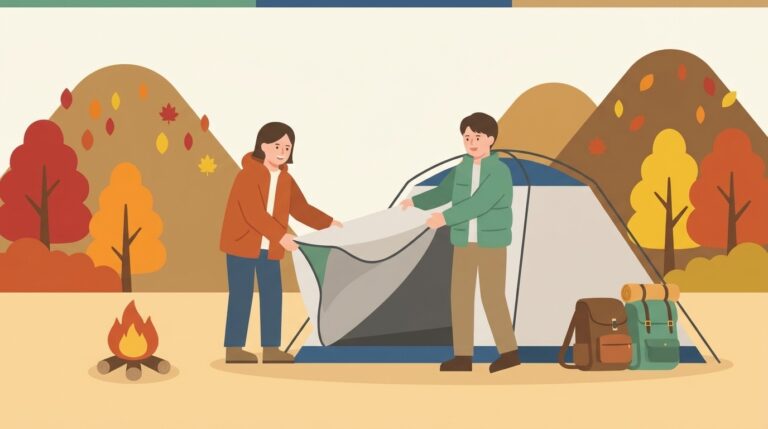
Pack Up Like a Pro: Easy Korean Phrases for Cleaning Up Your Campsite!
안녕하세요! (Annyeonghaseyo!) Hello there! It’s your favorite Korean study buddy and Daily Hangul’s Senior Editor. Have you ever dreamed of going camping in Korea? Camping (캠핑 – Kaemping) and car-camping (차박 – Chabak) are massive trends here! Imagine waking up to the misty mountains of Gangwon-do, enjoying a hot cup of coffee, and then… realizing it’s time to pack everything up.
Packing up the tent (텐트 걷기 – Tenteu geotgi) can be a bit overwhelming, especially when you are camping with Korean friends and want to help out but don’t know what to say. “Should I pull this pole?” “Where does the trash go?” Today, we are going to learn super simple, real-life Korean phrases that will make you the ultimate helpful camping companion!
Phase 2: Core Expressions for Packing Up
Here are 3 magic phrases you will absolutely use when the camping trip comes to an end.
1. 이제 텐트 걷을까요? (Ije tenteu geodeulkkayo?)
- Pronunciation: Ee-jae ten-teu guh-deul-kka-yo? (Rhymes with “let’s go”)
- Meaning: “Shall we pack up the tent now?”
- K-Culture Moment: You will hear this on Korean healing variety shows like House on Wheels (바퀴 달린 집) when the cast prepares to move to their next beautiful destination.
- Editor’s Insight: The verb ‘걷다’ (geotda) literally means “to fold” or “to gather.” When used with ‘텐트’ (tent), it means to pack it up.
- Situation Spectrum: Casual (이제 텐트 걷을까? ⚠️) | Semi-formal (이제 텐트 걷을까요? ✅) | Formal (이제 텐트를 해체할까요? 🚫 – too robotic!)
- 🤔 Think About It: In your country, do people use a specific word for “packing up a tent,” or do they just say “cleaning up”?
2. 이것 좀 도와줄래요? (Igeot jom dowajullaeyo?)
- Pronunciation: Ee-geot jom doh-wa-jool-lae-yo? (Soft, polite request)
- Meaning: “Could you help me with this?”
- K-Culture Moment: Folding a huge tent is almost impossible alone! When your friend is holding one side and you need them to pull, this is your go-to phrase.
- Editor’s Insight: Adding ‘좀’ (jom – a little) makes your request sound much softer and more natural to Korean ears.
- Situation Spectrum: Casual (이것 좀 도와줘! ✅) | Semi-formal (이것 좀 도와줄래요? ✅) | Formal (이것 좀 도와주시겠습니까? ⚠️ – too formal for friends)
- 🤔 Think About It: How does adding “a little” in your language change the politeness of a request?
3. 쓰레기 봉투 어디 있어요? (Sseuregi bongtu eodi isseoyo?)
- Pronunciation: Sseu-rae-gi bong-too uh-dee ees-suh-yo?
- Meaning: “Where is the trash bag?”
- K-Culture Moment: Koreans are incredibly strict about waste disposal. Before you leave, you must clean up your site perfectly!
- Editor’s Insight: You can buy a regional trash bag (종량제 봉투) at the campsite’s convenience store (매점).
- Situation Spectrum: Casual (쓰레기 봉투 어디 있어? ⚠️) | Semi-formal (쓰레기 봉투 어디 있어요? ✅) | Formal (쓰레기 봉투는 어디에 있습니까? ⚠️)
Phase 3: Textbook Korean vs. Real Korean
Let’s look at how textbooks teach camping compared to how real Koreans actually talk!
Scenario 1: Suggesting to pack up
- 📖 Textbook: “텐트를 해체합시다.” (Tenteureul haechehapsida. – “Let us disassemble the tent.”)
- 🗣️ Real Korean: “이제 텐트 걷자!” (Ije tenteu geotja! – “Let’s pack up the tent now!”)
- 💡 Why is it different? ‘해체’ (disassemble) sounds like a military operation or construction site. Real people use the warm, friendly verb ‘걷다’ (to pack/gather).
Scenario 2: Asking someone to hold something
- 📖 Textbook: “여기를 지탱해 주세요.” (Yeogireul jitaenghae juseyo. – “Please support this area.”)
- 🗣️ Real Korean: “이것 좀 잡아줘!” (Igeot jom jabajwo! – “Hold this for a second!”)
- 💡 Why is it different? Textbooks use technical terms like ‘지탱하다’ (support/sustain). In real camping, simply asking someone to ‘잡다’ (hold/grab) is much more natural and quick!
Phase 4: K-Culture Deep-Dive & Non-verbal Manners
4-1. The Art of “Nunchi” (눈치) During Pack-Up
When it’s time to pack up, never sit still! In Korean camping culture, teamwork is everything. Even if you don’t know how to fold the tent, stand nearby, look alert, and use your Nunchi (social intuitive sense). Simply grabbing the other end of a tarp or holding a pole while your friend detaches it shows that you are a caring, cooperative friend.
4-2. Clean Camping (클린캠핑)
Korea has a beautiful outdoor culture, but it relies on strict rules.
* 분리수거 (Bunrisugeo – Recycling): You must sort plastics, cans, paper, and food waste separately.
* 불멍 (Bulmeong) Clean-up: If you enjoyed a campfire (“fire-staring” or bulmeong), you must make sure the ashes are completely cold and disposed of in designated metal bins.
Phase 5: Real-Life Roleplay Scenario
Meet Minjun (민준), your friendly Korean camping buddy who organized this amazing trip. You are both standing outside the tent on Sunday morning.
민준: "아, 잘 잤다! 날씨 진짜 좋네요."
(Ah, jal jatda! Nalssi jinjja jonneyo.)
🎭 [Yawning and smiling at the bright sun]
"Ah, I slept so well! The weather is so nice."

You: "네, 진짜 좋았어요! 민준 씨, 이제 텐트 걷을까요?"
(Ne, jinjja joasseoyo! Minjun ssi, ije tenteu geodeulkkayo?)
🎭 [Politely pointing at the tent]
"Yes, it was really great! Minjun, shall we pack up the tent now?"

민준: "네, 그래요. 제가 폴대를 뺄 테니까 이것 좀 잡아줄래요?"
(Ne, geuraeyo. Jega poldaereul pael tenikka geot jom jabajullaeyo?)
🎭 [Unclipping the tent poles]
"Yes, let's. I'll take out the poles, so could you hold this for me?"

You: "네, 잡았어요! 쓰레기 봉투는 어디 있어요? 제가 정리할게요."
(Ne, jabasseoyo! Sseuregi bongtuneun eodi isseoyo? Jega jeongrihalgeyo.)
🎭 [Holding the tent fabric tightly and pointing to the trash pile]
"Got it, I'm holding it! Where is the trash bag? I'll clean up."

민준: "고마워요! 저기 매점 옆에 분리수거장 있어요."
(Gomawoyo! Jeogi maejeom yeope bunrisugeojang isseoyo.)
🎭 [Pointing toward the small campsite store]
"Thank you! The recycling area is right next to the campsite store over there."
🔀 Interactive Choice: What do you say next?
- Choice A: “귀찮아요. 그냥 두고 가요.” (Gwichanayo. Geunyang dugo gayo. – “It’s annoying. Let’s just leave it.”)
- Choice B: “네, 제가 다녀올게요!” (Ne, jega danyeoolgeyo! – “Okay, I will go do that!”)
- Choice C: “저는 텐트 안 치울래요.” (Jeoneun tenteu an chiullaeyo. – “I don’t want to clean up the tent.”)
Feedback on Your Choice:
- Best Choice (B): Perfect! Offering to take the trash to the recycling area (분리수거장) makes you a 10/10 camping partner.
- Risk (A): Oh no! Abandoning trash at a Korean campsite is a huge social taboo and can lead to heavy fines.
- Bad Choice (C): Yikes! Sitting out while your friend packs up the tent alone will definitely hurt your friendship.
Phase 6: 10-Second Shadowing Drill
Let’s practice speaking with the right rhythm and emotion!
- [😊 Friendly & Suggestive]
“이제 / 텐트 / 걷을까요?”
(Ije / tenteu / geodeulkkayo?) -
[🥺 Asking for a quick hand]
“이것 좀 / 잡아줄래요?”
(Igeot jom / jabajullaeyo?) -
[🙋♂️ Helpful & Eager]
“제가 / 정리할게요!”
(Jega / jeongrihalgeyo!)
Phase 7: K-Culture Mini Dictionary
- 불멍 (Bul-meong): Staring blankly at a campfire to relax. (A combination of ‘불’ [fire] and ‘멍때리다’ [to zone out]).
- 차박 (Cha-bak): Car camping. Sleeping in your SUV or car instead of a traditional tent.
- 분리수거 (Bun-ri-su-geo): Sorting garbage into recyclables. Highly organized in Korea!
- 매점 (Mae-jeom): A small shop inside a campsite selling firewood, snacks, and regional trash bags.
Phase 8: Survival Kit for Travelers
Top 3 Survival Phrases
- 이거 어디에 버려요? (Igeo eodie beoryeoyo?) – “Where do I throw this away?”
- 화장실 어디 있어요? (Hwajangsil eodi isseoyo?) – “Where is the restroom?”
- 불판 있어요? (Bulpan isseoyo?) – “Do you have a grill grate?” (Crucial for BBQ!)
Editor’s Travel Note 🗺️
If you plan to camp in Korea, download Naver Map or KakaoMap to find official campsites (캠핑장). Wild camping is restricted in many areas. Also, remember that campsite reservations usually open on the 1st of every month online!
Phase 9: “One Step Deeper” (Cultural Reflection)
In Korea, camping isn’t just about surviving in nature; it’s a social ritual of sharing food and helping each other. This traces back to the traditional Korean value of 품앗이 (Pumasi)—the spirit of cooperative, communal labor. When everyone pitches in to set up and pack up, the work becomes fun!
💬 Your Turn: Do people in your country camp similarly, or do they prefer solo camping? Let us know in the comments below!
Phase 10: FAQ & Mistakes
Q: Do I need to buy a special trash bag for the campsite?
A: Yes! In Korea, each district has its own official trash bags (종량제 봉투). You must buy the specific bag designated for that local county, usually available at the campsite’s 매점 (Maejeom).
Q: Can I leave the campfire ashes on the ground?
A: No, absolutely not. You must wait for the ashes to cool down and discard them in the campsite’s designated ash box, usually labeled ‘재 버리는 곳’.
Q: Is “차박” (Chabak) allowed anywhere?
A: No. While car camping is popular, sleeping in your car is only allowed in designated campsites or free zones where local laws permit. Always check signs first!
🚨 Common Mistakes Alert!
- Mistake 1: Throwing food waste in the regular trash.
- Correct Action: Food waste (음식물 쓰레기) must go in its own dedicated bin.
- Mistake 2: Saying “텐트를 파괴해 주세요” (Please destroy the tent).
- Correct Action: Say “텐트를 걷어 주세요” (Please pack up the tent).
- Mistake 3: Not separating PET bottles from their plastic labels.
- Correct Action: Peel off the plastic label before recycling the bottle!
Phase 11: Action Mission
- Bronze Mission 🥉: Say “이제 텐트 걷을까요?” out loud 3 times.
- Silver Mission 🥈: Share your favorite camping food with us on Instagram using the hashtag
#DailyHangulCamping. - Gold Mission 🥇: Use “이것 좀 도와줄래요?” the next time you need help from a Korean friend!
Phase 12: Interactive Quiz Challenge
Test your skills before you head out!
1. What does ‘분리수거’ (Bunrisugeo) mean?
A) Lighting a campfire
B) Sorting and recycling trash
C) Pitching a tent
2. Fill in the blank: “이것 좀 _________?” (Please hold this for a second.)
A) 먹을래요
B) 잡아줄래요
C) 버려요
3. True or False: You can use any regular plastic bag to throw away campsite trash. (True / False)
👉 Click to reveal the answers and explanations!
- Answer: B – ‘분리수거’ means sorting and recycling waste, a crucial part of camping etiquette!
- Answer: B – ‘잡아줄래요’ means “Could you hold this?”.
- Answer: False – You must use the official regional trash bag (종량제 봉투) purchased at the campsite’s shop.
Safe travels and happy camping! 다음에 또 만나요! (See you next time!)







