

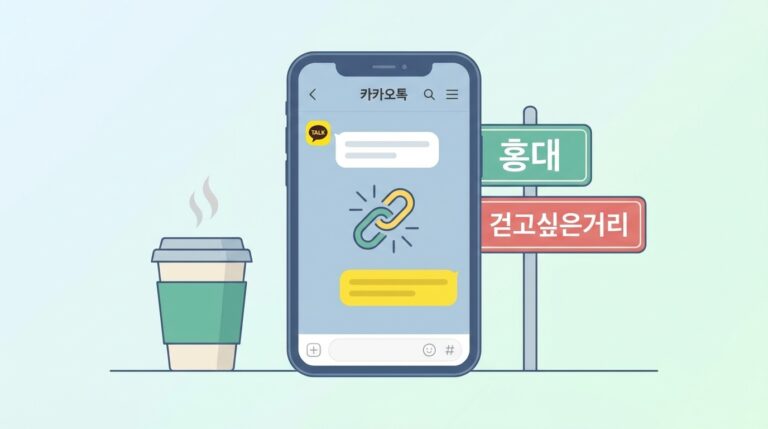
Stop Copy-Pasting in Silence! How to Share Links in Korean Like a Local
Phase 1: Hey Friend! Let’s Share the Fun (공감)
안녕하세요! (Annyeonghaseyo!) Hello! I am your friendly K-culture tutor and best friend from Daily Hangul.
Imagine this: You are scrolling through TikTok and you find a hilarious video of your favorite K-Pop idol trying a spicy noodle challenge. Or maybe you’re planning a trip to Seoul and found the ultimate aesthetic cafe in Seongsu-dong on Naver Maps. You want to send it to your Korean friend, but you hesitate. You copy the link, paste it into KakaoTalk, and… just press send. No text. Silence.
It feels a bit cold, doesn’t it?
In Korea’s super-connected digital culture, sharing links (링크 공유 – ring-keu go-ngyu) is practically a love language! Sending a link with a cute, natural Korean phrase makes you instantly look like an “inssa” (인싸 – insider/trendy person). Today, we’ll learn 3 simple, beginner-friendly phrases to share links naturally. This guide is based on real-world texting habits of my A1 students, so it’s 100% practical!
Phase 2: Three Core Expressions (핵심 표현)
1. 이거 봐봐 (I-geo bwa-bwa)
- Pronunciation: E-guh bwa-bwa (Sounds like “E-girl” without the ‘l’, followed by a friendly “wah-wah” but with a soft ‘b’ sound).
- Meaning: “Look at this!” or “Check this out!”
- K-Culture Moment: This is the ultimate reaction trigger. Picture two friends sitting in a cozy chicken-and-beer (Chimaek) shop, one frantically tapping their phone screen to show the other a viral meme.
- Editor’s Insight: It is short, energetic, and highly addictive. Repeating “봐” (bwa – look) twice makes it sound adorable and casual.
- Situation Spectrum:
- Friends & Close peers (Casual): ✅
- Co-workers (Semi-formal): ⚠️ (Better to use: “이것 좀 보세요” – I-geot jom bo-se-yo)
- Bosses & Elders (Formal): 🚫
- 🤔 Think About It: Why do Koreans repeat verbs like “봐봐” (look-look) or “빨리빨리” (hurry-hurry)? It softens the command and adds a rhythmic, friendly vibe. Does your native language repeat words to sound friendly?
2. 링크 보내줄게 (Ring-keu bo-nae-jul-ge)
- Pronunciation: Ring-cue bo-neh-jool-geh (Like “ring” + “cue” + “bonnet” without the ‘t’ + “Juliet” without the ‘it’).
- Meaning: “I will send you the link.”
- K-Culture Moment: You’re talking about a delicious K-BBQ restaurant you saw in a K-Drama. Your friend asks where it is, and you proudly offer to send the map link.
- Editor’s Insight: The word “링크” (ring-keu) is just “link” in Koreanized English! The magic is in “보내줄게” (bo-nae-jul-ge). The “~줄게” part means “I will do this for you,” which sounds incredibly helpful and warm.
- Situation Spectrum:
- Friends & Close peers (Casual): ✅
- Co-workers (Semi-formal): ⚠️ (Better to use: “링크 보내드릴게요” – Ring-keu bo-nae-deu-ril-ge-yo)
- Bosses & Elders (Formal): 🚫
- 🤔 Think About It: Notice how the Korean sentence doesn’t start with “I” (내가)? In Korean, if it’s obvious who is speaking, we drop the subject entirely. It keeps the communication light and fast!
3. 이거 눌러봐 (I-geo nul-leo-bwa)
- Pronunciation: E-guh nuhl-luh-bwa (Like “E-guh” + “null” + “luh” + “bwa”).
- Meaning: “Try clicking this” or “Tap this.”
- K-Culture Moment: Sending a KakaoTalk gift coupon to a friend on their birthday and telling them to click and claim it.
- Editor’s Insight: “누르다” (nu-reu-da) means to press or click. Combining it with “~봐” (try doing) turns a directive into a friendly suggestion: “Hey, give this a try!”
- Situation Spectrum:
- Friends & Close peers (Casual): ✅
- Co-workers (Semi-formal): ⚠️ (Better to use: “이거 눌러보세요” – I-geo nul-leo-bo-se-yo)
- Bosses & Elders (Formal): 🚫
- 🤔 Think About It: Koreans use the grammar “~해봐” (try doing) for almost everything—eating, watching, clicking. It’s an inviting way of sharing experiences.
Phase 3: Textbook Korean vs. Real Korean (실전 비교)
Let’s see how artificial textbook language compares to how young Koreans actually text on KakaoTalk!
Scenario 1: Asking someone to check a link
- 📖 Textbook Korean: 이 인터넷 링크를 연결하여 확인하십시오. (Please connect and check this internet link. – Sounds like an automatic IT helpdesk robot!)
- 🗣️ Real Korean: 이거 눌러봐! (Click this! – Simple, dynamic, and natural.)
- 💡 Why is it different? Korean mobile culture moves at lightning speed (빨리빨리). Long, formal words like “연결” (connection) are skipped for quick, action-oriented verbs.
Scenario 2: Telling someone you sent the link
- 📖 Textbook Korean: 제가 링크를 전송하였습니다. (I have transmitted the link. – Way too military and stiff!)
- 🗣️ Real Korean: 링크 보냈어! (Sent the link! – Friendly and direct.)
- 💡 Why is it different? Drop the formal “제가” (I) and use the casual past-tense “보냈어” (sent) to build an instant, friendly bond with your chat partner.
Phase 4: K-Culture Deep Dive & Digital Manners
4-1. Digital Nunchi (눈치) & Spammer Warnings
In Korea, “Nunchi” (tact/social reading) extends to your phone screen. Sending a raw URL link with zero context is considered slightly lazy or even spammy. To show polite digital manners, always send a warm introductory line before or with the link, like:
* “이거 대박이야!” (This is amazing!)
* “여기 갈래?” (Want to go here?)
4-2. The KakaoTalk Gift Culture
Did you know Koreans regularly buy coffee, cakes, and even movie tickets for each other via links? KakaoTalk has a “Gifting” (선물하기) system. When you send a gift link, it comes with a cute yellow card. Saying “이거 눌러봐!” (Click this!) is the key phrase your friend will use when gifting you a Starbucks coupon!
Phase 5: Live Roleplay — The Hongdae Cafe Hunt
Setting: A vibrant, sunny Saturday afternoon. You and your cool Korean friend, Minjun (민준), are trying to find a trendy donut shop in Hongdae. The streets are loud, street dancers are performing, and you just found the perfect cafe link on Instagram.
Cast:
* You: A passionate traveler with a phone in hand.
* Minjun: Your energetic local guide.
- Minjun: 🎭 (Wiping sweat from his forehead) 아, 배고프다! 우리 어디 갈까?
(Ah, bae-go-peu-da! U-ri eo-di gal-kka? / Ah, I’m hungry! Where should we go?) - You: 🎭 (Excitedly tapping your phone screen) 나 예쁜 카페 찾았어!
(Na ye-ppeun ka-pe cha-jasseo! / I found a pretty cafe!) - Minjun: 🎭 (Eyes shining) 진짜? 어디에 있어?
(Jin-jja? Eo-di-e is-seo? / Really? Where is it?) - You: 🎭 (Copying the map link) 카톡으로 링크 보내줄게.
(Ka-tok-eu-ro ring-keu bo-nae-jul-ge. / I’ll send you the link on KakaoTalk.) - Minjun: 🎭 (Phone buzzes) 오, 왔어!
(Oh, was-seo! / Oh, it’s here!) - You: 🎭 (Pointing at his screen) 이거 봐봐. 도넛 진짜 맛있겠지?
(I-geo bwa-bwa. Do-neot jin-jja ma-sit-get-ji? / Look at this. The donuts look amazing, right?) - Minjun: 🎭 (Confusedly tapping the wrong spot) 응? 지도가 안 열려.
(Eung? Ji-do-ga an yeol-ryeo. / Huh? The map isn’t opening.) - You: 🎭 (Guiding his thumb) 거기 말고, 이거 눌러봐!
(Geo-gi mal-go, i-geo nul-leo-bwa! / Not there, click this!) - Minjun: 🎭 (The screen pops up beautifully) 와! 대박! 여기 완전 가까워. 당장 가자!
(Wa! Dae-bak! Yeo-gi wan-jeon ga-kka-wo. Dang-jang ga-ja! / Wow! Awesome! This place is super close. Let’s go right now!) - You: 🎭 (High-fiving him) 가자! 도넛 먹으러 가자!
(Ga-ja! Do-neot meog-eu-reo ga-ja! / Let’s go! Let’s go eat donuts!)
🔀 Decision Point!
Minjun asks you to send another link for a photo booth. What do you send him?
* A) “링크를 전송합니다.”
* B) “링크 보내줄게!”
* C) “이거 연결하세요.”
💡 Choices Analysis:
- Best Choice: B! It is warm, natural, and perfect for friends. Minjun will smile at your smooth Korean.
- Awkward Choice: A! Too robotic. It sounds like you are sending an automated email.
- Awkward Choice: C! Sounds like you are a tech support agent telling him to connect a cable.
Phase 6: 10-Second Emotion Shadowing Drill
Let’s practice speaking with real Korean feelings! Pay attention to the slash / marks for tiny pauses.
- [😊 Super Excited & Hyped!]
*
Frequently Asked Questions (FAQ)
Q: What does "이거 봐봐 (I-geo bwa-bwa)" mean in Korean and how do you pronounce it?
A: In Korean, "이거 봐봐 (I-geo bwa-bwa)" is pronounced [E-guh bwa-bwa (Sounds like "E-girl" without the 'l', followed by a friendly "wah-wah" but with a soft 'b' sound] and means: "Look at this!" or "Check this out!"
Q: What does "링크 보내줄게 (Ring-keu bo-nae-jul-ge)" mean in Korean and how do you pronounce it?
A: In Korean, "링크 보내줄게 (Ring-keu bo-nae-jul-ge)" is pronounced [Ring-cue bo-neh-jool-geh (Like "ring" + "cue" + "bonnet" without the 't' + "Juliet" without the 'it'] and means: "I will send you the link."
Q: What does "이거 눌러봐 (I-geo nul-leo-bwa)" mean in Korean and how do you pronounce it?
A: In Korean, "이거 눌러봐 (I-geo nul-leo-bwa)" is pronounced [E-guh nuhl-luh-bwa (Like "E-guh" + "null" + "luh" + "bwa"] and means: "Try clicking this" or "Tap this."







