

Beyond the K-Drama Myth: The Real Language of Modern Korean Dads and Co-Parenting
Phase 1: 공감 (The Reality of the “K-Dad” Revolution)
안녕하세요! Welcome back to Daily Hangul. It’s your chief editor and Seoul-based cultural guide.
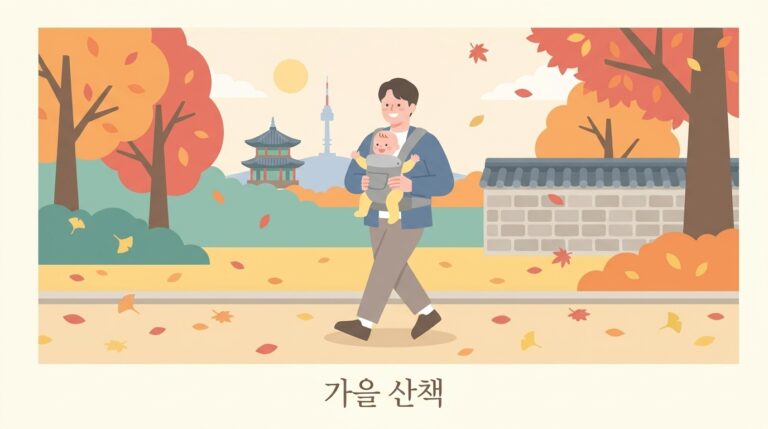
Imagine walking into a trendy cafe in Mapo-gu, Seoul, on a sunny Saturday afternoon. Instead of the classic K-drama image of a stern, distant Korean father sitting in his study, you see a young dad deftly soothing a crying infant, adjusting his high-tech baby carrier (아기띠), while discussing formula ratios with his wife. This is the heart of contemporary Korea’s 공동 육아 (co-parenting) revolution.
Yet, many advanced Korean learners still struggle when talking about family dynamics. They rely on outdated textbook phrases like “아버지는 엄격하십니다” (My father is strict) or accidentally use patronizing verbs when describing a husband’s contribution to parenting. If you want to sound like a true cultural insider and engage in deep, empathetic conversations about modern family life in Korea, mastering the nuanced vocabulary of modern parenting is your golden ticket. Let’s dive deep into the linguistic and cultural shift of modern Korean fatherhood.
Phase 2: 핵심 표현 3선 심층 분석 (Deep Dive: 3 Essential Expressions)
1. 공동 육아 (Gong-dong Yook-ah)
- Pronunciation: Gong-dong yook-ah / [gʌŋ.dʌŋ yuk.a] (Sounds like gong as in ‘gong’ + dong as in ‘dome’ without the ‘m’ + yook rhyming with ‘book’ but starting with a ‘y’ + ah as in ‘father’).
- Meaning: Communal parenting / Co-parenting.
- K-Culture Moment: This term is a staple in variety shows like The Return of Superman (슈퍼맨이 돌아왔다), where fathers gather to share childcare duties, showcasing that parenting is a shared social and familial endeavor, not a solo mission.
- Editor’s Insight: Historically, Korean society adhered to the traditional gender role division: 남편은 바깥일, 아내는 집안일 (Husband works outside, wife works inside). 공동 육아 represents a massive paradigm shift where both parents are equal co-captains of the parenting ship.
- Situation Spectrum:
- Casual (Friends/Family): ✅
- Semi-formal (Coworkers): ✅
- Formal (Public speaking/Essays): ✅
- 🤔 Think About It: How does the linguistic shift from “helping with childcare” to “co-parenting” alter the psychological contract between partners? Does your native language have a distinct term that carries the same weight as 공동 육아?
2. 독박육아 (Dok-bak Yook-ah)
- Pronunciation: Dok-bak yook-ah / [dok.bak yuk.a] (Sounds like doke as in ‘poke’ + bahk as in ‘box’ without the ‘s’ + yook-ah).
- Meaning: Sole parenting / Being stuck with all the childcare duties alone.
- K-Culture Moment: You will hear this word uttered with a heavy sigh in realistic family K-dramas like Go Back Couple (고백부부) or 18 Again (18 어게인), where mothers face the mental and physical toll of raising a child without partner support.
- Editor’s Insight: This is a highly colloquial, emotionally charged word. The prefix 독박 (dok-bak) comes from the Korean card game Go-Stop, referring to a penalty where one player pays for everyone else’s losses. Combining it with 육아 (childcare) creates a vivid, albeit painful, metaphor for carrying the entire burden of parenting alone.
- Situation Spectrum:
- Casual (Friends/Family): ✅
- Semi-formal (Close colleagues): ⚠️ (Use carefully to avoid sounding overly negative about your partner)
- Formal (Business/Elderly): 🚫
- 🤔 Think About It: The use of gambling terminology (독박) to describe domestic labor highlights a deep-seated societal frustration. Why do you think Korean slang uses such high-stakes metaphors for daily struggles?
3. 프렌디 (Peu-ren-di)
- Pronunciation: Peu-ren-di / [pɯ.ren.di] (Sounds like ‘Friend’ + ‘Daddy’ adapted to Korean phonology: peu as in ‘pull’ + ren as in ‘rent’ + di as in ‘deep’).
- Meaning: A friend-like father (Friend + Daddy).
- K-Culture Moment: In modern family vlogs and lifestyle social media accounts, you’ll see hashtags like #프렌디아빠 showing dads playing video games, going camping, or doing skincare routines with their kids.
- Editor’s Insight: This Konglish neologism represents the antithesis of the traditional, authoritative Korean father (엄한 아버지). A 프렌디 prioritizes emotional connection, active play, and open communication with his children.
- Situation Spectrum:
- Casual (Friends/Family): ✅
- Semi-formal (Workplace chats): ✅
- Formal (Formal presentations): ⚠️ (Use the standard term 친근한 아버지 instead)
- 🤔 Think About It: While 프렌디 sounds ideal, some child psychologists in Korea argue that fathers still need to maintain boundaries as authority figures. How do you balance being a ‘friend’ and a ‘parent’ in your culture?
Phase 3: 교과서 한국어 vs 진짜 한국어 (Textbook vs. Real-World Korean)
Situation 1: Describing a husband’s involvement in parenting
- 📖 Textbook Korean: “남편이 육아를 많이 도와줍니다.” (My husband helps out a lot with childcare.)
- 🗣️ Real Korean: “남편이 육아를 같이 전담하고 있어요.” (My husband and I are co-parenting/fully sharing the childcare duties.) or “저희는 공동 육아 체제예요.” (We are under a co-parenting system.)
- 💡 Why the difference? Saying a husband “helps” (도와주다) implies that parenting is primarily the mother’s responsibility and the husband is merely doing her a favor. Modern Korean couples, especially of the C1 linguistic caliber, consciously use 같이 전담하다 (share full responsibility) or 공동 육아 to establish equality.
Situation 2: Empathizing with a burnt-out parent
- 📖 Textbook Korean: “혼자 아이를 키우느라 힘드시겠습니다.” (It must be hard raising a child alone.)
- 🗣️ Real Korean: “요즘 계속 독박육아 하느라 진짜 진 빠지시겠어요.” (You must be absolutely drained from doing solo parenting lately.)
- 💡 Why the difference? The textbook version is grammatically flawless but emotionally detached. Using 독박육아 and the phrase 진이 빠지다 (to be physically and emotionally drained) shows a deep, native-level empathy for the grueling reality of modern parenting.
Phase 4: K-Culture 딥다이브 & 비언어적 매너 (K-Culture Deep Dive)
4-1. The Body Language of Modern K-Dads
If you watch young families in metropolitan areas like Seoul, you will notice a unique physical dynamic. Fathers are no longer passive bystanders carrying a briefcase. They are actively draped in 아기띠 (baby carriers) and carrying the heavy diaper bags. In restaurants, you’ll see the “turn-taking” manner: one partner quickly eats while the other holds or feeds the baby, then they switch. Offering to hold a friend’s baby or stepping in to handle the stroller during a steep incline in places like Namsan is considered highly respectful and socially aware (눈치 있는) behavior.
4-2. The Cultural Shift: From ” 가부장제” to “라떼파파”
Historically, South Korea was heavily influenced by Confucian patriarchal values (가부장제), where the father’s role was strictly provider and disciplinarian. Today, however, Sweden’s concept of “Latte Papas” (fathers who drink lattes while pushing strollers) has been warmly adopted into Korean urban culture as 라떼파파. While structural challenges like long working hours still exist, the social expectation has firmly shifted: a successful man is no longer just one who brings home a big paycheck, but one who actively participates in 공동 육아.
Phase 5: 실전 롤플레이 시나리오 (Interactive Roleplay Scenario)
The Setting: A cozy neighborhood playground in Seongsu-dong. The autumn air is crisp. You are an expat parent sitting on a bench while your child plays in the sandbox. Beside you sits Min-jun’s dad (민준 아빠), a modern Korean father who took parental leave.
Characters:
* You (C1 Learner)
* 민준 아빠 (Min-jun’s Dad): A friendly, active co-parenting father in his mid-30s.
Dialogue
- 민준 아빠: (🎭 Wiping sweat from his forehead, smiling warmly) 아이들이 에너지가 정말 넘치네요. 벌써 두 시간째 모래놀이 중이에요.
- Ai-deul-i e-neo-ji-ga jeong-mal neom-chi-ne-yo. Beol-sseo du si-gan-jjae mo-rae-nol-i jung-i-e-yo.
- “The kids have so much energy. They’ve been playing in the sand for two hours already.”
- You: (🎭 Nodding in agreement, offering him a wet wipe) 그러니까요. 아버님도 정말 대단하세요. 보통 주말에는 쉬고 싶으실 텐데 직접 데리고 나오시고요.
- Geu-rei-kka-yo. A-beo-nim-do jeong-mal dae-dan-ha-se-yo. Bo-tong ju-mal-e-neun swi-go si-peu-sil ten-de jik-jeop de-ri-go na-o-si-go-yo.
- “Exactly. You are amazing too. Usually, dads just want to rest on weekends, but you brought him out yourself.”
- 민준 아빠: (🎭 Chuckling, waving his hand modestly) 에이, 요즘 세상에 ‘도와주는 아빠’는 없죠. 저희는 철저히 공동 육아 시스템이라서요. 주말은 제가 전담하는 날이에요.
- E-i, yo-jeum se-sang-e ‘do-wa-ju-neun a-ppa’-neun eop-jjo. Jeo-hui-neun cheol-jeo-hi gong-dong yook-ah sis-tem-i-ra-seo-yo. Ju-mal-eun je-ga jeon-dam-ha-neun nal-i-e-yo.
- “Oh, come on, there’s no such thing as a ‘helper dad’ these days. We have a strict co-parenting system. Weekends are my shift.”
- You: (🎭 Expressing genuine interest) 와, 정말 멋지시네요! 요즘 한국에서도 육아휴직 쓰시는 아버님들이 많아졌다고 들었어요.
- Wa, jeong-mal meot-ji-si-ne-yo! Yo-jeum han-guk-e-seo-do yook-ah-hyu-jik sseu-si-neun a-beo-nim-deul-i man-a-jyeot-da-go deu-reot-seo-yo.
- “Wow, that’s wonderful! I heard that more fathers are taking parental leave in Korea these days.”
- 민준 아빠: (🎭 Sighing slightly but with a proud smile) 맞아요. 저도 이번에 큰맘 먹고 6개월 동안 육아휴직을 냈거든요. 안 그랬으면 아내가 독박육아 하느라 쓰러졌을 거예요.
- Ma-ja-yo. Jeo-do i-beon-e keun-mam meok-go yuk-gae-wol dong-an yook-ah-hyu-jik-eul naet-geon-deun-yo. An geu-raet-seu-면 a-nae-ga dok-bak-yook-ah ha-neu-ra sseu-reo-jyeot-eul geo-ye-yo.
- “Indeed. I took a deep breath and took a 6-month parental leave this time. If I hadn’t, my wife would have collapsed from sole parenting.”
- You: (🎭 Sympathizing deeply) 직장 생활하면서 그런 결정을 내리기가 쉽지 않았을 텐데, 진정한 프렌디시네요!
- Jik-jang saeng-hwal-ha-myeon-seo geu-reon gyeol-jeong-eul nae-ri-gi-ga sip-ji ana-sseul ten-de, jin-jeong-han peu-ren-di-si-ne-yo!
- “It couldn’t have been easy to make that decision while working, you are a true ‘Friendy’ dad!”
- 민준 아빠: (🎭 Blushing, scratches the back of his head) 하하, ‘프렌디’라는 말을 들으니 쑥스럽네요. 현실은 매일 육아 전투지만요.
- Ha-ha, ‘peu-ren-di’-ra-neun mal-eul deu-reu-ni ssuk-seu-reop-ne-yo. Hyeon-sil-eun mae-il yook-ah jeon-tu-ji-man-yo.
- “Haha, hearing ‘Friendy’ makes me feel shy. Though the reality is a daily parenting battle.”
- You: (🎭 Laughing softly) 그래도 아이와 쌓은 신뢰는 평생 갈 거예요. 제 남편/아내에게도 이런 비결을 좀 전수해 주세요.
- Geu-rae-do a-i-wa ssahn sil-roe-neun pyeong-saeng gal geo-ye-yo. Je nam-pyeon/a-nae-e-ge-do i-reon bi-gyeol-eul jom jeon-su-hae ju-se-yo.
- “Still, the trust you build with your child will last a lifetime. Please share your secrets with my husband/wife too.”
- 민준 아빠: (🎭 Nodding enthusiastically) 언제든 환영입니다! 다음 주에 저희 집에서 부부 동반으로 삼겹살 어떠세요? 육아 스트레스 좀 같이 풀어요.
- Eon-je-deun hwan-yeong-im-ni-da! Da-eum ju-e jeo-hui jip-e-seo bu-bu dong-ban-eu-ro sam-gyeop-sal eo-tteo-se-yo? Yook-ah seu-teu-re-seu jom ga-chi pul-eo-yo.
- “You’re welcome anytime! How about having Samgyeopsal at our place next week with our spouses? Let’s relieve some parenting stress together.”
- You: (🎭 Smiling broadly) 와, 정말 좋죠! 저도 맥주 사 갈게요. 저희 남편/아내도 정말 좋아할 거예요.
- Wa, jeong-mal jo-cho! Jeo-do maek-ju sa gal-ge-yo. Jeo-hui nam-pyeon/a-nae-do jeong-mal jo-a-hal geo-ye-yo.
- “Wow, that sounds amazing! I’ll bring some beer. My husband/wife will love it too.”
🔀 Decision Point: How do you react when Min-jun’s dad mentions his weekend shift?
- A. “남편분들은 보통 집에서 쉬는데 참 대단하시네요.” (Husbands usually just rest at home, you are quite amazing.)
- B. “요즘엔 남편이 육아를 돕는 게 당연한 트렌드잖아요.” (These days, it’s a natural trend for husbands to help with childcare.)
- C. “공동 육아를 철저하게 실천하시는 모습이 정말 귀감이 되네요.” (The way you thoroughly practice co-parenting is truly exemplary.)
💡 Choice Analysis:
- Best Choice: C
- Why: This choice uses high-level C1 vocabulary (귀감이 되다 – to serve as an exemplary model) and respects his agency. It highlights that he is an equal participant (공동 육아) rather than just a “helper,” reflecting the modern socio-linguistic consensus.
- Risky Choice: A & B
- Why: Option A stereotypes men as lazy or uninvolved, which can feel subtly insulting to a modern, hard-working father. Option B uses the verb 돕다 (to help), which diminishes his role as an equal parent and frames childcare as fundamentally a female duty that he is just “assisting” with.
Phase 6: 10초 감정 섀도잉 드릴 (10-Second Emotional Shadowing Drill)
To sound natural, you must master the cadence, pauses (/), and emotional weight of these phrases. Try saying these out loud with the designated emotion!
- [🥺 Exhausted & Empathetic]
- “아내 혼자 / 독박육아 하느라 / 진짜 고생이 많았어요.”
- Ah-nae hon-ja / dok-bak-yook-ah ha-neu-ra / jin-jja go-saeng-i man-as-seo-yo.
- (My wife went through so much / doing sole parenting / all by herself.)
- [😤 Determined & Progressive]
- “육아는 / 도와주는 게 아니라 / 같이 전담하는 거죠!”
- Yook-ah-neun / do-wa-ju-neun ge a-ni-ra / ga-chi jeon-dam-ha-neun geo-jyo!
- (Parenting is / not about helping / it’s about taking shared responsibility!)
- [😊 Warm & Admiring]
- “민준 아빠는 / 아이 눈높이를 잘 맞춰주시는 / 진짜 프렌디세요.”
- Min-jun a-ppa-neun / a-i nun-nop-i-reul jal mat-chweo-ju-si-neun / jin-jja peu-ren-di-se-yo.
- (Min-jun’s dad is / so good at matching his child’s level / a true ‘Friendy’.)
Phase 7: K-Culture 미니 사전 (Modern Family Lexicon)
- 육아휴직 (Yook-ah-hyu-jik) – Parental Leave
- Traditionally taken almost exclusively by mothers. Today, under the newly improved “3+3 Parent Leave” schemes in Korea, it is highly encouraged for fathers as well, dramatically shifting the domestic landscape in major cities.
- 아기띠 (Ah-gi-tti) – Baby Carrier
- In the past, Korean grandmothers wrapped babies in 포대기 (traditional quilted blankets) on their backs. Today, modern ergonomically engineered 아기띠 are worn by stylish young fathers walking around urban hotspots.
- 독박 (Dok-bak) – Sole Liability
- Originally a gambling term meaning to pay a penalty for everyone. In modern Korean slang, it’s attached to unfavorable tasks carried out alone (e.g., 독박육아, 독박살림 – sole housekeeping).
- 라떼파파 (Latte Papa) – Nordic-style Active Dads
- A cultural loanword used to describe trendy, middle-class fathers who actively balance their career with deep, physical engagement in their children’s early development.
Phase 8: 여행자를 위한 생존 키트 (Parenting Travel Survival Kit)
If you are traveling in Korea with an infant, these phrases and tips will save your trip.
Survival Phrases
- “여기 수유실이나 기저귀 갈이대 있나요?”
- Yeo-gi su-yu-sil-i-na gi-jeo-gwi gal-i-dae in-na-yo?
- “Is there a nursing room or a diaper-changing station here?”
- “혹시 유모차 대여 서비스를 받을 수 있을까요?”
- Hok-si yu-mo-cha dae-yeo seo-bi-seu-reul ba-deul su is-seul-kka-yo?
- “Could I possibly rent a stroller here?”
- “아기 의자 좀 준비해 주실 수 있으세요?”
- A-gi ui-ja jom jun-bi-hae ju-sil su is-seu-se-yo?
- “Could you prepare a high chair for the baby?”
📌 Editor’s Travel Note: Most major department stores in Korea (like Hyundai, Shinsegae, and Lotte) offer world-class “Family Lounges” (유아휴게실) complete with private nursing pods, bottle sterilizers, baby food microwaves, and premium stroller rentals. Don’t hesitate to look up these facilities on Naver Map App when exploring Seoul’s bustling shopping districts.
Phase 9: 깊이 있는 생각 질문 — “한 발 더 깊이” (Deep Cultural Insight)
South Korea currently records one of the lowest fertility rates in the world, a complex issue tied to real estate costs, intense education systems, and historically long working hours. The rise of 공동 육아 and the visual celebration of 프렌디 in public media are not just lifestyle choices; they are active social resistances against old systems. By redefining fatherhood from a distant authority to an empathetic partner, young Koreans are attempting to make family life sustainable and joyful.
💬 Your Turn: How does your home country incentivize fathers to participate in childcare? Do you see a similar linguistic shift from “paternal authority” to “paternal friendship” in your native culture? Share your thoughts with us in the comments below!
Phase 10: FAQ & 오해 방지 (FAQ Schema Optimized)
Q: Is the term “독박육아” offensive to use when talking about my partner to others?
A: Depends. If you are venting to close friends, it’s a perfectly normal way to express exhaustion. However, if you use it in front of colleagues or your in-laws, it can sound like you are publicly shaming your spouse. For semi-formal settings, it’s safer to say “요즘 남편/아내가 너무 바빠서 혼자 아이를 보느라 조금 힘드네요” (I’m struggling a bit watching the baby alone lately because my husband/wife is so busy).
Q: Can I use “프렌디” to describe my own father?
A: Yes! If your father was very friendly, played with you often, and was emotionally open, you can proudly say “우리 아빠는 진짜 프렌디였어” (My dad was a real ‘Friendy’). It shows a warm, modern dynamic.
Q: Does calling a father “라떼파파” sound mocking?
A: No. It is generally used as a positive, trendy descriptor for fashionable, hands-on fathers. However, don’t use it in high-level business environments as it remains a lifestyle neologism.
🚨 Common Mistakes Alert!
- Mistake 1: Saying “남편이 제 육아를 도와줘요” (My husband helps me with my parenting).
- Correct Action: Say “우리는 같이 육아해요” (We raise the child together).
- Mistake 2: Addressing an older Korean father as “프렌디” directly.
- Correct Action: Respect traditional hierarchy for the older generation; keep “프렌디” for peers or younger fathers.
Phase 11: 액션 미션 및 참여 유도 (Action Missions)
- 🥉 Bronze (Mirror Challenge): Look in the mirror and practice the 10-second shadowing drill with the exact emotional tones [🥺 Exhausted] and [😤 Determined]!
- 🥈 Silver (Community Challenge): Write a short post on your social media or language learning app using the words 공동 육아 and 프렌디 to describe your ideal family dynamic. Tag #DailyHangul!
- 🥇 Gold (Real-life Challenge): The next time you watch a modern K-drama featuring a family, actively listen for how the parents negotiate childcare. Can you spot the word 육아휴직 or 독박?
Phase 12: 인터랙티브 퀴즈 챌린지 (Interactive Quiz)
1. Which word best describes a father who behaves like a warm friend to his children?
- A) 가부장적 아빠 (Ga-bu-jang-jeok A-ppa)
- B) 프렌디 (Peu-ren-di)
- C) 라떼파파 (Latte Papa)
2. Fill in the blank: “남편이 주말 내내 출장을 가서 나 홀로
_______를 하느라 너무 피곤해.”
* A) 공동 육아 (Gong-dong Yook-ah)
* B) 독박육아 (Dok-bak Yook-ah)
* C) 육아휴직 (Yook-ah-hyu-jik)
🔍 Click to reveal the Answers & Explanations!
- Answer: B
- Explanation: 프렌디 (Friend + Daddy) specifically refers to a friend-like dad. While 라떼파파 (C) also represents active fathers, it carries the imagery of urban lifestyle and stroller-pushing, whereas 프렌디 directly speaks to the relationship dynamic.
- Answer: B
- Explanation: Since the husband is away on a business trip and the speaker is extremely tired from parenting alone, the perfect colloquial fit is 독박육아 (sole parenting).
- Explanation: Since the husband is away on a business trip and the speaker is extremely tired from parenting alone, the perfect colloquial fit is 독박육아 (sole parenting).






