

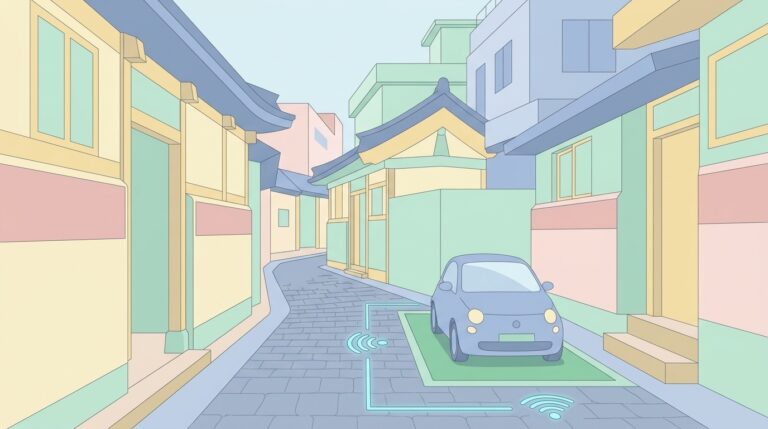
Mastering Seoul’s Toughest Urban Puzzle: How to Navigate Parking Sharing and Resident-Only Parking Like a True Local
안녕하세요! (Annyeonghaseyo!) Your trusted Daily Hangul cultural navigator and senior editor is here. If you have ever driven through the narrow, twisting labyrinth of Seoul’s trendy neighborhoods like Yeonnam-dong or Itaewon, you already know the ultimate urban dread: finding a parking spot.
You might have spotted a tempting empty space in a quiet alley, only to notice a yellow line and a mysterious number painted on the asphalt, accompanied by a sign reading 거주자 우선 주차구역 (Resident-Only Parking Zone). In the past, parking there would guarantee an immediate ticket or, worse, your rental car being towed away while you were enjoying your croffle at a nearby cafe.
But Korea’s cutting-edge smart city infrastructure has revolutionized this struggle through the 공유 경제 (gong-yu gyeong-je / sharing economy). Today, we are diving deep into the sophisticated language, high-tech apps, and unspoken social etiquette of Korea’s parking sharing business. This guide is curated from real-life lessons learned by advanced learners who wanted to transition from clueless tourists to savvy urban navigators. Let’s master the linguistic and cultural nuances of sharing space in Seoul!
Phase 2: Deep Dive into 3 Core Expressions
1. 거주자 우선 주차구역 (Geojuja Useon Jucha-guyeok)
- Pronunciation: [guh-joo-jah oo-suhn joo-chah-goo-yuhk] / Sound Analogy: “Guh-joo-ja” (Resident) + “Oo-suhn” (Priority) + “Joo-cha-guyeok” (Parking Zone).
- Meaning: Resident-Only Parking Zone / Designated Neighborhood Parking.
- K-Culture Moment: Think of slice-of-life K-Dramas like My Liberation Notes or Reply 1988, where neighbors constantly bicker over parking spaces in narrow alleyways (골목길). This system was implemented to curb those neighborhood wars, turning chaotic shared alleys into structured, designated zones.
- Editor’s Insight: While the literal translation sounds like a mere suggestion (“priority”), make no mistake: in Korea, this is a strict legal designation. Parking here without authorization during designated hours is a direct ticketable offense.
- Situation Spectrum:
- Casual (친구/사석): ✅ (e.g., “여기 거주자 구역인 것 같아.” – I think this is a resident zone.)
- Semi-formal (직장 동료/비즈니스): ✅
- Formal (직장 상사/어른): ✅
- 🤔 Think About It: How does your home country manage urban parking density? In Korea, high density led to a highly collectivized, legalistic system of spatial priority. Does your culture lean more toward private driveways or first-come, first-served street parking?
2. 주차장을 공유하다 (Juchajang-eul Gong-yu-hada)
- Pronunciation: [joo-chah-jahng-eul gohng-yoo-hah-dah] / Sound Analogy: “Joo-cha-jang” (Parking lot) + “eul” (object marker) + “gong-yu-hada” (to share).
- Meaning: To share a parking space (via IoT/Smart App platforms).
- K-Culture Moment: Modern K-Dramas showing sleek, tech-savvy Seoulites unlocking parking barriers with their smartphones. It highlights Korea’s hyper-digitized lifestyle where even the concrete beneath your car is part of the sharing economy.
- Editor’s Insight: The verb 공유하다 (to share) goes beyond social sharing; in the modern Korean economy, it specifically denotes participating in IoT platform-based micro-transactions.
- Situation Spectrum:
- Casual: ✅
- Semi-formal: ✅
- Formal: ✅
- 🤔 Think About It: Why has the sharing economy succeeded so rapidly in Korea? The linguistic transition from “mine” (내 것) to “our shared asset” (공유 자산) represents a unique blend of traditional communal values (정 – Jeong) and modern capitalistic efficiency.
3. 부정주차로 견인되다 (Bujeong-jucha-ro Gyeon-in-doeda)
- Pronunciation: [boo-juhng-joo-chah-roh gyuhn-een-doe-dah] / Sound Analogy: “Boo-jung” (Illegal/Improper) + “joo-cha” (parking) + “ro” (due to) + “gyeon-in-doeda” (to be towed).
- Meaning: To be towed due to unauthorized/illegal parking.
- K-Culture Moment: That agonizing scene in a drama where the protagonist runs out of a restaurant only to see their car being hauled away on a tow truck, leaving them stranded in the rain.
- Editor’s Insight: In Korean, 부정주차 (unauthorized parking) sounds highly formal and legalistic, but it is the exact term you will see on yellow warning stickers and app terms of service.
- Situation Spectrum:
- Casual: ✅ (e.g., “거기 대면 바로 견인돼!” – If you park there, you’ll get towed immediately!)
- Semi-formal: ✅
- Formal: ✅
- 🤔 Think About It: The word 부정 (不正) literally means “not right” or “corrupt.” It shows how deeply Korean society views unauthorized parking not just as an inconvenience, but as a moral breach of the community’s shared rules.
Phase 3: Textbook Korean vs. Real-World Korean
Let’s bridge the gap between classroom theory and real-world survival. Notice how native speakers strip away formal textbook bloat in favor of fast, high-efficiency expressions.
Situation 1: Checking if a parking space is shareable
- 📖 Textbook: 이 주차 공간은 공유가 가능한가요?
(Is this parking space shareable?) - 🗣️ Real Korean: 여기 “모두의 주차장”으로 대도 돼요?
(Can I park here using the “Modu Parking” app?) - 💡 Why the difference? Koreans are highly practical. Instead of using abstract terms like “shareable,” they immediately reference the most popular parking sharing app name, “모두의 주차장” (Modu’s Parking), to get straight to the point.
Situation 2: Warning someone about parking in a resident-only spot
- 📖 Textbook: 이곳은 거주자 우선 주차구역이므로 주차하면 안 됩니다.
(This is a resident-only parking zone, so you must not park here.) - 🗣️ Real Korean: 여기 대면 바로 딱지 끊기거나 견인돼요.
(If you park here, you’ll get ticketed or towed instantly.) - 💡 Why the difference? Native speakers focus on the immediate consequence rather than repeating the long official name of the zone. The phrase 딱지를 끊다 (to issue a ticket/sticker) is highly colloquial and universally used.
Phase 4: K-Culture Deep Dive & Non-Verbal Manners
4-1. The Dashboard Phone Number: The Ultimate Social Contract
In Korea, leaving your phone number visible on your dashboard (주차 알림판 – jucha allimpan) is not just polite; it is an absolute social contract. Because urban space is so tight, cars are often “double-parked” in neutral. If someone needs to get out, they will call you.
* The Etiquette: If you park in a shared space, even via an app, always make sure your phone number is displayed. If someone calls you to move your car, use a soft, apologetic tone: “아, 죄송합니다! 지금 바로 빼드릴게요!” (Oh, I’m sorry! I’ll move it for you right away!).
4-2. The Smart City Revolution
Korea has transitioned from localized, territorial parking disputes to an automated sharing economy. Under the 거주자 우선 주차제 (Resident-Only Parking System), residents who own a spot but work during the day can “register” their spot on sharing apps. Visitors can then park there for a small hourly fee (usually 1,200 KRW per hour). It is a win-win: residents make passive income, and drivers avoid predatory towing.
Phase 5: Interactive Roleplay Scenario
Setting: A narrow alleyway in the trendy neighborhood of Yeonnam-dong on a rainy Friday night. You are driving a rental car, desperately searching for a spot. You find an empty space marked with a resident number. You see a local resident, Min-jun (민준), walking out of the building.
Cast:
* You (The Visitor)
* Min-jun (The Resident / Spot Owner)
- You: 저기요, 실례지만 여기 잠깐 세워도 될까요?
(Jeogiyo, sillyejiman yeogi jamkkan seowo-do doelkkayo?)
(🎭 Approaching politely, waving hands slightly to catch attention)
“Excuse me, but could I park here for just a moment?” -
Min-jun: 아, 여기 제 거주자 우선 주차구역인데요. 지금 제가 차를 빼긴 하는데… 곧 다른 분이 예약하셨을 수도 있어요.
(Ah, yeogi je geojuja useon jucha-guyeogindeyo. Jigeum jega chareul ppaegin haneunde… got dareun buni yeyakhaseosseul sudo isseoyo.)
(🎭 Checking his smartphone screen while holding an umbrella)
“Ah, this is my resident-only parking spot. I’m taking my car out now, but… someone else might have reserved it soon.” -
You: 아, 정말요? 혹시 이 구역, 주차 공유 앱에 등록되어 있는 자리인가요?
(Ah, jeongmal-yo? Hoksi i guyeok, jucha gong-yu aep-e deungnok-doe-eo inneun jari-ingayo?)
(🎭 Tilting your head with polite interest)
“Oh, really? By any chance, is this spot registered on a parking sharing app?” -
Min-jun: 네, 맞아요! ‘모두의 주차장’ 어플 쓰시면 지금 바로 예약해서 쓰실 수 있어요. 등록해 두었거든요.
(Ne, majayo! ‘Modu-ui juchajang’ eopeul sseusimeon jigeum baro yeyakhaseo sseusil su isseoyo. Deungnokhadae-eotgeodeunyo.)
(🎭 Pointing at the green IoT sensor attached to the parking spot wall)
“Yes, that’s right! If you use the ‘Modu Parking’ app, you can reserve and use it right now. I have registered it.” -
You: 다행이네요! 어플로 지금 바로 예약할게요. 몇 시까지 비어 있나요?
(Dahaeng-ineyo! Eopeul-lo jigeum baro yeyak-halgeyo. Myeot sikaji bieo innayo?)
(🎭 Opening your phone quickly, smiling with relief)
“What a relief! I’ll reserve it on the app right away. Until what time is it vacant?” -
Min-jun: 저녁 9시 전까지는 쓰셔도 괜찮아요. 그 이후에는 제가 다시 주차해야 해서요.
(Jeonyeok ahopsi jeonkkajineun sseushyeodo gwaenchanchayo. Geu ihue-neun jega dasi juchahaeya haeseoyo.)
(🎭 Nodding in a friendly manner)
“You can use it until 9 PM. After that, I have to park here again.” -
You: 네, 확인했습니다! 9시 전에는 무조건 차 뺄게요. 정말 감사합니다!
(Ne, hwaginhassimnida! Ahopsi jeon-e-neun mu-jogeon cha bpaelgeyo. Jeongmal gamsahamnida!)
(🎭 Giving a polite, grateful bow)
“Yes, confirmed! I’ll absolutely move my car before 9 PM. Thank you so much!” -
Min-jun: 네, 주차 하시고 대시보드에 연락처 남겨주시는 것만 잊지 말아주세요!
(Ne, jucha hasigo daesibodeu-e yeonrakcheo namgyeojusineun geosman itji marajuseyo!)
(🎭 Waving gently as he walks toward his car)
“Sure, just don’t forget to leave your contact number on the dashboard after parking!”
🔀 Decision Point: How do you respond to Min-jun’s last reminder?
- Option A: “귀찮은데 꼭 연락처를 남겨야 하나요?” (Do I really have to leave my number? It’s a hassle.)
- Option B: “네, 걱정 마세요! 주차 알림판 잘 보이게 올려둘게요.” (Yes, don’t worry! I’ll place my phone number plate where it’s clearly visible.)
- Option C: “그냥 갈게요, 어차피 어플로 결제했는데요.” (I’ll just go, since I paid through the app anyway.)
💡 Analysis:
- Best Choice: Option B. It shows perfect understanding of Korean social etiquette (눈치 – Nunchi). Even when paying through an app, physical contactability is highly valued in Korea’s tight spaces.
- Risk Choice: Option A & C. This can be perceived as incredibly dismissive and rude. In Korea, ignoring the local “dashboard phone number” rule can lead to hostile calls from neighbors or sudden towing if an emergency arises.
Phase 6: 10-Second Emotional Shadowing Drill
Practice these sentences with emotional inflection. Follow the slash / marks for natural breathing pauses!
Drill 1: [🥺 Desperate but highly polite]
- “저기요… / 여기 잠깐만 대도 / 괜찮을까요? / 정말 급해서요.”
- Jeogiyo… / yeogi jamkkanman daedo / gwaenchanhulkkayo? / jeongmal geubhaeseoyo.
- (Excuse me… / is it okay if I park here / for just a moment? / I’m in a real hurry.)
Drill 2: [😤 Firm warning to a friend]
- “거기 대면 / 바로 견인된다니까! / 빨리 차 빼!”
- Geogi daemeon / baro gyeon-in-doendanikka! / ppalli cha ppae!
- (If you park there / I’m telling you, it’ll get towed immediately! / Move the car quick!)
Phase 7: K-Culture Mini Dictionary
| Keyword (Hangeul) | Romanization | English Translation | Cultural Context & Usage |
|---|---|---|---|
| 골목길 | Golmokgil | Alleyway | The narrow, romanticized roads of old Seoul where modern cars and pedestrians share tight spaces. |
| 주차 알림판 | Jucha Allimpan | Dashboard phone number plate | A small, often cute card or LED display showing the driver’s phone number, placed on the dashboard. |
| 딱지 | Ttakji | Fine sticker / Parking ticket | Literally means a small toy card, but colloquially refers to the dreaded yellow/red parking violation stickers. |
| 지정주차 | Jijeong-jucha | Designated parking | A parking spot assigned strictly to a specific person or vehicle, common in residential villas. |
Phase 8: Traveler’s Survival Kit
Survival Expressions TOP 3
- 혹시 주차장 공유하는 어플 뭐 써야 돼요?
(Hoksi juchajang gong-yuhaneun eopeul mwo sseoya doeyo?)- Pro Tip: Use this when asking a rental car agent or local friend which parking app is best for the specific city you are visiting.
- 거주자 우선 구역이라 주차가 안 된대요.
(Geojuja useon guyeog-ira juchaga an doendaeyo.)- Pro Tip: Use this to explain to your passengers why you cannot park in a tempting empty spot.
- 차 앞에 연락처 꼭 남겨두세요.
(Cha ap-e yeonrakcheo kkok namgyeoduseyo.)- Pro Tip: Say this to your travel companions to remind them of the essential Korean dashboard etiquette.
📌 Editor’s Travel Note
When driving in Seoul, do not rely on Google Maps for parking or navigation. Instead, download the Kakao T App Store Page or Naver Map Download Page which integrate direct booking of shared resident parking spaces seamlessly with real-time GPS navigation. Remember, international credit cards are widely accepted on Kakao T, making it perfect for foreign travelers!
Phase 9: Deep Thoughts — “One Step Deeper”
The sharing of residential parking spots in Seoul represents a fascinating intersection of hyper-density and communal trust. Historically, spatial boundaries in Korea were porous; the concept of a private “driveway” was foreign in traditional village setups. However, rapid modernization forced strict privatization of space. Now, the sharing economy is bridging these two eras. By using IoT technology to turn a private resource back into a shared community asset, Koreans are redefining what it means to coexist in a mega-city.
💬 Your Turn: Does your home country utilize digital apps to share private residential spaces like parking spots or driveways? Or is the concept of private ownership too strict to allow this? Share your thoughts in the comments below!
Phase 10: FAQ & Mistake Prevention
Q: Can I park in a “Resident-Only” (거주자 우선) spot if it is empty during the day?
A: No, unless you book it through a sharing app. Many spots are monitored by local ward offices (구청) or automated camera cars. Parking without booking will result in an immediate fine or tow, even if the resident is at work.
Q: What should I do if someone parked in the shared spot I officially reserved?
A: Do not block them. Take a photo of the vehicle and report it directly through the app you used (e.g., Modu Parking). The app will automatically reassign you a nearby spot and dispatch a warning or tow truck to the offending vehicle.
Q: Are parking sharing apps available for travelers without a Korean phone number?
A: Depends. Some apps require Korean phone verification, but global platforms like Kakao T allow registration via international numbers and payment via global credit cards, making them the safest bet for tourists.
🚨 Common Mistakes Warning Board
- Mistake: Assuming a yellow line in an alleyway is “free parking” because there are no signs.
- Correct Action: Check the ground for a painted registration number. If you see numbers like “12-3-45”, it is a resident-only spot!
- Mistake: Forgetting to put your phone number on the dashboard.
- Correct Action: Keep a temporary slip of paper with your phone number (with country code if using a roaming phone) visible on the front windshield.
- Mistake: Overstaying your app-booked shared slot.
- Correct Action: Set an alarm! The resident may return exactly at their registered time, and they have the legal right to have your vehicle towed instantly if you overstay.
Phase 11: Action Missions
- 🥉 Bronze (Room Challenge): Look up “모두의 주차장” (Modu Parking) on the App Store or Google Play Store. Practice reading the app interface translations in Korean.
- 🥈 Silver (Network Challenge): Share a photo of an interesting parking sign or narrow alleyway on your social media and tag it with #거주자우선주차 to show off your advanced urban vocabulary.
- 🥇 Gold (Real-World Challenge): Next time you drive or ride in a car in Korea, spot a yellow resident parking line and explain to your driver exactly how they can rent it using a sharing app.
- 🎮 K-Culture Mission: Watch a modern slice-of-life K-Drama (like Record of Youth or Run On) and try to spot a scene where characters negotiate space, park in narrow alleys, or use dashboard phone numbers!
Phase 12: Interactive Quiz Challenge
1. Situation Analysis
Q: You find an empty parking spot in Mapo-gu with “거주자 우선” painted on the ground. You only need to park for 10 minutes to grab a coffee. What is the most culturally and legally appropriate action?
* A) Park quickly and run to the café since it’s only 10 minutes.
* B) Check if the spot is registered on a sharing app, book a 30-minute slot, pay the 600 KRW, and leave your phone number visible.
* C) Park there but leave your hazard lights flashing to show you are nearby.
🔍 Click to reveal the Answer & Explanation
Correct Answer: B
Why: Even a 10-minute illegal parking slot in Seoul can result in a tow truck arriving or an automated camera car ticketing you. Using the sharing app keeps you legal, respects the resident’s space, and only costs pennies!
2. Fill in the Blanks
Q: Complete the sentence: “여기 대면 바로 ( ______ ) 끊기거나 견인돼요.”
(If you park here, you’ll get a ticket or towed instantly.)
* Hint: The literal word for “slap-on sticker/ticket”.
🔍 Click to reveal the Answer & Explanation
Correct Answer: 딱지 (Ttakji)
Why: “딱지를 끊다” is the natural, native colloquial idiom for getting a parking fine sticker.
3. True or False K-Culture Trivia
Q: Leaving your phone number on your dashboard in Korea is a legal requirement enforced by police.
* True or False?
🔍 Click to reveal the Answer & Explanation
Correct Answer: False
Why: It is not a formal statutory law, but rather a powerful social contract and cultural norm. Violating it won’t get you arrested, but it will severely damage your social standing among neighbors and lead to highly stressful confrontations.
Mastering the sharing economy is the ultimate proof of an advanced, integrated Korean speaker. Drive safe, share generously, and always keep your nunchi active on the roads of Seoul!







