

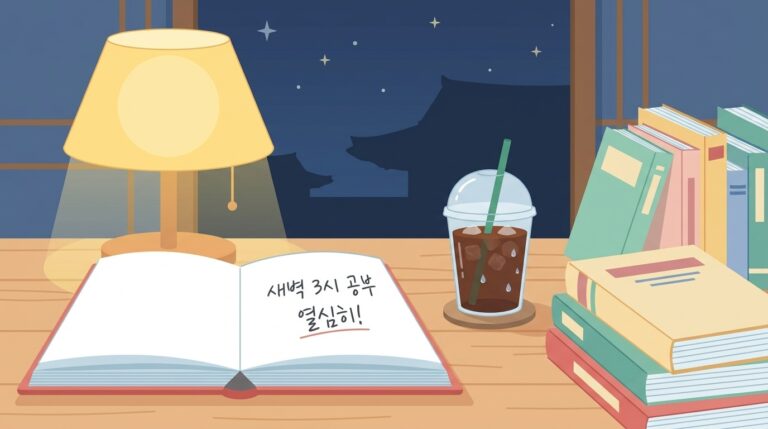
Surviving the Night: How to Talk About Your Coffee-Fueled All-Nighters in Korean
안녕하세요! (An-nyeong-ha-se-yo!) Welcome back to Daily Hangul, your premium language and culture hub. I’m your senior editor and local Seoul guide.
Imagine this: It’s 3:00 AM during midterm week in a cozy, modern study cafe (스터디 카페) in Sinchon, Seoul. The rain is gently tapping on the window. Around you, dozens of Korean university students are hunched over laptops, surrounded by highlighters, tablets, and a mountain of empty green cans of Chilsung Cider and cups of Iced Americano. You are exhausted, your eyes are heavy, but you have a 10-page report due at 9:00 AM.
If you’ve ever studied or worked in Korea, or watched dramas like Cheese in the Trap or Start-Up, you know that the intense cramming culture is a massive bond of solidarity. Today, we’re diving into the real-world expressions Korean students use when they are pulling all-nighters and practically keeping themselves alive on caffeine.
By the end of this guide, you won’t just know how to say “I studied and drank coffee.” You’ll know how to complain, bond, and order coffee like a true local student. Let’s get started!
Phase 2: Deep Dive into 3 Core Expressions
To sound like a natural, you need to move past textbook definitions. Here are the three most common expressions used when surviving exam season.
1. 밤을 새우다 (Bam-eul sae-u-da)
- Pronunciation: Bam-eul sae-u-da / Sound-alike: “Bah-meul seh-oo-dah”
- Meaning: To stay up all night / To pull an all-nighter.
- K-Culture Moment: You’ll see this constantly in university K-Dramas where characters are frantically cramming (벼락치기 – byeorak-chigi) the night before a major exam.
- Editor’s Insight: Notice that the verb is 새우다 (to stay awake/keep the night open), which is transitive. In casual speech, Koreans often drop the object particle and shorten it to 밤새우다 or simply 밤새다 (bam-sae-da).
- Situation Spectrum:
- Friends & Casual: ✅ (밤샜어 – I stayed up all night)
- Semi-formal: ✅ (밤새웠어요 – I stayed up all night)
- Formal / Superior: ⚠️ (Use sparingly, as complaining about tiredness to a boss might seem slightly unprofessional unless they ask first.)
- 🤔 Think About It: In Korean culture, sharing that you pulled an all-nighter is not just a complaint; it’s a badge of hard work and dedication. How does your culture view staying up all night to study?
2. 커피를 달고 살다 (Keo-pi-reul dal-go sal-da)
- Pronunciation: Keo-pi-reul dal-go sal-da / Sound-alike: “Kuh-pee-reul dahl-go sahl-dah”
- Meaning: To practically live on coffee (Literal: To live with coffee attached to oneself).
- K-Culture Moment: Think of your favorite office or school K-Dramas where characters walk around with an iced coffee cup in hand, even in sub-zero winter temperatures.
- Editor’s Insight: The word 달다 here means “to hang” or “to attach.” It implies that coffee is so constantly in your hand or mouth that it’s practically glued to you!
- Situation Spectrum:
- Friends & Casual: ✅ (요즘 커피를 달고 살아 – I live on coffee these days)
- Semi-formal: ✅ (요즘 커피를 달고 살아요 – I practically live on coffee these days)
- Formal / Superior: ⚠️ (Slightly idiomatic, but completely fine in polite casual chats with colleagues.)
- 🤔 Think About It: Why do you think Korea has such a massive cafe culture where “Iced Americano” is treated almost like water? What is your daily “attached” beverage?
3. 피곤해 죽겠다 (Pi-gon-hae juk-get-da)
- Pronunciation: Pi-gon-hae juk-get-da / Sound-alike: “Pee-gohn-hae jook-get-dah”
- Meaning: I’m so tired I could die / I’m exhausted.
- K-Culture Moment: This is the universal groan of every Korean student and salaryman stepping out of a subway station at 8:00 AM.
- Editor’s Insight: Koreans love using ~죽겠다 (~juk-get-da, “dying of…”) to exaggerate feelings. You can attach it to almost any feeling: 배고파 죽겠다 (starving to death), 바빠 죽겠다 (busy to death).
- Situation Spectrum:
- Friends & Casual: ✅ (피곤해 죽겠다 / 피곤해 죽겠어)
- Semi-formal: ✅ (피곤해 죽겠어요)
- Formal / Superior: 🚫 (Too dramatic and informal for a strict hierarchical setting. Use 많이 피곤합니다 instead.)
- 🤔 Think About It: Dramatic expressions like “dying of tiredness” highlight how Koreans use hyperbole to build instant empathy with others who are struggling just as hard.
Phase 3: Textbook Korean vs. Real Korean
Let’s compare what textbooks teach you with how Koreans actually speak in the trenches of exam season.
Situation 1: Explaining your lack of sleep
- 📖 Textbook Korean: “어제 공부를 많이 해서 잠을 자지 못했습니다.” (I could not sleep yesterday because I studied a lot.)
- 🗣️ Real Korean: “어제 밤새우느라 한숨도 못 잤어요.” (I couldn’t sleep a wink because I was up all night.)
- 💡 Why the difference? Real Koreans use the expressive grammar -느라 (due to doing something) and the idiom 한숨도 못 자다 (not sleep even a wink) to convey the drama and reality of their tired state.
Situation 2: Describing your heavy coffee consumption
- 📖 Textbook Korean: “정신을 차리기 위해 커피를 많이 마시고 있습니다.” (I am drinking a lot of coffee to wake up.)
- 🗣️ Real Korean: “살려고 커피 수혈 중이에요.” (I’m getting a coffee transfusion just to survive.)
- 💡 Why the difference? The phrase 커피 수혈 (keo-pi su-hyeol – coffee blood transfusion) is incredibly trendy. It humorously compares drinking iced coffee to getting a clinical IV drip to keep your body alive!
Phase 4: K-Culture Deep Dive & Non-verbal Manners
4-1. Nunchi (눈치) & Body Language in the Study Cafe
When you are studying in a Korean study cafe (스카 – short for 스터디 카페), silence is golden. Even the clicking of a mechanical keyboard can draw quiet glares.
* The “I’m Exhausted” Gesture: If you are yawing, it is polite to cover your mouth fully.
* Caffeine Solidarity: If you are studying in a group and want to show supreme social manners (눈치), send a KakaoTalk Gi-peu-ti-kon (gift icon/coupon) for a coffee to your friend sitting across from you. It’s the ultimate modern way to say, “Hang in there!”
4-2. The “Eol-Juk-Ah” (얼죽아) Phenomenon
In Korea, you will see students drinking Iced Americanos in the middle of a blizzard. This gave birth to the term 얼죽아 (Eol-Juk-Ah), an abbreviation for “얼어 죽어도 아이스” (Even if I freeze to death, iced drinks!). Drinking a freezing cold beverage is seen as a fast, icy shock to the system to keep you awake during long hours of studying.
Phase 5: Interactive Roleplay Scenario
The Setting: A dimly lit 24-hour study cafe in Sinchon, Seoul. It is 3:30 AM. Soft rain patters against the glass. You are sitting across from your Korean classmate, Min-jun (민준).
Your Character: An international student trying to finish a massive group project due tomorrow morning.
1. 민준: (Rubbing his eyes, whispering) 아... 벌써 새벽 세 시 반이네요. 피곤해 죽겠어요.
   Min-jun: (Ah... beol-seo sae-byeok se-si-ban-i-ne-yo. Pi-gon-hae juk-get-eo-yo.)
   Min-jun: (Ah... it's already 3:30 AM. I'm so tired I could die.)

2. You: (🎭 Yawning quietly) 저도요. 눈이 자꾸 감겨요.
   You: (Jeo-do-yo. Nun-i ja-kku gam-gyeo-yo.)
   You: (Me too. My eyes keep closing.)

3. 민준: (Looking at your empty cup) 벌써 커피 세 잔째 마신 거 아니에요?
   Min-jun: (Beol-seo keo-pi se-jan-jjae ma-sin-geo a-ni-e-yo?)
   Min-jun: (Haven't you already drank three cups of coffee?)

4. You: (🎭 Laughing weakly) 네, 요즘 시험 기간이라 커피를 달고 살아요.
   You: (Ne, yo-jeum si-heom gi-gan-i-ra keo-pi-reul dal-go sal-ah-yo.)
   You: (Yes, it's exam season lately, so I live with coffee attached to me.)

5. 민준: (Sighing) 맞아요. 이번 학기 과제는 왜 이렇게 많죠? 어제도 밤새웠는데...
   Min-jun: (Ma-ja-yo. I-beon hak-gi gwa-je-neun wae i-reo-ke man-jyo? Eo-je-do bam-sae-wot-neun-de...)
   Min-jun: (Right. Why are there so many assignments this semester? I stayed up all night yesterday too...)

6. You: (🎭 Shocked) 어제도요? 와, 진짜 대단해요. 저는 오늘 처음 밤새우는 거예요.
   You: (Eo-je-do-yo? Wa, jin-ja dae-dan-hae-yo. Jeo-neun o-neul cheo-eum bam-sae-u-neun-geo-yeo-yo.)
   You: (Yesterday too? Wow, you are amazing. Today is my first time staying up all night.)

7. 민준: (Stretching) 1층 편의점 가서 캔커피나 하나 더 사 올까요? 제가 살게요.
   Min-jun: (Il-cheung pyeon-ui-jeom ga-seo kaen-keo-pi-na ha-na deo sa-ol-kka-yo? Jeo-gae sal-gae-yo.)
   Min-jun: (Shall we go to the convenience store on the first floor and grab another can of coffee? My treat.)
🔀 Decision Point: What do you say to Min-jun?
- Option A: “아니요, 괜찮아요. 물 마실게요.” (No, thank you. I’ll drink water.)
- Option B: “우와, 좋아요! 역시 정신 차리려면 커피 수혈이 필요해요!” (Wow, awesome! As expected, to wake up I need a coffee transfusion!)
- Option C: “선배, 졸려 죽겠으니까 제일 비싼 걸로 사주세요.” (Senior, since I am dying of sleep, buy me the most expensive one.)
💡 Decision Analysis:
- Best Choice: Option B! It uses the fun slang 커피 수혈 (coffee transfusion) which will make Min-jun laugh and feel comfortable. It also accepts his kind gesture warmly.
- Risk Choice: Option C. Calling a classmate “선배” (senior) might be okay if he is older, but demanding the “most expensive one” (제일 비싼 것) can sound a bit cheeky and rude unless you are extremely close friends!
Phase 6: 10-Second Emotional Shadowing Drill
To sound natural, you need the right rhythm and emotion. Try saying these out loud!
- [🥺 Exhausted & Whining]
“진짜 / 피곤해 / 죽겠어요…”
(Jin-jja / pi-gon-hae / juk-get-eo-yo…)
Practice tip: Drag the “죽겠어요” slightly to sound genuinely tired. -
[😤 Resolute & Determined]
“오늘 무조건 / 밤새울 거예요!”
(O-neul mu-jo-geon / bam-sae-ul geo-yeo-yo!)
Practice tip: Put strong emphasis on “무조건” (absolutely/no matter what).
Phase 7: K-Culture Mini Dictionary
| Word (Korean + Romanization) | English Meaning | Cultural Insight & Usage |
|---|---|---|
| 벼락치기 (Byeorak-chigi) | Cramming | Literally “lightning strike.” It means waiting until the last second to study like a lightning bolt! |
| 얼죽아 (Eol-juk-ah) | Ice Coffee Devotee | Short for “Even if I freeze to death, Iced coffee!” A staple lifestyle of Korean youth. |
| 스카 (Seu-ka) | Study Cafe | Short for 스터디 카페. These are premium, ultra-quiet, aesthetic cafes built purely for studying. |
| 수혈 (Su-hyeol) | Transfusion | Usually means blood transfusion, but jokingly used with “커피” (coffee) or “몬스터” (Monster energy drink) to mean getting caffeine. |
Phase 8: Traveler’s Survival Kit
Even if you aren’t a student, you might find yourself needing a late-night cafe while traveling in Korea! Here are three survival sentences:
- Card 1: “여기 24시간 운영하는 카페가 어디예요?”
- Yeo-gi i-sip-sa-si-gan un-yeong-ha-neun ka-pe-ga eo-di-yeo-yo?
- Meaning: Where is a 24-hour cafe around here?
- Card 2: “아이스 아메리카노, 샷 추가해 주세요.”
- A-i-seu a-me-ri-ka-no, syat chu-ga-hae ju-se-yo.
- Meaning: Iced Americano with an extra shot, please. (Perfect when you need maximum power!)
- Card 3: “가장 가까운 스터디 카페가 어디에 있나요?”
- Ga-jang ga-kka-un seu-teo-di ka-pe-ga eo-di-e in-na-yo?
- Meaning: Where is the nearest study cafe?
📌 Editor’s Travel Note:
To find 24-hour locations easily in Korea, don’t use Google Maps (which is often outdated in Korea). Instead, download the Naver Map App and search for “24시 카페” (24-hour cafe) or “스터디 카페” (study cafe) to get real-time directions and reviews!
Phase 9: Deep Thought — “One Step Deeper”
Korean study culture is highly communal. While Western study styles often lean toward individual study at home, Korean students find comfort in doing 벼락치기 (cramming) together in packed cafes and libraries. There is a term called “공동체 의식” (gong-dong-che ui-sik – community consciousness). Knowing that you are not the only one “dying of tiredness” at 3 AM makes the struggle feel lighter and even nostalgic later in life.
💬 Your Turn: Do you prefer studying alone in complete silence, or do you thrive in a bustling, coffee-filled environment surrounded by other night owls? Let us know in the comments below!
Phase 10: FAQ & Common Mistakes
Q: Is there a difference between “밤을 새우다” (sae-u-da) and “밤이 새다” (sae-da)?
A: Yes, grammatically!
* 밤을 새우다 is active. You are actively staying awake all night.
* 밤이 새다 means “the night leaked/turned into dawn” (passive). For example: “이야기를 하다 보니 밤이 샜어요” (We talked so long that the night turned into morning).
Q: Can I use “피곤해 죽겠어요” with my professor or boss?
A: Generally, no. While adding “요” makes it grammatically polite, complaining that you are “dying of tiredness” can sound overly dramatic and slightly whiny to authority figures in Korea’s polite work culture. Instead, say: “조금 피곤하지만 괜찮습니다” (I’m a bit tired, but I’m okay).
Q: What is the most popular convenience store coffee for all-nighters?
A: The legendary “Snoopy Coffee”! Specifically, the Snoopy Coffee Milk (스누피 더 진한 커피우유) sold at GS25 convenience stores is famous among Korean students for having more caffeine than actual energy drinks!
🚨 Common Mistakes Alert:
- Mistake: Saying “커피를 많이 마시고 살아요” to mean you drink a lot of coffee.
- Correction: Use the natural idiom: “커피를 달고 살아요”.
- Mistake: Writing “밤을 세우다” instead of “밤을 새우다”.
- Correction: The spelling is 새 (ae), not 세 (e).
Phase 11: Action Missions
- 🥉 Bronze (The Mirror Challenge): Stand in front of a mirror, look exhausted, and say “아, 진짜 피곤해 죽겠어!” with dramatic sighing.
- 🥈 Silver (The Social Challenge): Post a photo of your morning coffee on Instagram or Threads and caption it: “오늘도 커피 수혈 중 ☕️”.
- 🥇 Gold (The Real-World Challenge): Next time you order coffee at a Korean cafe or kiosk, ask for “샷 추가해 주세요” (Please add an extra shot) like a pro!
Phase 12: Interactive Quiz
Test your knowledge below! Click to reveal the answers.
1. Which expression means “to practically live on coffee”?
- A) 커피를 먹고 살다
- B) 커피를 달고 살다
- C) 커피를 사고 살다
👉 Click to see the answer!
Correct Answer: B!
달고 살다 implies the coffee is “attached” to you constantly.
2. Fill in the blank: “시험 기간이라 요즘 매일 _______.” (I’m staying up all night every day lately because of exams.)
- A) 밤을 새워요
- B) 밤을 세요
- C) 아침을 새워요
👉 Click to see the answer!
Correct Answer: A!
새우다 is the correct verb root, conjugated to 새워요 in polite present tense.
3. True or False: It is highly polite to say “피곤해 죽겠어요” to your university professor when explaining why you couldn’t hand in homework.
👉 Click to see the answer!
Correct Answer: False!
It is too casual and dramatic. You should explain the situation politely without using extreme slang like “dying of tiredness.”







