

Beyond the Bowl: Decoding Korea’s White Rice vs. Purple Multigrain Rice Culture
Phase 1: 공감 (The Warm Welcome & That Purple Rice Mystery)
안녕하세요! (An-nyeong-ha-se-yo!) Hello there! I’m your Daily Hangul Senior Editor and local culture guide.
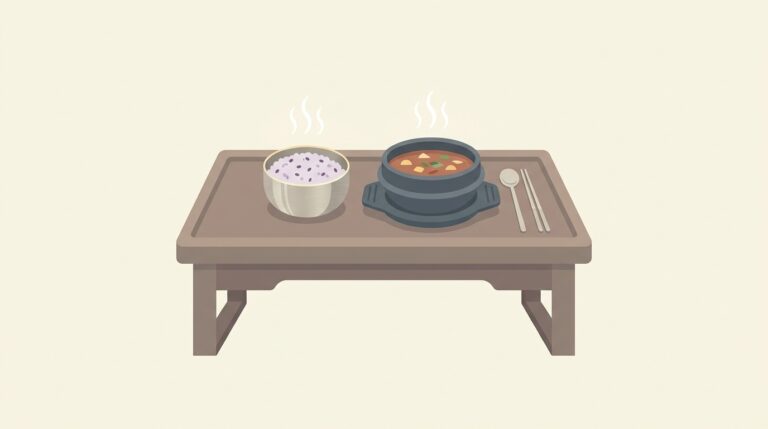
Imagine this: You’re sitting in a cozy, bustling restaurant in Seoul. The winter air outside is freezing, but the small restaurant is filled with the comforting steam of bubbling stews. You order a warm bowl of Doenjang-jjigae (된장찌개 – soybean paste stew). The server places a shiny, stainless-steel bowl in front of you. You eagerly pop open the lid, expecting to see a pristine mound of fluffy, snowy-white rice.
Instead, you find a deep, beautiful purple rice mixed with plump beans, barley, and millet.
Your first thought might be: Did they give me the wrong order? Is this some secret royal dish? And why is it purple?
Don’t worry! You haven’t made a mistake, and neither did the server. You’ve just encountered 잡곡밥 (Japgokbap), Korea’s beloved multigrain rice. In Korea, rice isn’t just a side dish; it is the emotional and nutritional anchor of the entire meal. Understanding the choice between white rice and multigrain rice is like holding a secret key to understanding modern Korean lifestyle, health trends, and culinary history.
In this guide, we’ll dive deep into this delicious cultural divide. By the end of this post, you’ll be able to order your rice like a true Seoulite and impress your Korean friends with your deep cultural intuition!
Phase 2: 핵심 표현 3선 심층 분석 (3 Essential Rice Expressions)
Let’s break down the three most crucial terms you need to know when navigating a Korean dining table.
1. 흰쌀밥 (Hinssalbap)
- Pronunciation: [Heen-ssal-bap] / Sounds like “Heen” (with a soft ‘h’) + “ssal” (with a tense ‘s’ sound as in ‘tsar’) + “bap” (like ‘pop’ but with a softer ‘b’).
- Meaning: White polished rice.
- K-Culture Moment: In historical Korean K-Dramas (사극 – Sageuk), you’ll often see poor peasants dreaming of eating a warm bowl of Hinssalbap. Historically, pure white rice was a luxury reserved for royalty and wealthy noblemen.
- Editor’s Insight: Today, while white rice is the standard default, it carries a nostalgic nuance of purity and simple comfort. If you want a clean, neutral flavor profile to let a spicy soup shine, Hinssalbap is your go-to.
- Situation Spectrum:
- Casual (친구/사석): ✅
- Semi-formal (직장 동료/비즈니스): ✅
- Formal (직장 상사/어른): ✅
- 🤔 Think About It: Why do you think white rice became the global symbol of Asian cuisine, even though ancient ancestors ate unpolished grains? How does the pure white color affect our perception of cleanliness in food?
2. 잡곡밥 (Japgokbap)
- Pronunciation: [Jap-gok-bap] / Sounds like “Jap” (as in ‘map’) + “gok” (rhymes with ‘oak’ but shorter) + “bap”.
- Meaning: Multigrain rice (literally “mixed grain rice”). It usually contains black rice (which turns the whole bowl purple!), brown rice, barley, beans, and millet.
- K-Culture Moment: Walk into any trendy health-conscious restaurant in Gangnam or a home-cooked meal style restaurant (가정식 – Gajeongsik), and you’ll almost always be served Japgokbap. It’s the ultimate symbol of the “well-being” (웰빙) wellness trend in Korea.
- Editor’s Insight: Some foreigners are intimidated by the black beans or the chewy texture, but the nutty flavor profile is incredibly rich. The purple color comes naturally from anthocynanin in black rice!
- Situation Spectrum:
- Casual (친구/사석): ✅
- Semi-formal (직장 동료/비즈니스): ✅
- Formal (직장 상사/어른): ✅
- 🤔 Think About It: In the past, eating mixed grains was associated with poverty when white rice was scarce. Today, it is more expensive and seen as a premium health choice. How does a society’s wealth change its relationship with “simple” foods?
3. 밥맛 (Bammat)
- Pronunciation: [Bam-mat] / Sounds like “Bam” (like the night) + “mat” (like ‘mud’ but with a sharp ‘t’ ending). Note: Due to Korean nasalization rules, ‘bap-mat’ is pronounced as ‘bam-mat’.
- Meaning: Literally “rice taste,” but colloquially used to describe one’s appetite or even a person’s likability.
- K-Culture Moment: You might hear a character in a K-Drama exclaim, “아, 진짜 밥맛 없어!” (Ah, jin-jja bam-mat eops-eo!). While it literally means “I have no appetite,” they are actually saying, “Ugh, that person is so annoying/unpleasant!”
- Editor’s Insight: Because rice is so central to life, a person who “ruins the taste of rice” is someone who ruins your day. It’s a highly colloquial, expressive idiom!
- Situation Spectrum:
- Casual (친구/사석): ✅
- Semi-formal (직장 동료/비즈니스): ⚠️ (Use with caution; sounds highly casual)
- Formal (직장 상사/어른): 🚫
- 🤔 Think About It: Can you think of an food-related idiom in your own language that is used to describe someone’s personality or behavior?
Phase 3: 교과서 한국어 vs 진짜 한국어 (Textbook vs. Real Korean)
Let’s compare the stiff sentences you learn in traditional textbooks with what native Koreans actually say in real-world situations.
Situation 1: Choosing your rice type at a restaurant
- 📖 Textbook Korean: “저는 흰 쌀밥을 먹겠습니다.” (I will eat white rice.) -> Too formal and unnatural in a casual diner.
- 🗣️ 진짜 한국어: “저 흰밥(잡곡밥)으로 할게요.” (Jeo heen-bap/jap-gok-bap-eu-ro hal-ge-yo.) -> “I’ll go with white rice (or multigrain).” Soft, polite, and very natural.
- 💡 Why it’s different: Koreans love efficiency. Dropping the word “쌀” (ssal – raw rice) and simply saying “흰밥” (heenbap) or pointing with “~로 할게요” (I’ll do/go with…) makes the conversation flow smoothly.
Situation 2: Expressing health preferences
- 📖 Textbook Korean: “잡곡밥은 건강에 매우 유익합니다.” (Multigrain rice is very beneficial to health.) -> Sounds like a medical textbook excerpt.
- 🗣️ 진짜 한국어: “요즘 건강 생각해서 잡곡밥 챙겨 먹고 있어요.” (Yo-jeum geon-gang saeng-gak-hae-seo jap-gok-bap chaeng-gyeo meok-go iss-eo-yo.) -> “Lately, I’ve been making sure to eat multigrain rice for my health.”
- 💡 Why it’s different: The verb “챙겨 먹다” (chaeng-gyeo meok-da – to make sure to eat / to eat regularly) is an incredibly common idiomatic expression that shows active self-care.
Phase 4: K-Culture 딥다이브 & 비언어적 매너 (Deep Dive & Manners)
4-1. 눈치 (Nunchi) & Table Manners: The Spoon vs. Chopstick Rule
In Western cultures, lifting a bowl to eat is normal in some contexts, and in neighboring Asian countries like Japan or China, lifting the rice bowl close to your mouth is polite.
But in Korea, this is a major social faux pas!
- Keep it on the table: Keep your metal rice bowl (공기밥) on the table. Lifting it is traditionally associated with beggars who have to eat on the run.
- The Spoon Rule: Eat your rice with your spoon (숟가락), and use your chopsticks (젓가락) strictly for the side dishes (반찬). Eating rice with chopsticks is considered impatient and messy.
4-2. The Political and Cultural History of Purple Rice
Why does Korea love Japgokbap? It dates back to the aftermath of the Korean War. White rice was incredibly scarce. To conserve white rice, the government actually implemented campaigns forcing restaurants to serve mixed grains (containing at least 25% barley or millet).
Fast forward to today: Korea is a fully developed nation, and white rice is cheap and abundant. However, the cultural memory shifted. Now, with rising rates of diabetes and modern health concerns, Japgokbap has risen as a premium option. Many young Koreans associate Hinssalbap with “empty carbs” and actively pay extra to get Japgokbap to stay fit and energetic.
Phase 5: 실전 롤플레이 시나리오 (Interactive Roleplay)
Setting: A warm, traditional Korean restaurant (한정식집) in the historic neighborhood of Insadong, Seoul. The tables are beautiful solid wood, and classical Korean music plays softly in the background.
Characters:
* Minji (민지): Your passionate Korean foodie friend who wants you to experience authentic local tastes.
* You (Guest): Eager to learn but slightly confused by the menu options.
- Turn 1 (Minji): (🎭 Smiling warmly, pointing at the menu) 여기 진짜 한정식 맛집이야! 뭐 먹을래?
(Yeo-gi jin-jja han-jeong-sik mat-jib-i-ya! Mwo meok-eul-lae?)
“This place is a real traditional Korean set-menu hotspot! What do you want to eat?” -
Turn 2 (You): (🎭 Looking curious) 와, 메뉴가 다 맛있어 보여. 찌개 정식으로 할래.
(Wa, me-nyu-ga da mas-iss-eo bo-yeo. Jji-gae jeong-sik-eu-ro hal-lae.)
“Wow, the menu all looks so good. I think I’ll go with the stew set meal.” -
Turn 3 (Minji): (🎭 Noding happily) 좋은 선택이야! 근데 여기는 밥을 고를 수 있어. 흰밥이랑 잡곡밥 중에 뭐 할래?
(Jo-eun seon-taek-i-ya! Geun-de yeo-gi-neun bap-eul go-reul su iss-eo. Heen-bap-i-rang jap-gok-bap jung-e mwo hal-lae?)
“Great choice! But here, you can choose the rice. Between white rice and multigrain rice, which do you want?” -
Turn 4 (You): (🎭 Tilting head slightly) 음… 둘이 맛 차이가 많이 나?
(Eum… dul-i mat cha-i-ga man-i na?)
“Hmm… is there a big difference in taste between the two?” -
Turn 5 (Minji): (🎭 Explaining with hand gestures) 흰밥은 부드럽고 깔끔해서 찌개랑 아주 잘 어울려. 잡곡밥은 엄청 고소하고 씹는 맛이 있어. 건강에도 훨씬 좋고!
(Heen-bap-eun bu-deu-rop-go kkal-kkeum-hae-seo jji-gae-rang a-ju jal eo-ul-ryeo. Jap-gok-bap-eun eom-cheong go-so-ha-go ssip-neun mas-i iss-eo. Geon-gang-e-do hweol-ssin jo-ko!)
“White rice is soft and clean, so it pairs perfectly with stew. Multigrain is super nutty and has a nice chew. And it’s way healthier!” -
Turn 6 (You): (🎭 Wondering aloud) 아, 드라마에서 보던 그 보라색 밥이 잡곡밥 맞지?
(Ah, deu-ra-ma-e-seo bo-deon geu bo-ra-saek bap-i jap-gok-bap mat-ji?)
“Ah, the purple rice I see in K-dramas is multigrain rice, right?” -
Turn 7 (Minji): (🎭 Clapping hands) 맞아, 맞아! 흑미가 들어가서 보라색으로 변하는 거야.
(Ma-ja, ma-ja! Heung-mi-ga deul-eo-ga-seo bo-ra-saek-eu-ro byeon-ha-neun geo-ya.)
“Exactly, yes! Black rice is added, which turns it purple.” -
Turn 8 (You): (🎭 Decided) 오, 그럼 나도 그 보라색 밥 먹어볼래! 잡곡밥으로 주문할게.
(Oh, geu-reom na-do geu bo-ra-saek bap meok-eo-bol-lae! Jap-gok-bap-eu-ro ju-mun-hal-ge.)
“Oh, then I want to try that purple rice too! I’ll order the multigrain rice.” -
Turn 9 (Minji): (🎭 Giving a thumbs up) 나이스! 사장님, 여기 찌개 정식 두 개 주시고, 밥은 둘 다 잡곡밥으로 주세요!
(Na-i-seu! Sa-jang-nim, yeo-gi jji-gae jeong-sik du gae ju-si-go, bap-eun dul da jap-gok-bap-eu-ro ju-se-yo!)
“Nice! Boss, two stew sets here please, and make both rice bowls multigrain!” -
Turn 10 (You): (🎭 Satisfied) 덕분에 진짜 한국식으로 먹어보네. 고마워!
(Deok-bun-e jin-jja Han-guk-sik-eu-ro meok-eo-bo-ne. Go-ma-wo!)
“Thanks to you, I’m eating real Korean style. Thank you!”
🔀 Decision Point: What if you wanted to try both?
- A) “반반 섞어 주실 수 있나요?” (Can you mix them half-and-half?)
- Critique: While creative, most restaurants prepare rice in massive batches. They cannot mix them custom-made for one bowl. The server might look confused!
- B) “잡곡밥 하나, 흰밥 하나 주세요.” (Please give us one multigrain and one white rice.)
- Critique: [BEST CHOICE] Perfect! If you are sharing with a friend, you can order one of each and share to taste-test the differences in texture and flavor.
- C) “저는 밥 말고 면으로 바꿀래요.” (Instead of rice, I want to swap it for noodles.)
- Critique: Traditional Korean set meals are built around rice (Bap). Swapping rice for noodles isn’t typically possible at standard Hanjeongsik restaurants.
Phase 6: 10초 감정 섀도잉 드릴 (Interactive Shadowing Drill)
Let’s practice saying these lines with the exact emotional intonation a native speaker would use. Pay attention to the pause markers /!
- [😊 Enthusiastic & Friendly]
- “저는 / 잡곡밥이 / 더 고소하고 / 맛있더라고요!”
- Jeo-neun / jap-gok-bap-i / deo go-so-ha-go / mas-it-deo-ra-go-yo!
- “For me, / multigrain rice / is nuttier / and tastes better!”
- [🥺 Polite & Asking for a favor]
- “혹시 / 흰밥 대신 / 잡곡밥으로 / 변경 가능할까요?”
- Hok-si / heen-bap dae-sin / jap-gok-bap-eu-ro / byeon-gyeong ga-neung-hal-kka-yo?
- “By any chance, / instead of white rice, / is it possible to switch / to multigrain rice?”
Phase 7: K-Culture 미니 사전 (4 Rice-related Keywords)
| Word (한글/Romanization) | English Meaning | Cultural Context & Usage |
|---|---|---|
| 밥심 (Bapsim) | Rice Power / Rice Energy | Koreans believe physical energy comes strictly from eating rice. When you are tired, friends will say, “밥심으로 버텨야지!” (You must hold on with rice power!). |
| 공기밥 (Gonggibap) | Bowl of Rice | The standard portion of white rice served in a stainless-steel bowl at restaurants, usually costing exactly 1,000 KRW (approx. $0.80 USD). |
| 햇반 (Hetban) | Instant Rice Cup | The iconic CJ brand of microwavable instant rice. It is so famous that “Hetban” is used as a generic term for all instant rice cups in Korea. |
| 숭늉 (Sungnyung) | Scorched Rice Tea | Traditional drink made by pouring warm water into the hot stone pot (Dolsot) after scraping out the rice. It is incredibly soothing for digestion. |
Phase 8: 여행자를 위한 생존 키트 (Traveler’s Survival Kit)
Survival Phrases TOP 3
- “공기밥 하나 추가해 주세요!” (Gong-gi-bap ha-na chu-ga-hae ju-se-yo!)
- Pro Tip: Use this when you’ve polished off your first bowl and need one more to finish your delicious stew.
- “이거 잡곡밥이에요?” (I-geo jap-gok-bap-i-e-yo?)
- Pro Tip: Use this to verify if the gorgeous purple rice served to you is indeed the healthy multigrain option.
- “누룽지 만들 물 주세요.” (Nu-rung-ji man-deul mul ju-se-yo.)
- Pro Tip: At hot stone pot rice restaurants, use this to ask for hot water to make your comforting scorched rice tea (Sungnyung) at the end.
📌 Editor’s Travel Note:
When traveling in Seoul, searching for authentic local restaurants on Google Maps can often lead to outdated tourist spots. Instead, download the Naver Map App or the KakaoMap App to find real-time local ratings and discover hidden Japgokbap gems in local neighborhoods!
Phase 9: 깊이 있는 생각 질문 (Deep Reflection)
In English, we ask “How are you?” or “Have a good day.” But in Korea, the ultimate greeting of affection and care is “밥 먹었어?” (Have you eaten rice?).
This simple question is deeply rooted in Korea’s agricultural and historical journey. During tough times in the mid-20th century, starvation was a real threat, and checking if someone had eaten was the ultimate form of empathy. Today, even when food is abundant, asking “밥 먹었어?” remains a warm cultural code. It means: I care about your well-being, and I want you to be healthy and nourished.
💬 Your Turn:
How does your native culture express care and affection through language? Is there a food-related greeting in your hometown? Let us know in the comments below!
Phase 10: FAQ & 오해 방지 (FAQ & Common Mistakes)
Q: Why is the multigrain rice in Korea purple?
A: It’s because of 흑미 (Heungmi – black rice)! Even a tiny handful of black rice mixed with white rice will turn the entire pot a deep, vibrant violet color during cooking. It does not contain artificial food coloring!
Q: Is white rice considered unhealthy in modern Korea?
A: Not necessarily “unhealthy,” but health-conscious Koreans view it as simple carbohydrates. Many people who are managing their blood sugar or weight prefer Japgokbap because of its lower glycemic index and higher fiber content.
Q: Can I find multigrain rice at Korean convenience stores?
A: Absolutely! Brands like Hetban offer various instant cups including Japgokbap (잡곡밥), Hyeonmibap (현미밥 – brown rice), and Heungmibap (흑미밥 – black rice).
🚨 Common Mistakes Warning!
- Mistake 1: Eating your rice with chopsticks.
- Correct Action: Always use your spoon for rice, and chopsticks for side dishes.
- Mistake 2: Lifting the stainless-steel bowl to your mouth.
- Correct Action: Leave the bowl flat on the table.
- Mistake 3: Assuming purple rice is sweet.
- Correct Action: It is savory and nutty! Expect a hearty, wholesome texture.
Phase 11: 액션 미션 및 참여 유도 (Action Mission)
- 🥉 Bronze (The Mirror Challenge): Practice ordering in your room: “잡곡밥 하나 주세요!” out loud three times with a confident smile!
- 🥈 Silver (The SNS Challenge): Next time you watch a K-Drama or go to a Korean restaurant, snap a photo of the rice. Tag us on Instagram with the hashtag #DailyHangul and identify if it is Hinssalbap or Japgokbap!
- 🥇 Gold (The Real-world Challenge): Go to your local Korean restaurant or grocery store. Politely ask the staff if they serve Japgokbap (잡곡밥) instead of Hinssalbap (흰쌀밥).
Phase 12: 인터랙티브 퀴즈 챌린지 (Quiz Challenge)
1. Culture & Etiquette
Which of the following behaviors is considered polite at a traditional Korean dinner table?
* A) Lifting the rice bowl close to your mouth to eat quickly.
* B) Keeping the rice bowl on the table and eating it with a spoon.
* C) Eating rice strictly with chopsticks.
👉 Click to reveal Answer & Explanation
Correct Answer: B
In Korea, lifting the rice bowl is associated with bad manners, and rice should always be eaten with a spoon! Chopsticks are reserved for side dishes.
2. Fill-in-the-blank
“요즘 건강을 위해서 흰밥 대신
_______________ 을/를 먹고 있어요.”
(Lately, for my health, I am eating ________ instead of white rice.)
👉 Click to reveal Answer & Explanation
Correct Answer: 잡곡밥 (Japgokbap – multigrain rice)







