

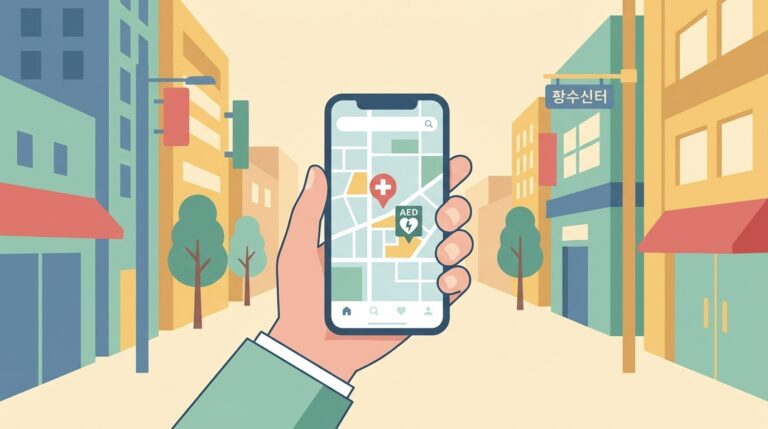
Saved by the App: Navigating Medical Emergencies and CPR in Korea
Phase 1: Empathy (An Emergency Doesn’t Ask for Your Korean Level)
안녕하세요! (Annyeonghaseyo!) Your trusted Korean tutor and local navigator from Daily Hangul here.
Imagine this: You are walking down the vibrant, neon-lit streets of Hongdae, hummed with buskers playing acoustic K-pop covers. Suddenly, the elderly gentleman in front of you collapses. Or perhaps you’re having an amazing late-night K-BBQ feast, and your friend suddenly exhibits signs of a severe allergic reaction. Your heart races. You want to help, but your mind goes blank. In your native country, you know exactly what to do. But here in Korea, even at a C1 level, the panic of a medical emergency can make the most fluent speaker feel tongue-tied.
Many advanced learners think they only need to know medical terminology when they get sick. But true cultural fluency is about knowing how to react under pressure to save a life. Learning how to navigate Korea’s emergency infrastructure and leverage localized medical apps isn’t just a linguistic exercise—it’s an indispensable survival skill. Today, we’re going to master the high-stakes vocabulary of CPR (심폐소생술) and learn how to use Korea’s official emergency apps to locate resources in real-time. Let’s make sure you’re the person who knows exactly what to do when every second counts.
Phase 2: Deep Dive into 3 Core Emergency Expressions
To act quickly, you need high-precision vocabulary. Here are three critical phrases that can dramatically alter the outcome of an emergency.
1. 응급실 위치를 확인해 주세요 (Eung-geup-sil wi-chi-reul hwa-gin-hae ju-se-yo)
- Pronunciation: [eung-geup-sil wi-chi-reul hwa-gin-hae-ju-se-yo] / Sound-alike: “Oong-goop-sil wee-chee-reul hwah-geen-hae joo-seh-yo”
- Meaning: Direct: “Please check the emergency room location.” | Nuance: A firm, polite request to look up the nearest open Emergency Room (ER) using an app or navigation.
- K-Culture Moment: You’ve likely seen this in medical K-Dramas like Hospital Playlist (슬기로운 의사생활) or Romantic Doctor, Teacher Kim (낭만닥터 김사부). When a critical patient is being transported, characters frantically coordinate with the closest “응급실” to secure a bed.
- Editor’s Insight: In Korea, not all hospitals operate ERs 24/7, and some may not have specialized doctors on duty. Using this exact phrase prompts locals to open the E-Gen App to check real-time availability.
- Situation Spectrum:
- Casual (Friends): ✅ (Slightly formal but acceptable in emergencies)
- Semi-formal (Colleagues): ✅
- Formal (Authority/Public): ✅
- 🤔 Think About It: In English, we often say “Call an ambulance!” but in Korea, where urban density is incredibly high, identifying the specific hospital with an open ER bed is often the primary bottleneck. How does this highlight the difference between resource management in highly centralized cities versus vast suburban areas?
2. 근처에 야간 영업 약국이 있나요? (Geun-cheo-e ya-gan yeong-eop yak-guk-i in-na-yo?)
- Pronunciation: [geun-cheo-e ya-gan yeong-eop yak-guk-i in-na-yo] / Sound-alike: “Geun-chuh-eh yah-gahn yung-up yahk-gook-ee een-nah-yo?”
- Meaning: Direct: “Is there a late-night pharmacy nearby?” | Nuance: Searching for a specialized duty pharmacy (“휴일지킴이약국” or “야간약국”) that operates past standard business hours.
- K-Culture Moment: In K-Dramas, when a character falls ill late at night, a loved one inevitably runs through the rain to find a glowing green pharmacy sign. While convenience stores sell basic antipyretics, true medical supplies require a licensed pharmacy.
- Editor’s Insight: The keyword here is 야간 영업 (night operations) or 당번 약국 (duty pharmacy). Apps like E-Gen show you these in real-time so you don’t run around empty streets in vain.
- Situation Spectrum:
- Casual (Friends): ✅
- Semi-formal (Colleagues): ✅
- Formal (Authority/Public): ✅
- 🤔 Think About It: Korean pharmacies are heavily regulated, and medicines are categorized strictly. Why do you think Korea maintains a physical “duty pharmacy” system instead of allowing all medications to be sold in local convenience stores?
3. 자동심장충격기(AED)는 어디에 있나요? (Ja-dong-sim-jang-chung-gyeok-gi-neun eo-di-e in-na-yo?)
- Pronunciation: [ja-dong-sim-jang-chung-gyeok-gi-neun eo-di-e een-nah-yo] / Sound-alike: “Jah-dong-sheem-jahng-choong-gyuk-gee-neun uh-dee-eh een-nah-yo?”
- Meaning: Direct: “Where is the Automated External Defibrillator (AED)?”
- K-Culture Moment: Subway stations, public offices, and apartment complexes in Korea are legally mandated to have AEDs. You’ve likely walked past their red-and-white cases near subway turnstiles without realizing it.
- Editor’s Insight: Locals might not instantly recognize the English acronym “AED” if they are panicked. Using the full Korean term 자동심장충격기 ensures zero miscommunication during a CPR event.
- Situation Spectrum:
- Casual (Friends): ✅
- Semi-formal (Colleagues): ✅
- Formal (Authority/Public): ✅
Phase 3: Textbook Korean vs. Real Korean
When a crisis occurs, formal textbook Korean can sound detached and cost precious seconds. Here is how to sound urgent and natural when every second counts.
Situation 1: Calling for Help in a Crowd
- 📖 Textbook Korean: 도와주세요. 의사를 불러주세요. (Do-wa-ju-se-yo. Ui-sa-reul bul-leo-ju-se-yo. – “Help me. Please call a doctor.”)
- 🗣️ Real Korean: 여기 사람 쓰러졌어요! 119에 신고 좀 해주세요! (Yeo-gi sa-ram sseu-reo-jyeos-seo-yo! Il-il-gu-e sin-go jom hae-ju-se-yo! – “Someone collapsed here! Please call 119!”)
- 💡 Why the Difference? Asking for a “doctor” is highly unrealistic in public spaces. Pointing out that someone has collapsed (사람 쓰러졌어요) and explicitly requesting a 119 dispatch is the immediate standard protocol in Korea.
Situation 2: Asking for a Late-Night Pharmacy
- 📖 Textbook Korean: 약국이 열었습니까? (Yak-guk-i yeol-eot-seup-ni-ka? – “Is the pharmacy open?”)
- 🗣️ Real Korean: 지금 문 연 약국 있을까요? (Ji-geum mun yeon yak-guk is-seul-kka-yo? – “Would there happen to be any open pharmacies right now?”)
- 💡 Why the Difference? In natural spoken Korean, using the phrase 문 연 (literally “door opened”) is far more idiomatic than 열었습니까, which sounds like a rigid reading comprehension question.
Phase 4: K-Culture Deep Dive & Non-verbal Manners
4-1. Nunchi (눈치) and Body Language in Emergencies
In a crowded Korean public space like a subway platform, bystander apathy can sometimes occur due to a cultural hesitation to interfere in others’ affairs. To break through this, you must apply active Nunchi paired with direct commands.
* The Finger-Point Rule: When calling for help, do not shout “Somebody call 119!” to the crowd. Look directly at someone, make eye contact, point, and state a defining characteristic:
“거기 검은색 패딩 입으신 분, 119에 신고해 주세요!” (You there in the black puffer jacket, call 119!)
* Physical Mannerism during CPR: If you are certified and need to perform CPR, loudly announce your intention to clear the area: “제가 심폐소생술 하겠습니다. 물러서 주세요!” (I will perform CPR. Please step back!). This establishes immediate authority and cooperation.
4-2. The Digital Safety Net: Korea’s Civic Tech
Korea’s response to medical emergencies is heavily digitalized. The E-Gen (응급의료포털) system is integrated into national safety networks. Culturally, Koreans expect real-time data accuracy. If you show someone your phone running the E-Gen app, they will instantly recognize the interface and help you navigate the map. This seamless integration of tech and civic duty is a hallmark of modern K-Travel safety.
Phase 5: Interactive Roleplay Scenario
The Setting: It is a rainy Friday night at 11:30 PM near Gangnam Station, Exit 10. The streets are slick with rain. An elderly pedestrian slips and collapses onto the pavement. A young local bystander, Min-ho (민호), panicked and unsure of what to do, freezes. You step in to take charge using your phone’s emergency medical app.
The Cast:
- You: An advanced bilingual speaker prepared to assist.
- Min-ho (민호): A worried local bystander.
Dialogue:
- Min-ho: 헐, 어떡해! 할아버지가 갑자기 쓰러지셨어요!
(Heol, eo-tteok-hae! Hal-a-beo-ji-ga gap-ja-gi sseu-reo-ji-syeos-seo-yo!)
(🎭 Gasps, pointing at the elderly man on the ground with wide eyes) -
You: 잠시만요, 제가 상태를 볼게요. 의식이 있으신가요? 할아버지, 제 목소리 들리세요?
(Jam-si-man-yo, je-ga sang-tae-reul bol-ge-yo. Ui-sik-i is-seu-sin-ga-yo? Hal-a-beo-ji, je mok-so-ri deul-li-se-yo?)
(🎭 Kneeling down, gently tapping the man’s shoulders to check responsiveness) -
Min-ho: 전혀 대답이 없으세요. 숨도 안 쉬시는 것 같아요!
(Jeon-hyeo dae-dab-i eop-seu-se-yo. Sum-do an swi-si-neun geot gat-a-yo!)
(🎭 Clutching his hands in panic, looking around frantically) -
You: 호흡과 맥박이 없습니다. 민호 씨, 바로 119에 전화해 주세요!
(Ho-heup-gwa maek-bak-i eop-seum-ni-da. Min-ho ssi, ba-ro il-il-gu-e jeon-hwa-hae ju-se-yo!)
(🎭 Looking directly at Min-ho, speaking in a commanding, firm tone) -
Min-ho: 아, 네! 119에 전화 걸고 있어요. 주소를 뭐라고 해야 하죠?
(Ah, ne! Il-il-gu-e jeon-hwa geol-go is-seo-yo. Ju-so-reul mwo-ra-go hae-ya ha-jyo?)
(🎭 Fumbling with his phone, dialling with shaking fingers) -
You: 제 핸드폰으로 응급 의료 정보 앱(E-Gen)을 켰어요. 여기 현재 위치 주소를 불러주세요. ‘강남역 10번 출구 근처 빌딩 앞’이라고요!
(Je haen-deu-pon-eu-ro eung-geup ui-ryo jeong-bo aep-eul kyeo-seo hyeon-jae wi-chi ju-so-reul bul-leo-ju-se-yo. ‘Gang-nam-yeok sip-beon chul-gu geun-cheo bil-ding ap’-i-ra-go-yo!)
(🎭 Shifting the screen towards Min-ho, showing the real-time GPS coordinates) -
Min-ho: 네, 접수됐어요! 119에서 심폐소생술을 계속하래요. 구급차가 올 때까지 도와주세요!
(Ne, jeop-su-dwaes-seo-yo! Il-il-gu-e-seo sim-pye-so-saeng-sul-eul gye-sok-ha-rae-yo. Gu-geup-cha-ga ol ttae-kka-ji do-wa-ju-se-yo!)
(🎭 Nodding rapidly, keeping the phone to his ear) -
You: 제가 심폐소생술(CPR)을 시작하겠습니다. 하나, 둘, 셋, 넷…
(Je-ga sim-pye-so-saeng-sul-eul si-jak-hal-ge-yo. Ha-na, dul, set, net…)
(🎭 Placing hands on the center of the chest, pushing hard and fast at a rhythmic pace) -
Min-ho: 제가 뭘 더 도와드리면 될까요? 너무 떨려요.
(Je-ga mwol deo do-wa-deu-ri-myeon doel-kka-yo? Neo-mu tteol-lyeo-yo.)
(🎭 Hovering nervously, wanting to be useful) -
You: 앱 화면에서 근처 자동심장충격기(AED) 위치를 확인해 주세요! 지하철역 안에 있을 거예요!
(Aep hwa-myeon-e-seo geun-cheo ja-dong-sim-jang-chung-gyeok-gi wi-chi-reul hwa-gin-hae ju-se-yo! Ji-ha-cheol-yeok an-e is-seul geo-ye-yo!)
(🎭 Shouting clearly over the rain while maintaining deep chest compressions) -
Min-ho: 아, 찾았어요! 앱 보니까 강남역 지하 1층 대합실에 있대요. 바로 뛰어갔다 올게요!
(Ah, cha-jas-seo-yo! Aep bo-ni-kka Gang-nam-yeok ji-ha il-cheung dae-hap-sil-e is-dae-yo. Ba-ro ttui-eo-gat-da ol-ge-yo!)
(🎭 Snatching the phone, sprinting toward the subway entrance) -
You: 고마워요, 조심히 빨리 다녀오세요! 구급대원 올 때까지 계속하겠습니다!
(Go-ma-wo-yo, jo-sim-hi ppal-li da-nyeo-o-se-yo! Gu-geup-dae-won ol ttae-kka-ji gye-sok-ha-get-seum-ni-da!)
(🎭 Focusing entirely on the rhythmic compressions, breathing heavily but steadily)
🔀 Decision Point: What is your next move?
Imagine Min-ho comes back with the AED but doesn’t know how to turn it on, and the voice prompt is entirely in Korean. What do you do?
- Option A: Stop CPR completely, take the AED, and read the manual carefully.
- Option B: Keep performing CPR and instruct Min-ho: “전원 버튼을 누르면 한국어 음성 안내가 나와요. 그대로 따라 하세요!” (Press the power button; the Korean voice guide will play. Follow it exactly!)
- Option C: Shrug and tell him to wait until the 119 ambulance arrives.
Best Choice Analysis:
- Option B is the absolute best. High-quality CPR must not be interrupted. AEDs in Korea are designed with simple voice prompts. Even if the voice is in Korean, the instructions are incredibly intuitive (e.g., “패드를 부착하세요” – Attach the pads, “커넥터를 연결하세요” – Connect the plug). Keeping calm and letting the audio guide direct Min-ho is the safest path.
- Option A is highly risky because interrupting chest compressions for too long decreases survival rates.
- Option C is dangerous because the first few minutes (the “Golden Time”) are crucial.
Phase 6: 10-Second Emotion Shadowing Drill
In emergency situations, your tone of voice can either panic the crowd or command immediate cooperation. Practice this phrase out loud to master the urgent, authoritative tone required:
“여기 심정지 환자가 있습니다! / 빨리 / 자동심장충격기 좀 / 가져다주세요!”
- Romanization: Yeo-gi sim-jeong-ji hwan-ja-ga is-seum-ni-da! / Ppal-li / ja-dong-sim-jang-chung-gyeok-gi jom / ga-jyeo-da-ju-se-yo!
- Emotional Cue: [😤 Urgent, authoritative, and loud]
- Delivery Guide: Stress the words 심정지 (Cardiac arrest) and 자동심장충격기 (AED) with sharp, clear articulation. Pause briefly at each
/to let the command register.
Phase 7: K-Culture Mini Dictionary
| Word (Korean/Romanization) | Target Meaning | Cultural / Linguistic Context |
|---|---|---|
| 골든타임 (Gol-deun Ta-im) | Golden Time (Window of Opportunity) | Borrowed from medical terminology, Koreans use this heavily in media, business, and daily life to denote the critical period where action must be taken before it’s too late. |
| 당번약국 (Dang-beon Yak-guk) | Duty Pharmacy / Late-Night Pharmacy | Pharmacies that take turns staying open on weekends and public holidays to maintain public health safety nets. |
| 심폐소생술 (Sim-pye-so-saeng-sul) | CPR (Cardiopulmonary Resuscitation) | Literally translates to “heart-lung resurrection technique.” CPR training is highly standardized in Korean schools and military service. |
| 선한 사마리안 법 (Seon-han Sa-ma-ri-an Beop) | Good Samaritan Law | The legal framework in Korea that protects citizens who perform emergency first aid (like CPR) from civil or criminal liability if things go wrong. |
Phase 8: Traveler’s Survival Kit
Survival Phrases TOP 3
- “119에 전화해 주시고 심폐소생술 키트 좀 찾아주세요!”
- Romanization: Il-il-gu-e jeon-hwa-hae ju-si-go sim-pye-so-saeng-sul ki-teu jom cha-ja-ju-se-yo!
- Pro Tip: Use this to command bystanders to divide tasks quickly.
- “제가 금속 알레르기가 있어요.”
- Romanization: Je-ga geum-sok al-le-reu-gi-ga is-seo-yo.
- Pro Tip: Vital if medical staff need to apply any monitors or equipment.
- “가장 가까운 야간 응급실로 가주세요.”
- Romanization: Ga-jang ga-kka-un ya-gan eung-geup-sil-lo ga-ju-se-yo.
- Pro Tip: Tell this to a taxi driver if you are bypassing the ambulance for minor but urgent night-time injuries.
📌 Editor’s Travel Note
Before stepping foot outside your hotel, make sure you download the official Ministry of Health and Welfare’s Emergency Medical Information (E-Gen) App. While major map services like Naver Maps are fantastic for routing, E-Gen specifically catalogs active pediatric units, holiday pharmacies, and real-time open ER beds across the country.
Note: Operating hours for duty pharmacies can change without prior warning; always call 1339 (Emergency Medical Information Center) if you are in a remote area.
Phase 9: Deep Thinking — “The Collectivist Pulse of Safety”
In many Western cultures, the decision to perform CPR on a stranger is often weighed against legal anxieties. In Korea, however, you will find a strong undercurrent of community duty. Historically rooted in Jeong (정) and collectivism, Korean society expects citizens to actively look out for one another in public.
This is mirrored in Korea’s 선한 사마리안 법 (Good Samaritan Law), which was strengthened specifically to encourage bystander CPR without the fear of lawsuits. When you use an app to fetch an AED or call out instructions, you aren’t just an observer—you are actively participating in a highly coordinated, communal safety net.
💬 Your Turn: How does your home country handle bystander intervention? Is there a strong legal safety net for those who perform CPR, or do people hesitate out of liability fears? Let us know in the comments below!
Phase 10: FAQ & Avoiding Misunderstandings
Q: Can I just dial 911 on my phone in Korea?
A: Yes, but with a catch. Dialing 911 inside Korea will automatically redirect you to 119 (for fire and medical emergencies) or 112 (for police). However, to avoid any routing delays, it is highly recommended to dial 119 directly from the start.
Q: Are there English-speaking operators available on 119?
A: Yes. When you call 119, you can request an English interpreter. Simply say, “영어 통역 부탁드립니다” (Yeong-eo tong-yeok bu-tak-deu-rim-ni-da). They will patch you through to a translation service.
Q: What if I accidentally perform CPR incorrectly and cause injury?
A: You are legally protected. Under Article 5-2 of the Emergency Medical Service Act (the Good Samaritan clause), emergency first aid performed on a patient in imminent danger does not carry civil or criminal liability for accidental injury (such as fractured ribs during compressions).
🚨 Common Mistakes Alert:
- Calling the wrong agency: Do not call 112 (Police) for medical crises. 119 is the sole dispatcher for ambulances.
- Mispronouncing “응급실”: Saying Eun-haeng-sil (은행실 – bank room) instead of Eung-geup-sil (응급실 – ER). Keep the pronunciation sharp!
- Neglecting GPS tracking: Always ensure your phone’s location services are toggled ON when using the E-Gen app, as cellular tower triangulation in dense areas like Seoul can sometimes be slightly off.
Phase 11: Action Missions
- 🥉 Bronze (At-Home Challenge): Open your phone’s app store. Locate and download the 응급의료정보제공 (E-Gen) app. Familiarize yourself with the interface and find the nearest AED to your current accommodation.
- 🥈 Silver (Network Challenge): Record a voice note of yourself practicing the 10-Second Shadowing Drill and share it with a study partner or on social media with the hashtag
#DailyHangulEmergency. - 🥇 Gold (Real-world Challenge): Next time you are in a Korean subway station, physically locate the red AED (자동심장충격기) cabinet. Read the instructions printed on the glass door to ensure you recognize the layout.
- 🎮 K-Culture Mission: Watch an episode of a Korean medical drama (like Hospital Playlist). Pay close attention to how dispatchers and characters speak over the phone during emergency scenes. Write down at least two terms you recognized!
Phase 12: Interactive Quiz Challenge
Test your instincts and your Korean skills under pressure!
1. Situational Judgment
You see someone choking in a restaurant. You want to ask the staff if there is anyone who can do CPR. Which phrase is culturally and grammatically correct?
* A) CPR 하시는 분 계세요? (CPR ha-si-neun bun gye-se-yo?)
* B) 여기 요리사 어디 있어요? (Yeo-gi yo-ri-sa eo-di is-seo-yo?)
* C) 심폐소생술 하실 수 있는 분 계신가요? (Sim-pye-so-saeng-sul ha-sil su in-neun bun gye-sin-ga-yo?)
Click to reveal the Answer & Explanation
Correct Answer: C
While ‘A’ is understandable, ‘C’ is the most natural, respectful, and precise way to ask a crowd or staff if anyone is certified in CPR under high-stress conditions.
2. Fill-in-the-blank
Complete the emergency instruction: “빨리 근처 지하철역에 가서 __________(을/를) 가져다주세요!”
* A) 은행카드 (Bank card)
* B) 자동심장충격기 (AED)
* C) 휴일지킴이약국 (Holiday pharmacy)
Click to reveal the Answer & Explanation
Correct Answer: B
You need an AED (자동심장충격기) immediately for emergency resuscitation efforts.
3. True or False
True or False: The E-Gen App (응급의료정보제공) only displays information inside Seoul.
Click to reveal the Answer & Explanation
Correct Answer: False
E-Gen is a nationwide system covering all provinces in South Korea, including Jeju Island and rural mountainous areas.






