

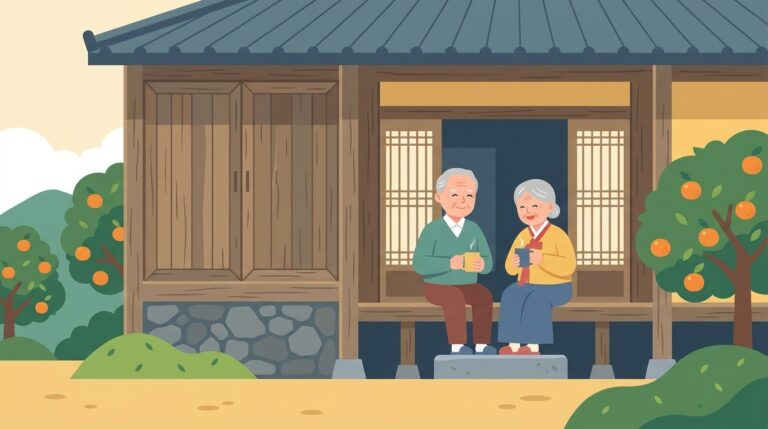
Designing Your Second Act: How to Talk About Retirement Dreams in Korean
안녕하세요! Welcome back to Daily Hangul, your premium space for mastering not just the Korean language, but the beautiful lifestyle and culture behind it. I’m your senior editor and cultural navigator.
Have you ever watched the touching K-Drama Navillera (나빌레라)? It tells the story of a 70-year-old retired mailman who decides to pursue his lifelong dream of learning ballet. Or perhaps you’ve daydreamed while watching Hometown Cha-Cha-Cha (갯마을 차차차) or Little Forest (리틀 포레스트) about escaping the hustle of city life to open a quiet, cozy bookstore in Jeju Island or start a small organic farm in the countryside.
In Korea, retirement is no longer seen as just “the end of work.” Instead, it is passionately celebrated as the beginning of 인생 2막 (Insaeng i-mak)—the “Second Act of Life.”
Today, we are going to dive deep into the vocabulary, cultural nuances, and real-world expressions you need to talk about your long-term dreams, retirement plans, and post-career goals in Korean. Let’s make sure that when you share your future dreams with Korean friends, you sound warm, thoughtful, and incredibly fluent!
Phase 2: Deep Dive into 3 Key Expressions
Let’s look at three essential expressions that will immediately elevate your Korean from “textbook-flat” to “culturally rich.”
1. 인생 2막을 준비하다 (In-saeng i-mak-eul jun-bi-ha-da)
- Pronunciation: [In-seng ee-mahk-eul joon-bee-hah-dah]
- Meaning: To prepare for the second act of life (planning retirement).
- K-Culture Moment: You will hear this phrase constantly on Korean talk shows and documentaries when interviewing retirees who started successful second careers, like becoming a senior model, a YouTuber, or opening a local bakery.
- Editor’s Insight: This expression uses the theater metaphor “Act 2” (2막). It has an incredibly active, hopeful, and positive nuance. It implies that your life isn’t winding down; rather, a new and exciting curtain is rising!
- Situation Spectrum:
- Friends & Casual: ✅
- Coworkers & Semi-formal: ✅
- Seniors & Formal: ✅
- 🤔 Think About It: Why do you think modern Korean society prefers the poetic “Second Act” (인생 2막) over the dry, clinical term “Retirement” (은퇴)? How does this reflect the dynamic, never-give-up spirit of Korean culture?
2. 귀농/귀촌을 꿈꾸다 (Gwi-nong / Gwi-chon-eul kkum-kku-da)
- Pronunciation: [Gwee-nong / Gwee-chohn-eul kkoom-kkoo-dah]
- Meaning: To dream of returning to farming (귀농) or returning to rural/countryside life (귀촌).
- K-Culture Moment: This is the ultimate dream for many exhausted Seoul office workers. Dramas like Summer Strike (아무것도 하고 싶지 않아) capture this beautiful desire to escape the “Pali-Pali” (hurry-hurry) city routine for a slow, mindful life.
- Editor’s Insight: Be careful with the distinction! 귀농 (Gwi-nong) means you are actively going to farm and grow crops for a living. 귀촌 (Gwi-chon) simply means you are moving to a quiet country village to relax, read, and enjoy nature without the pressure of commercial farming.
- Situation Spectrum:
- Friends & Casual: ✅
- Coworkers & Semi-formal: ✅
- Seniors & Formal: ✅
- 🤔 Think About It: In many Western cultures, retirees move to suburban gated communities or warm coastal cities. In Korea, why is there such a strong emotional pull to “return to the land” (귀촌)?
3. 유유자적하게 살다 (Yu-yu-ja-jeok-ha-ge sal-da)
- Pronunciation: [Yoo-yoo-jah-juck-hah-gheh sahl-dah]
- Meaning: To live leisurely and free from worldly cares.
- K-Culture Moment: This expression comes from classical Hanja (Sino-Korean characters). It evokes the image of ancient Korean scholars (선비) drinking tea by a quiet stream, watching the clouds pass.
- Editor’s Insight: At the B1 level, using a four-character idiom (사자성어) like 유유자적 (Yu-yu-ja-jeok) will absolutely blow your Korean friends away! It shows you appreciate the deeper philosophy of peace, mindfulness, and unhurried living.
- Situation Spectrum:
- Friends & Casual: ⚠️ (A bit poetic, but lovely if used with a smile!)
- Coworkers & Semi-formal: ✅
- Seniors & Formal: ✅
- 🤔 Think About It: Is your personal retirement style more “active” (learning new things, traveling) or “yu-yu-ja-jeok” (pure relaxation and quiet contemplation)?
Phase 3: Textbook Korean vs. Real Korean
Let’s compare how a standard classroom textbook would teach you to talk about retirement versus how real Koreans express these dreams in casual conversation.
Situation 1: Expressing the desire to rest and live comfortably.
- 📖 Textbook Korean: “저는 은퇴한 후에 많이 쉴 것입니다.” (I will rest a lot after I retire.)
- 🗣️ Real Korean: “은퇴하면 그냥 소확행 즐기면서 편안하게 살고 싶어요.” (When I retire, I just want to live comfortably while enjoying life’s small but certain happiness.)
- 💡 Why the difference? The textbook sentence is grammatically correct but sounds very stiff and robotic. Real Koreans love using the trendy lifestyle term 소확행 (So-hwak-haeng – Small but Certain Happiness) to express their retirement philosophy of appreciating daily joys like a warm cup of tea or a morning walk.
Situation 2: Planning to start a small business or hobby shop.
- 📖 Textbook Korean: “저는 은퇴한 후에 카페를 열 계획입니다.” (I plan to open a cafe after I retire.)
- 🗣️ Real Korean: “은퇴하고 제주도 같은 데서 작은 북카페나 하나 차리면 정말 좋겠어요.” (It would be so great to set up something like a small book cafe in a place like Jeju Island when I retire.)
- 💡 Why the difference? Using the particle “~나 하나” before “차리다” (to set up/open a shop) softens the statement. Instead of sounding like a cold, aggressive business plan, it sounds like a warm, cozy, and modest dream.
Phase 4: K-Culture Deep Dive & Non-verbal Manners
4-1. The Art of “Nunchi” (눈치) When Discussing Aging
In Korea, age and retirement are deeply respected milestones. When an elder or senior colleague talks about their retirement dreams, never jump in with unsolicited advice or realistic business warnings (e.g., “But running a cafe is hard work!”).
Instead, practice active listening with polite physical gestures:
* The Gentle Nod: Slow, deep nods of the head show deep respect and agreement.
* Supportive Exclamations: Use warm phrases like “우와, 정말 멋진 계획이세요!” (Wow, that is a truly wonderful plan!) or “진심으로 응원합니다!” (I am cheering for you with all my heart!).
4-2. The “Jeju-살이” (Living in Jeju) Culture Code
If you ask ten Koreans in their 30s to 50s where they want to spend their retirement, at least half of them will mention 제주도 (Jeju Island). Thanks to reality shows like Hyori’s Homestay (효리네 민박), “한 달 살기” (living for a month) or permanently retiring to Jeju has become the ultimate cultural symbol of healing, slow living, and emotional restoration.
Phase 5: Interactive Roleplay Scenario
The Setting: A cozy, warm traditional tea house (찻집) in Insadong, Seoul. Rain is gently tapping on the window. You are sitting across from Mr. Kim (김 선생님), a retired middle school teacher who recently opened a small ceramic pottery studio in the countryside.
Cast:
- Mr. Kim (김 선생님): Wise, warm-hearted, and loves sharing his life lessons.
- You (B1 Student): Curious, respectful, and looking for inspiration for your own future.
- Mr. Kim: (Sipping his warm mugwort tea slowly) 벌써 빗소리가 참 좋네요. 은퇴하고 나니까 이런 소소한 여유가 정말 소중하다는 걸 매일 느낍니다.
(The sound of the rain is already so nice. Since retiring, I feel every day how truly precious this small leisure is.) - You: (Nodding warmly) 네, 정말 분위기가 좋아요. 선생님, 은퇴하신 후에 이렇게 도자기 공방을 시작하신 건 진짜 대단하신 것 같아요.
(Yes, the atmosphere is really wonderful. Teacher, I think it’s truly amazing that you started a pottery studio like this after retiring.) - Mr. Kim: (Smiling gently) 허허, 대단할 것까지야 있나요. 평생 교직에 있으면서 늘 흙을 만지고 싶었거든요. 이제야 제 진짜 인생 2막이 시작된 기분입니다.
(Haha, I wouldn’t call it amazing. While working as a teacher my whole life, I always wanted to work with clay. I feel like my real ‘second act of life’ has finally begun now.) - You: 저도 나중에 선생님처럼 멋지고 의미 있는 삶을 살고 싶어요.
(I also want to live a cool and meaningful life like you in the future.) - Mr. Kim: 고마워요. 그런데 우리 OO 씨는 은퇴 후에 어떤 삶을 살고 싶나요? 머릿속에 그려둔 꿈이 있어요?
(Thank you. By the way, what kind of life do you want to live after retirement, OO? Do you have a dream drawn in your mind?)
🔀 Decision Point: How will you answer Mr. Kim?
Choose your path below to see how Mr. Kim would respond to your cultural fluency!
- Option A: “저는 그냥 집에서 편하게 쉬면서 유유자적하게 살고 싶어요.”
(I just want to comfortably rest at home and live leisurely and free from worldly cares.) - Option B: “은퇴하면 한국 시골로 귀촌해서 작은 채소밭을 가꾸고 싶어요.”
(When I retire, I want to move to the Korean countryside and cultivate a small vegetable garden.) - Option C: “저는 은퇴 따위는 생각 안 하고 평생 일만 할 거예요.”
(I don’t think of things like retirement; I will just work my whole life.)
🔎 See the Feedback for Your Choice!
- If you chose Option A (Best for Slow-Life Fans):
Mr. Kim’s Reaction: “오, ‘유유자적’이라는 표현을 아시는군요! 맞아요. 아무것도 하지 않는 평화로움만큼 큰 행복은 없지요. 차를 마시며 여유를 즐기는 모습이 벌써 어울립니다!”
Editor’s Note: Perfect! Using “유유자적” beautifully conveys a deep, philosophically relaxed vibe. Mr. Kim will be highly impressed by your vocabulary. -
If you chose Option B (Best for Healing & Countryside Dreamers):
Mr. Kim’s Reaction: “귀촌이라니! 정말 멋진 꿈이네요. 직접 기른 무공해 채소로 밥상을 차리는 기쁨은 말로 다 표현할 수 없답니다. 시골 이웃들과 정을 나누는 삶도 참 따뜻할 거예요.”
Editor’s Note: Excellent! Showing an interest in “귀촌” (moving to the countryside) resonates deeply with the healing trend in modern Korea. -
If you chose Option C (Too Direct/Workaholic Vibe):
Mr. Kim’s Reaction: “허허… 아주 열정적인 청년이군요. 하지만 가끔은 쉼표도 필요하답니다. 너무 달리다 보면 지칠 수 있으니, 마음속에 작은 쉼터 하나는 만들어 두세요.”
Editor’s Note: While being passionate about work is fine, in a conversation about retirement dreams, this response can sound slightly abrupt or dismissive of the beauty of resting.
Phase 6: 10-Second Emotion Shadowing Drill
Let’s practice speaking with real Korean emotion! Pay close attention to the pause markers / and mimic the emotional cues.
1. [🥺 Dreamy and Hopelike]
“은퇴하고 / 제주도에서 / 작은 책방 하나 / 차렸으면 좋겠어요.”
* Romanization: Eun-toe-ha-go / Je-ju-do-e-seo / ja-geun chaek-bang ha-na / cha-ryeot-seu-myeon jo-ke-sseo-yo.
* Guide: “After retiring, / in Jeju Island, / a small bookstore / I wish I could open.”
2. [😊 Warm and Appreciative]
“선생님의 / 인생 2막을 / 진심으로 / 응원합니다!”
* Romanization: Seon-saeng-nim-ui / in-saeng i-mak-eul / jin-sim-eu-ro / eung-won-ham-ni-da!
* Guide: “Your / second act of life / with all my heart / I am cheering for!”
Phase 7: K-Culture Mini Dictionary
| Word (Korean + Romanization) | English Translation | Cultural Context & Usage |
|---|---|---|
| 인생 2막 (Insaeng Imak) | The Second Act of Life | Refers to starting a brand new lifestyle, hobby, or career after formal retirement. |
| 귀농 / 귀촌 (Gwinong / Gwichon) | Returning to Farm / Rural Life | Escaping busy city life to settle down in a quiet country village. |
| 평생교육 (Pyeongsaeng Gyoyuk) | Lifelong Education | A massive cultural movement in Korea where seniors attend local centers to learn languages, instruments, or tech. |
| 시니어 (Sinieo) | Active Senior | A modern, respectful way to refer to active, healthy, and stylish older adults. |
Phase 8: Traveler’s Survival Kit
Even if you are not retiring yet, here are the top practical phrases you can use when chatting with senior hosts at guesthouses or traditional shops during your travels in Korea!
Survival Phrase Cards
- “공기가 참 맑고 평화롭네요.”
- Pronunciation: [Gong-gi-ga cham mahl-go pyeong-hwa-rop-ne-yo]
- Meaning: “The air is so clean and it’s so peaceful here.”
- Pro Tip: Use this when visiting traditional Hanok villages or pensions in Gangwon-do or Jeju. Local owners will beam with pride!
- “나중에 이런 곳에서 살고 싶어요.”
- Pronunciation: [Na-jung-e i-reon got-e-seo sal-go sip-eo-yo]
- Meaning: “I want to live in a place like this in the future.”
- Pro Tip: This is the ultimate compliment to any countryside host or local cafe owner.
- “좋은 말씀 감사드립니다.”
- Pronunciation: [Jo-eun mal-sseum gam-sa-deu-rim-ni-da]
- Meaning: “Thank you for your wise and kind words.”
- Pro Tip: Say this to a senior Korean who has shared stories about their life or retirement with you.
📌 Editor’s Travel Note: To explore the most peaceful countryside cafes and healing spots hidden away from typical tourist tracks, download the Naver Map Application instead of relying on standard global maps, which often lack precise rural routes and operating hours for local senior-run businesses in Korea.
Phase 9: Deep Thoughts — “One Step Deeper”
In traditional agricultural Korea, retirement didn’t really exist. Elders stayed within the family home, supported entirely by their children. However, as modern Korea became a global economic powerhouse, family dynamics shifted.
Today’s Korean seniors are fiercely independent. They do not want to be a financial burden on their children. Instead, they actively seek self-realization, joining public workshops, traveling, and learning new skills. Talking about “인생 2막” is not just a trend; it’s a social revolution where the elderly are reclaiming their dreams and proving that passion has no expiration date.
💬 Your Turn: How is retirement viewed in your home country? Do people dream of returning to the countryside (귀촌), or do they prefer staying close to big cities? Let’s talk about it in the comments below!
Phase 10: FAQ & Avoiding Misunderstandings
Q: Can I use the word “노인” (Noin – Elderly person) when talking to seniors about their retirement?
A: No, try to avoid it. While “노인” is used in legal or official government contexts, it can sound a bit cold, clinical, or ageist in direct conversation. Instead, refer to them respectfully as 어르신 (Eoreushin – Honored Elder) or address them by their title, such as 선생님 (Seonsaengnim – Teacher/Sir/Madam).
Q: What is the difference between “은퇴” (Euntoe) and “퇴직” (Toejik)?
A: 은퇴 (Euntoe) refers to complete retirement from one’s career or professional life permanently. 퇴직 (Toejik) simply means leaving a specific job or company (resigning or finishing a contract), but you might still look for a job somewhere else.
Q: Is it polite to ask a senior in Korea about their age when discussing their retirement?
A: Yes, absolutely! In Korea, asking about age is not considered rude; it is a necessary cultural step to establish proper hierarchy, polite language (존댓말), and show genuine interest in their life journey.
🚨 Common Mistakes Alert!
- Saying “은퇴했어요” to an active older adult: Don’t assume every senior is retired! Many are working hard. Always ask gently first: “요즘 어떤 일을 하세요?” (What kind of work do you do these days?).
- Confusing 귀농 (Gwinong) and 귀촌 (Gwichon): If you tell a farmer you want to do “귀촌,” they might laugh and say, “Ah, you just want to drink coffee and look at mountains, not dig dirt!”
- Using Banmal (Casual language) with seniors: Even if you become very close friends with an older adult, always maintain polite language (존댓말) unless they explicitly tell you to speak comfortably (말 편하게 하세요).
Phase 11: Action Missions
Let’s put your new Korean vocabulary into action! Complete these 3 levels of challenge:
- 🥉 Bronze (The Mirror Challenge): Stand in front of a mirror or open your phone’s voice recorder. Practice saying “저는 은퇴 후에 유유자적하게 살고 싶어요” three times with a peaceful, relaxed facial expression.
- 🥈 Silver (The Community Challenge): Leave a comment below this post in Korean, describing your dream “인생 2막” (Second Act of Life). Try to use at least one of these terms: 귀촌, 소확행, or 인생 2막.
- 🥇 Gold (The Reality Challenge): Next time you visit a cozy cafe or a guest house run by a senior host in Korea, gently strike up a conversation and say: “공방/카페가 너무 예뻐요. 저도 나중에 이런 인생 2막을 꿈꿔요.” (Your studio/cafe is so beautiful. I also dream of a second act of life like this in the future.)
- 🎮 K-Culture Bonus Mission: Watch the first episode of the K-Drama Navillera (available on Netflix) and try to spot how many times the characters mention age, dreams, and life after retirement!
Phase 12: Interactive Quiz Challenge
Test your understanding of Korean retirement culture and vocabulary!
1. Situational Judgment
Which of the following is the most polite and natural way to compliment an elderly potter on their post-retirement business?
* A) “이제 노인이니까 쉬세요.” (Since you are an old person now, please rest.)
* B) “선생님의 멋진 인생 2막을 응원합니다!” (I cheer for your wonderful second act of life!)
* C) “도자기 파는 것이 많이 힘드시겠어요.” (It must be very hard selling pottery.)
2. Fill in the Blank
“저는 은퇴하면 시골로 내려가서 조용히 자연을 즐기며 ( )을/를 하고 싶어요. 농사는 짓지 않고 그냥 쉴 거예요.”
- Choices: ① 귀농 ② 귀촌 ③ 출근
3. True or False?
In modern Korea, the term “소확행” (So-hwak-haeng) is commonly used to describe the cozy, small-scale happiness people seek during retirement.
* True or False?
🔑 Click to Reveal the Answers and Explanations!
- Answer: B
Explanation: Calling someone a “노인” (A) or pitying their hard work (C) is culturally insensitive. Expressing warm support for their “인생 2막” (B) is highly respectful and polite! -
Answer: ② 귀촌 (Gwichon)
Explanation: Since the sentence specifies “not farming, just resting” (농사는 짓지 않고 그냥 쉴 거예요), the correct term is 귀촌 (moving to the country), not 귀농 (returning to farming). -
Answer: True
Explanation: Yes! Many retirees express wanting to enjoy simple daily pleasures (like gardening, brewing coffee, or walking) rather than chasing grand achievements, making “소확행” the perfect modern keyword for retirement.
Great job today, learning friends! Remember, planning your career and dreams is a lifelong journey. No matter your age, it is never too late to start your own beautiful “Act 2.”
Keep practicing, keep dreaming, and we will see you in the next lesson!
다음에 또 만나요! (See you next time!)







