

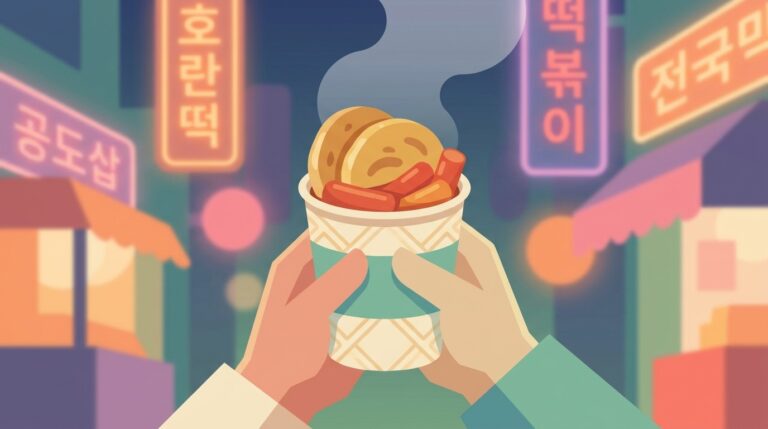
Hold It in a Paper Cup: The Secret Code of Korean Street Food
Phase 1: Welcome to the Streets of Seoul!
안녕하세요! (Annyeonghaseyo!) I am your friendly native Korean tutor and neighborhood cultural guide from Daily Hangul.
Imagine this: It is a chilly evening in Hongdae. The streets are glowing with neon signs, and a delicious, sweet scent fills the air. You follow your nose and find a cozy street food cart—what Koreans call a 포장마차 (Pojangmacha). You order a delicious, syrup-filled 호떡 (Hotteok – sweet pancake) or some spicy 떡볶이 (Tteokbokki – rice cakes).
But wait! Instead of a plate, the friendly stall owner (often called 이모님 – Imonim, meaning auntie) hands you your steaming hot food inside… a tiny, ordinary paper cup!
If you have watched K-dramas like Weightlifting Fairy Kim Bok-joo or My Mister, you have probably seen characters walking down the street, happily munching on food from these little cups. Eating street food from a paper cup is a true Korean cultural rite of passage.
By learning a few simple phrases today, you will not only avoid burning your fingers, but you will also order like a true Seoulite and get instant smiles from street vendors! Let’s dive in.
Phase 2: 3 Core Expressions to Eat Like a Local
1. 종이컵에 담아 주세요 (Jong-i-keop-e dam-a ju-se-yo)
- Pronunciation: Jong-ee-cup-eh dahm-ah joo-seh-yo
- Sound-alike Guide: “Jong-ee” (sounds like ‘joy’ but with an ‘ng’) + “cup” + “eh” + “dahm-ah” + “joo-seh-yo” (please give).
- Meaning: “Please put it in a paper cup.”
- K-Culture Moment: This is what you say when you want to eat your food immediately while walking around shopping or exploring.
- Editor’s Insight: This phrase is super polite and incredibly clear. It immediately tells the owner that you do not need a plastic bag or a seat; you are ready to enjoy it on the go!
- Situation Spectrum:
- Casual (Friends): ✅
- Semi-formal (Stall Owners): ✅
- Formal (Polite setting): ⚠️ (Street food is casual by nature, so this polite form is perfect here!)
- 🤔 Think About It: Why do you think Korean street food culture evolved around the humble paper cup instead of plastic containers?
2. 종이컵 하나만 더 주세요 (Jong-i-keop ha-na-man deo ju-se-yo)
- Pronunciation: Jong-ee-cup ha-na-mahn duh joo-seh-yo
- Meaning: “Please give me just one more paper cup.”
- K-Culture Moment: You bought a super hot 호떡 (Hotteok), and it is burning through your single cup. Or, you want to share your cup of 떡볶이 (Tteokbokki) with your travel buddy!
- Editor’s Insight: The word 하나만 (ha-na-man) means “only one,” and 더 (deo) means “more.” Asking for an extra cup to double-wrap your hot food is a classic local hack.
- Situation Spectrum:
- Casual: ✅
- Semi-formal: ✅
- Formal: ⚠️
- 🤔 Think About It: Sharing is a huge part of Korean food culture. How does your home country view sharing small street snacks?
3. 들고 갈게요 (Deul-go gal-ge-yo)
- Pronunciation: Deul-go gahl-gheh-yo
- Meaning: “I will take it on the go (while holding it).”
- K-Culture Moment: The vendor asks if you want to eat at the stall stand or take it away. You want to walk and eat.
- Editor’s Insight: This literally translates to “I will hold and go.” It is much more natural than saying the textbook “포장해 주세요” (Please wrap/pack it) when you do not need a plastic bag.
- Situation Spectrum:
- Casual: ✅
- Semi-formal: ✅
- Formal: ⚠️
- 🤔 Think About It: In Korean, the action of “holding” (들다 – deul-da) and “going” (가다 – ga-da) combine into one fluid concept. Isn’t it efficient?
Phase 3: Textbook Korean vs. Real Korean
Sometimes, learning straight from a dictionary makes you sound like a robot. Let’s look at the difference!
Scenario 1: Ordering street food to eat while walking
- 📖 Textbook Korean: 여기서 먹는 것을 포장해 주세요. (Yeo-gi-seo meok-neun geos-eul po-jang-hae ju-se-yo.) -> “Please package the thing that I eat here.”
- 🗣️ Real Korean: 들고 갈게요! (Deul-go gal-ge-yo!) -> “I’ll carry it on the go!”
- 💡 Why is it different? Koreans value speed and efficiency (빨리빨리 – Ppalli-ppalli culture). Saying “들고 갈게요” is short, sweet, and perfectly clear.
Scenario 2: Asking for a skewer/toothpick to pick up your food
- 📖 Textbook Korean: 이쑤시개를 주시겠습니까? (I-ssu-si-gae-reul ju-si-ges-seup-ni-ka?) -> “Would you please bestow a toothpick upon me?”
- 🗣️ Real Korean: 꼬치 하나 주세요. (Kko-chi ha-na ju-se-yo.) -> “Please give me a skewer.”
- 💡 Why is it different? At street stalls, we use long wooden skewers (꼬치 – kko-chi) rather than tiny toothpicks. Asking for a “꼬치” makes you sound like an experienced street food lover.
Phase 4: K-Culture Deep Dive & Non-verbal Manners
4-1. The “Paper Cup Fold” Masterclass (Non-verbal Gesture)
When eating a round, hot pancake like Hotteok, do not just hold the cup. Gently pinch and fold the bottom half of the paper cup inward. This pushes the hot pancake upward so you can take a bite without your lips touching the hot paper edges!
Also, remember: when receiving your hot cup from an older vendor, always accept it with both hands as a sign of respect.
4-2. The Spirit of “Jeong” (정) on the Street
In Korea, street food is not just about fuel; it is about human connection. When you stand near the steaming hot pots of a Pojangmacha, the owner might offer you a free cup of warm fish cake broth (어묵 국물 – Eomuk guk-mul). This acts as a warm welcome. It is polite to drink it happily and say: “국물 너무 맛있어요!” (Guk-mul neo-mu ma-si-sseo-yo! – The broth is so delicious!)
Phase 5: Roleplay Scenario – Cozy Night in Hongdae
Setting: It is 9:00 PM. The street smells like toasted sugar. You approach a bright red cart with steam rising into the night air. The friendly female owner (Imo-nim) smiles at you.
- Imo-nim (이모님): 어서 오세요! 뭐 드릴까요?
(Eo-seo o-se-yo! Mwo deu-ril-kka-yo?)
(🎭 Smiling warmly, waving her tongs)
“Welcome! What can I get you?” -
You (너): 안녕하세요! 혹시 호떡 있어요?
(An-nyeong-ha-se-yo! Hok-si ho-tteok i-sseo-yo?)
(🎭 Pointing gently to the sweet griddle)
“Hello! Do you happen to have hotteok?” -
Imo-nim (이모님): 그럼요! 지금 바로 만들어 줄게요. 하나?
(Geu-reom-yo! Ji-geum ba-ro man-deul-eo jul-ge-yo. Ha-na?)
(🎭 Flipping a fresh golden pancake)
“Of course! I will make it right now. Just one?” -
You (너): 네, 하나 주세요. 들고 갈게요.
(Ne, ha-na ju-se-yo. Deul-go gal-ge-yo.)
(🎭 Nodding your head politely)
“Yes, one please. I’ll take it on the go.” -
Imo-nim (이모님): 자, 여기요! 뜨거우니까 조심해요!
(Ja, yeo-gi-yo! Tteu-geo-u-ni-ka jo-sim-hae-yo!)
(🎭 Placing the hot pancake inside a paper cup and handing it over)
“Here you go! Be careful, it’s hot!” -
You (너): 아, 진짜 뜨겁네요! 이모님, 종이컵 하나만 더 주세요.
(Ah, jin-jja tteu-geop-nae-yo! I-mo-nim, jong-i-keop ha-na-man deo ju-se-yo.)
(🎭 Blowing air on your fingers with a sheepish smile)
“Ah, it really is hot! Imo-nim, please give me one more paper cup.” -
Imo-nim (이모님): 아이고, 미안해요! 여기 하나 더!
(Ai-go, mi-an-hae-yo! Yeo-gi ha-na deo!)
(🎭 Handing you an extra cup with a motherly laugh)
“Oh dear, sorry! Here is one more!” -
You (너): 감사합니다! 잘 먹을게요!
(Gam-sa-ham-ni-da! Jal meok-eul-ge-yo!)
(🎭 Bowing slightly and holding the double-cup safely with both hands)
“Thank you! I will eat it well!”
🔀 Decision Point!
What should you do with your empty paper cup when you are finished eating?
* Choice A: Drop it on the street next to the cart.
* Choice B: Hand it back to the Imo-nim and ask: “이거 버려 주실 수 있나요?” (Can you throw this away for me?)
* Choice C: Put it in your backpack and carry it back to your hotel.
The Best Choice is B! Most street food owners are happy to take back their own paper cups and dispose of them in their private trash bins. Saying “감사합니다! (Thank you!)” as you hand it back will make their day!
Phase 6: 10-Second Emotion Shadowing Drill
Let’s practice speaking with real Korean feelings! Pay attention to the pauses marked by /.
- [🥺 Needing help / Feeling hot]
- “아 뜨거워요! / 종이컵 하나만 / 더 주세요!”
- Ah tteu-geo-wo-yo! / Jong-i-keop ha-na-man / deo ju-se-yo!
- (Ah, it’s hot! / One paper cup / more please!)
- [😊 Brightly / On the go]
- “여기서 안 먹고 / 들고 갈게요!”
- Yeo-gi-seo an meok-go / deul-go gal-ge-yo!
- (I’m not eating here / I’ll take it to go!)
Phase 7: K-Culture Mini Dictionary
- 포장마차 (Pojangmacha): Traditional tented street food stalls. Perfect for late-night snacks and deep conversations.
- 이모님 (Imonim): Literally “maternal aunt.” It is the friendliest way to address female street food and restaurant owners.
- 꼬치 (Kko-chi): Skewers. Essential for picking up street food like tteokbokki and fish cakes without getting your hands dirty.
- 종이컵 (Jong-i-keop): Paper cup. Not just for coffee—it is Korea’s ultimate eco-friendly, portable street bowl.
Phase 8: Traveler’s Survival Kit
Top 3 Street Survival Phrases:
- “얼마예요?” (Eol-ma-yeo-yo?) – “How much is it?”
- “카드 돼요?” (Ka-deu dwae-yo?) – “Do you accept card?” (Pro Tip: Some small carts prefer cash or bank transfers, so keeping some 1,000 KRW bills handy is highly recommended!)
- “안 맵게 해 주세요.” (An maep-ge hae ju-se-yo.) – “Please make it not spicy.”
📌 Editor’s Travel Note: To locate the best authentic local markets (like Mangwon Market or Gwangjang Market), avoid using Google Maps as it is not fully updated in Korea. Instead, search on the Naver Map app download page to find direct transit routes and real-time reviews.
Phase 9: Deep Thoughts — “One Step Deeper”
Korean street food is an amazing lens into the country’s social fabric. In a society that is highly structured and professional, the Pojangmacha represents a democratic space where class, status, and age disappear. Whether you are a CEO in a luxury suit or a university student, everyone stands side-by-side around the same metal grill, holding their humble paper cups. It shows that warmth and community are never far away in busy Seoul.
💬 Your Turn: Does your hometown have a unique way of serving street food? Do you use cups, papers, or leaves? Let us know in the comments below!
Phase 10: FAQ & Common Mistakes
Q: Can I sit down at the stall table if I am eating from a paper cup?
A: Yes, but with a catch. If you sit at a Pojangmacha table, it is usually expected that you order a full portion or a drink. If you only bought one cheap 1,500 KRW hotteok in a cup, it is polite to stand up or eat while walking.
Q: Is it rude to walk and eat in Korea?
A: Generally, no. While older generations prefer sitting down to eat, street food is the big exception. Everyone walks and eats street food! Just be careful not to bump into people and spill your red spicy sauce.
Q: Can I reuse my paper cup for multiple stalls?
A: Better not. It is cleaner and more respectful to use a fresh cup provided by each specific vendor.
🚨 Common Mistakes Alert!
- Squeezing the cup too hard: Street food cups are soft. If you squeeze too hard, hot syrup or soup can shoot out. Hold it gently by the dry rim!
- Calling the vendor “할머니” (Halmeoni – Grandma): Even if the owner looks older, stick to 이모님 (Imonim). It sounds much younger and sweeter!
Phase 11: Daily Hangul Action Missions!
- 🥉 Bronze Mission: Practice saying “종이컵에 담아 주세요” (Please put it in a paper cup) 3 times out loud in front of a mirror!
- 🥈 Silver Mission: Take a photo of your favorite snack at home, put it in a cup, and post it online with the caption: “들고 갈게요!”
- 🥇 Gold Mission: Visit a local Korean market (or your closest Korean grocery store street corner) and order your food using today’s phrases!
Phase 12: Interactive Quiz Challenge
1. Which phrase should you say if your Hotteok is too hot to hold?
- A) 맛없어요 (Mat-eop-seo-yo)
- B) 종이컵 하나만 더 주세요 (Jong-i-keop ha-na-man deo ju-se-yo)
- C) 집에 갈게요 (Jib-e gal-ge-yo)
2. True or False: It is polite to receive the paper cup with only one hand.
- A) True
- B) False
🔍 Click here for the answers and explanations!
- Correct Answer: B (Asking for an extra cup helps protect your hands! Choice A means “It tastes bad,” and Choice C means “I’m going home.”)
- Correct Answer: B (False) (Always receive items from vendors, especially those older than you, with both hands to show respect!)







