

How to Order and Pack Desserts in Korea Like a K-Drama Pro
안녕하세요! (An-nyeong-ha-se-yo! – Hello!) Welcome back to Daily Hangul, your friendly neighborhood Korean guide. I’m your senior editor and tutor, here to make sure your next trip to a trendy cafe in Seoul goes smoother than a freshly whipped dalgona coffee!
Phase 1: Picture This – The Sweet Escape
You’re walking down the beautiful streets of Hongdae. It is a crisp autumn afternoon, just like a scene from your favorite K-Drama. You step into a gorgeous Hanok-style cafe, and the sweet smell of freshly baked croissants and strawberry cakes fills the air. You want to buy a delicious slice of cake to eat later at the Han River park while watching the sunset.
But as you approach the counter, your heart starts racing. How do you say “to-go” for desserts? Is it different from ordering a coffee? What if they ask if you need an ice pack?
Don’t worry! Today, we are going to learn how to pack desserts (디저트 포장 – di-jeo-teu po-jang) with confidence. By the end of this guide, you will sound so natural that the barista might mistake you for a local!
Phase 2: The Big 3 – Core Expressions for Dessert Packaging
Let’s master the three magic phrases you need at any Korean cafe counter.
1. 포장해 주세요 (Po-jang-hae ju-se-yo)
- Pronunciation: [Po-jang-hae ju-se-yo] / Sound-alike: “Poh-jahng-heh Joo-seh-yo”
- Meaning: Please wrap it up / Please pack it to-go.
- K-Culture Moment: You often see characters in dramas buying sweet macarons or cakes in pretty boxes to apologize to their friends or surprise a coworker. This is the exact phrase they use!
- Editor’s Insight: While you can use “테이크아웃” (te-i-keu-a-ut / take-out) for coffee, Koreans almost always use 포장 (po-jang – packaging/wrapping) for food and desserts.
- Situation Spectrum:
- Casual (Friends): ✅
- Semi-formal (Cafes/Restaurants): ✅
- Formal (Polite/Elderly): ✅
- 🤔 Think About It: In English, we say “to-go” or “take-out”. In Korean, the word 포장 literally means “wrapping” or “packaging”. Why do you think Korean culture focuses on the act of “wrapping”? It shows care and respect for the food and the person receiving it!
2. 따로 담아주세요 (Tta-ro dam-a-ju-se-yo)
- Pronunciation: [Tta-ro dam-a-ju-se-yo] / Sound-alike: “Tah-roh dahm-ah-joo-seh-yo”
- Meaning: Please pack them separately.
- K-Culture Moment: Imagine buying a hot egg tart and a cold strawberry cream cake. You don’t want them in the same box, right? Use this phrase to keep them separated!
- Editor’s Insight: 따로 (tta-ro) means “separately” and 담아주세요 (dam-a-ju-se-yo) means “please put/contain”. It’s a lifesaver when buying multiple desserts.
- Situation Spectrum:
- Casual (Friends): ✅
- Semi-formal (Cafes/Restaurants): ✅
- Formal (Polite/Elderly): ✅
3. 가면서 먹을게요 (Ga-myeon-seo meog-eul-ge-yo)
- Pronunciation: [Ga-myeon-seo meog-eul-ge-yo] / Sound-alike: “Gah-myuhn-suh muhg-eul-geh-yo”
- Meaning: I will eat it on the way (while walking).
- K-Culture Moment: Eating hot hotteok (sweet pancakes) or street churros while walking around the romantic streets of Samcheong-dong is a classic travel experience.
- Editor’s Insight: Use this when you don’t need fancy box wrapping, just a simple paper napkin or a small paper cup to hold the dessert while you walk.
- Situation Spectrum:
- Casual (Friends): ✅
- Semi-formal (Cafes/Restaurants): ✅
- Formal (Polite/Elderly): ⚠️ (Slightly casual, but still polite enough for quick street food interaction)
Phase 3: Textbook Korean vs. Real-World Korean
Let’s look at how textbooks teach you, versus how real Koreans actually talk!
Situation 1: Ordering a dessert to-go
- 📖 Textbook Korean: 이것을 가지고 가겠습니다. (I-geos-eul ga-ji-go ga-ges-seub-ni-da.) – “I will take this and go.” (Too formal and robotic!)
- 🗣️ Real Korean: 포장해 주세요. (Po-jang-hae ju-se-yo.) – “Please pack it to-go.” (Natural and friendly!)
- 💡 Why the difference? Koreans value efficiency and speed, especially in busy cafes. “포장해 주세요” is the fastest and most natural way to get your point across.
Situation 2: Asking for separate bags
- 📖 Textbook Korean: 봉투 두 개에 각각 넣어 주십시오. (Bong-tu du gae-e gak-gak neo-eo ju-sip-si-o.) – “Please put them into two bags respectively.” (Sounds like a military command!)
- 🗣️ Real Korean: 따로 담아주세요. (Tta-ro dam-a-ju-se-yo.) – “Please pack them separately.” (Soft, polite, and short.)
- 💡 Why the difference? Subject pronouns and overly complex grammar are dropped in conversational Korean to make interactions warmer and smoother.
Phase 4: K-Culture Deep Dive & Non-Verbal Manners
4-1. The Art of the Polite Nod (Nunchi & Body Language)
When ordering at a Korean cafe, you don’t need to make intense eye contact. Instead, keep a friendly smile and give a slight bow/nod of your head when saying 감사합니다 (Gam-sa-ham-ni-da – Thank you).
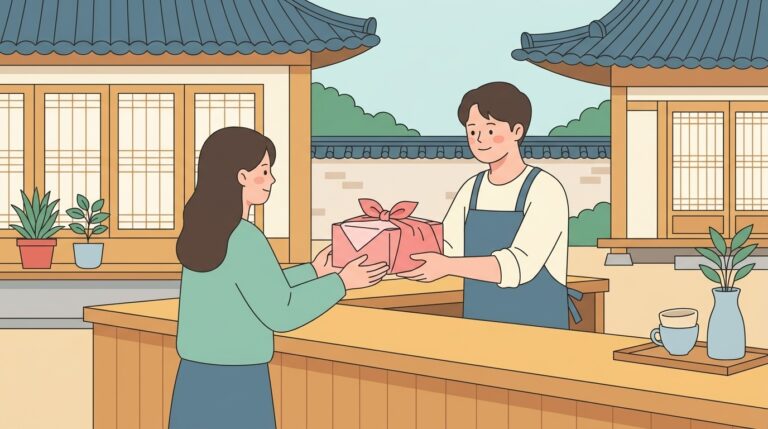
When receiving your beautifully wrapped dessert, always receive the bag with both hands. Using two hands is a sign of respect in Korea. If you grab it with one hand carelessly, it can look a bit rude!
4-2. The “Dessert Belly” Culture (디저트 배)
Koreans have a famous saying: “디저트 배는 따로 있다” (Di-jeo-teu bae-neun tta-ro it-da), which means “There is a separate stomach for dessert.” No matter how full you are after eating Korean BBQ, you must visit a cafe for a croffle (croissant-waffle), bingsu (shaved ice), or cake!
Phase 5: Live Roleplay – The Hanok Cafe Challenge
Let’s practice! Imagine you are at a famous cafe in Seoul. Your barista is Ji-su, a friendly local.
- Setting: A warm afternoon at a busy cafe. Jazz music is playing.
- Cast: Ji-su (The Barista) and You (The Sweet-Toothed Traveler).
1. Ji-su: 안녕하세요! 주문하시겠어요?
(An-nyeong-ha-se-yo! Ju-mun-ha-si-ges-seo-yo?)
🎭 (Smiling warmly, waiting for your order)
“Hello! Would you like to order?”
2. You: 네, 아이스 아메리카노 한 잔이랑 초코 케이크 하나 주세요.
(Ne, a-i-seu a-me-ri-ka-no han jan-i-rang cho-ko ke-i-keu ha-na ju-se-yo.)
🎭 (Pointing at the menu board politely)
“Yes, one iced Americano and one chocolate cake, please.”
3. Ji-su: 케이크는 드시고 가시나요?
(Ke-i-keun-eun deu-si-go ga-si-na-yo?)
🎭 (Holding a small cake box, ready to pack)
“Will you have the cake in the shop?”
4. You: 아니요, 포장해 주세요.
(A-ni-yo, po-jang-hae ju-se-yo.)
🎭 (Answering clearly with a friendly smile)
“No, please pack it to-go.”
5. Ji-su: 아, 네! 커피랑 케이크 같이 담아드릴까요?
(A, ne! Keo-pi-rang ke-i-keu gat-i dam-a-deu-ril-ka-yo?)
🎭 (Tilting her head slightly to ask)
“Ah, yes! Shall I pack the coffee and cake together?”
6. You: 아니요, 따로 담아주세요.
(A-ni-yo, tta-ro dam-a-ju-se-yo.)
🎭 (Using both hands to gesture separation gently)
“No, please pack them separately.”
7. Ji-su: 네, 알겠습니다. 쇼핑백은 필요하신가요? 100원 추가됩니다.
(Ne, al-get-seub-ni-da. Syo-ping-baeg-eun pil-yo-ha-sin-ga-yo? Baeg-won chu-ga-doem-ni-da.)
🎭 (Pointing to the small paper shopping bag)
“Okay, understood. Do you need a shopping bag? It is an extra 100 won.”
8. You: 네, 쇼핑백 주세요.
(Ne, syo-ping-baeg ju-se-yo.)
🎭 (Nodding politely)
“Yes, please give me a shopping bag.”
9. Ji-su: 진동벨 가지고 잠시만 기다려주세요.
(Jin-dong-bel ga-ji-go jam-si-man gi-da-ryeo-ju-se-yo.)
🎭 (Handing you a round plastic buzzer)
“Please wait a moment with the buzzer.”
10. You: 감사합니다!
(Gam-sa-ham-ni-da!)
🎭 (Receiving the buzzer with both hands and bowing slightly)
“Thank you!”
🔀 Decision Point!
When Ji-su asks if you need a shopping bag (쇼핑백), what is the best choice?
- A) “네, 주세요” (Ne, ju-se-yo / Yes, please): [BEST CHOICE] In Korea, cafes are legally required to charge 100 won (~$0.08 USD) for plastic or paper bags to protect the environment. Saying yes is normal and convenient!
- B) “아니요, 괜찮아요” (A-ni-yo, gwen-cha-na-yo / No, thank you): Good if you have your own eco-bag!
- C) “그냥 주세요” (Geu-nyang ju-se-yo / Just give it to me): Be careful! If you say this without a bag, you will have to carry the loose cake box and cold coffee in your bare hands while walking. Highly risky for clumsy dessert lovers!
Phase 6: 10-Second Shadowing Drill
Let’s practice speaking with real Korean feelings! Pay attention to the slash (/) pauses.
- [😊 Friendly and Polite]
포장해 / 주세요!
(Po-jang-hae / ju-se-yo!)
Pause slightly after “Po-jang-hae” and finish with a soft, rising tone at “ju-se-yo!” -
[🥺 Careful and Precise]
따로 / 담아주세요.
(Tta-ro / dam-a-ju-se-yo.)
Emphasize the double ‘T’ sound in “Tta-ro” quickly, then say “dam-a-ju-se-yo” smoothly.
Phase 7: K-Culture Mini Dictionary
| Keyword | Meaning | How it is used |
|---|---|---|
| 포장 (Pojang) | To-go / Packaging | Used when buying any food or bakery item to take home. |
| 진동벨 (Jindongbel) | Buzzing pager | The wireless buzzer cafes hand you so you know when your dessert is ready. |
| 서비스 (Seobiseu) | Free of charge / Bonus | Sometimes, if you order a lot of desserts, the owner might slide a free cookie in your bag saying: “서비스예요!” (It’s a free gift!) |
| 디저트 배 (Dessert-bae) | Dessert stomach | The imaginary extra stomach everyone has reserved strictly for sweet treats. |
Phase 8: Traveler’s Survival Kit
TOP 3 Emergency Phrases
- 포크 두 개 주세요 (Po-keu du gae ju-se-yo)
- Meaning: Please give me two forks.
- Pro Tip: Perfect when sharing a dessert with a friend.
- 물티슈 좀 주세요 (Mul-ti-syu jom ju-se-yo)
- Meaning: Please give me some wet wipes.
- Pro Tip: Extremely useful when eating sticky pastries like donuts or croissants.
- 빨대 주세요 (Ppal-dae ju-se-yo)
- Meaning: Please give me a straw.
📌 Editor’s Travel Note: When navigating the bustling cafe streets of Seoul, Google Maps doesn’t work very well. Make sure to download the Naver Map app download page to find hidden dessert gems down narrow alleys! Also, tip culture does not exist in Korea, so you don’t need to leave any extra money at the counter.
Phase 9: Deep Reflection – One Step Deeper
In many Western cultures, takeaway packaging is simple—often just a brown paper bag. But in Korea, even a single macaron is packaged beautifully with colorful ribbons, custom boxes, and small ice packs to prevent melting. This reflects the Korean culture of 정 (Jeong – affection and caring). Giving someone food in a pretty package is a way of showing deep care and sincerity. Next time you receive a beautifully wrapped cake, take a moment to enjoy the thoughtful packaging!
💬 Your Turn: How does your hometown handle dessert packaging? Do cafes wrap things with ribbons, or is it simple? Let me know in the comments below!
Phase 10: FAQ & Common Mistakes
Q: Can I use “테이크아웃” (Take-out) for desserts?
A: Yes, baristas will understand you. However, “테이크아웃” is mostly used for drinks. For food, bread, and cakes, “포장” (po-jang) is much more natural and preferred.
Q: What should I say if I want an ice pack for my cream cake?
A: You can ask: “아이스팩 넣어주세요” (A-i-seu-paek neo-eo-ju-se-yo – Please put an ice pack in).
Q: Can I eat my packed dessert inside the cafe?
A: No. Due to Korean tax and environmental laws, if you order your food “to-go” (포장), you cannot sit at the indoor cafe tables to eat it.
🚨 Common Mistakes Alert!
- Mistake 1: Saying “밖에서 먹을게요” (Bag-es-seo meog-eul-ge-yo) thinking it means “I’ll eat outside”. It sounds unnatural. Use “포장해 주세요” instead.
- Mistake 2: Grabbing the box with one hand. Always use two hands to show respect to the server.
Phase 11: Your Mission Today
Let’s put your skills to the test with three levels of challenges!
- 🥉 Bronze (At-Home Challenge): Stand in front of your mirror and say “포장해 주세요” three times with a bright smile!
- 🥈 Silver (Social Challenge): Take a photo of your favorite sweet treat, post it on social media, and caption it: “I want to eat this in Seoul! 포장해 주세요!”
- 🥇 Gold (Real-World Challenge): Next time you visit an Asian bakery or Korean cafe in your city, try ordering in Korean!
Phase 12: Interactive Quiz Challenge
Test your dessert ordering knowledge!
1. Which phrase should you use to pack a slice of cake to-go?
- A) 마셔요 (Ma-syeo-yo)
- B) 포장해 주세요 (Po-jang-hae ju-se-yo)
- C) 앉으세요 (An-jeu-se-yo)
Reveal Answer
Answer: B!
“포장해 주세요” means “Please pack it to-go”. A means “drink”, and C means “please sit”.
2. True or False: In Korea, it is polite to receive your dessert bag with only one hand.
Reveal Answer
Answer: False!
Always use both hands to receive items from others to show respect and polite manners.
Great job today! You are officially ready to conquer the dessert cafes of Seoul. Keep practicing, and remember—your dessert stomach (디저트 배) is always ready for more Korean! See you in the next lesson!






