

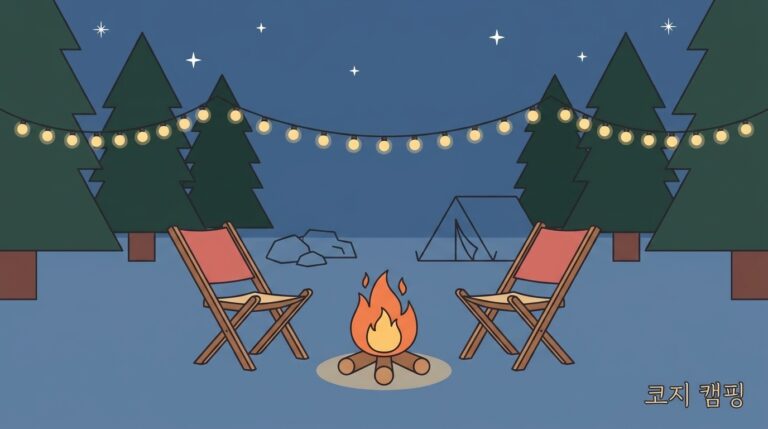
Unlocking the Korean Campfire Vibe: The Ultimate Guide to Bul-meong and Aesthetic Camping Culture
Phase 1: Empathy (Welcome to the Cozy Fireplace)
안녕하세요! (An-nyeong-ha-se-yo!) Welcome back to Daily Hangul, your premium guide to the heart and soul of Korean language and culture. I’m your senior editor and cultural guide, bringing you the warmest insights straight from the streets—and campsites—of Korea.
Have you ever watched a K-Drama where the main characters escape the chaotic city life of Seoul, head to a quiet forest in Gapyeong, and sit around a beautifully lit tent under strings of glowing fairy lights? They sit in silence, staring intently at the crackling campfire, holding a warm cup of coffee. No one says a word, yet the silence is incredibly comfortable.
If you’ve felt a sudden urge to jump through your screen and join them, you’re experiencing the core of modern Korean youth culture: 감성 캠핑 (Gam-seong kaem-ping – Aesthetic Camping) and the magical art of 불멍 (Bul-meong – Fire Gazing).
In high-stress, fast-paced Korea, camping isn’t just about survival or rugged outdoor skills. It has evolved into a highly curated, deeply comforting therapeutic ritual. Knowing how to talk about these experiences like a true local will instantly make you the star of any outdoor gathering. Let’s dive into the essential expressions and cultural codes that will turn you into an insider!
Phase 2: Deep Dive into 3 Core Expressions
1. 불멍 (Bul-meong)
- Pronunciation: [Bul-meong] / Sound-alike: “Bull” + “mung” (like the sound of a dog’s bark but softer)
- Meaning: Staring blankly at a campfire to empty one’s mind (Fire Gazing).
- K-Culture Moment: In the healing K-Drama Hospital Playlist, the characters often escape to camp sites, sit in folding chairs, and engage in “불멍” to wash away the stress of the hospital operating rooms.
- Editor’s Insight: The word is a compound of 불 (bul – fire) and 멍하니 (meong-ha-ni – blankly/spacing out). It’s not just looking at fire; it is an active state of doing absolutely nothing to heal your brain.
- Situation Spectrum:
- Friends & Casual: ✅
- Co-workers & Semi-formal: ✅
- Superiors & Formal: ⚠️ (Acceptable in casual conversations about weekend hobbies, but use polite endings: “불멍을 좋아합니다”)
- 🤔 Think About It: Why does Korean culture have so many specific words for “spacing out” (e.g., 물멍 – staring at water, 숲멍 – staring at the forest)? What does this tell us about the need for mental rest in modern society?
2. 감성 캠핑 (Gam-seong kaem-ping)
- Pronunciation: [Gam-seong kaem-ping] / Sound-alike: “Gahm-seong” (gourmet-vibe sound) + “Camping”
- Meaning: Aesthetic, cozy, and highly photogenic camping.
- K-Culture Moment: You’ll see this all over Instagram (under the hashtag #감성캠핑). It involves wooden tables, warm-toned Edison bulbs, vintage lanterns, and beautifully color-coordinated blankets.
- Editor’s Insight: “감성” means sensibility or emotion. When Koreans add “감성” to anything (like 감성 카페, 감성 캠핑), it means the visual vibe, atmosphere, and emotional comfort take priority over practical utility.
- Situation Spectrum:
- Friends & Casual: ✅
- Co-workers & Semi-formal: ✅
- Superiors & Formal: ⚠️
- 🤔 Think About It: Compare “survival camping” to “gamsung camping.” How does our perception of nature change when we focus on making the outdoors look like a cozy living room?
3. 장박 (Jang-bak)
- Pronunciation: [Jang-bak] / Sound-alike: “Jahng” + “bahk” (like the park but with a ‘b’)
- Meaning: Long-term seasonal camping (leaving your tent pitched at a campsite for months).
- K-Culture Moment: Popularized by busy city dwellers who want a weekend villa without the high cost. They set up an elaborate, insulated tent in October and leave it there until March to visit every weekend.
- Editor’s Insight: A compound of 장기 (jang-gi – long term) and 숙박 (suk-bak – lodging). It represents the ultimate dedication to the camping lifestyle.
- Situation Spectrum:
- Friends & Casual: ✅
- Co-workers & Semi-formal: ✅
- Superiors & Formal: ✅
- 🤔 Think About It: In many Western countries, camping means moving to different wild spots. Why do you think static “장박” became so popular in Korea’s organized campsite system?
Phase 3: Textbook Korean vs. Real Korean Showcase
Let’s look at how native Koreans actually talk about their camping experiences compared to rigid textbook lessons.
Situation 1: Inviting a friend to look at the campfire
- 📖 Textbook Korean: “우리 같이 모닥불을 감상합시다.” (Let us appreciate the campfire together.)
- 🗣️ Real Korean: “우리 이제 슬슬 불멍할까?” (Shall we start doing some ‘bul-meong’ now?)
- 💡 Why the difference?: The textbook version sounds like a formal poetry reading. Real Koreans use “슬슬” (seul-seul – gently/gradually) and the trendy noun-turned-verb “불멍하다” to create a relaxed, cozy invitation.
Situation 2: Commenting on a beautiful campsite setup
- 📖 Textbook Korean: “텐트의 야간 조명 시설이 매우 아름답습니다.” (The night lighting facilities of the tent are very beautiful.)
- 🗣️ Real Korean: “와, 전구 다니까 감성 대박이다!” (Wow, now that the lights are up, the vibe is absolutely insane!)
- 💡 Why the difference?: Locals rarely say “조명 시설” (lighting facilities). They refer to fairy lights simply as “전구” (bulbs) or “조명” (lights), and express admiration using “감성 대박” (emotional vibe is huge/amazing).
Phase 4: K-Culture Deep Dive & Non-verbal Manners
4-1. Nunchi (눈치) & Campfire Etiquette
To truly fit in at a Korean campsite, you must practice high-level 눈치 (Nunchi – situational quick-wittedness). Korean campsites are highly organized, social communities.
* 매너타임 (Manner Time): This is the most crucial camping rule in Korea. Usually starting at 10 PM, “매너타임” requires all campers to lower their voices, turn off bright lights, and play music only through personal earphones. Loud behavior during Manner Time is considered a major social faux pas.
* 분리수거 (Trash Separation): When you pack up, you are expected to sort your plastic, vinyl, glass, and food waste perfectly. Leaving even a small piece of trash behind ruins the “gamsung” for the next camper.
4-2. The Flavor of Bul-meong: K-Food Rituals
You cannot separate Korean camping from food. While Westerners roast s’mores, Koreans have their own campfire culinary delights:
* 군고구마 (Gun-goguma): Wrapping sweet potatoes in aluminum foil and tossing them directly into the embers of your “불멍” fire. When pulled out, they are soft, sweet, and steaming hot.
* 반건조 오징어 (Ban-geon-jo o-jing-eo): Semi-dried squid toasted over the open flames, served with a dipping sauce of mayonnaise, soy sauce, and chopped hot peppers.
Phase 5: Interactive Roleplay Scenario
The Setting: A chilly October evening at a gorgeous pine forest campsite in Gapyeong. The air is crisp, pine scent fills the air, and warm string lights hang from the trees. You are sitting on a folding canvas chair next to Min-woo (민우), your camping-expert Korean friend.
Cast:
- You: A passionate traveler learning the secrets of Korean camping.
- Min-woo (민우): A warm, aesthetic-obsessed camper who brought three different types of vintage lanterns.
The Dialogue
- 민우: (Satisfied sigh, rubbing hands) 날씨 진짜 딱 좋다. 춥지도 않고 덥지도 않고.
(Nal-ssi jin-jja ttak jo-ta. Chup-ji-do an-go deop-ji-do an-go.)
“The weather is seriously perfect. Not too cold, not too hot.” -
You: (Nodding happily) 맞아요. 서울에서 벗어나니까 공기가 달라요.
(Ma-ja-yo. Seo-ul-e-seo beot-eo-na-ni-kka gong-gi-ga dal-la-yo.)
“Indeed. Now that we’ve escaped Seoul, the air feels different.” -
민우: (Points at the fire pit) 자, 이제 슬슬 캠핑의 하이라이트를 시작해야지?
(Ja, i-je seul-seul kaem-ping-ui ha-i-ra-i-teu-reul si-jak-hae-ya-ji?)
“Now, shall we slowly start the highlight of camping?” -
You: 오! 드디어 불멍 타임인가요?
(O! Deu-di-eo bul-meong ta-im-in-ga-yo?)
“Oh! Is it finally ‘bul-meong’ time?” -
민우: (Beaming) 역시 센스 있네! 장작 더 넣을 테니까 잠깐 기다려 봐.
(Yeok-si sen-seu in-ne! Jang-jak deo neo-eul te-ni-kka jam-kkan gi-da-ryeo bwa.)
“As expected, you’ve got great sense! I’ll throw in more firewood, so hold on a second.” -
You: (Looking at the vintage lights) 근데 이 조명 진짜 예뻐요. 완전 감성 캠핑 느낌이에요.
(Geun-de i jo-myeong jin-jja yeop-peo-yo. Wan-jeon gam-seong kaem-ping neu-kkim-i-e-yo.)
“By the way, these lights are gorgeous. It feels totally like ‘aesthetic camping’.” -
민우: (Laughs) 장비 사느라 내 통장이 텅장 되었잖아. 그래도 예쁘니까 괜찮아!
(Jang-bi sa-neu-ra nae tong-jang-i teong-jang doe-eot-jan-a. Geu-rae-do yeop-peu-ni-kka gwen-chan-a!)
“I spent so much on gear that my bank account is empty! But since it’s pretty, it’s fine!” -
You: (Laughs) 대단해요! 가끔 이렇게 비우는 시간도 필요하죠.
(Dae-dan-hae-yo! Ga-kkeum i-reo-ke bi-u-neul si-gan-do pil-yo-ha-jyo.)
“That’s amazing! Sometimes we need this kind of time to empty our minds.” -
민우: (Hands you a small packet of colorful powder) 이거 볼래? 이거 불에 넣으면 초록색, 파란색 불꽃이 나오거든. 해볼래?
(I-geo bol-rae? I-geo bul-e neo-eum-yeon cho-rok-saek, pa-ran-saek bul-kkot-i na-o-geu-deun. Hae-bol-rae?)
“Want to see this? If you throw this in the fire, green and blue flames come out. Want to try?”
🔀 Decision Point: What do you say to Min-woo?
- Option A: “우와, 대박! 이거 SNS에서 봤어요. 당장 넣어봐요!” (Wow, amazing! I saw this on social media. Let’s put it in right now!)
- Option B: “불은 그냥 빨간색이 좋은데요. 안 넣을래요.” (I prefer natural red fire. I don’t want to put it in.)
- Option C: “이거 몸에 해로운 화학 물질 아닌가요?” (Isn’t this a chemical substance harmful to the body?)
Best Choice: Option A
- Why: You enthusiastically match Min-woo’s efforts to create a perfect “aesthetic” night. Using terms like “대박” (dae-bak – awesome) and mentioning “SNS” (social media) shows you understand modern Korean visual culture.
Risk/Bad Choices: Option B & C
- Why: While practically correct, Option B and C are absolute mood-killers (called 분위기 깨다 in Korean). They disregard the effort your friend made to bring unique “gamsung” accessories to make your night special.
Phase 6: 10-Second Shadowing Drill
Let’s inject some real soul and emotion into your Korean speaking! Practice these phrases with the recommended emotional guides:
1. Expressing absolute delight at the visual setup
“여기 / 진짜 / 감성 장난 아니다!”
* Pronunciation: [Yeo-gi / jin-jja / gam-seong / jang-nan a-ni-da!]
* Emotion: [😊 Delighted, eyes wide open, emphasizing “장난 아니다” (no joke/insane)]
2. Suggesting a peaceful quiet moment
“우리 이제 / 조용히 / 불멍하자.”
* Pronunciation: [U-ri i-je / jo-yong-hi / bul-meong-ha-ja.]
* Emotion: [🥺 Cozy, quiet tone, speaking softly to match the crackling fire]
Phase 7: K-Culture Mini Dictionary
| Word (Korean + Romanization) | English Meaning | Cultural Context & Usage |
|---|---|---|
| 장비빨 (Jang-bi-bpal) | The Power of Gear / Equipment Flex | Used when someone relies on expensive, top-tier gear to look professional in sports, photography, or camping. |
| 불안멍 (Bul-an-meong) | Indoor fire gazing | Gazing at artificial LED fireplace heaters in micro-apartments where real campfires are forbidden. |
| 매너타임 (Maen-eo-ta-im) | Camp Manner Time | The sacred unspoken contract of Korean campsites—silence is gold after 10 PM. |
| 홈캠핑 (Hom-kaem-ping) | Home Camping | Transforming balconies or living rooms into mini campsites using artificial grass, folding chairs, and string lights. |
Phase 8: Traveler’s Survival Kit
Are you planning a trip to a Korean glamping site or campsite? Keep these three emergency sentences handy!
Survival Cards
- “장작 한 상자 더 주실 수 있나요?”
- [Jang-jak han sang-ja deo ju-sil su in-na-yo?]
- Meaning: “Could I please get one more box of firewood?”
- Pro Tip: If you run out of fuel mid-bulmeong, head to the campsite store (매점) and use this phrase.
- “여기 매너타임은 몇 시부터예요?”
- [Yeo-gi maen-eo-ta-im-eun myeot si-bu-teo-yeo-yo?]
- Meaning: “From what time does the Manner Time start here?”
- Pro Tip: Asking this beforehand shows you are a deeply respectful and cultured guest.
- “쓰레기 분리수거장은 어디에 있어요?”
- [Sseu-re-gi bun-ri-su-geo-jang-eun eo-di-e is-seo-yo?]
- Meaning: “Where is the trash recycling station located?”
- Pro Tip: Essential for keeping the aesthetic standard of the campsite high before you leave.
📌 Editor’s Travel Note: To book campsites in Korea, most locals use specialized apps like Camfit (캠핏) or search through the Naver Map App Download Page. Please note that reservation systems often require a Korean mobile number, so glamping sites (which offer pre-pitched luxury tents) booked via global platforms are highly recommended for international travelers.
Phase 9: One Step Deeper — “Why We Stare at Fire”
Historically, camping was a tool for rugged survival, often associated with military service in Korea (which is mandatory for all men). For a long time, the older generation associated sleeping outdoors with hardship.
However, the Millennial and Gen Z counter-movement has turned camping completely on its head. In a hyper-connected country where high-speed internet and KakaoTalk notifications never stop, the young generation feels constantly watched and pressured to produce results.
“불멍” represents a voluntary disconnection. Sitting in front of a fire, looking at nothing but the flames, gives young Koreans a rare “socially acceptable excuse” to do absolutely nothing. It is a form of active mindfulness disguised as an aesthetic hobby.
💬 Your Turn: How does your culture view spacing out or spending time in nature? Do you have a similar concept to “불멍” in your native language? Let us know in the comments below!
Phase 10: FAQ & Avoiding Misunderstandings
Q: Can I pitch a tent and start a campfire anywhere in Korea (like public parks or beaches)?
A: Absolutely not. Korea has very strict forest protection and safety laws. Starting an unauthorized fire or wild camping in non-designated areas will result in heavy fines. Always use official campsites or designated glamping zones.
Q: Is ‘Gam-seong camping’ only for rich people with expensive gear?
A: No! While “장비빨” (gear flex) is real, many students practice “미니멀 감성” (minimal aesthetic) by buying budget-friendly lights and using cozy blankets they already own.
Q: Can I speak loudly with my friends if we are outside the tent?
A: No. Sound travels incredibly fast in quiet forest environments. Always observe the local “매너타임” rules to avoid complaints from neighbors.
🚨 Common Mistakes Alert:
- Mistake 1: Using “캠프파이어” (Campfire) instead of “불멍” when hanging out with young friends. (It sounds like a 1980s school retreat!)
- Correct Action: Use “우리 불멍하자”.
- Mistake 2: Leaving your trash in a pile near your tent.
- Correct Action: Always separate recycling carefully at the designated trash zone.
Phase 11: Action Missions
- 🥉 Bronze (At-Home Challenge): Find a 1-hour “Korean Bul-meong ASMR” video on YouTube. Turn off your room lights, stare at the screen, and practice saying: “와, 진짜 감성 장난 아니다.”
- 🥈 Silver (Social Challenge): Take a cozy picture of a candle, lamp, or fireplace. Post it on Instagram with the caption: “오늘 밤은 가볍게 불멍 타임! 🔥 #DailyHangul #감성캠핑”
- 🥇 Gold (Reality Challenge): Book a glamping site in Korea (like in Gapyeong or Yangpyeong) and successfully buy a box of “장작” (firewood) from the host using our survival card phrase!
Phase 12: Interactive Quiz Challenge
1. Situation Judgement
Your Korean friend spent two hours setting up beautiful retro lanterns, vintage blankets, and a wooden table. What is the most culturally sensible reaction?
* A) “근데 텐트가 좀 작아서 불편해 보여요.”
* B) “우와, 진짜 감성 대박이다! 고생 많았어!”
* C) “어차피 내일 치워야 하는데 왜 고생해?”
👉 Check Answer & Feedback
- Correct Answer: B
- Feedback: Acknowledging the “gamsung” (aesthetic vibe) and thanking them for their hard work (“고생 많았어!”) shows great empathy and high emotional intelligence (눈치)!
2. Fill-in-the-blank
Complete the sentence:
“머리가 아플 때는 아무 생각 없이 캠핑장에서 ( )을 하는 게 최고야.”
(When you have a headache, doing [ ] at a campsite without thinking about anything is the best.)
👉 Check Answer & Feedback
- Correct Answer: 불멍 (or 불멍하기)
- Feedback: Great job! Staring blankly at the fire is the ultimate Korean remedy for a busy, stressed brain.
3. True or False
True or False: At a Korean campsite, it is acceptable to play loud music until midnight because you are outdoors in nature.
👉 Check Answer & Feedback
- Correct Answer: False
- Feedback: Absolutely False! “매너타임” (Manner Time) starting around 10 PM is strictly observed to ensure everyone gets a quiet, healing rest.







