

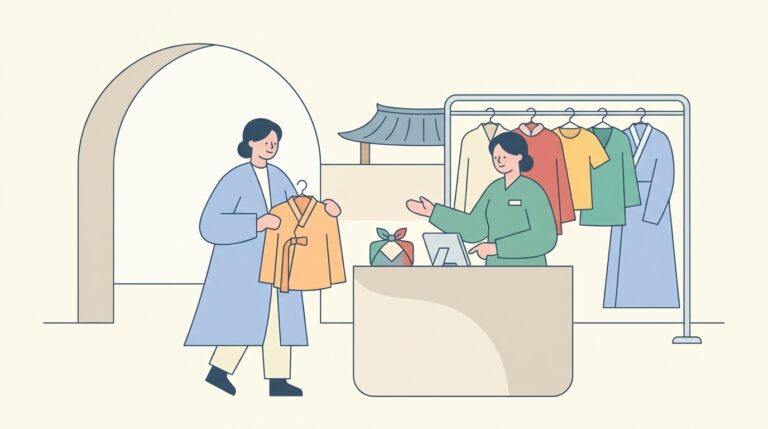
Speak Up, Stand Your Ground: Resolving Consumer Disputes and Refunds in Korea Like a Sophisticated C1 Speaker
안녕하세요! Daily Hangul Chief Editor here, your trustiest Korean culture navigator and language tutor.
Imagine this: You are strolling through a beautiful, dimly lit boutique in Garosu-gil or browsing high-end skincare sets in Myeongdong. You find a gorgeous designer jacket or a premium K-Beauty set. You pay, head back to your hotel, and unwrap it with excitement—only to discover a prominent rip along the inner seam, or a broken pump on your luxury serum.
You return to the store the next day, but the owner sighs, points to a tiny sign at the counter, and says, “이거 세일 상품이라 교환, 환불 안 돼요” (This is a sale item, so no exchanges or refunds).
How do you respond? For many language learners, conflict in a foreign tongue triggers either passive submission or accidental, overly aggressive confrontation. But at a C1 level, you have the power to navigate this delicate social dance with poise, razor-sharp precision, and absolute respect. Today, we are going to master the art of 소비자 피해 구제 (consumer redress) and 환불 (refunds) using advanced linguistic strategies that respect Korean social harmony while firmly securing your consumer rights.
1. Deep Dive: Three Core Advanced Expressions for Conflict Resolution
To resolve disputes smoothly in Korea, you must balance 눈치 (nunchi – situational tact) with assertiveness. Here are three highly sophisticated, C1-level expressions that will immediately elevate you from a tourist to an esteemed, savvy communicator.
① 규정상 어렵다는 말씀은 이해하지만, 이 부분은 명백한 제품 결함입니다.
- Pronunciation: gyu-jeong-sang eo-ryeop-da-neun mal-sseu-meun i-hae-ha-ji-man, i bu-bu-neun myeong-baek-han je-pum gyeol-ham-im-ni-da.
- Sound-alike guide: “Gyu-jung-sang uh-ryup-da-neun mahl-sseu-meun ee-hae-ha-jee-mahn, ee boo-boo-neun myung-baek-hahn jeh-poom gyul-hahm-eem-nee-dah.”
- Meaning: I understand your point that it is difficult due to store policy, but this part is clearly a product defect.
- K-Culture Moment: You will often hear this exact structure in K-Dramas when a sharp, professional protagonist politely but unyieldingly corners a stubborn business representative. It shows you respect their boundary (“I understand the policy”) before rendering it irrelevant (“but this is a defect”).
- Editor’s Insight: By phrasing it as “이해하지만” (I understand, but…), you disarm the clerk’s defense mechanism. In Korean business culture, outright dismissing someone’s explanation is a social taboo; acknowledging it first is the key to maintaining a cooperative atmosphere.
- Situation Spectrum:
- Friend / Casual: 🚫 (Too formal for personal dynamics)
- Colleagues / Semi-formal: ⚠️ (A bit intense for everyday workplace favors)
- Business / Formal: ✅ (Perfect for consumer complaints or contract negotiations)
- 🤔 Think About It: Why does this sentence use “말씀” (honorable words) to refer to the clerk’s statement, even when pointing out their policy’s flaw? In Korean linguistic psychology, elevating the opponent’s speech acts as a shield, ensuring your subsequent firm criticism is received professionally rather than personally.
② 소비자보호원 규정에 따르면 이 경우 환불이나 교환 대상이 맞는지 확인해 주시겠어요?
- Pronunciation: so-bi-ja-bo-ho-won gyu-jeong-e tta-reu-myeon i gyeong-u hwan-bul-i-na gyo-hwan dae-sang-i mat-neun-ji hwa-gin-hae ju-si-get-eo-yo?
- Sound-alike guide: “So-bee-jah-boh-ho-won gyu-jung-eh ddah-reu-myun ee gyung-oo hwahn-bool-ee-nah gyoh-hwahn dae-sahng-ee maht-neun-jee hwah-gheen-hae joo-shee-gess-uh-yo?”
- Meaning: According to the Korea Consumer Agency regulations, could you please verify if this case qualifies for a refund or exchange?
- K-Culture Moment: The ultimate “secret weapon” phrase. Bringing up the 소비자보호원 (Korea Consumer Agency) politely signals that you are not an uninformed shopper. It gently raises the stakes of the conversation without raising your voice.
- Editor’s Insight: The magic lies in the ending “~ 확인해 주시겠어요?” (Could you verify for me?). You aren’t threatening them; you are politely inviting them to double-check their legal standing.
- Situation Spectrum:
- Friend / Casual: 🚫
- Colleagues / Semi-formal: ⚠️
- Business / Formal: ✅
③ 서로 원만하게 해결하고 싶은데, 혹시 책임자분과 직접 이야기할 수 있을까요?
- Pronunciation: seo-ro won-man-ha-ge hae-gyeol-ha-go si-peun-de, hok-si chae-gim-ja-bun-gwa jik-jeop i-ya-gi-hal su is-seul-kka-yo?
- Sound-alike guide: “Suh-roh won-mahn-hah-geh hae-gyul-hah-goh shee-peun-deh, hohk-shee chaeg-eem-jah-boon-gwah jeek-jup ee-yah-ghee-hahl soo eess-eul-ggah-yo?”
- Meaning: I would like for us to resolve this amicably, but is it possible for me to speak directly with the person in charge?
- K-Culture Moment: This is the polite Korean equivalent of “I’d like to speak to your manager.” The word 원만하게 (amicably/smoothly) is highly valued in Korean collectivist culture, signaling that your goal is harmony, not drama.
- Editor’s Insight: Using “책임자분” (the person in charge) with the honorific “분” keeps the tone impeccably polite. It prevents the front-line clerk from feeling defensive or personally attacked.
- Situation Spectrum:
- Friend / Casual: 🚫
- Colleagues / Semi-formal: ✅
- Business / Formal: ✅
2. Textbook Korean vs. Real-World Korean
Many intermediate textbooks teach direct translations of requests, which can sound surprisingly abrasive or childlike in a real-world conflict. Let\’s bridge that gap.
Situation 1: Pointing out a tear in a garment
- 📖 Textbook Korean: “이 옷이 찢어졌으니 환불해 주세요.” (This clothing is torn, so refund it.)
- Why it fails: It sounds like an aggressive command. It lacks linguistic padding, making the seller feel cornered.
- 🗣️ Real Korean: “제품 안감에 미세한 하자가 있는 것 같아서 환불 처리를 좀 부탁드리려고 하는데요.” (There seems to be a minor defect in the lining, so I wanted to request a refund processing.)
- Why it works: Using 미세한 하자 (minor/subtle defect) and softening the claim with ~는 것 같아서 (it seems like) and ~하려고 하는데요 (I am looking to…) makes you sound incredibly elegant and highly educated. You are stating a fact while leaving room for the other person to save face.
Situation 2: Addressing an overcharge on a bill
- 📖 Textbook Korean: “계산이 틀렸습니다. 다시 하세요.” (The calculation is wrong. Do it again.)
- Why it fails: Extremely blunt. In Korea, implying someone made a mistake directly can trigger immediate defensiveness due to the loss of 체면 (face/prestige).
- 🗣️ Real Korean: “저희가 주문한 내역이랑 결제된 금액이 조금 상이한 것 같아서, 확인 한 번만 부탁드릴게요.” (The amount paid seems slightly different from what we ordered, so I\’d like to kindly ask you to check it just once.)
- Why it works: 상이하다 (to be different/discrepant) is a highly professional, Sino-Korean (Hanja) verb. Substituting “틀리다” (to be wrong) with “상이하다” (to be different) de-escalates the tension immediately.
3. K-Culture Deep Dive & Non-Verbal Etiquette
3-1. The Body Language of De-escalation
In a dispute, your body language speaks louder than your vocabulary. To wield C1-level Korean effectively, align your physical presence with these cultural standards:
* The Open-Palm Gesture: Never point at a receipt, a defect, or the clerk with a single finger. Instead, present your evidence using an open hand with fingers together, palms facing slightly upward.
* The Soft Head Tilt: When expressing disappointment, a slight tilt of the head accompanied by a gentle sigh (not an aggressive huff) conveys to the staff that you are saddened by the situation, not angry. In Korea, eliciting empathy (인정 – human warmth/connection) often works faster than quoting cold hard legal codes.
3-2. Cultural Code: “Sonnim-eun Wang” (손님은 왕) vs. Modern Mutual Respect
Historically, South Korea operated on the maxim “손님은 왕이다” (The customer is king). However, due to recent national discussions regarding the emotional labor (감정노동) of service workers, public sentiment has shifted dramatically. Today, “black consumers” (블랙컨슈머 – abusive customers) are highly frowned upon. Showing respect, using advanced honorifics, and maintaining a calm composure will make the staff want to bend the rules to help you.
4. Immersive Roleplay: The Garosu-gil Boutique Showdown
Let\’s put your skills to the test. You are at a trendy boutique in Seoul. You bought a premium, handmade trench coat yesterday, but found a significant dye stain under the collar. The shop owner, Ms. Park, is notoriously protective of her boutique\’s “no-refund” policy.
- Setting: A quiet boutique scented with lavender. Jazz plays softly. Ms. Park is behind the counter, drinking tea.
- Your Role: A polite but uncompromising customer.
1. You: (Approaching the counter with a soft bow)
   안녕하세요, 사장님. 어제 여기서 트렌치코트 구매한 사람인데요.
   (An-nyeong-ha-se-yo, sa-jang-nim. Eo-je yeo-gi-seo teu-ren-chi-ko-teu gu-mae-han sa-ram-in-de-yo.)
   "Hello, ma'am. I'm the person who bought the trench coat here yesterday."

2. Ms. Park: (Smiling warmly)
   아, 네! 기억해요. 옷은 마음에 드시죠?
   (Ah, ne! Gi-eok-hae-yo. Ot-eun ma-eum-e deu-si-jyo?)
   "Ah, yes! I remember you. You like the coat, right?"

3. You:
   디자인은 정말 마음에 드는데, 집에 가서 확인해 보니 카라 안쪽에 이염이 좀 있더라고요.
   (Di-ja-in-eun jeong-mal ma-eum-e deu-neun-de, jip-e ga-seo hwa-gin-hae bo-ni ka-ra an-jjok-e i-yeom-i jom it-deo-ra-go-yo.)
   "I love the design, but when I checked it at home, I noticed some dye staining inside the collar."

4. Ms. Park: (Her face stiffening slightly)
   어머, 그럴 리가 없는데... 저희가 수제 의류라 검수를 엄청 꼼꼼히 하거든요.
   (Eo-meo, geu-reol li-ga eop-neun-de... Jeo-hui-ga su-je ui-ryu-ra geom-su-reul eom-cheong kkom-kkom-hi ha-geol-deun-yo.)
   "Oh, that shouldn't be possible... Since it's handmade apparel, we inspect it extremely thoroughly."

5. You: (Showing the stain with an open hand)
   네, 저도 아쉬워서 드리는 말씀인데... 여기 보시면 염색이 고르지 않게 뭉쳐 있는 부분이 확연히 보여서요.
   (Ne, jeo-do a-swi-weo-seo deu-ri-neun mal-sseum-in-de... Yeo-gi bo-si-myeon yeom-saek-i go-reu-ji ant-ge mung-chyeo in-neun bu-bun-i hwak-yeon-hi bo-yeo-seo-yo.)
   "Yes, I'm bringing this up because I'm genuinely disappointed as well... If you look here, you can clearly see the dye clumping unevenly."

6. Ms. Park: (Sighing politely)
   죄송하지만 영수증 밑에도 적혀 있듯이, 저희 매장은 수제작 특성상 교환이나 환불은 불가능해요.
   (Joe-song-ha-ji-man yeong-su-jeung mit-e-do jeok-hyeo it-deu-si, jeo-hui mae-jang-eun su-je-jak teuk-seong-sang gyo-hwan-i-na hwan-bul-eun bul-ga-neung-hae-yo.)
   "I'm sorry, but as written at the bottom of the receipt, our shop cannot offer exchanges or refunds due to the nature of handmade items."
🔀 Decision Point: Choose Your Path!
- Option A: “그래도 법적으로 환불해 주셔야 하는 거 아닌가요? 신고할게요.” (Still, legally, aren’t you supposed to refund this? I will report you.)
- Option B: “규정상 어렵다는 말씀은 이해하지만, 이 부분은 명백한 제품 결함이라 소비자 보호 규정에 따라 처리를 부탁드리고 싶습니다.” (I understand that it is difficult under your policy, but since this is clearly a product defect, I would like to request processing in accordance with consumer protection regulations.)
- Option C: “알겠습니다… 그냥 갈게요.” (Understood… I’ll just leave.)
💡 Analysis of Your Choice:
- If you chose A (The Aggressive Path): While legally correct, threatening to report Ms. Park right away completely destroys any chance of an amicable resolution. She will likely become defensive, resulting in an exhausting, emotional shouting match.
- If you chose B (The C1 Masterclass – Best Choice!): You successfully validated her policy first, highlighted the clear defect, and anchored your request on consumer regulations without sounding hostile. Ms. Park will recognize your high linguistic caliber and yield to maintain her shop’s reputation.
- If you chose C (The Passive Path): You lose your money and a great coat! Remember, C1 speakers don’t shy away from conflict; they resolve it with grace.
5. 10-Second Emotional Shadowing Drill
To sound natural, you must master the cadence of polite insistence. Practice these with the designated emotional cues:
- [🥺 Genuinely Sad & Polite]
제가 / 정말 마음에 들어서 / 구매했는데… / 하자가 있어서 / 너무 속상하네요.
(Je-ga / jeong-mal ma-eum-e deu-reo-seo / gu-mae-haet-neun-de… / ha-ja-ga is-seo-seo / neo-mu sok-sang-ha-ne-yo.)
“I bought this because I truly loved it… I’m so upset that there’s a defect.” -
[😤 Firm, Measured, and Highly Professional]
매장 규정보다 / 소비자보호법이 / 우선시된다는 점 / 정중히 말씀드립니다.
(Mae-jang gyu-jeong-bo-da / so-bi-ja-bo-ho-beop-i / u-seon-si-doen-da-neun jeom / jeong-jung-hi mal-sseum-deu-rim-ni-da.)
“I respectfully point out that the Consumer Protection Act takes precedence over store policies.”
6. K-Culture Mini Dictionary
| Word (Hangul / Romanization) | English Translation | Real-world Contextual Usage |
|---|---|---|
| 하자 (Ha-ja) | Product Defect | The official, legal, yet commonly used term for any physical flaw in a purchased item. |
| 상이하다 (Sang-i-ha-da) | To be discrepant/different | A high-level vocabulary word used instead of “다르다” to describe differences in bills, contracts, or agreements professionally. |
| 원만히 (Won-man-hi) | Amicably / Smoothly | The ultimate Korean relational word. It signals you wish to resolve a problem without causing a public scene or ruining relationships. |
| 소비자원 (So-bi-ja-won) | Korea Consumer Agency (KCA) | The government agency that protects consumer rights in Korea. Mentioning this name usually fast-tracks corporate resolutions. |
7. Traveler’s Survival Kit
Top 3 Quick-Action Phrases
- “이거 영수증이랑 결제 카드예요.” (This is the receipt and the payment card.)
- Pro Tip: Keep physical receipts! While digital logs work, retail staff in Korea find processing refunds significantly faster with physical paper slips.
- “전액 환불로 처리해 주세요.” (Please process it as a full refund.)
- Pro Tip: Use this when a shop tries to offer store credit instead of cash/card refunds.
- “혹시 교환증 발급해 주실 수 있나요?” (Could you issue an exchange voucher?)
- Pro Tip: If you are buying a gift, always ask for a 교환증 (exchange slip). It allows the recipient to exchange the item at any branch without seeing the price.
📌 Editor’s Travel Note:
If you experience severe consumer fraud or unfair treatment as a foreign tourist, do not panic. Download Naver Map to find the nearest local community center or police station, or instantly call the Korea Tourism Organization Helpline (1330), which offers robust, multi-lingual support for tourist complaints.
8. Deep Thoughts: “Going One Step Deeper”
In Western cultures, asserting consumer rights is often transactional: “I paid for X, you gave me Y, now fix it.” However, Korean resolution dynamics are deeply rooted in relational psychology. Even in conflict, the preserving of 정 (Jeong – affection/bonding) and avoiding the cutting of ties plays a major role.
When you approach an owner with advanced, soft-spoken honorifics, you are appealing to their identity as a benevolent host. By choosing sophisticated vocabulary, you signal that you respect their status, which in turn compels them to reciprocate that respect. In Korea, conflict resolution is not about winning an argument; it is about restoring a balanced, respectful connection.
- 💬 Your Turn: How does consumer resolution work in your country? Is it more transactional, or do you have similar unspoken social rules? Let me know in the comments below!
9. FAQ & Avoiding Common Misunderstandings
Q: Can I get a refund for clothes I bought at an underground shopping mall (e.g., Goto Mall)?
A: Yes, but it depends. Legally, the Consumer Protection Act applies nationwide, even to small stalls. However, underground mall owners often work on razor-thin margins and are highly resistant to cash refunds. To avoid high-stress situations, inspect items meticulously before leaving the underground stall.
Q: Is it true that beauty products cannot be refunded once opened?
A: Yes, unless there is a physical defect or skin reaction. If you experience an allergic reaction, you can get a refund by presenting a dermatological certificate (진단서) within a specified period.
🚨 Common Mistakes Warning Board
- Mistake 1: Raising your voice (소리 지르기). In Korea, raising your voice in public immediately marks you as the “aggressor” in the eyes of onlookers, regardless of who was originally in the wrong.
- Mistake 2: Demanding to see the CEO directly. Asking for the “사장님” (owner) is fine for small shops, but in department stores, ask for the 고객센터 (customer service center) instead.
10. Your Action Mission Today!
- 🥉 Bronze (The Mirror Challenge): Stand in front of a mirror and read the Phase 5 Shadowing Drills out loud three times. Focus on keeping your face relaxed and your tone polite yet firm.
- 🥈 Silver (The Social Media Hunt): Watch your favorite K-Drama. Spot a scene where characters are arguing in a restaurant or store. Note down what words they use to express frustration politely!
- 🥇 Gold (Real-Life Champion): Next time you receive the wrong drink at a Korean cafe, do not just drink it! Use the phrase: “죄송한데 저희가 주문한 거랑 음료가 다르게 나온 것 같아서요…” with a warm smile.
11. Interactive Quiz Challenge
Test your conflict-resolution instincts!
Q1. Which phrase is the most professional way to point out a bill discrepancy?
- A) 이거 계산 틀렸으니까 다시 해주세요.
- B) 저희가 주문한 내역이랑 결제된 내역이 조금 상이한 것 같아서요.
- C) 돈이 왜 이렇게 많이 나왔어요?
Q2. True or False: If a boutique has a “No Refunds” sign on the wall, they are legally exempt from refunding damaged or defective items in Korea.
- A) True
- B) False
🔍 Reveal Answers & Explanations
- Q1 Answer: B. Option B uses the sophisticated Hanja verb “상이하다” (to be discrepant), which is polite and professional. Option A and C are too aggressive and accusatory.
- Q2 Answer: B (False). Under Korean Consumer Protection laws, arbitrary store policies cannot override statutory consumer rights regarding defective products. You are legally entitled to a remedy for defective items!







