

Who is Your K-Pop Ultimate Bias? Learn How to Say It Like a True Korean Fan!
Phase 1: Welcome to the Fandom! (An Editor’s Hello)
안녕하세요! (An-nyeong-ha-se-yo!) Hello! I am your senior editor and friendly Korean guide here at Daily Hangul.
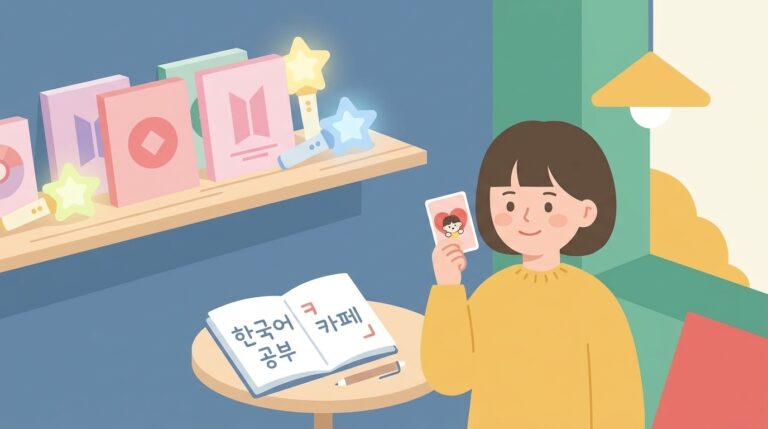
Imagine this: You are sitting in a gorgeous, pastel-colored café in Hongdae, Seoul. The air smells like sweet strawberry lattes, and your favorite K-pop song is playing in the background. You see a group of friendly Korean fans trading colorful photocards of their favorite idol members. You want to join the fun, smile, and say: “My absolute favorite member is Felix!” or “I totally fell in love with Jimin at first sight!”
But suddenly, your mind goes blank. You only know the stiff textbook phrase: “저는 이 멤버를 좋아합니다” (I like this member), which sounds like you are reading a cold robot manual.
Don’t worry! Today, we are going to learn the warm, bubbly, and real words that local K-pop fans actually use. By the end of this guide, you will sound like a true “in-crowd” fan, and your Korean friends will ask you, “Wow, how did you learn to speak so naturally?” Let’s dive in!
Phase 2: The Core 3 “Bias” Expressions
Let’s learn the three magic words every beginner K-pop fan must know.
1. 최애 (Choe-ae)
- Pronunciation: [Choe-ae] / Sound-alike guide: “Choy-eh”
- Meaning: Your Ultimate Bias (Literal meaning: “Most Loved”).
- K-Culture Moment: You will hear fans say this constantly at concerts, cupsleeve events, and on Twitter (X) when showing off their collection of photocards.
- Editor’s Insight: This word originally comes from Hanja (Chinese characters: 最 meaning “most” and 愛 meaning “love”). It is extremely cute and friendly, used for the absolute number one member of your heart.
Situation Spectrum:
- Friend / Casual: ✅ (Perfect!)
- Coworker / Semi-formal: ⚠️ (A bit casual, but totally fine if you are sharing hobbies.)
- Boss / Formal: 🚫 (Too informal for a strict business meeting.)
🤔 Think About It: In many Western countries, we just say “my favorite.” But in Korea, we have a unique, beautiful word just for the person we love the most in a group. Why do you think Korean fans created a special word just for love?
2. 덕통사고 (Deok-tong-sa-go)
- Pronunciation: [Deok-tong-sa-go] / Sound-alike guide: “Duck-tong-sah-go”
- Meaning: A sudden “fan-accident” (Falling in love with an idol suddenly and unexpectedly).
- K-Culture Moment: You are casually watching a music video, and suddenly, a member winks at the camera. Boom! You are instantly in love. That is a Deok-tong-sa-go!
- Editor’s Insight: This is a hilarious mashup of Deok-hu (덕후 – geek/fan) and Gyotong-sago (교통사고 – traffic accident). It means love hit you like a sudden, unstoppable truck!
Situation Spectrum:
- Friend / Casual: ✅ (Super funny and relatable!)
- Coworker / Semi-formal: ⚠️ (Good for a laugh with close coworkers.)
- Boss / Formal: 🚫 (Do not tell your boss you had a fan-accident!)
3. 입덕 (Ip-deok)
- Pronunciation: [Ip-deok] / Sound-alike guide: “Ip-duck”
- Meaning: Entering the fandom / Becoming a fan (Literal meaning: “Entering fandom-gate”).
- K-Culture Moment: When your friend asks you, “When did you start loving BTS?”, you can say your Ip-deok moment was during the ‘Dynamite’ era.
- Editor’s Insight: Ip (입) means “to enter” (like entrance – 입구). It marks the exact day or era you crossed the line into fan life!
Situation Spectrum:
- Friend / Casual: ✅ (Daily slang!)
- Coworker / Semi-formal: ✅ (Very common to explain your hobby.)
- Boss / Formal: 🚫 (Keep it casual.)
Phase 3: Textbook Korean vs. Real Korean
Let’s compare the stiff language from textbooks with the fresh, living language of Seoul!
Scenario 1: Introducing your favorite member
- 📖 Textbook Korean: “저는 지민을 가장 좋아합니다.” (Jeo-neun Ji-min-eul ga-jang jo-a-hap-ni-da.)
- Translation: “I like Jimin the most.” (Too formal, sounds like a job interview!)
- 🗣️ Real Korean: “제 최애는 지민이에요!” (Je choe-ae-neun Ji-min-i-e-yo!)
- Translation: “My ultimate bias is Jimin!”
- 💡 Why is it different? Real fans use the word 최애 (Choe-ae). It immediately shows you understand the K-pop community culture and makes you sound warm and close!
Scenario 2: Explaining when you became a fan
- 📖 Textbook Korean: “저는 최근에 이 그룹의 팬이 되었습니다.” (Jeo-neun choe-geun-e i geu-rup-ui paen-i doe-eot-seup-ni-da.)
- Translation: “I became a fan of this group recently.” (Very dry and long.)
- 🗣️ Real Korean: “얼마 전에 입덕했어요!” (Eol-ma jeon-e ip-deok-haet-eo-yo!)
- Translation: “I joined the fandom a little while ago!”
- 💡 Why is it different? 입덕 (Ip-deok) is short, punchy, and highly emotional. It shows excitement and belonging!
Phase 4: K-Culture Deep Dive & Non-Verbal Manners
4-1. “Nunchi” (눈치) and Fan Manners
When you meet other K-pop fans in Korea, showing 눈치 (Nunchi – social intuition/tact) is super important! Here are two crucial etiquette tips:
1. The Photocard Salute: When sharing photos of your bias at a restaurant, it is a fun trend to hold your photocard next to the food and take a photo. Always make sure you do not block other people’s views or touch their cards without permission!
2. Respect All Members: Even if you have one absolute Choe-ae (bias), always speak lovingly of the other members too. In Korea, loving the whole group is seen as very polite and sweet!
4-2. The Cupsleeve Cafe Culture
In Korea, fans rent entire cafes to celebrate an idol’s birthday. They decorate the walls with beautiful photos and give out custom 컵홀더 (keop-hol-deo – cupsleeves) with your drink. It is the ultimate survival space for any international fan to make local friends!
Phase 5: Roleplay – The Dream Cafe Encounter
The Setting: A bright, busy birthday cafe in Hongdae decorated with colorful balloons and flower displays. You are standing in line to get a special cup sleeve.
The Cast: You (a passionate beginner fan) and Minji (a friendly Korean fan holding a big professional camera).
- Minji: “안녕하세요! 오늘 컵홀더 이벤트 오셨어요?”
(An-nyeong-ha-se-yo! O-neul keop-hol-deo i-ben-teu o-syeot-eo-yo?)
(🎭 Smiling warmly and pointing to the cup sleeve)
“Hi! Did you come for the cupsleeve event today?” - You: “네, 맞아요! 줄이 진짜 기네요.”
(Ne, ma-ja-yo! Jul-i jin-짜 gi-ne-yo.)
(🎭 Looking around the busy cafe)
“Yes, that’s right! The line is really long.” - Minji: “맞아요! 아, 혹시 누구 팬이세요?”
(Ma-ja-yo! Ah, hok-si nu-gu paen-i-se-yo?)
(🎭 Tilting her head curiously)
“I know! Oh, by the way, whose fan are you?” - You: “저는 스트레이 키즈 팬이에요!”
(Jeo-neun Seu-teu-re-i Ki-jeu paen-i-e-yo!)
(🎭 Smiling proudly)
“I am a Stray Kids fan!” - Minji: “와, 정말요? 최애가 누구예요?”
(Wa, jeong-mal-yo? Choe-ae-ga nu-gu-yeo-yo?)
(🎭 Eyes widening with excitement)
“Wow, really? Who is your bias?”
🔀 Decision Point: What do you say next?
- Option A: “저는 필릭스를 가장 좋아합니다.”
- Option B: “제 최애는 필릭스예요!”
- Option C: “필릭스 최애!!”
Best Choice: Option B!
Option B (“제 최애는 필릭스예요!”) is perfect. It is extremely natural, polite but casual, and uses the correct word 최애 (Choe-ae).
* Option A is too dry and sounds like a textbook.
* Option C is a bit too short and might sound a little blunt to a stranger!
Phase 6: 10-Second Emotion Shadowing Drill
Let’s practice speaking with real Korean soul and emotion! Use the pauses (/) and try to match the feelings in the brackets.
- [😊 Super Excited & Happy]
- “제 최애는 / 필릭스예요!”
- Je choe-ae-neun / Pil-lik-seu-ye-yo!
- “My ultimate bias / is Felix!”
- [🥺 Starstruck & Adoring]
- “완전 / 덕통사고 / 당했어요!”
- Wan-jeon / deok-tong-sa-go / dang-haet-eo-yo!
- “I totally / had / a fan-accident! (I fell in love instantly!)”
Phase 7: K-Culture Mini Dictionary
| Word (Korean/Roman) | Meaning | How it’s used |
|---|---|---|
| 최애 (Choe-ae) | Ultimate Bias | “My 최애 is Felix!” (Number one favorite) |
| 차애 (Cha-ae) | Second Bias | “My 차애 is Bang Chan!” (Number two favorite / Bias wrecker) |
| 덕질 (Deok-jil) | Fan Life / Fangirling | “I did some 덕질 today!” (Buying albums, watching videos) |
| 포카 (Po-ka) | Photocard | “I got my bias’s 포카!” (Short for Photo Card) |
Phase 8: Traveler’s Survival Kit
Heading to Seoul for a concert or album shopping? Keep these 3 golden phrases in your pocket!
Survival Phrase Cards
- Phrase 1: “포카 있어요?” (Po-ka is-seo-yo?)
- Meaning: “Do you have the photocard?”
- Pro Tip: Use this when trading with other fans or buying albums at shops!
- Phrase 2: “이거 얼마예요?” (I-geo eol-ma-ye-yo?)
- Meaning: “How much is this?”
- Pro Tip: Perfect for buying lovely fan-made goods outside concert halls.
- Phrase 3: “사진 찍어주세요.” (Sa-jin jjig-eo-ju-se-yo.)
- Meaning: “Please take a picture for me.”
- Pro Tip: Ask another fan gently when standing in front of a beautiful idol billboard.
📌 Editor’s Travel Note: When searching for these amazing K-pop hot spots, Google Maps can sometimes be inaccurate in Korea. Make sure to download the Naver Map app download page for flawless walking directions to the best cupsleeve cafes in Hongdae! (Note: Always check cafe social media pages for opening hours as they change rapidly!)
Phase 9: Think Deeper — “Fandom as a Family”
In many parts of the world, being a fan is a solo hobby. But in Korea, being in a fandom is like joining a giant, warm family. This is why words like 입덕 (entering the fandom gate) exist. It feels like you are entering a cozy, shared house of love. Fans look out for each other, share free treats (called 나눔 – na-num), and celebrate together.
💬 Your Turn: Who is your K-pop ultimate bias (최애)? How did you first fall in love with them (입덕)? Let us know in the comments below! We love reading your stories!
Phase 10: FAQ & Common Mistakes
Q: Can I use “최애” (Choe-ae) for things other than K-pop?
A: Yes! This is a wonderful secret. You can use it for your favorite food (e.g., “My 최애 food is Tteokbokki!”), your favorite movie, or your favorite place in Seoul. It is extremely cute and common!
Q: Is “덕통사고” (Deok-tong-sa-go) too informal to use with older people?
A: Yes, it is slang. While it is totally fine with younger people and close friends, avoid using it with your Korean language teachers, bosses, or older adults unless you are sharing a light, funny joke!
Q: What is the difference between 최애 (Choe-ae) and 차애 (Cha-ae)?
A: 최 (Choe) means “most” (First place), and 차 (Cha) means “next” (Second place). So, your Choe-ae is your ultimate bias, and your Cha-ae is your bias wrecker/second favorite!
🚨 Fandom Language Common Mistakes
- Mistake: Saying “I am a fan of [Idol]” as “저는 [Idol]의 덕후입니다” to a strict boss.
- Fix: Use “저는 [Idol]을 좋아해요” (I like [Idol]) for polite, non-slang conversations.
- Mistake: Pronouncing 최애 as “Choi-ay”.
- Fix: Say it smoothly as “Choy-eh” to sound like a native speaker.
Phase 11: Action Missions!
Are you ready to use what you learned? Try these three levels of K-pop missions!
- 🥉 Bronze (At Home): Look in the mirror and say out loud: “제 최애는 [Your Bias]예요!” three times with a bright smile!
- 🥈 Silver (Social Media): Post a picture of your favorite idol on Instagram or Twitter and caption it: “오늘도 덕질 중! 💖” (Fangirling/boying today too!)
- 🥇 Gold (In the Wild): Visit a local Korean supermarket or a K-pop store, look at an album, and tell a fellow fan or worker: “제 최애도 이 멤버예요!” (My bias is this member too!)
Phase 12: Interactive Quiz Challenge!
Let’s test your new K-pop fandom Korean powers!
1. What does “덕통사고” (Deok-tong-sa-go) mean?
- A) Getting into a car accident on the way to a concert.
- B) Suddenly falling in love with an idol like a sudden accident.
- C) Buying too many albums.
2. Fill in the blank: “제 _____는 지민이에요!” (My ultimate bias is Jimin!)
- A) 입덕 (Ip-deok)
- B) 최애 (Choe-ae)
- C) 덕질 (Deok-jil)
👉 Click here to see the answers and explanations!
- Correct Answer: B! “덕통사고” is a hilarious slang for falling in love with your favorite idol suddenly.
- Correct Answer: B! “최애” (Choe-ae) means ultimate bias. So the full sentence is “제 최애는 지민이에요!”
Great job! You are officially ready to explore the exciting world of Korean K-pop fandom! See you in the next lesson! 🎉






