

How to Debunk Climate Change Skepticism in Sophisticated Korean: A C2 Guide to Scientific Skepticism
Phase 1: Empathy (An Intellectual Late-Night Coffee in Seongsu-dong)
안녕하세요! (Annyeonghaseyo!) It’s your Korean bestie and Daily Hangul senior editor here.
Picture this: You are sitting in a sleek, eco-friendly cafe in Seongsu-dong, Seoul’s trendiest hub for young intellectuals and green startups. You are with Korean colleagues or friends, enjoying a deep talk after watching a thought-provoking eco-documentary or a sci-fi K-drama like The Silent Sea (고요의 바다), which vividly warns us about resource depletion.
Suddenly, someone in the group sighs and says, “Isn’t climate change just a natural cycle? Why are we being so dramatic?”
As a C2-level speaker, you want to jump into this intellectual arena. You don’t just want to say “No, you’re wrong” in flat, textbook Korean. You want to deliver a sharp, scientifically sound refutation with the elegance, rhetorical poise, and intellectual depth of a seasoned Korean debater. You want them to gasp at both your climatology knowledge and your flawlessly nuanced Korean.
Today, we are moving beyond simple daily banter. We are diving deep into Scientific Skepticism (과학적 회의주의 – Gwahakjeok Hoeuijuu-i), specifically focusing on how to scientifically refute climate change skepticism (기후 변화 회의론에 대한 과학적 반박 – Gihu byeonhwa hoe-uiron-e daehan gwahakjeok banbak). Grab your notes; this is where you become a true master of Korean discourse!
Phase 2: Core Expressions (C2-Level Deep Dive)
To command respect in a debate, you must use precise, high-register vocabulary. Let’s master three powerful expressions that Korean intellectuals use when debunking groundless claims.
1. 기우에 불과하다 (gi-u-e bul-gwa-ha-da)
- Pronunciation: [gi-u-e bul-gwa-ha-da] / Key-oo-eh bool-gwa-ha-da
- Meaning: “It is nothing more than an unfounded worry / a groundless anxiety.”
- K-Culture Moment: This expression originates from the ancient Hanja idiom 기우 (杞憂)—referring to a man from the ancient state of Qi who couldn’t sleep because he was worried the sky might fall. In legal and political K-dramas like Stranger (비밀의 숲), sharp-witted prosecutors use this to dismiss groundless speculations during high-stakes briefings.
- Editor’s Insight: Use this when a skeptic claims that adopting green policies will instantly ruin the entire national economy. It gently but firmly labels their catastrophic predictions as a needless, unscientific panic.
- Situation Spectrum:
- Friends/Casual: ⚠️ (Might sound a bit too formal unless you are playing a pseudo-intellectual character for fun)
- Colleagues/Semi-formal: ✅
- Business/Formal Debate: ✅
- 🤔 Think About It: “기우” is a beautiful Sino-Korean idiom. Why do you think Korean culture preserves these ancient literary references in modern scientific debates? How does using classical metaphors enhance your credibility as an intellectual speaker?
2. 인과관계를 왜곡하다 (in-gwa-gwan-gye-reul wae-gok-ha-da)
- Pronunciation: [in-gwa-gwan-gye-reul wae-gok-ha-da] / In-gwa-gwan-gyeh-reul weh-gok-ha-da
- Meaning: “To distort the causal relationship (cause and effect).”
- K-Culture Moment: You will hear this in academic settings, university debate clubs, or dramas like Melancholia (멜랑꼴리아), where math and science are used to uncover complex truths.
- Editor’s Insight: Climate skeptics love to point out that “CO2 levels have risen after warming periods in ancient ice cores,” confusing the feedback loop. This phrase is your perfect weapon to point out that they are misrepresenting scientific data by messing with the sequence of cause and effect.
- Situation Spectrum:
- Friends/Casual: 🚫 (Too rigid; use “원인이랑 결과를 헷갈리는 것 같아” instead)
- Colleagues/Semi-formal: ✅
- Business/Formal Debate: ✅
- 🤔 Think About It: Notice how “인과관계” (Causality) merges ‘cause’ (인 – in) and ‘effect’ (과 – gwa). In Western rhetoric, we often say “confusing correlation with causation.” In Korean, pointing out the distortion (왜곡 – wae-gok) of this fundamental cosmic balance carries immense rhetorical weight.
3. 어불성설이다 (eo-bul-seong-seol-i-da)
- Pronunciation: [eo-bul-seong-seol-i-da] / Eo-bull-seong-seol-ee-da
- Meaning: “To be utterly illogical / preposterous / holding no water.”
- K-Culture Moment: Commonly thrown around by lawyers in intense courtroom dramas like Law School (로스쿨) or Extraordinary Attorney Woo (이상한 변호사 우영우) when a witness offers a completely contradictory alibi.
- Editor’s Insight: Literally translating to “words that do not form a coherent theory,” this four-character idiom (사자성어) is the ultimate logical shutdown. If someone claims we don’t need to stop carbon emissions because “plants love carbon dioxide,” you can confidently label that claim as 어불성설.
- Situation Spectrum:
- Friends/Casual: ⚠️ (Use only with close friends when jokingly arguing, otherwise, it feels like an academic lecture)
- Colleagues/Semi-formal: ✅
- Business/Formal Debate: ✅
- 🤔 Think About It: How does utilizing a four-character idiom (사자성어) shift the power dynamic in an argument? In Korea, mastery of these idioms signals deep literacy and intellectual status.
Phase 3: Textbook Korean vs. Real-World Korean
Let’s look at how standard textbooks teach you to disagree, compared to how high-level Korean intellectuals actually articulate scientific pushback.
Situation 1: Expressing Scientific Consensus
- 📖 Textbook Korean: 과학자들의 의견이 일치합니다.
(gwahakjadeul-ui uigyeon-i ilchihamnida.)
“Scientists’ opinions match.” - 🗣️ Real-World C2 Korean: 학계의 압도적인 과학적 합의(Consensus)가 이미 도출된 상태입니다.
(hakgye-ui apdojeogin gwahakjeok habui-ga imi dochuldoen sangtae-imnida.)
“An overwhelming scientific consensus has already been reached in the academic community.” - 💡 Why is it different? At a C2 level, you want to use vocabulary like ‘학계’ (the academic circle/world) and ‘도출되다’ (to be drawn/derived), which shows a native-like grasp of formal registry and institutional processes.
Situation 2: Addressing “Natural Cycle” Claims
- 📖 Textbook Korean: 지구 온도가 원래 변하는 것은 아닙니다.
(jigu ondo-ga wonrae byeonhaneun geos-eun animnida.)
“It’s not that Earth’s temperature just changes naturally.” - 🗣️ Real-World C2 Korean: 최근의 급격한 온난화를 단순한 지구 주기의 일환으로 치부하는 것은 본질을 흐리는 처사입니다.
(choegeun-ui geupgyeokhan onnanwha-reul dansunhan jigu jugi-ui ilhwan-euro chibu-haneun geos-eun bonjil-eul heurireun cheosa-imnida.)
“Dismissing the recent rapid warming as merely a part of Earth’s natural cycle is an act that clouds the essence of the issue.” - 💡 Why is it different? The use of ‘치부하다’ (to dismiss/regard as something minor) and ‘본질을 흐리다’ (to cloud the essence/deflect the main point) displays a highly sophisticated rhetorical strategy, avoiding emotional aggression while intellectually dismantling the opponent’s premise.
Phase 4: K-Culture Deep Dive & Non-verbal Manners
4-1. Nunchi (눈치) and Non-verbal Manners in Academic Debates
In Korea, even when you are scientifically dismantling someone’s argument, you must never destroy their “Chemyeon” (체면 – saving face). This requires incredible Nunchi (눈치 – situational tact).
- The Head Tilt (고개 갸웃하기): When a senior colleague makes a skeptical claim, do not immediately shake your head side-to-side (which is seen as confrontational). Instead, tilt your head slightly to the side with a thoughtful gaze. It shows: “I am processing your input, but there is a logical gap.”
- The “Cushion” Tone: Before dropping a hard scientific truth bomb, always pad your sentence. Start with: “물론 말씀하신 취지는 충분히 이해합니다만…” (Of course, I fully understand the intent of what you are saying, but…) This preserves social harmony (화합) while allowing you to deliver a sharp counterattack.
4-2. The Korean Eco-Wave: K-Media’s Focus on the Environment
Environmental concern isn’t just an academic debate in Korea; it’s a massive cultural theme. Shows like Netflix’s The Silent Sea reflect a deep societal anxiety about water scarcity. Meanwhile, the Korean variety show Hangout with Yoo (놀면 뭐하니?) has highlighted zero-waste challenges. Korea’s rapid transition to advanced eco-systems—such as food waste recycling fees based on weight—means that being environmentally conscious is associated with being a modern, trend-setting, and responsible global citizen.
Phase 5: Interactive Roleplay Scenario
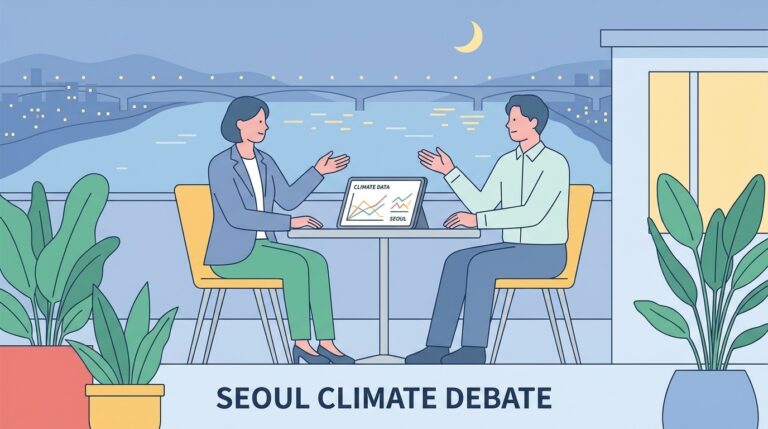
The Setting: A late-night debate over craft beer at a rooftop lounge in Yeouido, overlooking the Han River.
The Cast:
* You: A passionate environmental consultant.
* Min-woo (민우): A brilliant but stubborn tech-startup founder who believes market forces and natural cycles explain everything.
민우: (맥주잔을 내려놓으며 냉소적인 미소를 지으며)
      근데 솔직히 말해서, 기후 변화가 전부 인간 때문이라는 건 너무 비약 아닌가요?
      지구 역사를 보면 늘 빙하기와 간빙기가 반복됐잖아요.
      (But honestly, isn't it a huge leap to say climate change is entirely due to humans?
      Looking at Earth's history, ice ages and interglacial periods have always cycled.)

유 (You): (미소를 머금고 고개를 가볍게 끄덕이며)
          아, 주기적인 자연 변동 말씀이시군요. 충분히 그렇게 생각하실 수 있습니다.
          (Ah, you mean the periodic natural cycles. It is completely understandable to think that way.)

민우: 그렇죠? 자연스러운 지구의 생체 리듬인 거죠. 인간이 오버하는 걸 수도 있어요.
      (Right? It’s just the Earth's natural biological rhythm. Humans might be overreacting.)

유 (You): (차분하지만 확신에 찬 목소리로)
          하지만 민우 씨, 그 관점은 최근의 온난화 속도를 간과한 것입니다.
          과거의 기후 변화는 수만 년에 걸쳐 서서히 일어난 반면,
          산업혁명 이후의 기온 상승은 불과 150년 만에 전례 없는 속도로 진행되고 있거든요.
          (However, Min-woo, that perspective overlooks the speed of recent warming.
          While past climate changes occurred gradually over tens of thousands of years,
          the temperature rise since the Industrial Revolution has progressed at an unprecedented rate in just 150 years.)

민우: (눈을 가늘게 뜨며)
      그거야 뭐 데이터 측정 기술이 발달해서 그렇게 보이는 것 아닐까요?
      (Could that just be because our data measurement technology has improved, making it look that way?)

유 (You): (단호히 고개를 저으며)
          그것은 명백한 과학적 사실을 단순한 기우로 치부하는 것입니다.
          빙하 코어 분석과 위성 데이터 등 다각적인 증거가 인간 활동에 의한 탄소 배출을 가리키고 있습니다.
          이것을 부정하는 것은 학계의 압도적인 합의를 거스르는 어불성설에 가깝죠.
          (To say that is to dismiss clear scientific facts as mere unfounded worries.
          Multifaceted evidence, including ice core analysis and satellite data, points to carbon emissions from human activities.
          To deny this is close to being preposterous, going against the overwhelming consensus of the academic community.)

민우: (조금 당황한 듯 맥주를 한 모금 들이켜며)
      어불성설이라니요... 표현이 좀 강하시네요. 하하.
      (Preposterous?... That's a bit of a strong expression. Haha.)
🔀 Decision Point: How do you ease the tension while keeping your ground?
- Option A: “아, 기분 나쁘셨다면 사과드립니다. 하지만 데이터가 그렇습니다.” (Sorry if you felt bad, but the data is what it is.)
- Option B: “제가 조금 격양되었네요. 하지만 민우 씨 같은 혁신적인 IT 리더분이야말로 이런 과학적 팩트를 바탕으로 새로운 기후 테크 시장을 선도하셔야 하지 않을까 해서 열정을 부려봤습니다.” (I might have gotten a bit passionate. But I did so because I believe innovative IT leaders like you, Min-woo, should lead the new climate-tech market based on these scientific facts.)
- Option C: “네, 말이 안 되니까 안 된다고 한 겁니다.” (Yeah, I said it doesn’t make sense because it literally doesn’t make sense.)
🏆 Best Choice: Option B
- Why: This is pure C2 level social mastery. Option B uses a high-class, face-saving compliment (칭찬) combined with a business opportunity. By calling Min-woo an “innovative IT leader” and linking climate science to
Frequently Asked Questions (FAQ)
Q: What does "기우에 불과하다 (gi-u-e bul-gwa-ha-da)" mean in Korean and how do you pronounce it?
A: In Korean, "기우에 불과하다 (gi-u-e bul-gwa-ha-da)" is pronounced [gi-u-e bul-gwa-ha-da] and means: "It is nothing more than an unfounded worry / a groundless anxiety."
Q: What does "인과관계를 왜곡하다 (in-gwa-gwan-gye-reul wae-gok-ha-da)" mean in Korean and how do you pronounce it?
A: In Korean, "인과관계를 왜곡하다 (in-gwa-gwan-gye-reul wae-gok-ha-da)" is pronounced [in-gwa-gwan-gye-reul wae-gok-ha-da] and means: "To distort the causal relationship (cause and effect)."
Q: What does "어불성설이다 (eo-bul-seong-seol-i-da)" mean in Korean and how do you pronounce it?
A: In Korean, "어불성설이다 (eo-bul-seong-seol-i-da)" is pronounced [eo-bul-seong-seol-i-da] and means: "To be utterly illogical / preposterous / holding no water."







