

Ouch! Got a Blister? How to Buy a Band-Aid in Korea Like a Local
안녕하세요! (An-nyeong-ha-se-yo!) Hello there, beautiful souls! It is your favorite senior editor and friendly neighborhood Korean tutor from Daily Hangul (매일한글).
Picture this: You are having the absolute time of your life wandering through the trendy, colorful streets of Hongdae, or maybe hiking up Namsan Mountain to catch that iconic sunset. Suddenly—ouch! Your new shoes start rubbing against your heel. A blister is forming, and every step feels like walking on Lego blocks.
You look around. You see a glowing convenience store and a pharmacy, but your mind goes blank. “How do I say Band-Aid in Korean? Is it the same? Will they understand me?”
Don’t worry! Today, we are going to learn exactly how to handle this minor emergency. You will learn how to confidently walk into any store, buy a bandage, and even get the perfect ointment to heal your skin. Let’s step into this easy, pain-free guide together!
Phase 2: Top 3 Essential Expressions for “Band-Aid” Survival
When you need first aid, you want to keep things quick and simple. Here are the three most common, natural expressions you need to know at an A2 (Elementary) level.
1. 밴드 주세요 (Band-eu ju-se-yo)
- Pronunciation: [band-eu ju-se-yo] / Sounds like: “Band” + “uh” + “Ju-say-yo”
- Meaning: “Please give me a bandage (Band-Aid).”
- K-Culture Moment: You have definitely seen this in K-Dramas! The sweet male lead runs to the convenience store late at night because the female lead has a scratch on her ankle from wearing high heels. He kneels down and gently applies the “밴드” (band).
- Editor’s Insight: While the official word is “일회용 반창고” (disposable plaster), nobody says that in real life unless they are writing a medical report. Just say “밴드” (band) or “대일밴드” (Daeil-band)—which is Korea’s most famous brand name, just like “Band-Aid” in English!
- Situation Spectrum:
- Casual (Friends): ✅
- Semi-formal (Clerks/Pharmacists): ✅
- Formal (Doctors/Elders): ✅
- 🤔 Think About It: In your home country, do people call bandages by their actual name, or do they use a famous brand name (like Band-Aid or Elastoplast)? Why do you think societies do this?
2. 상처 연고도 같이 주세요 (Sang-cheo yeon-go-do gat-i ju-se-yo)
- Pronunciation: [sang-chuh yun-go-do ga-chee ju-se-yo] / Sounds like: “Sang-chuh” + “yuhn-go-do” + “gah-chee” + “ju-say-yo”
- Meaning: “Please give me wound ointment, too.”
- K-Culture Moment: In Korea, if you get a cut, mothers will instantly reach for Madecassol (마데카솔) or Fucidin (후시딘). These are the two holy-grail healing ointments found in 99% of Korean homes!
- Editor’s Insight: “상처” (sang-cheo) means wound/cut, and “연고” (yeon-go) means ointment. Adding “도” (do) means “too/also”. Putting them together makes you sound incredibly fluent and prepared!
- Situation Spectrum:
- Casual: ✅
- Semi-formal: ✅
- Formal: ✅
- 🤔 Think About It: Healing wounds quickly to prevent scars is a big deal in Korea’s skin-conscious culture. How does your culture view minor scars?
3. 방수 밴드 있어요? (Bang-su band-eu it-seo-yo?)
- Pronunciation: [bang-su band-eu eet-suh-yo?] / Sounds like: “Bahng-soo” + “band-uh” + “eet-suh-yo?”
- Meaning: “Do you have waterproof bandages?”
- K-Culture Moment: Super useful if you are planning to visit a traditional Korean bathhouse (찜질방 – Jjimjilbang) or go swimming at a beautiful beach in Busan, but still need to protect your cut!
- Editor’s Insight: “방수” (bang-su) means waterproof. The prefix “방-” (bang) means “to block” or “prevent” (just like in 방탄소년단 – Bangtan Sonyeondan / BTS, which literally means Bulletproof Boy Scouts!).
- Situation Spectrum:
- Casual: ✅
- Semi-formal: ✅
- Formal: ✅
- 🤔 Think About It: Can you guess what “방풍” (bang-pung) means if “풍” (pung) means wind? (Answer: Windproof! Korean prefixes are like magic lego blocks!)
Phase 3: Textbook Korean vs. Real-World Korean
Let’s compare what traditional books teach you versus what Koreans actually say. It will save you from sounding like a robot!
Situation 1: Asking for a plaster at the counter
- 📖 Textbook: “일회용 반창고를 구매하고 싶습니다.” (I would like to purchase a disposable plaster.)
- 🗣️ Real Korean: “밴드 좀 주세요.” (Please give me some bands.)
- 💡 Why the difference? The textbook sentence is grammatically correct but feels way too stiff and formal, like you are buying a rare antique. “밴드 좀 주세요” is warm, natural, and gets straight to the point.
Situation 2: Asking where they are kept in a convenience store
- 📖 Textbook: “의약외품 보관 구역이 어디에 위치해 있습니까?” (Where is the quasi-drug storage area located?)
- 🗣️ Real Korean: “밴드 어디에 있어요?” (Where are the bandages?)
- 💡 Why the difference? Convenience stores are fast-paced. Using simple nouns + “어디에 있어요?” (Where is/are…?) is the golden key for easy survival communication in Korea.
Phase 4: K-Culture Deep Dive & Non-Verbal Manners
4-1. Body Language: The “Two-Hand” Rule (두 손)
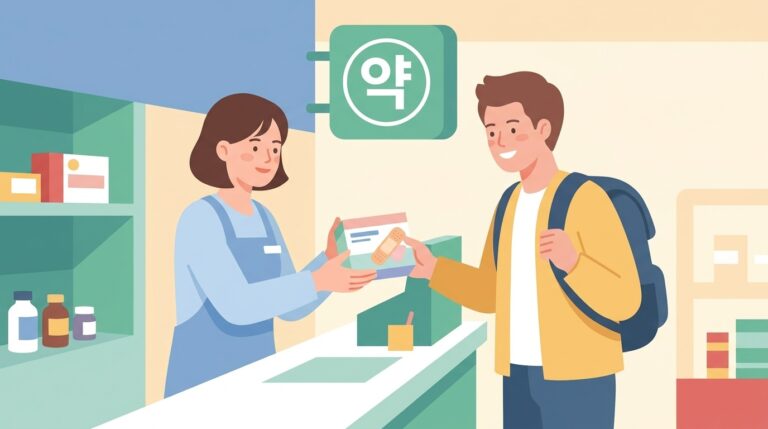
When you pay for your bandages at a pharmacy (약국 – yak-guk) or convenience store (편의점 – pyeon-ui-jeom), always present your cash or card with both hands. When the clerk hands you the bandage box, receive it with both hands while giving a slight, polite nod of your head. It shows great respect and immediately makes the locals warm up to you!
4-2. The Secret World of Korean “Pimple Patches”
If you have a minor scratch on your face, don’t use a regular brown bandage! Ask for a 습윤 밴드 (seup-yun band-eu – hydrocolloid band) or 여드름 패치 (yeo-deu-reum pae-chi – acne patch). These are round, transparent skin-colored stickers that heal wounds without scabs. They are incredibly cheap in Korea and a staple of K-Beauty!
Phase 5: Interactive Roleplay Scenario
- Setting: A bright, clean GS25 convenience store in Hongdae. Upbeat K-pop is playing from the speakers. You are limping slightly from your heel blister.
- Cast:
- You: A traveler with sore feet.
- Ji-hoon (지훈): The friendly, part-time store clerk.
Ji-hoon: 어서 오세요! (Eo-seo o-se-yo!)
         (Clapping hands slightly) "Welcome!"

You: 안녕하세요. 혹시 밴드 있어요? (An-nyeong-ha-se-yo. Hok-si band-eu it-seo-yo?)
     (Pointing to your foot and smiling weakly) "Hello. Do you happen to have bandages?"

Ji-hoon: 아, 발이 아프시구나. 네, 있어요! 저기 약품 코너에 있습니다. (Ah, bal-i a-peu-si-gu-na. Ne, it-seo-yo! Jeo-gi yak-pum ko-neo-e it-seum-ni-da.)
         (Pointing to a small shelf near the counter) "Ah, your feet must hurt. Yes, we do! They are over there in the medicine corner."

You: (Walking over) 아, 여기 있네요! (Ah, yeo-gi it-nae-yo!)
     (Picking up a box) "Ah, here they are!"

Ji-hoon: 어떤 밴드 필요하세요? 일반 밴드도 있고, 방수 밴드도 있어요. (Eo-tteon band-eu pil-yo-ha-se-yo? Il-ban band-eu-do it-go, bang-su band-eu-do it-seo-yo.)
         (Leaning forward helpfully) "Which bandage do you need? We have regular ones and waterproof ones."
🔀 Your Decision Point!
What should you say next? Choose the best path:
- A) “방수 밴드 주세요.” (Bang-su band-eu ju-se-yo.)
- B) “반창고를 나에게 바치시오.” (Ban-chang-go-reul na-e-ge ba-chi-si-o.)
- C) “밴드 필요 없어!” (Band-eu pil-yo eop-seo!)
Check the Analysis & Best Choice!
- Best Choice: A! It is polite, natural, and uses the correct word for waterproof bandages. Ji-hoon will hand them to you with a smile.
- Awkward Choice: B! This translates to “Present the plaster to me!” in a historical drama king’s voice. Unless you are playing a Joseon King, please don’t use this!
- Rude Choice: C! This means “No need for bandages!” in an informal, aggressive tone. It might scare poor Ji-hoon!
Phase 6: 10-Second Emotion Shadowing Drill
Let’s practice speaking with real Korean feelings!
- [🥺 Hurt & Urgent]
“아 참! / 밴드 / 어디에 / 있어요?”
(A cham! / Band-eu / eo-di-e / it-seo-yo?)
“Oh my! / Bandages / where / are they?” -
[😊 Relieved & Grateful]
“네, / 정말 / 감사합니다!”
(Ne, / jeong-mal / gam-sa-ham-ni-da!)
“Yes, / thank you / so much!”
Phase 7: K-Culture Mini Dictionary
| Word (Hangul) | Romanization | English Translation | Cultural Insight |
|---|---|---|---|
| 약국 | Yak-guk | Pharmacy | Look for the big red or green “약” sign on the street. Only pharmacies can sell strong pain-relief ointments. |
| 대일밴드 | Daeil-band | Band-Aid | The grandfather of Korean bandage brands. Even kids know this name! |
| 연고 | Yeon-go | Ointment | The magical ointment your Korean friends will offer you the second you get a scratch. |
| 편의점 | Pyeon-ui-jeom | Convenience Store | Open 24/7. They sell basic bandages and basic emergency medicines at night. |
Phase 8: Traveler’s Survival Kit
Emergency Phrases TOP 3:
- 약국 어디에 있어요? (Yak-guk eo-di-e it-seo-yo?) – “Where is the pharmacy?”
- 상처 났어요. (Sang-cheo nat-seo-yo.) – “I got a cut/wound.”
- 제일 잘 듣는 걸로 주세요. (Jeil jal deut-neun geol-lo ju-se-yo.) – “Please give me the one that works best.”
📌 Editor’s Travel Note: To locate the nearest open pharmacy, use the Naver Map App. Google Maps is not fully optimized in Korea, so Naver Map is your true local savior! If pharmacies are closed, head to a nearby convenience store. They carry basic medical supplies labeled as “안전상비의약품” (safely stocked medicines).
Phase 9: Deep Thoughts — “More than just a bandage”
In Korea, offering someone a bandage is a warm act of 정 (Jeong)—which means deep affection and caring for others. If a Korean friend sees a scratch on your hand and runs to get you a “대일밴드,” they are showing that they care about your well-being. It is a small but powerful gesture of connection.
💬 Your Turn: How do people show care for minor injuries in your hometown? Do you carry band-aids in your bag just in case? Let us know in the comments below!
Phase 10: FAQ & Common Mistakes
Q: Can I buy bandages at any time in Korea?
A: Yes! While pharmacies (약국) usually close around 8 PM to 10 PM, major convenience stores (편의점) are open 24/7 and always stock basic bandages.
Q: I asked for a “plaster” but the clerk looked confused. Why?
A: Standard British or European terms like “plaster” are not widely used in Korea. Stick to “밴드” (band) or “대일밴드” (Daeil-band) for instant understanding!
Q: Can I buy strong medical ointments at convenience stores?
A: No. Convenience stores only sell very basic bandages. For antibiotic ointments like Fucidin, you should visit a pharmacy (약국).
Phase 11: Action Missions!
- 🥉 Bronze: Look in the mirror and say “밴드 주세요!” (Band-eu ju-se-yo!) three times with a cute, hurt expression.
- 🥈 Silver: Next time you watch a K-Drama, try to spot the scene where a character gets hurt and check what brand of bandage they use!
- 🥇 Gold: Walk into a Korean convenience store or mart and find where the bandages are located. If you can, buy a box using our polite “two-hand” rule!
Phase 12: Interactive Quiz Challenge
1. Which word should you use to buy a waterproof bandage?
- A) 방풍 밴드
- B) 방수 밴드
- C) 그냥 밴드
2. Fill in the blank: “약국
(Where is the pharmacy?)”
* A) 가고 싶어요
* B) 어디에 있어요?
* C) 맛있어요
3. True or False: You should use only one hand to hand your card to a pharmacist in Korea.
- A) True
- B) False
Click here to check the answers!
- Answer: B) 방수 밴드 (Bang-su band). “방수” means waterproof!
- Answer: B) 어디에 있어요? (eo-di-e it-seo-yo?) which means “Where is it?”.
- Answer: B) False! Always use both hands to show respect and polite manners in Korea!







