

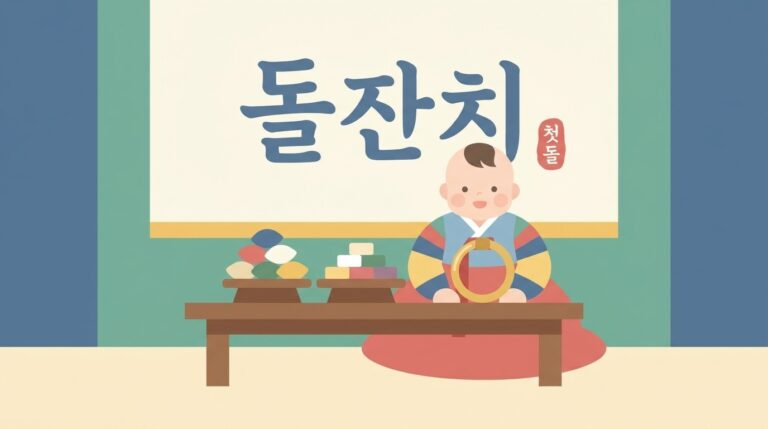
Celebrating a Milestone: Master the Art of Korean First Birthday Blessings (덕담)
안녕하세요! (An-nyeong-ha-se-yo!) Welcome back to Daily Hangul, your cozy corner for mastering real-world Korean and culture. I’m your senior editor and cultural navigator.
Imagine this: You’ve just walked into a beautifully decorated banquet hall in Seoul. The air is filled with the sweet aroma of Baekseolgi (백설기 – white steamed rice cakes), laughter, and the gentle clinking of glasses. In the center of the room, a baby dressed in a vibrant, multi-colored Hanbok (한복) sits on a throne of cushions. This is a Doljanchi (돌잔치)—the deeply significant Korean celebration of a baby’s first birthday.
As a guest, you see aunts, uncles, and grandparents lining up to whisper warm words into the parents’ ears and coo at the baby. Suddenly, your friend—the proud parent—spots you and waves you over. Your heart does a little flip. “What should I say? Is ‘Happy Birthday’ enough? How do I wish the baby a bright future without sounding like a textbook robot?”
Don’t worry! Today, we are going to dive deep into Deokdam (덕담)—the traditional words of blessing and well-wishing. By the end of this guide, you’ll know exactly what to say to make the grandparents beam with pride and the parents feel deeply touched.
Phase 2: Three Core Blessings for a First Birthday
To help you sound natural and culturally respectful, let’s analyze three essential expressions used during a Doljanchi.
1. 건강하고 밝게 자라렴 (Geon-gang-ha-go bal-ge ja-ra-ryeom)
- Pronunciation: Gun-gang-ha-go bahl-geh jah-rah-ryeom (Sounds like: “Gun-gang” + “ha-go” + “bahl-gheh” + “jah-rah-ryum”)
- Meaning: “Grow up healthy and bright.”
- K-Culture Moment: This is the ultimate, classic blessing. In K-Dramas like Hospital Playlist or Reply 1988, whenever elders look at a child, they say this with a warm, wrinkly eye-smile.
- Editor’s Insight: The ending -렴 (-ryeom) is a gentle, affectionate way for older people (or friends of the parents acting as an ‘adult’ figure to the baby) to give a command or wish to a young child. It carries a deeply loving, protective nuance.
- Situation Spectrum:
- Casual (To the baby/informal): ✅
- Semi-formal (To the parents): ⚠️ (Use a polite ending like “건강하고 밝게 자라길 바랄게요”)
- Formal (To elders): 🚫
- 🤔 Think About It: Why do Koreans prioritize “bright” (밝게) alongside “healthy”? In Korean culture, a “bright” child refers to someone with a sunny disposition, resilience, and positive energy—traits highly valued in close-knit communities.
2. 첫 돌을 진심으로 축하드립니다 (Cheot do-reul jin-si-meu-ro chuk-ha-deu-rim-ni-da)
- Pronunciation: Chut do-reul jeen-she-meu-ro chook-hah-deu-reem-nee-dah
- Meaning: “I sincerely congratulate [the baby] on their first birthday (first ‘Dol’).”
- K-Culture Moment: You say this directly to the parents as you hand them the congratulatory envelope (축의금봉투) at the reception desk.
- Editor’s Insight: 돌 (Dol) specifically refers to the first birthday. Saying “첫 돌” (first milestone birthday) sounds much more culturally authentic than the generic “첫 번째 생일” (first birthday).
- Situation Spectrum:
- Casual (To friends): ⚠️ (Too formal, say “돌 축하해!” instead)
- Semi-formal (To acquaintances/colleagues): ✅
- Formal (To older relatives or bosses): ✅
3. 엄마 아빠 좋은 점만 닮으렴 (Eomma appa jo-eun jeom-man dal-meu-ryeom)
- Pronunciation: Um-mah ah-pah joh-eun jum-mahn dahl-meu-ryeom
- Meaning: “Only take after the best traits of your mom and dad!”
- K-Culture Moment: This is a lighthearted, witty blessing that always brings laughter to the room. It’s a playful nod to the parents’ personality traits.
- Editor’s Insight: It acts as a double compliment—you are praising the parents while wishing a beautiful, smart future for the child.
- Situation Spectrum:
- Casual (To the baby/close friends): ✅
- Semi-formal (To colleagues): ✅ (Use “엄마 아빠 좋은 점만 닮았으면 좋겠어요”)
- Formal: ⚠️
Phase 3: Textbook Korean vs. Real-World Korean
Let’s compare the stiff, dictionary translations with what Koreans actually say at a party.
Situation 1: Congratulating the exhausted parents
- 📖 Textbook Korean: 아기의 첫 번째 생일을 축하합니다. (Ah-gi-ui cheot beon-jjae saeng-il-eul chuk-ha-ham-ni-da.) – “Congratulations on the baby’s first birthday.”
- 🗣️ Real Korean: 벌써 돌이라니 시간 진짜 빠르네요! 그동안 키우느라 고생 많으셨어요. (Beol-sseo do-ri-ra-ni si-gan jin-jja bpa-reu-nae-yo! Geu-dong-an ki-oo-neu-ra go-saeng man-eu-shyeot-eo-yo.)
- 💡 Why the difference? Raising a child for a year is hard work! Real Korean emphasizes empathy and acknowledges the parents’ dedication (고생 많으셨어요 – “You went through a lot of hard work”).
Situation 2: Cheering during the Doljabi (돌잡이 – fortune-telling ritual)
- 📖 Textbook Korean: 아기가 부자가 되기를 원합니다. (Ah-gi-ga bu-ja-ga doe-gi-reul won-ham-ni-da.) – “I want the baby to become rich.”
- 🗣️ Real Korean: 우리 OO이, 돈 잡았으니 나중에 엄청 부자 되겠네! 대박! (U-ri [Baby’s Name]-i, don jab-at-eu-ni na-jung-e eom-cheong bu-ja doe-get-nae! Dae-bak!)
- 💡 Why the difference? During the Doljabi (where the baby picks an item like money, thread, or a pencil), the atmosphere is ecstatic. Using high-energy phrases like 대박! (Awesome/Jackpot!) keeps the festive vibe alive.
Phase 4: K-Culture Deep Dive & Non-Verbal Manners
4-1. The Art of Giving Deokdam & Body Language
When delivering a blessing to the baby or parents, remember that how you deliver it matters just as much as the words:
* The Two-Handed Envelope Hand-off: If you are giving a cash gift, hold the envelope with both hands, bowing your head slightly. Never hand it over with one hand.
* Eye Level with the Baby: When speaking directly to the baby, squat down to their eye level. Gently wave, but avoid touching their face or hands unless the parents invite you to, as babies can easily get overwhelmed or catch germs.
4-2. Decoding the Doljabi (돌잡이) Items
During the party, the baby will be presented with a tray of symbolic items. What the baby grabs predicts their future! Here is your quick cultural cheat sheet:
* Thread (실 – Sil): Long life and health.
* Money/Gold (돈/금 – Don/Geum): Wealth and abundance.
* Pencil/Book (연필/책 – Yeon-pil/Chaek): Academic success, becoming a scholar or professor.
* Stethoscope (청진기 – Cheong-jin-gi): A future in medicine (doctor/pediatrician).
* Gavel (판사봉 – Pan-sa-bong): A future in law (judge/lawyer).
Phase 5: Live Roleplay — The Big Celebration
Setting: A grand Korean buffet restaurant in Gangnam, decorated with pastel-colored balloons and elegant wooden tables. Traditional folk music plays softly in the background.
Cast:
* You (A close foreign friend of the parents)
* Minho (The proud, slightly sleep-deprived father)
* Halmeoni (Minho’s warm-hearted mother/The baby’s grandmother)
- Minho: 🎭 (Smiling widely, waving you over) 어서 와! 진짜 바쁠 텐데 여기까지 와줘서 너무 고마워.
(Eo-seo wa! Jin-jja ba-ppeul ten-de yeo-gi-kka-ji wa-jweo-seo neo-mu go-ma-wo.)
(Welcome! Thank you so much for coming all this way when you must be busy.) -
You: 🎭 (Gently handing over a white envelope with both hands) 민호 씨, 정말 축하해요! 벌써 예준이가 돌이라니 믿기지 않아요.
(Minho-ssi, jeong-mal chuk-ha-hae-yo! Beol-sseo Ye-jun-i-ga do-ri-ra-ni mit-gi-ji an-ah-yo.)
(Minho, congratulations! I can’t believe Ye-jun is already one year old.) -
Minho: 🎭 (Sighing happily) 그러게, 시간이 정말 빠르네. 아, 이쪽은 우리 어머니야.
(Geu-reo-ge, si-gan-i jeong-mal bpa-reu-ne. Ah, i-jjok-eun u-ri eo-meo-ni-ya.)
(Indeed, time flies. Oh, this is my mother.) -
Halmeoni: 🎭 (Smiling warmly, holding a plate of rice cakes) 아이구, 멀리서 온 귀한 손님이네! 떡 좀 들어요.
(Aigoo, meol-ri-seo on gwi-han son-nim-i-ne! Tteok jom deul-eo-yo.)
(Oh, a precious guest from afar! Please have some rice cakes.) -
You: 🎭 (Bowing politely) 감사합니다, 어머니. 예준이가 할머니 닮아서 눈이 정말 예뻐요!
(Gam-sa-ham-ni-da, eo-meo-ni. Ye-jun-i-ga hal-meo-ni dal-ma-seo nun-i jeong-mal ye-bpeo-yo!)
(Thank you, mother. Ye-jun’s eyes are so beautiful because he takes after you!) -
Halmeoni: 🎭 (Giggling, deeply flattered) 호호, 정말? 말도 참 예쁘게 하네! 우리 예준이한테 덕담 한마디 해줘요.
(Hoho, jeong-mal? Mal-do cham ye-bpeu-ge ha-ne! U-ri Ye-jun-i-han-te deok-dam han-ma-di hae-jweo-yo.)
(Hoho, really? You speak so beautifully! Please say a blessing to our Ye-jun.)
🔀 Decision Point: What is your response to the baby?
- Option A: “예준아, 대학교 꼭 좋은 데 가거라!” (Ye-jun-ah, dae-hak-gyo kkok jo-eun de ga-geo-ra! – “Ye-jun, make sure to go to a good university!”)
- Option B: “예준아, 아프지 말고 건강하고 밝게 자라렴!” (Ye-jun-ah, a-peu-ji mal-go geon-gang-ha-go bal-ge ja-ra-ryeom! – “Ye-jun, don’t get sick and grow up healthy and bright!”)
- Option C: “예준아, 돈 많이 벌어서 나한테 맛있는 거 사줘!” (Ye-jun-ah, don man-i beol-eo-seo na-han-te mas-it-neun geo sa-jweo! – “Ye-jun, make lots of money and buy me delicious food!”)
Best Choice Analysis:
- The Winner is Option B! This is the heart and soul of traditional Deokdam. It focuses on health and happiness, which is the ultimate wish of any parent and grandparent. Saying this will make Halmeoni’s heart melt.
- Risk of Option A: While academic success is valued in Korea, pushing university pressure on a 1-year-old baby might sound a bit too intense and premature!
- Risk of Option C: Though meant as a joke, asking a baby to buy you food might sound a bit cheeky or materialistic to traditional elders.
Phase 6: 10-Second Shadowing Drill
Let’s practice saying a warm blessing with the perfect emotional cadence. Pay attention to the pauses (/) and the emotional cues!
[😊 Warm, gentle, and smiling directly at the baby]
“예준아, / 아프지 말고 / 건강하게만 / 자라다오!”
(Ye-jun-ah, / a-peu-ji mal-go / geon-gang-ha-ge-man / ja-ra-da-o!)
Meaning: “Ye-jun, don’t get sick, and just grow up healthy!”
Phase 7: K-Culture Mini Dictionary
| Word | Pronunciation | English Meaning & Cultural Context |
|---|---|---|
| 돌잔치 | Dol-jan-chi | First Birthday Party: Historically, due to high infant mortality rates, surviving the first year was a monumental feat, celebrated by the entire village. |
| 덕담 | Deok-dam | Words of Blessing: Uplifting, positive wishes spoken to someone on special occasions like New Year’s or birthdays to invite good fortune. |
| 돌잡이 | Dol-ja-bi | The Fortune-telling Ritual: The highlight of the party where the baby selects an item representing their future path. |
| 금반지 | Geum-ban-ji | Gold Ring: The traditional gift for a first birthday. Guests often gift a small 24k gold ring (usually 1 ‘don’, about 3.75g) as a financial safety net for the baby’s future. |
Phase 8: Traveler’s Survival Kit
Are you attending a Doljanchi in Korea soon? Keep these three quick phrases handy:
- “초대해 주셔서 감사합니다” (Cho-dae-hae ju-shyeo-seo gam-sa-ham-ni-da)
- Tip: “Thank you for inviting me.” Say this to the parents as soon as you arrive.
- “아이 얼굴이 정말 천사 같네요” (A-i eol-gul-i jeong-mal cheon-sa gat-nae-yo)
- Tip: “The baby’s face looks like a real angel.” A surefire compliment to make parents smile.
- “화장실이 어디에 있나요?” (Hwa-jang-sil-i eo-di-e in-na-yo?)
- Tip: “Where is the restroom?” (Essential for busy buffet halls!).
📌 Editor’s Travel Note:
To find your way to modern hotel buffet venues or traditional hanok party spaces in Seoul, download the Naver Map App for accurate walking and transit directions, as Google Maps is often less reliable in Korea.
Phase 9: A Deeper Reflection — “One Step Deeper”
In Western cultures, birthdays are often celebrated with cake, candles, and gifts directly for the individual. In Korea, however, a baby’s Doljanchi is not just about the baby; it is a communal celebration of survival, resilience, and collective parenting.
Historically, Korea faced harsh winters and diseases. Reaching age one meant the baby was strong enough to survive childhood. Therefore, Deokdam is not just a polite phrase; it’s an active invocation of life and prosperity. When you offer Deokdam, you are actively participating in the community’s protective shield around that child.
💬 Your Turn: How does your home country celebrate a baby’s first major milestone? Do you have a ritual similar to the Doljabi? Let us know in the comments below! We love learning about your cultures.
Phase 10: FAQ & Avoiding Mistakes
Q: Do I have to buy a gold ring? They are quite expensive!
A: Not anymore! While gold rings (금반지) are traditional, with gold prices rising, many close friends and colleagues now choose to give cash (usually between 50,000 KRW to 100,000 KRW depending on closeness) in a clean white envelope. Baby clothes or organic toys are also wonderful alternatives!
Q: Can I use casual language (반말 – Banmal) when giving Deokdam to the baby?
A: Yes! Because the baby is a newborn, you should use soft, affectionate casual forms (like ending with -렴 or -다오). However, always use formal language (존댓말 – Jondaetmal) when congratulating the parents or talking to the grandparents.
Q: What should I wear to a Doljanchi?
A: Smart casual is best. Think of it as a semi-formal brunch or a relaxed wedding. Avoid overly revealing clothes or extremely casual sportswear. A nice dress shirt, slacks, or a modest dress will make you look respectful and elegant.
🚨 Three Common Mistakes to Avoid:
- Writing in Red Ink: When writing the baby’s name on the gift envelope, never use red ink. Historically, red ink is associated with death or warding off evil spirits, and writing a living person’s name in red is considered extremely bad luck.
- Grabbing the Doljabi Items First: Let the baby make their choice naturally. Don’t point or wave specific items (like money) to influence the baby’s choice unless you are asked by the host to help cheer.
- Skipping the Food: Doljanchi is famous for its abundant food. Leaving without eating is considered impolite, as the parents prepared the feast to thank the guests for blessing their baby.
Phase 11: Action Missions
Ready to put your knowledge into practice? Try these three levels of challenges!
- 🥉 Bronze (At-home Challenge): Look at a picture of a cute baby online, and practice saying “건강하고 밝게 자라렴!” aloud three times with a warm smile.
- 🥈 Silver (Social Media Challenge): If you have a friend with a baby, send them a sweet KakaoTalk message using the phrase: “벌써 돌이라니 시간 정말 빠르네요! 축하해요!”
- 🥇 Gold (Real-world Challenge): Attend a Korean celebratory event (or a friend’s baby’s online birthday post) and leave a thoughtful comment using both a compliment for the parents and a Deokdam for the baby.
🎮 K-Culture Mission: Go watch Episode 5 of the hit K-Drama Hospital Playlist or search “Doljanchi vlog” on YouTube. Pay close attention to what the guests write on the message boards!
Phase 12: Interactive Quiz Challenge
Let’s test your knowledge! Click on the toggle buttons below to reveal the answers.
1. Situational Challenge
You are at the Doljabi table. The baby just grabbed the stethoscope! What is the most appropriate and high-energy reaction to say to the parents?
* A) “아기가 아픈가 봐요!”
* B) “나중에 멋진 의사 선생님 되겠네요! 축하해요!”
* C) “의사는 공부를 너무 많이 해야 해요.”
🔍 Click here to check the correct answer!
Correct Answer: B
* Why: Pointing out that the baby will become a “wonderful doctor” (멋진 의사 선생님) is a highly positive Deokdam that directly matches the stethoscope item.
* Option A (“The baby must be sick”) and Option C (“Doctors have to study too much”) are mood-killers! 😅
2. Fill-in-the-Blank
“예준아, 아프지 말고 _________ 자라렴!” (Hint: Grow up healthy and bright.)
🔍 Click here to check the correct answer!
Correct Answer: 밝게 (bal-ge)
* Full Sentence: “예준아, 아프지 말고 밝게 자라렴!” (Ye-jun, don’t get sick and grow up brightly!)
3. True or False?
Q: It is polite to hand over the congratulatory cash envelope with only one hand if you are smiling.
🔍 Click here to check the correct answer!
Correct Answer: False
* Why: In Korea, regardless of your facial expression, presenting gifts, money, or business cards to someone must always be done with two hands to show respect.
See you in the next lesson! Until then, stay healthy and bright—건강하고 밝게 지내세요!







