

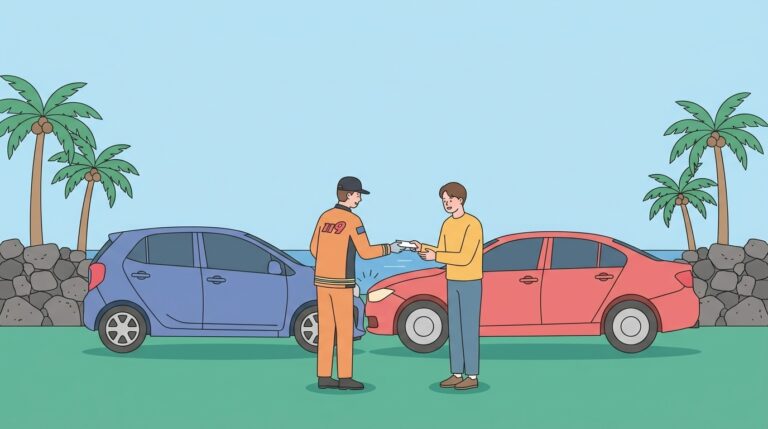
Handling the Unexpected: How to Say “I Got into a Car Accident” in Korean like a Local
안녕하세요! (An-nyeong-ha-se-yo!) Welcome back to Daily Hangul. I’m your chief editor and companion on this journey to mastering real-world Korean.
We’ve all seen those dramatic K-Drama scenes: the screeching tires, the sudden gasp, and the inevitable hospital room scene where the protagonist wakes up with temporary amnesia. But what if you are walking through the bustling streets of Hongdae, or driving a rental car along Jeju Island’s scenic coastal roads, and a real-life fender bender occurs?
When adrenaline spikes and panic sets in, your mind shouldn’t be struggling to conjugate high-level verbs. You need clear, immediate, and culturally fluent expressions to get help. Today, we are diving into A2-level survival phrases for telling someone you’ve been in a traffic accident, combined with critical local safety tips that could save your day (and your wallet!). Let’s learn how to handle this tough situation with confidence.
Phase 2: Key Expressions for Emergencies
When an accident happens, speed and clarity matter. Here are the three most critical, native-approved expressions you need to know.
1. 교통사고가 났어요 (Gyo-tong-sa-go-ga nas-seo-yo)
- Pronunciation: gyoh-tong-sah-goh-gah nah-suh-yoh (Sounds like “gyoh-tong” + “sah-goh” + “gah” + “nah-suh-yo”)
- Meaning: “There has been a traffic accident” / “I got into a car accident.”
- K-Culture Moment: This is the universal phrase screamed into smartphones in almost every modern K-Drama when a character witnesses or gets into a crash.
- Editor’s Insight: This phrase uses the verb 나다 (na-da), which means “to occur” or “to break out.” By saying this, you are objectively stating that an accident has happened, which is perfect for immediately getting the attention of bystanders or police.
- Situation Spectrum:
- Friends/Casual: ⚠️ 교통사고 났어 (gyo-tong-sa-go nas-seo)
- General Public/Strangers: ✅ 교통사고가 났어요
- Emergency Dispatchers/Formal: ✅ 교통사고가 났습니다 (gyo-tong-sa-go-ga nas-seub-ni-da)
- 시ᅢ Think About It: Notice how Korean speakers often omit “I” or “My” (내가/제 차가) in emergencies? Why do you think Korean prioritizes the event itself over the person who experienced it? Think about how collective context shapes the language.
2. 차가 부딪혔어요 (Cha-ga bu-dit-hyeos-seo-yo)
- Pronunciation: chah-gah boo-deet-hyuh-suh-yoh (Rhymes with “chah-gah” + “boo-deet” + “yuh-suh-yoh”)
- Meaning: “The cars collided” / “My car got bumped.”
- K-Culture Moment: Perfect for minor parking lot scrapes or typical Seoul traffic nudges. You’ll hear this when someone is explaining a small scratch on their vehicle.
- Editor’s Insight: 부딪히다 (bu-dit-hi-da) means “to be bumped” or “to collide.” Even if someone hit you, saying “차가 부딪혔어요” is a polite, non-confrontational way to state the physical fact before diving into insurance details.
- Situation Spectrum:
- Friends/Casual: ✅ 차가 부딪혔어 (cha-ga bu-dit-hyeos-seo)
- Insurance Agent/Police: ✅ 차가 부딪혔어요
- Formal Written Report: ✅ 차량 충돌 사고가 발생했습니다 (cha-ryang chung-dol sa-go-ga bal-saeng-haet-seub-ni-da)
- 시ᅢ Think About It: In your culture, when cars bump, do people immediately apologize, or do they wait for insurance companies to decide who is at fault? In Korea, saying “sorry” first can sometimes be misinterpreted as admitting legal guilt, so stating objective facts like this phrase is highly recommended.
3. 다친 사람이 있어요 (Da-chin sa-ram-i is-seo-yo)
- Pronunciation: dah-cheen sah-rahm-ee ee-suh-yoh (Sounds like “dah-cheen” + “sah-rahm” + “ee” + “ee-suh-yo”)
- Meaning: “Someone is injured” / “There is a hurt person.”
- K-Culture Moment: You’ll hear this when someone urgently signals to a paramedic or asks a bystander to call for help on a busy road.
- Editor’s Insight: This combines 다치다 (da-chi-da – to get hurt), 사람 (sa-ram – person), and 있다 (it-da – to exist/be). Use this to prioritize medical help immediately.
- Situation Spectrum:
- Friends/Casual: ✅ 다친 사람 있어! (da-chin sa-ram is-seo!)
- Emergency Dispatcher (119): ✅ 다친 사람이 있어요
- Official/Formal: ✅ 부상자가 존재합니다 (bu-sang-ja-ga jon-jae-hab-ni-da)
- 시ᅢ Think About It: Why does Korean use “person who is hurt” (다친 사람) instead of a direct noun like “victim” in everyday speech? It keeps the tone human and urgent without sounding overly academic during a stressful moment.
Phase 3: Textbook Korean vs. Real-World Korean
When we open standard Korean textbooks, we see phrases that sound like they were written in 1995. Let’s look at how textbook phrases compare to what locals actually say on the road.
Scenario 1: Reporting the crash
- ᄇ Textbook: “교통사고를 당했습니다.” (gyo-tong-sa-go-reul dang-haet-seub-ni-da) — “I suffered a traffic accident.” (Too stiff, sounds like a news anchor).
- ᅣ Real Korean: “교통사고 났어요.” (gyo-tong-sa-go nas-seo-yo) — “An accident happened.” (Natural, urgent, used by 99% of Koreans).
- ᄇ Why the difference? Koreans prefer short, active verbs over passive academic constructions in high-stress moments.
Scenario 2: Pointing out the bumper scratch
- ᄇ Textbook: “차량이 다른 차량과 접촉하였습니다.” (cha-ryang-i da-reun cha-ryang-gwa jeob-chok-ha-yeot-seub-ni-da) — “The vehicle made contact with another vehicle.”
- ᅣ Real Korean: “차가 부딪혔어요” (cha-ga bu-dit-hyeos-seo-yo) or simply “차가 박았어요” (cha-ga bag-as-seo-yo) — “The cars bumped” / “A car hit me.”
- ᄇ Why the difference? “접촉” (contact) is insurance jargon. Real humans say “박다” (to strike/hit) or “부딪히다” (to collide) to describe the physical reality instantly.
Phase 4: K-Culture Deep Dive & Non-Verbal Manners
Handling an accident in Korea requires more than just words; it requires Nunchi (넌ᅮ치 – situational wit) and cultural understanding.
1. The Power of the Dashboard Camera (브랙박스 – Black Box)
In Korea, almost every single vehicle is equipped with a dual-channel dashcam, locally called a “Black Box” (브랙박스). If you get into an accident, do not get into an aggressive shouting match with the other driver. Simply point at your windshield or theirs and say “블랙박스 확인할게요” (beul-laek-bak-seu hwa-gin-hal-ge-yo – “I’ll check the dashcam”). This immediately cools down the temperature because both parties know everything is recorded.
2. Don’t Move the Car Yet! (Use Spray or Photos)
Before moving vehicles to the shoulder of the highway, Koreans historically used white spray paint to outline the tire positions. Today, everyone simply uses their smartphones to take detailed photos of the tire directions, the skid marks, and the angles of collision from 5 meters away. Be polite, keep your head bowed slightly as a sign of non-confrontation, and focus on documenting the scene.
Phase 5: Interactive Roleplay Scenario
Imagine you are driving a rental car near Hallasan Mountain in Jeju. Suddenly, a car merging from a side road scrapes your passenger door. Let’s navigate this scenario step-by-step.
- Setting: A quiet intersection in Jeju. Wind is blowing, and both cars are pulled over.
- Cast: You (Alex, the rental driver) and Min-woo (the other driver, looking stressed but polite).
- Min-woo: ᄀ (Steps out of the car, rubbing the back of his neck) ᄀ “아이고, 죄송합니다! 괜찮으세요?” (Ai-go, joe-song-hab-ni-da! Gwan-chan-eu-se-yo?) — “Oh dear, I am so sorry! Are you okay?”
- You (Alex): ᄀ (Taking a deep breath to stay calm) ᄀ “네, 저는 괜찮아요. 하지만 교통사고가 났어요.” (Ne, jeo-neun gwan-chan-ah-yo. Ha-ji-man gyo-tong-sa-go-ga nas-seo-yo.) — “Yes, I am fine. But we have a traffic accident.”
- Min-woo: ᄀ (Examining the car doors) ᄀ “차가 많이 부딪혔네요. 혹시 다치지는 않으셨어요?” (Cha-ga ma-ni bu-dit-hyeot-nae-yo. Hok-si da-chi-ji-neun an-eu-syeos-seo-yo?) — “The cars bumped hard. You aren’t hurt anywhere?”
- You (Alex): ᄀ (Checking your passenger) ᄀ “저는 안 다쳤는데, 옆사람이 조금 아파해요.” (Jeo-neun an da-chyeot-neun-de, yeob-sa-ram-i jo-geum a-pa-hae-yo.) — “I am not hurt, but my passenger is in a bit of pain.”
- Min-woo: ᄀ (Anxious) ᄀ “어머나, 병원에 가야 할까요? 119를 부를까요?” (Eo-meo-na, byeong-won-e ga-ya hal-kka-yo? Il-il-gu-reul bu-reul-kka-yo?) — “Oh my, should we go to the hospital? Should I call 119?”
- You (Alex): ᄀ (Nodding calmly) ᄀ “네, 다친 사람이 있어요. 119 좀 불러주세요.” (Ne, da-chin sa-ram-i is-seo-yo. Il-il-gu jom bul-leo-ju-se-yo.) — “Yes, there is an injured person. Please call 119.”
- Min-woo: ᄀ (Dialing quickly) ᄀ “알겠습니다. 지금 바로 전화할게요. 그리고 보험사에도 연락하겠습니다.” (Al-get-seub-ni-da. Ji-geum ba-ro jeon-hwa-hal-ge-yo. Geu-ri-go bo-heom-sa-e-do yeon-rak-ha-get-seub-ni-da.) — “Understood. I’ll call right now. And I will also contact the insurance company.”
- You (Alex): ᄀ (Preparing your camera) ᄀ “네. 저는 사진을 찍고 블랙박스를 확인할게요.” (Ne. Jeo-neun sa-jin-eul jjik-go beul-laek-bak-seu-reul hwa-gin-hal-ge-yo.) — “Yes. I will take photos and check the dashboard camera.”
- Min-woo: ᄀ (Relieved by your calm attitude) ᄀ “도와주셔서 감사합니다. 안전지대로 차를 조금 이동할까요?” (Do-wa-ju-syeo-seo gam-sa-hab-ni-da. An-jeon-ji-dae-ro cha-reul jo-geum i-dong-hal-kka-yo?) — “Thank you for your help. Shall we move the cars slightly to a safe zone?”
- You (Alex): ᄀ (Smiling reassuringly) ᄀ “네, 사진 다 찍었으니까 옆으로 이동해요.” (Ne, sa-jin da jjik-eot-eu-ni-kka yeob-eu-ro i-dong-hae-yo.) — “Yes, since I finished taking photos, let’s move to the side.”
해 Decision Point: What should you do next?
Your rental car insurance requires a police report. How do you handle this?
- A. Scream and accuse Min-woo of driving poorly.
- Critique: 🚫 Bad Choice! This will cause Min-woo to get defensive, ruin any chance of a smooth mutual settlement, and waste energy. Korea highly values calm, logical cooperation at accident scenes.
- B. Say “Let’s just exchange phone numbers and go home without calling insurance.”
- Critique: ⚠️ Risky Choice! If you leave without contacting your rental agency or the police, you might be liable for hit-and-run charges (물피도주 – mul-pi-do-ju) if there’s a misunderstanding later. Always document officially.
- C. Take clear photos, agree to wait for the insurance agent together, and call the police (112) or medical services (119) if there are injuries.
- Critique: ✅ Best Choice! This is culturally mature, aligns perfectly with Korean traffic laws, and protects your legal status in a foreign country.
Phase 6: 10-Second Emotion Shadowing Drill
Let’s add some real Korean emotion to these phrases. Don’t read like a robot—mimic the feeling of a real scene! The slash (/) indicates a natural pausing point.
- [ᄅ Urgent & Breathless]
- “아저씨! / 여기 / 교통사고가 / 났어요!”
- Ah-jeos-si! / yeo-gi / gyo-tong-sa-go-ga / nas-seo-yo!
- “Sir! / Here / a traffic accident / happened!”
- [ᄋ Worried & Polite]
- “제 차가 / 조금 / 부딪혔어요. / 도와주세요.”
- Je cha-ga / jo-geum / bu-dit-hyeos-seo-yo. / do-wa-ju-se-yo.
- “My car / slightly / collided. / Please help me.”
- [ᄒ Serious & Focused]
- “빨리요! / 다친 사람이 / 있어요!”
- Ppal-ri-yo! / da-chin sa-ram-i / is-seo-yo!
- “Hurry! / An injured person / is here!”
Phase 7: K-Culture Mini Dictionary
| Word (Korean + Romanization) | English Meaning | Real-world Contextual Meaning |
|---|---|---|
| 보험 (Bo-heom) | Insurance | Essential for any crash. Both drivers will call their respective “bo-heom-sa” (insurance company) to the scene immediately. |
| 블랙박스 (Beul-laek-bak-seu) | Dashcam | Literally “Black Box.” The absolute truth-teller in Korean road disputes. Always mention this to keep things fair. |
| 렉카 (Rek-ka) | Tow Truck | A Konglish slang term for tow trucks. They are famous for arriving incredibly fast—sometimes even before the police! |
| 합의금 (Hap-ui-geum) | Settlement Money | The financial settlement paid to resolve minor injuries and vehicle repairs without going through a full criminal trial. |
Phase 8: Traveler’s Survival Kit
If you ever find yourself in a bind, open this quick digital kit immediately!
Survival Cards
- ᆞ “119에 전화해 주세요!” (il-il-gu-e jeon-hwa-hae ju-se-yo!) — “Please call 119 (Emergency/Ambulance)!”
- ᆞ “제 렌터카가 고장 났어요.” (je ren-teo-ka-ga go-jang nas-seo-yo) — “My rental car broke down.”
- ᆞ “경찰을 불러야 해요.” (gyeong-chal-eul bul-leo-ya hae-yo) — “We must call the police.”
ᄎ Editor’s Travel Note
Before stepping foot behind the wheel in Korea, make sure you download Naver Map (Android/iOS) for flawless GPS navigation, and keep the contact number of your rental car company saved on your phone. Korea’s emergency dispatch service (112 for police, 119 for fire/medical) supports translation services, so do not fear speaking in English if you are in a pinch!
Phase 9: One Step Deeper
Did you notice how we say “차가 부딪혔어요” (The car collided) instead of “내 차가 부딪혔어요” (My car collided)?
Korean culture values a shared, collective perspective. Pointing out ownership using “my” (제/내) in tense moments can sound overly defensive or individualistic. Speaking about the object or situation objectively (“The car”) sounds smoother and more mature to Korean ears. This subtle shift from “me-focused” to “situation-focused” language is the true secret of cultural fluency.
ᆬ Your Turn: How does your home country handle minor traffic accidents? Do people exchange insurance cards quietly, or is there a lot of discussion on the road? Tell us in the comments below!
Phase 10: FAQ & Avoiding Common Mistakes
Q: Can I call the police or ambulance if I don’t speak fluent Korean?
A: Yes! If you dial 112 (Police) or 119 (Ambulance), simply say “영어 통역 부탁드립니다” (Yeong-eo tong-yeok bu-tak-deu-rib-ni-da – “English translation, please”). They will quickly connect you to a three-way call with a translator.
Q: What if the other driver insists on paying me cash directly instead of calling the insurance company?
A: Depends. For very minor scratches (like a tiny paint chip), locals sometimes agree on a small cash settlement (합의금) to keep insurance premiums from rising. However, as a traveler, it is always safest to call your rental agency and let them handle the legalities.
Q: What is the biggest mistake tourists make during a car accident in Korea?
A: Leaving the scene without taking photos or exchanging contact details. Even a tiny bump can technically be prosecuted as “property damage hit-and-run” (물피도주) if you drive away without notifying the owner or police.
ᄋ Common Mistakes Warning Board
- Saying “미안해요” (Mi-an-hae-yo) repeatedly: While being polite is great, apologizing excessively on the road can sometimes be weaponized by insurance companies as an admission of fault. Stick to “괜찮으세요?” (Are you okay?).
- Forgetting to check the Black Box: Always ensure your dashcam is plugged in and working before you start driving in Korea. It is your ultimate shield.
- Shouting or raising your voice: Road rage is extremely frowned upon in Korean society. Calm, objective communication gets resolved twice as fast.
Phase 11: Action Mission
- ᄅ Bronze (Home Challenge): Practice speaking “교통사고가 났어요” into your phone recorder 5 times until you can say it under 2 seconds!
- ᄋ Silver (Network Challenge): Write down “차가 부딪혔어요. 블랙박스를 확인할게요.” on your study notebook and share a picture of it with your online study group.
- ᄎ Gold (Real Challenge): Next time you watch a K-Drama and see a car accident, try to catch if they say “교통사고” or “부딪혔어요”. Write down the drama name and timestamps!
Phase 12: Interactive Quiz Challenge
Test your road survival skills!
1. Situation Judgment Quiz
You accidentally scraped a parked car in a narrow alley in Seoul. There is no owner in sight. What is the most culturally and legally correct move?
ᄒ Click here to see the answer and explanation!
Answer: You must take a photo of the scratch, leave your phone number on a note under the windshield wiper, and call your rental company. Leaving without doing this can result in a hefty fine for ‘물피도주’ (mul-pi-do-ju / hit-and-run of property).
2. Fill in the Blank
“차가 조금 ___________. 블랙박스를 확인할게요.” (The cars bumped a little. I’ll check the dashcam.)
ᄒ Click here to see the answer!
Answer: 부딪혔어요 (bu-dit-hyeos-seo-yo)
3. True or False?
In Korea, police and ambulances can provide free telephone translation services when you call 112 or 119.
ᄒ Click here to see the answer!
Answer: True! They have robust on-demand translation services for English, Chinese, Japanese, and several other languages to assist tourists in distress.







