

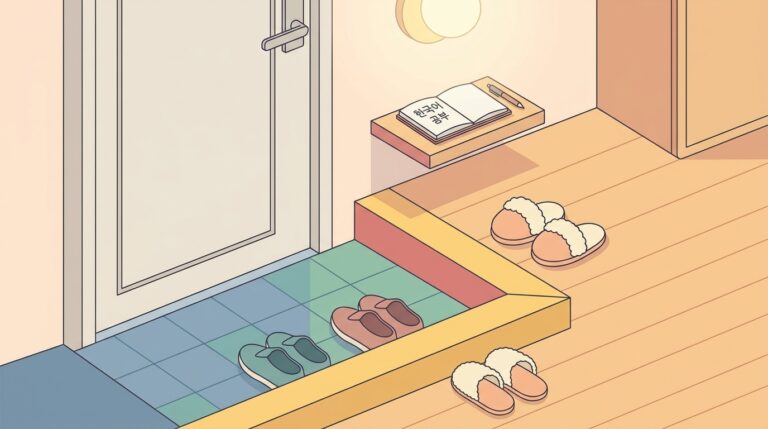
Step Inside But Slip Them Off: The Ultimate Guide to Korean Entryway Etiquette
Phase 1: Empathy (The Hyeon-gwan Hesitation)
안녕하세요! (An-nyeong-ha-se-yo!) Hello! I am your lead editor at Daily Hangul. If you have ever watched a K-Drama, you have probably seen this exact scene: a character rushes home, tired from a long day at work, and the very first thing they do is slip off their shoes at the door, stepping onto a clean, polished floor in one smooth motion.
But for many of my students, this moment is filled with mild panic. Imagine this: you are invited to a Korean friend’s home for dinner. You walk up to their apartment, the door opens, and you see a small, lowered tiled area right inside the door. Your friend is smiling, welcoming you in, but you stand there frozen. Do I take my shoes off here? Can I step on that wooden ledge? What if my socks have holes in them?
Take a deep breath! This guide is built from real-world lessons and composite cases of students just like you. Today, we will transform that awkward entryway hesitation into a confident, polite entrance that will make your Korean hosts whisper, “Wow, they really know Korean culture!”
Phase 2: Core Expressions (The Three Golden Phrases)
Let’s break down the three most common phrases you will hear or use at a Korean entryway (현관, hyeon-gwan).
1. 신발 벗고 들어오세요 (Sin-bal beot-go deul-eo-o-se-yo)
- Pronunciation: [sin-bal beot-go deul-eo-o-se-yo] / Sound-alike guide: “Seen-bahl buht-go deul-uh-oh-seh-yo”
- Meaning: Please take off your shoes and come in.
- K-Culture Moment: You will hear this warm invitation in almost every domestic K-Drama scene when family or friends arrive. It marks the transition from the cold, public outside world to the warm, intimate private space.
- Editor’s Insight: This is polite but warm. The verb 벗다 (beot-da) means “to take off (clothing/shoes)” and 들어오다 (deul-eo-o-da) means “to come in.”
- Situation Spectrum:
- Casual Friends: ✅
- Semi-formal (Coworkers): ✅
- Formal (Boss/Elders): ✅ (To be even more polite, you might hear or use “들어가다” forms, but this standard polite form is perfectly safe!)
- 🤔 Think About It: In many Western cultures, keeping shoes on inside is common or at least acceptable in some homes. Why do you think Koreans are so strict about taking them off? Let’s discover the architectural secret in Phase 4!
2. 실내화로 갈아 신으세요 (Sil-nae-hwa-ro gal-a sin-eu-se-yo)
- Pronunciation: [sil-nae-hwa-ro gal-a sin-eu-se-yo] / Sound-alike guide: “Sheel-neh-hwah-ro gahl-ah sheen-uh-seh-yo”
- Meaning: Please change into slippers.
- K-Culture Moment: In modern Korean apartments or when visiting aesthetic offices, the host will hand you cozy, sometimes cute, indoor slippers (sil-nae-hwa).
- Editor’s Insight: 갈아 신다 (gal-a sin-da) specifically means “to change footwear.” The particle ~로 (-ro) indicates the direction of change (into slippers).
- Situation Spectrum:
- Casual Friends: ✅
- Semi-formal: ✅
- Formal: ✅
3. 여기 신발 두시면 돼요 (Yeo-gi sin-bal du-si-myeon dwae-yo)
- Pronunciation: [yeo-gi sin-bal du-si-myeon dwae-yo] / Sound-alike guide: “Yuh-gee seen-bahl doo-shee-myun dweh-yo”
- Meaning: You can just leave your shoes here.
- K-Culture Moment: When you are not sure where to place your dirty shoes in a crowded entryway, the host will point to a shoe rack or a specific spot on the entryway floor.
- Editor’s Insight: 두다 (du-da) means “to place/leave.” The grammar pattern -(으)시면 돼요 (-(eu)si-myeon dwae-yo) translates to “it is fine if you do…” or “you can just…”
- Situation Spectrum:
- Casual Friends: ✅
- Semi-formal: ✅
- Formal: ✅
Phase 3: Textbook Korean vs. Real Korean
Textbooks often teach highly formal, rigid sentences that sound a bit robotic in a warm, cozy home setting.
1. Welcoming Someone Inside
- 📖 Textbook Korean: “구두를 벗고 들어오십시오.” (Gu-du-reul beot-go deul-eo-o-sip-si-o. – Please remove your dress shoes and enter.)
- 🗣️ Real Korean: “편하게 신발 벗고 들어와~!” (Pyeon-ha-ge sin-bal beot-go deul-eo-wa! – Just take off your shoes and come on in!)
- 💡 Why the difference?: The textbook uses the ultra-formal “하십시오” (hasipsio) and specifies “구두” (gudu, dress shoes). Real friends want you to be “편하게” (pyeon-ha-ge, comfortably) and use “신발” (sin-bal) as a general term for all footwear.
2. Offering Slippers
- 📖 Textbook Korean: “이 실내화를 착용하시기 바랍니다.” (I sil-nae-hwa-reul chak-yong-ha-si-gi ba-ram-ni-da. – I hope you wear these indoor slippers.)
- 🗣️ Real Korean: “이거 신어!” (I-geo sin-eo! – Wear this!/Put these on!)
- 💡 Why the difference?: “착용하다” (chakyonghada) is a highly formal verb for wearing items (like safety gear or seatbelts). In a friendly home, Koreans simply use “신다” (sinda, to wear on feet) with the casual “이거” (igeo, this).
Phase 4: K-Culture Deep Dive & Non-Verbal Manners
4-1. Nunchi & Body Language at the Hyeon-gwan
- The Sock Rule: Never go barefoot if you can avoid it! Bare feet on a host’s floor can feel slightly sticky or overly casual. If you are wearing sandals, carry a clean pair of socks in your bag to slip on before stepping onto the living room floor.
- The Shoe Direction: When you take off your shoes, do not just kick them off in a messy pile. Turn them around so the toes point toward the exit. This makes leaving easier and shows incredible mindfulness (nunchi) and respect for the home.
4-2. The Cultural Code: Ondol (온돌)
Why is the floor so sacred in Korea? It comes down to Ondol (온돌), Korea’s traditional underfloor heating system. Because the floor itself is heated, Koreans historically sat, ate, and slept directly on the floor. Even in modern apartments with couches and beds, the floor is treated as a clean furniture surface, not just a ground to walk on. Bringing outside dirt onto an Ondol floor is a major cultural taboo!
Phase 5: Interactive Roleplay Scenario
Setting: A rainy Friday evening. You have arrived at your Korean friend Minji’s apartment for a homemade dinner.
Cast:
- You (Guest): Curious and polite.
- Minji (Host): Warm, welcoming, and excited to cook for you.
Dialogue:
- Minji: 🎭 (Opens the door with a bright smile) “어머, 왔어? 비 많이 오는데 오느라 고생했어!”
(Eo-meo, wass-eo? Bi manh-i o-neun-de o-neu-ra go-saeng-haess-eo! / Oh, you’re here? It’s raining hard, you must have had a tough time getting here!) -
You: 🎭 (Smiling, shaking off your umbrella) “아니야, 괜찮아. 초대해 줘서 고마워!”
(An-i-ya, gwaen-chan-ha. Cho-dae-hae jwo-seo go-ma-wo! / No, I’m okay. Thanks for inviting me!) -
Minji: 🎭 (Gesturing toward the entryway tiled floor) “얼른 들어와. 신발은 그냥 거기 벗어두면 돼.”
(Eol-reun deul-eo-wa. Sin-bal-eun geu-nyang geo-gi beot-eo-du-myeon dwae. / Come on in quickly. You can just take off your shoes and leave them there.) -
You: 🎭 (Hesitating slightly at the step) “응! 신발 벗고 들어갈게. 신발 어디에 둘까?”
(Eung! Sin-bal beot-go deul-eo-gal-ge. Sin-bal eo-di-e dul-kka? / Okay! I’ll take off my shoes and come in. Where should I put them?) -
Minji: 🎭 (Pointing to a neat row of slippers) “여기 신발장에 올려둬도 되고, 그냥 바닥에 둬도 돼. 그리고 이거 실내화로 갈아 신어!”
(Yeo-gi sin-bal-jang-e ol-ryeo-dwo-do doe-go, geu-nyang ba-dak-e dwo-do doe. Geu-ri-go i-geo sil-nae-hwa-ro gal-a sin-eo! / You can put them on the shoe rack here, or just leave them on the floor. And change into these slippers!) -
You: 🎭 (Carefully stepping onto the wooden floor in clean socks) “고마워. 실내화 진짜 귀엽다!”
(Go-ma-wo. Sil-nae-hwa jin-jja gwi-yeop-da! / Thank you. These slippers are really cute!) -
Minji: 🎭 (Laughing) “그치? 너 주려고 새로 샀어. 거실로 가자!”
(Geu-chi? Neo ju-ryeo-go sae-ro sass-eo. Geo-sil-lo ga-ja! / Right? I bought them new just for you. Let’s go to the living room!)
🔀 Decision Point
You are standing in the entryway. Your shoes are muddy from the rain. What do you do?
- Choice A: Step onto the wooden living room floor first, then bend down to untie and slip off your wet shoes.
- Choice B: Keep your feet strictly on the lower tiled area (hyeon-gwan), slide your shoes off, step onto the clean wooden floor, and then turn your shoes around neatly.
- Choice C: Keep your shoes on because your socks have a tiny hole in the toe, hoping your friend won’t notice.
Best Choice: Choice B!
This is the perfect Korean entryway etiquette. You keep the dirt on the lower tile, keep the upper wooden floor perfectly clean, and show mindfulness by arranging your shoes.
Bad/Risk Choices:
- Choice A: A major cultural faux pas! Bringing wet, muddy shoe soles onto the clean floor boundary will stress your host out immediately.
- Choice C: Keeping shoes on inside a Korean home is an absolute emergency situation. Your friend will be shocked. (Tip: It is much better to show a tiny sock hole with a laugh than to wear shoes inside!).
Phase 6: 10-Second Shadowing Drill
Let’s practice saying these like a natural! Focus on the pauses (/) and the emotional vibe.
- [😊 Cheerful and warm]
“편하게 / 신발 벗고 / 들어와요!”
(Pyeon-ha-ge / sin-bal beot-go / deul-eo-wa-yo!)
“Just comfortably / take off your shoes / and come in!” -
[🥺 Polished and polite]
“실내화로 / 갈아 신으시면 / 돼요.”
(Sil-nae-hwa-ro / gal-a sin-eu-si-myeon / dwae-yo.)
“You can / change into / slippers.”
Phase 7: K-Culture Mini Dictionary
| Word (Hangeul) | Romanization | Translation | Contextual Insight |
|---|---|---|---|
| 현관 | Hyeon-gwan | Entryway | The physical and psychological boundary between the public street and the private home. Always lowered by a few inches. |
| 실내화 | Sil-nae-hwa | Indoor slippers | Literally “indoor shoes.” Essential for keeping feet warm on hard floors and preventing footprints. |
| 신발장 | Sin-bal-jang | Shoe cabinet | The tall closet located in the hyeon-gwan where dozens of family shoes are neatly stored. |
| 발매트 | Bal-maeteu | Foot mat | The soft carpet mat placed right at the edge of the living room floor to step on immediately after removing shoes. |
Phase 8: Traveler’s Survival Kit
Top 3 Survival Expressions
-
신발 벗어야 돼요? (Sin-bal beot-eo-ya dwae-yo?)
- Meaning: Do I need to take off my shoes?
- Pro Tip: Use this when entering traditional restaurants, temple stay rooms, or boutique clinics where the floor setup is confusing.
- 실내화 있어요? (Sil-nae-hwa iss-eo-yo?)
- Meaning: Do you have slippers?
- Pro Tip: Helpful if you have cold feet and want to request indoor slippers politely.
- 양말 신고 왔어요. (Yang-mal sin-go wass-eo-yo.)
- Meaning: I wore socks.
- Pro Tip: Assuring your host that you have clean socks ready for their floor!
📌 Editor’s Travel Note: To navigate your way smoothly to a friend’s house or find cozy places in Seoul, make sure to download navigation apps beforehand. We highly recommend using the Naver Map App Download Page instead of Google Maps, as Google Maps does not support full pedestrian routing in South Korea.
Phase 9: One Step Deeper
In many Western cultures, a home’s entryway is just a hallway. But in Korea, the 현관 (hyeon-gwan) is a sacred threshold. It represents the separation of pure and impure, clean and dirty. Leaving your shoes at the door is not just about keeping dust away; it is an act of leaving the stress, noise, and chaos of the outside world behind. By removing your shoes, you show respect for the peace and purity of your host’s personal sanctuary.
💬 Your Turn: How does your home country handle footwear inside? Do people wear shoes, slippers, or go barefoot? Let us know your cultural traditions in the comments below!
Phase 10: FAQ & Common Mistakes
Q: Can I wear my shoes inside if I am just quickly grabbing something I forgot?
A: No, absolutely not! Even for two seconds, stepping onto the clean floor with shoes is considered very disrespectful. Instead, do the “one-legged hop”: keep one foot in your shoe on the tiled entryway, and stretch your body forward to grab the item without letting your shoe touch the main floor!
Q: What if a restaurant has tables and chairs but a raised wooden floor at the entrance?
A: Look at the floor. If you see a hyeon-gwan step with shoe shelves, you must take your shoes off, even if you are sitting at a Western-style table with chairs inside. When in doubt, ask: “Sin-bal beot-eo-ya dwae-yo?” (Do I need to take off my shoes?)
Q: Do I need to wear socks even in hot summer?
A: Yes, it is highly recommended when visiting someone’s home. Bare, sweaty feet on wooden floors are considered impolite. Keep a spare pair of light socks in your bag!
🚨 The “Never-Do” Mistake Board
- Mistake 1: Stepping on the wooden ledge with your shoes still on. (Correction: Stay on the lower tile until your shoes are completely off!)
- Mistake 2: Leaving your shoes pointing inward. (Correction: Turn them around pointing toward the door!)
- Mistake 3: Stepping on the bathroom slippers and then walking back into the living room with them. (Correction: Bathroom slippers stay inside the bathroom only!)
Phase 11: Action Missions
- 🥉 Bronze (Mirror Challenge): Stand in your entryway at home, practice sliding off your shoes smoothly, turning them 180 degrees, and saying out loud: “신발 벗고 들어갈게요!” (Sin-bal beot-go deul-eo-gal-ge-yo! – I’ll take off my shoes and enter!)
- 🥈 Silver (Social Challenge): Take a picture of your favorite, neatest pair of socks and post them on Instagram or Twitter with the caption: “한국 친구 집에 갈 준비 완료! (Ready to visit a Korean friend’s house!)” Tag us at #DailyHangul!
- 🥇 Gold (Real-Life Challenge): The next time you visit a Korean restaurant, Asian market, or a friend’s house, observe the entryway. Apply the shoe-turning trick and watch how pleased your hosts are!
Phase 12: Interactive Quiz Challenge
Test your new entryway wisdom!
1. Situation Quiz: You arrive at Minji’s home. Where do you leave your shoes?
Answer: On the lower tiled area (현관, hyeon-gwan) or inside the shoe cabinet (신발장, sin-bal-jang) if suggested. Never step onto the raised wooden floor before taking them off!
2. Vocabulary Match: What is the Korean word for “indoor slippers”?
Answer: 실내화 (Sil-nae-hwa).
3. True or False: It is perfectly fine to walk into the living room wearing the slippers you wore in the bathroom.
Answer: False! Bathroom slippers must remain strictly inside the bathroom because the bathroom floor is wet and considered a separate zone.







