

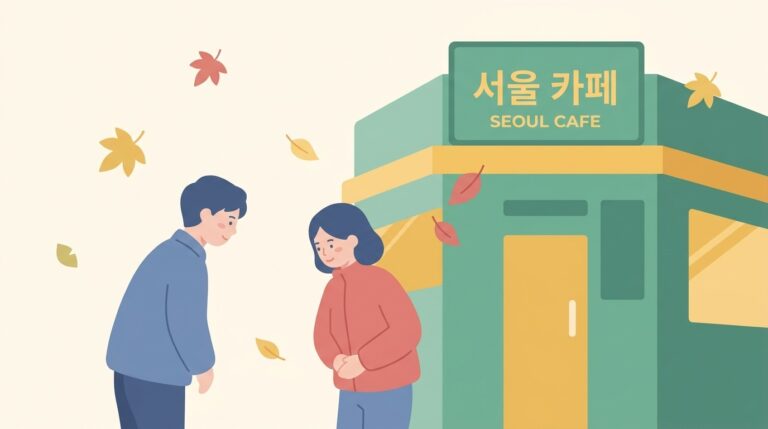
Master the Art of Parting: How to Say ‘Goodbye’ in Korean Without the Awkward Silence
Phase 1: The Awkward ‘Goodbye’ That Every Korean Learner Knows
Imagine this: You are sitting in a cozy, warm Hanok-style cafe in Insadong. The rain is gently tapping on the window, and you’ve just finished a delightful cup of hot Jujube tea with Minji, your Korean language exchange partner. Minji stands up, slings her bag over her shoulder, and smiles warmly.
“It was so fun today!” she says. You smile back, your heart racing. You know it’s time to say “Goodbye” in Korean.
Your brain scrambles. Is it “Annyeonghi gaseyo”? Or is it “Annyeonghi gyeseyo”? They sound almost identical to your beginner ears! You stutter, combine them into a weird hybrid “Annyeonghi ga-gye-se-yo,” and Minji blinks in polite confusion before laughing softly.
Don’t worry! Every single Korean learner has been there. At Daily Hangul, we hear this story from our students weekly. The struggle is real because, unlike English where “Goodbye” works for everyone, Korean goodbyes depend entirely on who is leaving and who is staying.
By the end of this guide, you won’t just memorize these phrases; you will understand the cultural warmth behind them, letting you say goodbye with the effortless confidence of a native K-Drama star!
Phase 2: The Big Three Korean Goodbyes
Let’s break down the three most essential parting phrases you need to survive—and thrive—in Korea.
1. 안녕히 가세요 (An-nyeong-hi ga-se-yo)
- Pronunciation: Ahn-young-hee gah-say-yo (Think of saying “On-young-he” followed by “Gah-say-yo”)
- Meaning: “Go peacefully” (To the person who is leaving)
- K-Culture Moment: Think of your favorite K-Drama where the warm restaurant owner bows to the main leads as they step out of the cozy eatery into the Seoul night.
- Editor’s Insight: The word “안녕” (An-nyeong) literally means “peace/health.” By saying this, you are wishing the departing person a safe and peaceful journey home.
- Situation Spectrum:
- Casual Friends: ⚠️ (A bit too formal for close friends)
- Coworkers / Semi-formal: ✅ (Perfect and polite)
- Elders / Bosses: ✅ (Highly respectful and safe)
- 🤔 Think About It: Why does Korean focus so much on the physical movement of the other person? In Korean culture, keeping track of spatial relationships and showing consideration for someone’s journey is a core sign of respect.
2. 안녕히 계세요 (An-nyeong-hi gye-se-yo)
- Pronunciation: Ahn-young-hee gyeh-say-yo (Notice the “Gyeh” sound, like “ye” in “yes”)
- Meaning: “Stay peacefully” (To the person who is staying behind)
- K-Culture Moment: You are leaving a cute local bakery, and the baker is staying behind the counter. You turn around and bid them farewell while they remain in their shop.
- Editor’s Insight: The only difference between this and the first phrase is one tiny syllable: 가 (Ga – to go) vs. 계 (Gye – to stay/exist).
- Situation Spectrum:
- Casual Friends: ⚠️ (Too stiff for peers)
- Coworkers / Semi-formal: ✅ (Extremely appropriate)
- Elders / Bosses: ✅ (Standard polite etiquette)
- 🤔 Think About It: How does your native language handle the distinction between leaving and staying? Do you think separating these concepts makes a language feel more connected to the physical environment?
3. 조심히 가세요 (Jo-sim-hi ga-se-yo)
- Pronunciation: Jo-seem-hee gah-say-yo
- Meaning: “Go safely” / “Take care on your way back”
- K-Culture Moment: An older coworker or a friendly taxi driver saying goodbye to you at the end of a long day.
- Editor’s Insight: This is a slightly warmer, highly practical alternative to “Annyeonghi gaseyo.” It shows genuine concern for the other person’s safety on the road.
- Situation Spectrum:
- Casual Friends: ✅ (If used without the polite ending, “조심히 가!”)
- Coworkers / Semi-formal: ✅ (Very warm and natural)
- Elders / Bosses: ⚠️ (Stick to “Annyeonghi gaseyo” for absolute formal safety)
- 🤔 Think About It: In Korea, asking someone to “go safely” is an everyday verbal hug. It shows how community-centric Korean society is.
Phase 3: Textbook Korean vs. Real-World Korean
Textbooks love rules, but the streets of Seoul love speed and warmth. Here is how real Koreans actually say goodbye.
Scenario 1: Leaving a Restaurant or Shop
- 📖 Textbook Korean: 안녕히 계세요 (An-nyeong-hi gye-se-yo) – “Stay peacefully.”
- 🗣️ Real Korean: 감사합니다! 수고하세요! (Gam-sa-ham-ni-da! Su-go-ha-se-yo!) – “Thank you! Keep up the good work!”
- 💡 Why the difference? While “Annyeonghi gyeseyo” is correct, saying “Su-go-ha-se-yo” to workers acknowledges their hard work and instantly makes you sound like a local insider.
Scenario 2: Parting with a Colleague After Work
- 📖 Textbook Korean: 안녕히 가세요 (An-nyeong-hi ga-se-yo) – “Go peacefully.”
- 🗣️ Real Korean: 먼저 들어갑니다! 내일 봐요! (Meon-jeo deu-reo-gam-ni-da! Nae-il bwa-yo!) – “I’m leaving first! See you tomorrow!”
- 💡 Why the difference? Saying you are leaving “first” (먼저) shows respect in a hierarchical workspace, emphasizing that you are politely slipping out.
Phase 4: K-Culture Deep Dive & Non-Verbal Manners
4-1. The Body Language of Goodbye
In Korea, words are only half the battle. Your physical presence communicates just as much respect as your vocabulary.
* The Bow: Never say “Annyeonghi gaseyo” while standing perfectly upright with your hands in your pockets. A gentle 15 to 30-degree tilt of your head and upper torso is the gold standard of Korean politeness.
* Eye Contact: Do not lock eyes while bowing. Look down slightly during the bow, then make warm, smiling eye contact as you straighten up.
* Hand Gestures: Avoid a frantic, wide Western wave. Instead, keep your arms close to your torso and wave your hand gently from side to side at chest level, or bow with your hands formally clasped in front of you.
4-2. The Cultural Value of ‘Jeong’ (정)
When Koreans say “Go safely” (조심히 가세요), they are expressing Jeong (정)—a unique Korean concept of deep, warm attachment and collective care. Saying goodbye isn’t just a transactional end to a conversation; it is an active reassurance that you care about the other person’s safe return to their home.
Phase 5: Interactive Roleplay: The Rainy Night in Hongdae
Setting: You are inside a vibrant Korean BBQ restaurant in Hongdae. The sizzling pork belly smell fills the air. You and your new Korean coworker, Ji-hoon, have just finished eating. Ji-hoon has paid the bill and is heading to the subway station, while you are staying behind to wait for your friend.
Cast:
- You (The Passionate Learner)
- Ji-hoon (The Helpful Korean Coworker)
Dialogue:
- Ji-hoon: 🎭 (Patting his full stomach happily) 아, 정말 잘 먹었습니다! 너무 배불러요.
(Ah, jeong-mal jal meok-eot-seom-ni-da! Neo-mu bae-bul-leo-yo.)
“Ah, I ate so well! I am so full.” -
You: 🎭 (Smiling and nodding) 저도요! 고기 정말 맛있었어요. 지훈 씨, 잘 먹었습니다.
(Jeo-do-yo! Go-gi jeong-mal mas-it-eot-eo-yo. Ji-hoon ssi, jal meok-eot-seom-ni-da.)
“Me too! The meat was delicious. Thank you for the meal, Ji-hoon.” -
Ji-hoon: 🎭 (Checking his phone) 벌써 10시네요! 저는 이제 지하철 타러 갈게요.
(Beol-sseo yeol-si-ne-yo! Jeo-neun i-je ji-ha-cheol ta-reo gal-ge-yo.)
“It’s already 10 PM! I will head to the subway now.” -
You: 🎭 (Standing up slightly to show respect) 아, 벌써 시간이 그렇게 됐네요.
(Ah, beol-sseo si-gan-i geu-reo-ke dwaet-ne-yo.)
“Oh, time flew by so fast.” -
Ji-hoon: 🎭 (Putting on his coat) 네, 먼저 갈게요. 오늘 정말 즐거웠어요!
(Ne, meon-jeo gal-ge-yo. O-neul jeong-mal jeul-geo-wot-eo-yo!)
“Yes, I’ll go first. I had a really great time today!”
🔀 Decision Point!
Ji-hoon is leaving the restaurant. You are staying inside to wait for your friend. What do you say to Ji-hoon?
- Option A: 안녕히 계세요! (An-nyeong-hi gye-se-yo!)
- Option B: 안녕히 가세요! 조심히 들어가세요! (An-nyeong-hi ga-se-yo! Jo-sim-hi deu-reo-ga-se-yo!)
- Option C: 안녕! 잘 가! (An-nyeong! Jal ga!)
💡 Choice Analysis:
- Best Choice: Option B! Because Ji-hoon is the one leaving and you are staying, “Annyeonghi gaseyo” is perfect. Adding “Jo-sim-hi deu-reo-ga-se-yo” (Go home safely) adds a lovely touch of warmth that will make him smile.
- Bad Choice: Option A. Remember, “Annyeonghi gyeseyo” means “Stay peacefully.” Since Ji-hoon is walking away, telling him to stay will make him look back in confusion!
- Risk Choice: Option C. “Annyeong!” is casual language (반말 – Banmal). Unless Ji-hoon is your younger sibling or absolute best friend, using this with a coworker might sound slightly rude.
Phase 6: 10-Second Emotion Shadowing Drill
Let’s practice speaking with real Korean emotion! Try to read these aloud, pausing at the slashes (/).
- [😊 Warm & Polite – Saying goodbye to an elder]
“안녕히 / 가세요! / 조심히 / 들어가세요!”
(An-nyeong-hi / ga-se-yo! / Jo-sim-hi / deu-reo-ga-se-yo!) -
[🥺 Reluctant & Sad – Saying goodbye to a close friend]
“아쉽다! / 다음에 / 진짜 / 또 봐요!”
(A-swip-da! / Da-eum-e / jin-jja / tto bwa-yo!) -
[😤 Energetic – Leaving a convenience store quickly]
“감사합니다! / 수고하세요!”
(Gam-sa-ham-ni-da! / Su-go-ha-se-yo!)
Phase 7: K-Culture Mini Dictionary
| Word (Korean/Romanized) | English Translation | Real-world Context |
|---|---|---|
| 정 (Jeong) | Deep emotional bond | The warm, sticky attachment Koreans feel toward friends, neighbors, and even frequent customers. |
| 눈치 (Nunchi) | Social intuition / Wit | The art of reading the room. Knowing when to stay, when to leave, and which goodbye fits the vibe. |
| 막차 (Makcha) | The last train/bus | The ultimate party-stopper in Seoul. Many goodbyes are rushed because someone needs to catch the makcha. |
| 인싸 (Inssa) | Insider / Popular person | Someone who uses modern, warm, and highly natural greetings naturally instead of stiff textbook phrases. |
Phase 8: Traveler’s Survival Kit
If you are exploring the bustling streets of Seoul today, keep these three survival phrases ready to use alongside your goodbyes:
- 계산해 주세요 (Gye-san-hae ju-se-yo): “Please give me the bill / Please let me pay.”
- 봉투 필요해요 (Bong-tu pil-yo-hae-yo): “I need a plastic/shopping bag.”
- 감사합니다 (Gam-sa-ham-ni-da): “Thank you.”
📌 Editor’s Travel Note: Don’t rely on generic global maps in Korea as they often lack accurate pedestrian pathways. Before you step out, download the Naver Map app download page to navigate subway exits and find cute local cafes with ease.
Phase 9: Deep Thoughts — “Why Two Goodbyes?”
Have you noticed how English only needs one word—”Goodbye”—regardless of who moves? Korean, however, forces you to look at the physical space between you and the other person.
This reflects a deeply rooted philosophical viewpoint: in Korea, identity is defined in relation to others and your shared environment. You are never just an isolated individual; you are a person staying in a space or a person traversing a space.
💬 Your Turn: Does your native language distinguish between the person staying and the person leaving? Let us know in the comments below!
Phase 10: FAQ & Avoiding Awkward Blunders
Q: What if we are BOTH leaving the location at the same time?
A: If both of you are leaving the coffee shop together to walk to different subway stations, you should both say 안녕히 가세요 (An-nyeong-hi ga-se-yo) because both of you are physically moving!
Q: Is it okay to just say “Annyeong” (안녕) to keep it safe?
A: Only if you are speaking to children, close friends of the same age, or younger people. Using “Annyeong” with restaurant staff or elder acquaintances will sound impolite.






