

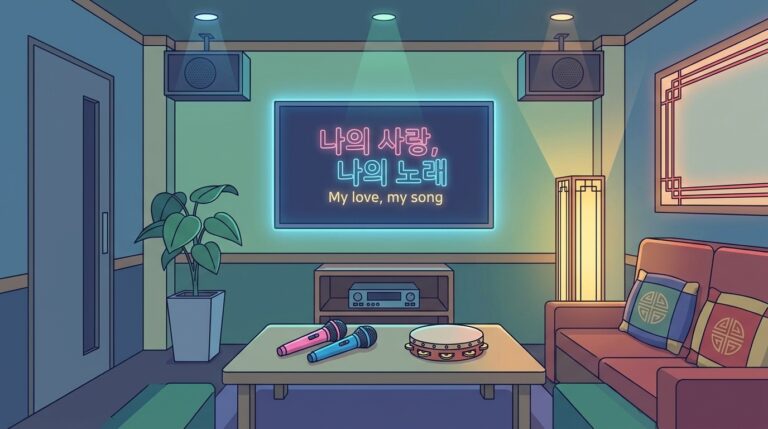
Sing Your Heart Out: How to Order Karaoke Hours in Korean Like a Local
Phase 1: Rocking the Korean Noraebang without the Panic!
안녕하세요! (Annyeonghaseyo!) It’s your favorite Korean tutor and Seoul navigator from Daily Hangul!
Imagine this: You are walking down the vibrant, neon-lit streets of Hongdae on a Friday night. The air smells like delicious street food, and K-Pop beats are echoing from every corner. You and your friends decide it is finally time for the ultimate Korean experience: 노래방 (Noraebang – Karaoke)!
You open the door, walk up to the counter, and the friendly host smiles and asks:
“몇 시간 하실 거예요?” (Myeot sigan hasil geoyeyo? – How many hours will you do?)
Suddenly, your mind goes blank. You know the word for “one” and the word for “hour,” but how do you put them together without sounding like a textbook robot?
Many of my students, like Sarah from Chicago, have frozen at this exact moment. Sarah wanted to sing for one hour but got so nervous she accidentally said “일 시간” (il-sigan), which sounded so confusing that the host thought she wanted to book the room for days!
Don’t worry. In this guide, you will learn exactly how to state your hours like a true Seoulite, win the host’s heart, and maybe even score some legendary 서비스 (seobiseu – free bonus minutes)!
Phase 2: The Big Three: Core Expressions for Booking Your Room
Here are the three most natural ways to tell the host how long you want to sing.
1. 한 시간만 할게요. (Han sigan-man halgeyo.)
- Pronunciation: Han shee-gan-man hal-ge-yo (Sounds like: “Han” + “she-gun” + “mon” + “hull-ge-yo”)
- Meaning: “Just one hour, please.” (Literal: “I will do only one hour.”)
- K-Culture Moment: You will hear this phrase in almost every slice-of-life K-Drama when high school friends or university students head to a local Noraebang after a stressful exam to blow off some steam.
- Editor’s Insight: The tiny word 만 (man – only/just) is the magic ingredient here. It softens your sentence and makes you sound polite and casual, indicating you want a quick, fun session.
- Situation Spectrum:
- Friends & Casual: ✅
- Semi-formal (Staff/Host): ✅
- Formal (Boss/Elders): ⚠️ (Use politely with a bow)
- 🤔 Think About It: Why does Korean use Native Korean numbers (한, 두, 세…) for counting hours, but Sino-Korean numbers (일, 이, 삼…) for counting minutes? How does your native language handle different counting systems?
2. 두 시간 주세요. (Du sigan juseyo.)
- Pronunciation: Du shee-gan ju-se-yo (Sounds like: “Do” + “she-gun” + “jew-say-yo”)
- Meaning: “Two hours, please.”
- K-Culture Moment: This is the golden standard for K-Pop fans. Two hours is the perfect amount of time to perform your entire BTS, BLACKPINK, and NewJeans playlist without losing your voice!
- Editor’s Insight: 주세요 (juseyo) is the ultimate utility phrase in Korea. Whether you are ordering delicious fried chicken or booking karaoke hours, adding 주세요 to the end of your sentence instantly makes you polite and easy to understand.
- Situation Spectrum:
- Friends & Casual: ✅
- Semi-formal (Staff/Host): ✅
- Formal (Boss/Elders): ✅
- 🤔 Think About It: 주세요 literally translates to “please give.” Notice how Korean requests focus on asking for actions gently rather than demanding them directly.
3. 서비스 더 주실 수 있어요? (Seobiseu deo jusil su isseoyo?)
- Pronunciation: Seo-bee-seu deo ju-sheel soo eet-saw-yo? (Sounds like: “Suh-bee-she” + “duh” + “jew-she-all” + “sue” + “eat-saw-yo?”)
- Meaning: “Could we get some extra free minutes, please?”
- K-Culture Moment: This is a legendary part of Korean hospitality culture. “Service” (서비스) refers to free perks given by business owners. In a Noraebang, it means the host suddenly adds 10, 20, or even 30 free minutes to your screen when your time is about to run out!
- Editor’s Insight: Only use this phrase if you have booked a regular hour-rate room (not a coin booth) and the venue isn’t super busy. Say it with a warm, hopeful smile, and the host will love your confidence!
- Situation Spectrum:
- Friends & Casual: ✅
- Semi-formal (Staff/Host): ⚠️ (Keep it cute and polite!)
- Formal (Boss/Elders): 🚫
- 🤔 Think About It: “Service” is an English loanword, but its meaning in Korea has evolved into a beautiful symbol of generosity and building a warm relationship (정 – Jeong) with customers.
Phase 3: Textbook Korean vs. Real-World Korean
Let’s look at how textbooks teach this versus how real Koreans actually talk.
Scenario 1: Booking one hour at the counter
- 📖 Textbook Korean: 저는 일 시간 동안 노래하기를 원합니다. (Jeoneun il sigan dongan noraehagireul wonhamnida.)
- Why it’s awkward: It sounds like: “As for me, I desire to sing for the duration of one hour.” It is way too robotic, uses the wrong number system (일 instead of 한), and is too long!
- 🗣️ Real Korean: 한 시간만 할게요! (Han sigan-man halgeyo!)
- Why it works: It is fast, natural, and drops the unnecessary “I” (저는) because the host already knows who is speaking!
Scenario 2: Asking for more time
- 📖 Textbook Korean: 시간을 추가로 제공해 주실 수 있습니까? (Siganeul chugaro jegonghae jusil su isseumnida?)
- Why it’s awkward: It sounds like a formal business contract request: “Is it possible for you to additionally provide time?”
- 🗣️ Real Korean: 혹시 서비스 좀 주실 수 있어요? (Hoksi seobiseu jom jusil su isseoyo?)
- Why it works: Adding 혹시 (hoksi – by any chance) and 좀 (jom – a little/please) softens your tone, making you sound polite and charming.
Phase 4: K-Culture Deep Dive: The Noraebang Etiquette
4-1. Nunchi (눈치) and Body Language Tips
In Korea, non-verbal cues are just as important as spoken words. When you are talking to the Noraebang host:
1. The Polite Head-Nod: When saying 한 시간만 할게요, give a small, polite nod of your head. It shows respect and friendliness.
2. Handing Over the Card: When paying, always hold your credit card with both hands (or support your right elbow with your left hand). This is a vital sign of respect in Korean culture!
3. Receiving ‘Service’: If the host adds free minutes to your room, make sure to wave, smile, and say a bright “감사합니다!” (Gamsahamnida!) when you see them again.
4-2. The Traveler’s Noraebang Survival Code
Did you know there are two main types of Noraebangs in Korea?
* 코인노래방 (Coin Noraebang): Perfect for 1-2 people. You pay per song (usually 1,000 KRW for 3-4 songs) using coins or cash. You don’t need to book hours here—just walk into an empty room and insert your money!
* 일반 노래방 (Regular Noraebang): Perfect for groups. You pay per hour at the counter. This is where you can use your new phrases and request 서비스 (service time)!
Phase 5: Interactive Roleplay: Friday Night in Hongdae
Let’s practice! Imagine you are standing at the counter of “Star Noraebang” in Seoul with your Korean friend, Minjun.

- Host (Ajumma): 어서 오세요! 몇 분이세요?
(Eoseo oseyo! Myeot buniseyo?)
“Welcome! How many people?” [🎭 Welcomes you with a warm smile, holding sanitary microphone covers] - You: 두 명이에요!
(Du myeong-ieyo!)
“Two people!” [🎭 Holds up two fingers cheerfully] - Host (Ajumma): 네, 몇 시간 하실 거예요?
(Ne, myeot sigan hasil geoyeyo?)
“Alright, how many hours will you do?” [🎭 Taps on her computer screen to check open rooms] - You: [Your Choice! See the decision point below]
- Minjun: 이모, 오늘 노래 많이 부를 건데 서비스 좀 주세요!
(Imo, oneul norae mani bureul geonde seobiseu jom juseyo!)
“Auntie, we are going to sing a lot today, please give us some service!” [🎭 Winks playfully at the host] - Host (Ajumma): 아이구, 서비스 많이 줄게! 5번 방으로 가세요!
(Aigu, seobiseu mani julge! O-beon bang-euro gaseyo!)
“Oh my, I will give you lots of service! Go to Room 5!” [🎭 Laughs and hands you the microphones with a wink] - You: 우와, 감사합니다! 서비스 최고!
(Uwa, gamsahamnida! Seobiseu choego!)
“Wow, thank you! Service is the best!” [🎭 Bows slightly and walks happily down the neon corridor]
🔀 Decision Point: What do you say to the Host?
- Option A: “두 시간 주세요!” (Du sigan juseyo!)
👉 Best Choice! This is perfectly polite, grammatically correct, and uses the proper counting system for hours. The host will easily understand you! - Option B: “이 시간 원해요.” (I sigan wonhaeyo.)
👉 Bad/Risk Choice. In Korean, “이” can mean “two” (Sino-Korean) but it also means “this.” Saying 이 시간 sounds like “I want this time.” The host might get confused! - Option C: “노래방 영원히!” (Noraebang yeongwonhi!)
👉 The Funny Choice. This means “Noraebang forever!” While the host will love your high energy, she still needs to know an actual number to charge your credit card!
Phase 6: 10-Second Emotion Shadowing Drill
Let’s practice speaking with the right emotion! Read these aloud, focusing on the pauses (/):
- 한 / 시간만 / 할게요!
[😊 Bright, polite, and excited to sing]
Han / shee-gan-man / hal-ge-yo! -
두 / 시간 / 주세요.
[🙋♀️ Confident, friendly, and ready for a long music session]
Du / shee-gan / ju-se-yo. -
서비스 / 좀 / 주실 수 / 있어요?
[🥺 With hopeful, cute puppy-dog eyes]
Seo-bee-seu / jom / ju-sheel soo / eet-saw-yo?
Phase 7: K-Culture Mini Dictionary
| Word (Korean) | Romanization | English Translation | Real-World Context |
|---|---|---|---|
| 서비스 | Seobiseu | Service | Free bonus time or snacks given as a gesture of kindness by the business owner. |
| 코인노래방 | Coin Noraebang | Coin Karaoke | A small, automated budget-friendly booth where you pay per song. |
| 취소 | Chwiso | Cancel | The most important button on the remote control! Use it to skip a song instantly if you make a mistake. |
| 템버린 | Tembeorin | Tambourine | The ultimate instrument found in every Noraebang. You must shake it to cheer for your friends! |
Phase 8: Traveler’s Survival Kit
Essential Travel Phrases
- 카드 돼요? (Kadeu dwaeyo?) -> “Do you accept cards?” (Pro Tip: Almost all regular Noraebangs do, but keep cash for coin booths!)
- 마이크 커버 주세요. (Maikeu keobeo juseyo.) -> “Please give me microphone covers.” (Pro Tip: Hygiene first! Noraebangs always provide fresh covers.)
- 시간 다 됐어요. (Sigan da dwaesseoyo.) -> “The time is all up.” (Pro Tip: Use this to tell your friends it’s time to head out.)
📌 Editor’s Travel Note:
When looking for the best Noraebang in Seoul, skip Google Maps (which isn’t fully updated in Korea). Instead, download the Naver Map App Download Page or KakaoMap App Download Page and search for “코인노래방” (Coin Noraebang) or “노래연습장” (Noraebang) to find highly rated local spots near you!
Phase 9: Deep Thoughts — “One Step Deeper”
In Western cultures, business is often transactional—you pay for exactly what you get. But in Korea, the culture of 서비스 (Seobiseu) and 정 (Jeong – warm emotional attachment) turns business into something deeply human.
By giving you free minutes, the Noraebang owner isn’t just trying to make a sale; they are sharing a moment of generosity with you. Experiencing this makes you feel like more than just a customer—you feel like a welcomed guest in their home.
💬 Your Turn: How does your culture show warm hospitality to customers? Do you have anything similar to “서비스” in your country? Let me know in the comments below!
Phase 10: FAQ & Avoiding Mistakes (FAQ Schema Optimized)
Q: Can I go to a Korean Noraebang alone?
A: Yes! Absolutely. Going alone to sing is called “혼코노” (Hon-kono – solo coin noraebang) and is incredibly popular among locals to relieve stress after school or work.
Q: What is the difference between “시간” (sigan) and “시” (si)?
A: 시간 (sigan) is used for duration (e.g., 한 시간 = for one hour), while 시 (si) is used to tell a specific time on the clock (e.g., 한 시 = 1 o’clock).
Q: Do I need to tip the host if they give me lots of “Service” time?
A: No! Korea has a strict no-tipping culture. Tipping can actually be confusing or uncomfortable for local hosts. Just say a warm, enthusiastic “감사합니다!” (Thank you!) instead.
🚨 Common Mistakes Warning Board
- Saying “일 시간” (il sigan): Never use Sino-Korean numbers for hours! Always use Native Korean numbers: 한 시간 (1 hour), 두 시간 (2 hours), 세 시간 (3 hours).
- Demanding service rudely: Saying “서비스 줘!” (Give me service!) is very rude. Always ask politely with “혹시 서비스 좀 주실 수 있어요?”.
- Not pressing the Start button: After typing your song number on the big remote, don’t forget to press 시작 (Sijak – Start) to play the track!
Phase 11: Action Mission: Let’s Do It!
- 🥉 Bronze (At-Home Challenge): Record a voice memo on your phone saying: “한 시간만 할게요!” with a bright, friendly voice.
- 🥈 Silver (Social Challenge): Share your favorite K-Pop song on social media and write: “I want to sing this for 두 시간 (two hours) at a Korean Noraebang!”
- 🥇 Gold (Real-World Challenge): Visit a Noraebang in your local Korea Town (or on your next trip to Seoul!) and order your hours entirely in Korean.
- 🎮 K-Culture Mission: Watch a Noraebang scene in a K-Drama (like Hospital Playlist or Reply 1988) and count how many times they shake the tambourine!
Phase 12: Interactive Quiz Challenge
1. Situation Judgement
You want to sing for 3 hours with your friends. What is the correct phrase to say to the host?
– A) 삼 시간 주세요. (Sam sigan juseyo.)
– B) 세 시간 주세요. (Se sigan juseyo.)
Reveal Answer & Explanation
Correct Answer: B) 세 시간 주세요.
Explanation: You must use Native Korean numbers with hours (한, 두, 세, 네…). “삼” is a Sino-Korean number, which is only used for minutes (e.g., 삼십 분 = 30 minutes).
2. Fill in the Blank
Fill in the missing word to ask for free bonus minutes politely:
“혹시
________ 좀 주실 수 있어요?”
Reveal Answer & Explanation
Correct Answer: 서비스 (Seobiseu)
Explanation: This is the magical Korean word for free extra minutes in a Noraebang!
3. True or False?
True or False: You should tip the Noraebang host if they give you 30 minutes of free service.
Reveal Answer & Explanation
Correct Answer: False!
Explanation: Korea is a tipping-free country. Offering tips can make the staff feel awkward. Just give them a beautiful smile and a warm “감사합니다!” (Gamsahamnida!).







