

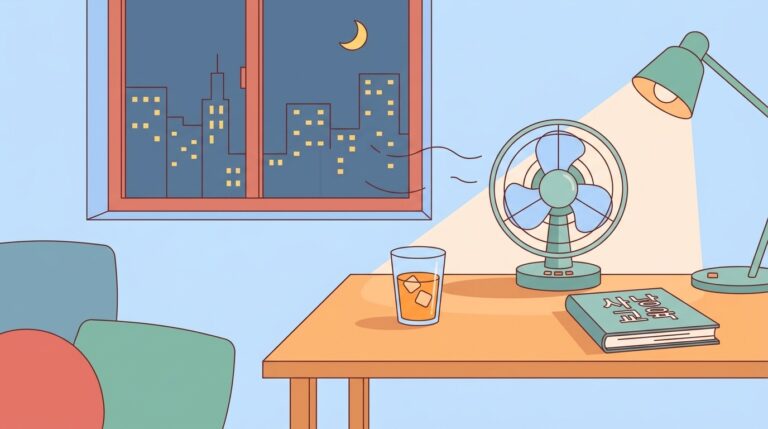
Beat the Heat: Mastering the Korean ‘Yeoldaeya’ (Tropical Nights) Like a Local
안녕하세요! (Annyeonghaseyo!) Welcome back to Daily Hangul. It’s your premium tutoring guide and local cultural navigator. Summer in Korea is vibrant, filled with exciting music festivals, delicious chilled noodles, and late-night adventures. But as July rolls into August, a sweaty, sleepless phenomenon takes over the peninsula: 열대야 (Yeoldaeya – Tropical Nights).
If you’ve ever tossed and turned in a humid Seoul apartment at 2 AM, wondering why your body feels like sticky rice, this guide is for you. Today, we are diving into the perfect vocabulary, natural slang, and cultural secrets to help you navigate Korea’s sweltering summers like a true local.
Phase 1: Toss, Turn, and Talk—The Reality of Korean Summer Nights
Imagine this: It’s midnight in Hongdae. The sun set hours ago, but the concrete is still radiating heat. The air is so thick you could slice it. Your Korean friend looks at you, wipes a bead of sweat from their forehead, and sighs: “아, 진짜 열대야 때문에 잠을 못 자겠어.”
Many intermediate learners simply say “날씨가 더워요” (The weather is hot). While correct, it completely misses the shared cultural misery—and unique bonding opportunity—of a true Korean summer. Last year, my B1 student Sarah from Chicago was staying with a homestay family. She didn’t want to complain constantly, but she was exhausted. Once she learned how to express her sleeplessness using the culturally accurate term 열대야, her host mother immediately sympathized, brought her an ice-cold slice of watermelon (수박), and adjusted the aircon timer.
Learning how to describe your summer struggles doesn’t just improve your vocabulary; it unlocks authentic connection and shows locals that you truly understand the rhythm of Korean life.
Phase 2: 3 Essential Expressions to Survive the Heat
Let’s break down three crucial expressions you need to describe those hot, sleepless nights.
1. 열대야 때문에 잠을 못 이뤘어요 (yeol-dae-ya ttae-mun-e jam-eul mot i-rwot-eo-yo)
- Pronunciation: [yul-dae-ya ttae-mun-eh jam-eul mot ee-wot-uh-yo] / Sound-alike: “Yul-day-yah” (similar to ‘yule’ + ‘day’ + ‘ya’)
- Meaning: I couldn’t sleep because of the tropical night.
- K-Culture Moment: You will hear this constantly on the morning news in July and August, or spoken by tired office workers holding giant iced Americanos (아아 – A-A) as they walk into elevators.
- Editor’s Insight: 잠을 못 이루다 (jam-eul mot i-ru-da) is a beautiful, slightly literary way of saying “to be unable to sleep/fall asleep.” It sounds much more natural and expressive than the basic 잠을 못 자다.
- Situation Spectrum:
- Casual Friends: ✅ (Use: 열대야 때문에 잠을 못 잤어)
- Semi-formal (Co-workers): ✅
- Formal (Boss/Elders): ✅ (Use: 열대야 때문에 잠을 못 이뤘습니다)
- 🤔 Think About It: In Korean, we often use passive or atmospheric nouns like 열대야 (tropical night) as the active cause of our problems. Instead of saying “I am hot,” Koreans say “The tropical night made me sleepless.” How does your native language attribute cause to weather-related struggles?
2. 몸이 끈적거려서 불쾌지수가 높아요 (mom-i kkeun-jeok-geo-ryeo-seo bul-kwae-ji-su-ga nop-a-yo)
- Pronunciation: [mom-ee kkeun-juk-guh-ryuh-suh bool-kway-jee-soo-gah nop-ah-yo]
- Meaning: My body is sticky, so the discomfort index is high.
- K-Culture Moment: This is the ultimate excuse for why someone might seem a bit prickly or sensitive on a crowded subway line 2 in Seoul during rush hour.
- Editor’s Insight: 불쾌지수 (discomfort/misery index) is a real meteorological term that Koreans use casually to describe their mood when humidity makes everything sticky (끈적거리다).
- Situation Spectrum:
- Casual Friends: ✅
- Semi-formal: ✅
- Formal: ⚠️ (A bit too personal to complain about stickiness to a high-ranking CEO, but fine with close seniors!)
3. 더위 먹지 않게 조심하세요 (deo-wi meok-ji ant-ge jo-sim-ha-se-yo)
- Pronunciation: [duh-wee muk-jee ant-geh jo-shim-hah-seh-yo]
- Meaning: Be careful not to “eat” the heat (suffer from heat exhaustion).
- K-Culture Moment: This is the ultimate warm, caring phrase to write in a text message to a colleague, client, or language exchange partner during August.
- Editor’s Insight: To “eat the heat” (더위를 먹다) is a classic Korean idiom for getting sick, dizzy, or lose appetite because of hot weather. Saying this shows high emotional intelligence (눈치 – Nunchi).
- Situation Spectrum:
- Casual Friends: ✅ (Use: 더위 먹지 마!)
- Semi-formal: ✅
- Formal: ✅
Phase 3: Textbook Korean vs. Real Korean
Let’s compare what dry textbooks teach you versus how Koreans actually converse during a heatwave.
Situation 1: Expressing how incredibly hot the room is at night
- 📖 Textbook Korean: “방 안의 온도가 너무 높아서 더운 상태입니다.” (The temperature inside the room is too high, so it is in a hot state.)
- 🗣️ Real Korean: “와, 오늘 밤 진짜 에어컨 각이다!” (Wow, tonight definitely calls for the air conditioner!)
- 💡 Why is it different?: Koreans love the slang suffix ~각 (gak), which means “this situation definitely calls for [X]” or “[X] is highly likely.” It’s punchy, modern, and captures the absolute necessity of turning on the AC.
Situation 2: Suggesting an escape to the outdoors
- 📖 Textbook Korean: “더위를 피하기 위해 편의점 밖에서 맥주를 마십시다.” (Let us drink beer outside the convenience store to avoid the heat.)
- 🗣️ Real Korean: “우리 편맥 한잔하면서 더위 좀 식힐래요?” (Shall we cool down with a cup of ‘Pyeonmaek’ – convenience store beer?)
- 💡 Why is it different?: 편맥 (Pyeon-maek) is a portmanteau of 편의점 (convenience store) and 맥주 (beer). Sitting on plastic chairs outside a 24-hour GS25 or CU with a cold can of Cass is a sacred summer ritual. Saying 더위를 식히다 (to cool down the heat) sounds incredibly natural.
Phase 4: K-Culture Deep Dive & Non-verbal Manners
4-1. Nunchi (눈치) & Body Language: How to Complain Politely
In Korea, complaining directly can sometimes disrupt collective harmony (기분 – Kibun). However, everyone agrees that summer heat is a common enemy.
* The Sizzling Sigh: When entering a hot room, it is culturally appropriate to let out a soft, dramatic “아휴, 덥다~” (Ahyu, deopda~ – Phew, it’s hot). It relieves your frustration without pointing fingers at anyone.
* The Shared Fan: If you are holding a portable electric fan (손선풍기), it is polite to point it toward your friend or colleague for a few seconds before pointing it back at yourself. This tiny gesture speaks volumes about your care for others.
4-2. The Cultural Myth: Fan Death (선풍기 괴담)
Have you heard of the infamous “Fan Death”? For decades, many Koreans believed that sleeping in a closed room with an electric fan turned on could lead to asphyxiation or hypothermia. While younger generations know it is a myth, you will still find that almost all Korean electric fans come equipped with an automatic timer (타이머) for safety! If you stay at an older guesthouse, don’t be surprised if your host warns you to leave the door cracked or set the timer before sleeping.
Phase 5: Interactive Roleplay—A Sticky Midnight at the Han River
Setting: It is July 25th, 11:30 PM. The humidity is at 88%. You are sitting on a plastic chair outside a convenience store near the Han River with your Korean coworker, Minjun. Rainbow lights from the Banpo Bridge reflect on the water, but there is barely any breeze.
Your Role: You are exhausted from the heatwave, but happy to hang out.
- Minjun: (Wiping his neck with a damp towel) 아, 진짜 숨이 턱턱 막히네요. 오늘 밤도 장난 아니죠?
(Ah, jin-jja sum-i teok-teok mak-hi-ne-yo. Oh-neul bam-do jang-nan a-ni-jyo?)
“Wow, the air is suffocating. Tonight is no joke either, right?” -
You (B1): 🎭 (Nodding and fanning yourself with your hand) 맞아요. 요즘 열대야 때문에 잠을 못 이뤘어요.
(Ma-ja-yo. Yo-jeum yeol-dae-ya ttae-mun-e jam-eul mot i-rwot-eo-yo.)
“I know. Lately, I haven’t been able to sleep because of the tropical nights.” -
Minjun: (With sympathy) 어머, 정말요? 어쩐지 오늘 피곤해 보이더라고요. 에어컨 안 켜고 주무세요?
(Eo-meo, jeong-mal-yo? Eo-tteon-ji oh-neul pi-gon-hae bo-i-deo-ra-go-yo. E-eo-keon an kyeo-go ju-mu-se-yo?)
“Oh, really? No wonder you looked tired today. Do you sleep without turning on the AC?” -
You (B1): 🎭 (Sighing slightly) 에어컨을 밤새 켜면 감기 걸릴까 봐 타이머를 맞춰 놓는데, 에어컨이 꺼지면 바로 깨요.
(E-eo-keon-eul bam-sae kyeo-myeon gam-gi geol-ril-kka bwa ta-i-meo-reul mat-chwo not-neun-de, e-eo-keon-i kkeo-ji-myeon ba-ro kkae-yo.)
“I’m afraid of catching a cold if I keep it on all night, so I set a timer. But the moment it turns off, I wake up.” -
Minjun: (Laughing) 아, 그 기분 뭔지 알아요! 저도 매번 그래요. 이럴 때는 시원한 맥주 한잔이 보약이죠. 맥주 한 캔 더 하실래요?
(Ah, geu gi-bun mwon-ji al-ah-yo! Jeo-do mae-beon geu-rae-yo. I-reol ttae-neun si-won-han maek-ju han-jan-i bo-yak-i-jyo. Maek-ju han kaen deo ha-sil-rae-yo?)
“Ah, I know exactly how that feels! I’m the same. Times like this, a cold beer is the best medicine. Want another can?”
🔀 Decision Point: What do you say next?
- Option A: “아니요, 너무 피곤해서 집에 가고 싶어요.” (No, I’m too tired and want to go home.)
- Option B: “좋아요! 편맥 한 캔 더 하면서 더위 좀 식혀요.” (Sounds great! Let’s have one more ‘pyeonmaek’ and cool down.)
- Option C: “한국 여름은 최악이에요. 정말 싫어요.” (Korean summer is the worst. I hate it.)
Best Choice: Option B
Option B shows enthusiasm and utilizes the perfect slang 편맥 (pyeonmaek). It keeps the warm social vibe alive. Option A is acceptable but ends the conversation abruptly. Option C is too negative and might make your companion feel defensive about their country’s climate!
Phase 6: 10-Second Emotion Shadowing Drill
To speak like a native, you need the right rhythm and emotion. Try saying this out loud, focusing on the pauses marked by /.
- Scenario: Complaining about the heat (with an exhausted, slightly whiny sigh) [😫 피곤하고 덥게]
“아… / 진짜 / 열대야 때문에 / 잠을 한숨도 못 잤어요…”
(Ah… / jin-jja / yeol-dae-ya ttae-mun-e / jam-eul han-sum-do mot jat-eo-yo…)
“Ugh… seriously… because of the tropical night… I didn’t sleep a wink…” - Scenario: Offering a friendly invite to grab something cold [😊 밝고 시원하게]
“더운데 / 우리 / 시원한 아이스 아메리카노 / 마시러 가요!”
(Deon-de / u-ri / si-won-han a-i-seu a-me-ri-ka-no / ma-si-reo ga-yo!)
“Since it’s hot, let’s go grab a cool iced Americano!”
Phase 7: K-Culture Mini Dictionary
| Word | Hangul / Romanization | Definition & Insight |
|---|---|---|
| 1. 열대야 | 열대야 (Yeoldaeya) | Tropical Night. Metereologically defined as a night when the temperature does not drop below 25°C (77°F). |
| 2. 편맥 | 편맥 (Pyeonmaek) | Convenience store beer. Drinking cheap beer outside a convenience store. It is the cheapest, most nostalgic therapy for young adults in Korea. |
| 3. 이열치열 | 이열치열 (Iyeolchiyeol) | Fighting heat with heat. The traditional wisdom of eating boiling hot, nutritious food like 삼계탕 (ginseng chicken soup) on the hottest days to sweat out the heat. |
| 4. 홈캉스 | 홈캉스 (Hom-cance) | Home-vacation. A combination of “Home” and “Vacance”. Staying at home under the AC with Netflix and delivery food to avoid the summer crowds. |
Phase 8: Traveler’s Survival Kit
If you find yourself in Korea during a heatwave, keep these three survival phrases in your back pocket.
Survival Phrases TOP 3
- “에어컨 좀 세게 틀어주실 수 있나요?”
- ae-eo-keon jom se-ge teu-reo-ju-sil su in-na-yo?
- Pro Tip: Use this in taxis or restaurants if you feel suffocated by the heat.
- “얼음컵 하나 주세요.”
- eol-eum-keop ha-na ju-se-yo.
- Pro Tip: Go to any convenience store, grab a pouch of beverage (coffee, peach tea), take an ice cup from the freezer, and pay at the counter.
- “여기 물 좀 더 주시겠어요?”
- yeo-gi mul jom deo ju-si-get-eo-yo?
- Pro Tip: Hydration is key! Restaurants always provide free water, but if you run out, use this phrase.
📌 Editor’s Travel Note
If you want to escape the heat like a local, download the Naver Map App to find nearby Han River parks (like Yeouido or Banpo) or 24-hour cafes. To stay dry, pop into an Olive Young store and purchase “Cooling Sheets” (쿨링시트) or a portable USB hand-fan (손선풍기)—essential summer accessories for anyone walking the streets of Seoul!
Phase 9: Deep Thoughts—Why Koreans Share the Hot Nights Together
In many Western cultures, when the weather gets unbearably hot, people retreat into their private air-conditioned spaces. But in Korea, you will see a fascinating phenomenon: thousands of people pouring out into public parks, riverbanks, and plazas at midnight.
This stems from Korea’s deep-rooted culture of 정 (Jeong – collective affection and community). Historically, before home air-conditioning was common, neighbors would gather on wooden platforms (평상 – Pyeong-sang) under a big tree to share slices of cold watermelon, swap stories, and fan each other. Today, that spirit lives on in Han River park gatherings. Sharing the heat makes it more bearable.
💬 Your Turn: How do people in your hometown handle extremely hot summer nights? Do you stay indoors, or is there a special place where everyone gathers? Let us know in the comments below!
Phase 10: FAQ & Avoiding Common Mistakes
Q: Can I use “열대야” (Yeoldaeya) during the daytime?
A: No. 열대야 specifically means “tropical night“. For daytime heatwaves, use the word 폭염 (pok-yeom – extreme heat/heatwave) or simply say 찜통더위 (jjim-tong-deo-wi – steamer-pot heat).
Q: Is it okay to use “더워 죽겠다” (I’m going to die of heat) in professional settings?
A: It depends. With close coworkers during lunch, it’s a common, colorful hyperbole. However, in a formal presentation or with a high-level client, opt for: “오늘 날씨가 무척 덥습니다” (The weather is very hot today).
🚨 Common Mistakes Warning Board
- Mistake: Saying “나는 더워요” (I am hot).
- Correct Action: In Korean, the subject is usually dropped. Just say “더워요” (It’s hot) or “더워 죽겠어요” (It’s so hot I could die). Adding “I” (나) sounds unnatural and overly direct.
- Mistake: Confusing 더위를 타다 (to suffer from/be sensitive to heat) with 더위를 먹다 (to get heat exhaustion).
- Correct Action: Say “저는 더위를 많이 타요” (I am sensitive to heat) as a general trait, but use “더위 먹었어요” only if you actually feel sick or exhausted from being in the sun.
Phase 11: Action Missions
Ready to put your skills to the test? Complete these three challenges to level up your Korean summer survival skills!
- 🥉 Bronze (The Mirror Challenge): Look in the mirror, make an exhausted face, and practice the shadowing phrase: “아, 진짜 열대야 때문에 잠을 못 이뤘어요…” three times with feeling.
- 🥈 Silver (The Social Challenge): Post a picture of your favorite cold summer drink or a late-night view on Instagram or HelloTalk with the caption: “더위 먹지 않게 조심하세요! ☀️🍹”
- 🥇 Gold (The Real-World Challenge): Go to a local Korean restaurant or supermarket and naturally ask the staff: “오늘 진짜 덥네요, 그쵸?” (It’s really hot today, right?) and see how they respond!
Phase 12: Interactive Quiz Challenge
Test your knowledge of Korean summer culture and vocabulary!
Q1. What is the correct term for a night where the temperature does not drop below 25°C?
- Answer: 열대야 (Yeoldaeya – Tropical Night).
- Explanation: 열대야 is the specific combination of ‘tropical’ (열대) and ‘night’ (야).
Q2. Fill in the blank: “Keep safe from the heat wave! Don’t ______ the heat!” (더위 ______ 마세요!)
- Answer: 먹지 (meok-ji – eat).
- Explanation: The idiomatic phrase is 더위를 먹다 (to eat the heat). Therefore, to say “don’t get sick from the heat,” you say 더위 먹지 마세요.
Q3. True or False: If you are at a business dinner, it is highly polite to say “몸이 끈적거려서 불쾌지수가 높아요” to your client.
- Answer: False.
- Explanation: Complaining about your sticky body (몸이 끈적거리다) is too casual and slightly personal for formal business clients. Stick to safer weather comments like “요즘 열대야 때문에 잠을 설치는 분들이 많네요.” (Lately, many people are losing sleep due to the tropical nights.)
Stay cool, drink lots of water, and see you in the next lesson! 다음에 또 만나요!”,







