

The Ultimate Guide to Gundaesliga: How to Master Korean Military Soccer Talk Like a True Local
Phase 1: Welcome to the Ultimate Korean Bonding Secret
안녕하세요! (Annyeonghaseyo!) It’s your favorite Korean culture navigator and Daily Hangul senior editor. Have you ever sat at a noisy Korean BBQ restaurant, surrounded by Korean male friends, when suddenly the conversation turned into a passionate, sweat-inducing debate about… soccer? But not just any soccer—soccer played on a gravel field inside an army base, in the freezing cold, wearing mismatched military shirts.
Welcome to the world of Gundaesliga (군대스리가).
There’s a famous, long-standing joke in South Korea: “Korean women hate three things most: men talking about their military service, men talking about playing soccer, and men talking about playing soccer in the military.”
Yet, despite this classic joke, if you can navigate this topic with a bit of wit and cultural nuance, you will instantly unlock the ultimate level of social chemistry with Korean men. In Korea, mandatory military service (병역 의무 – byeong-yeok ui-mu) is a monumental, shared life chapter for nearly half the population. Understanding “military soccer” isn’t just about sports; it’s about understanding Korean resilience, camaraderie, and the unique humor that binds people together.
Note: This guide was crafted based on real-world classroom conversations with intermediate Korean learners who wanted to understand why their Korean colleagues get so incredibly nostalgic—and competitive—about their military days.
Phase 2: Master the Core Vocabulary
Let’s dive into the three most essential military soccer terms that will make your Korean friends drop their chopsticks in amazement.
1. 군대스리가 (Gundaesliga)
- Pronunciation: [Gun-dae-seul-ri-ga] / Sound-alike: “Gun-dae” (Military) + “Bundesliga” (The German football league)
- Meaning: Military Soccer.
- K-Culture Moment: You might have seen parodies of this in classic variety shows like Real Men (진짜 사나이) or mentioned in nostalgic K-dramas like Reply 1994 (응답하라 1994).
- Editor’s Insight: This portmanteau blends “Gundae” (military) and “Bundesliga” to humorously elevate basic army soccer matches to the status of a professional European league. It represents highly competitive, rough-and-tumble soccer where rank sometimes matters more than rules.
- Situation Spectrum:
- Friends/Casual: ✅ (Perfect for casual banter!)
- Colleagues/Semi-formal: ✅ (Great icebreaker at after-work dinners)
- Bosses/Formal: ⚠️ (Use lightheartedly, but avoid overusing slang in serious meetings)
- 🤔 Think About It: Why do you think Korean society created such a grand, parodied name for a simple game of army soccer? How does your home country use humor to cope with demanding life experiences?
2. 전투축구 (Jeontu-chukgu)
- Pronunciation: [Jeon-tu chuk-gu] / Sound-alike: “John-too” (Combat) + “Chook-goo” (Soccer)
- Meaning: Combat Soccer.
- K-Culture Moment: Picture a winter morning on an unpaved, dusty field. Soldiers are sliding on gravel, getting scraped up, yet immediately jumping back up because their commander is watching. That is combat soccer.
- Editor’s Insight: Jeontu-chukgu refers to the raw, intense, and physically demanding nature of military matches. It’s not about elegant tactics or FIFA fair play; it’s about sheer willpower, grit, and surviving the match without getting injured (or worse, disappointing your squad leader).
- Situation Spectrum:
- Friends/Casual: ✅
- Colleagues/Semi-formal: ✅
- Bosses/Formal: 🚫 (A bit too informal for formal briefings)
- 🤔 Think About It: Koreans love attaching the word “combat” (전투) to various daily tasks to highlight intensity—like jeontu-육아 (combat parenting) or jeontu-쇼핑 (combat shopping). What does this reveal about the high-energy, fast-paced nature of modern Korean life?
3. 포상휴가 (Posang-hyuga)
- Pronunciation: [Po-sang hyu-ga] / Sound-alike: “Po-sahng” (Reward) + “Hyoo-gah” (Vacation)
- Meaning: Reward Leave / Bonus Vacation Pass.
- K-Culture Moment: This is the ultimate prize. In K-dramas, you often see a soldier’s eyes light up when the commanding officer promises a 3-day vacation pass to the winning team of a tournament.
- Editor’s Insight: Why is Gundaesliga so competitive? Because the stakes are incredibly high. For a conscripted soldier, even a single extra day outside the military base is worth more than gold. Posang-hyuga is the ultimate motivator.
- Situation Spectrum:
- Friends/Casual: ✅
- Colleagues/Semi-formal: ✅
- Bosses/Formal: ✅
- 🤔 Think About It: How does the concept of “reward leave” compare to corporate incentives in your culture? Why is “time off” such a powerful driver of productivity and morale in structured organizations?
Phase 3: Textbook Korean vs. Real-World Korean
When you study Korean from a standard textbook, you learn clean, polite, and sometimes overly stiff phrases. Here is how you can transform textbook Korean into natural, culturally resonant language.
Situation 1: Describing a highly competitive project or sports game
- 📖 Textbook Korean: “어제 축구 경기는 아주 치열하고 힘들었습니다.” (Yesterday’s soccer match was very competitive and difficult.)
- 🗣️ Real Korean: “어제 경기는 완전히 군대스리가 급이었어요! 기가 다 빨렸네요.” (Yesterday’s match was completely Gundaesliga level! I’m totally drained.)
- 💡 Why it works: Comparing a difficult situation to Gundaesliga adds humor and instantly paints a picture of intense, gritty effort that everyone can relate to.
Situation 2: Expressing the need for a well-deserved break
- 📖 Textbook Korean: “열심히 일했으니 주말에 쉬고 싶습니다.” (Because I worked hard, I want to rest this weekend.)
- 🗣️ Real Korean: “이번 프로젝트 대박 났으니까, 사장님이 포상휴가 좀 주셔야 하는 거 아니에요?” (Since this project was a huge hit, shouldn’t the boss give us something like a reward leave?)
- 💡 Why it works: Using the military term posang-hyuga in an office setting is a playful, lighthearted way to ask for recognition or a break without sounding demanding.
Phase 4: K-Culture Deep Dive & Non-Verbal Manners
4-1. The Art of “Nunchi” (눈치) on the Field
If you ever find yourself playing soccer or footvolley (족구 – jokgu) with Korean colleagues, you must master the ultimate non-verbal skill: Nunchi (tactful situational awareness).
If your company director or senior manager is playing on the opposing team, your physical defensive skills must be tuned perfectly. You cannot tackle them too hard—that would violate social hierarchy and make office life tomorrow very awkward. However, you also cannot simply let them score too easily—that would look obvious and wound their pride. The secret? Run as fast as you can, scream with passion, dive dramatically to block the ball, but “just miss” it by a hair. That is true Korean workplace etiquette in action!
4-2. The Cultural Underpinnings of the Military Experience
For young Korean men, military service is often the first time they are separated from their comfortable home environments to live in a highly structured, collective hierarchy. The shared hardships—eating army food (짬밥 – jjambap), freezing on night shifts, and bonding over a simple cup noodle—create a unique type of social glue called Jeong (정 – deep affection/bonding). When they laugh about Gundaesliga, they are expressing nostalgia for a time when they relied purely on their comrades to get through tough times.
Phase 5: The K-BBQ Interactive Roleplay
Let’s practice! Imagine you are at a lively Korean pork belly restaurant (삼겹살집) with your team after a long week. The grill is sizzling, glasses are clinking, and the conversation turns to sports.
Cast:
- You (An intermediate Korean learner trying to connect with the team)
- Min-woo (A sports-loving colleague in his late 20s)
- Team Leader Kim (A charismatic manager in his 40s, proud of his army days)
Dialogue:
- Min-woo: (🎭 Pouring you a drink with both hands) “오늘 다들 진짜 수고하셨어요! 이번 주 업무는 완전 전투적이었네요.”
(You all did great today! This week’s work was completely combative.) - You: (🎭 Receiving the cup with both hands respectfully) “감사합니다, 민우 씨! 진짜 바쁜 한 주였어요.”
(Thank you, Min-woo! It was indeed a busy week.) - Team Leader Kim: (🎭 Laughing loudly while grilling garlic) “하하! 이 정도 바쁜 건 군대에 비하면 아무것도 아니지! 내 군대 시절에는 말이야…”
(Haha! This level of busyness is nothing compared to the army! Back in my military days…) - Min-woo: (🎭 Whispering to you with a playful wink) “아, 부장님 또 군대 이야기 시작하신다. 조심하세요!”
(Ah, Team Leader is starting his military stories again. Watch out!) - Team Leader Kim: (🎭 Looking at you with curiosity) “이봐요! 축구 좋아해요? 군대 축구 얘기 들어봤어요?”
(Hey! Do you like soccer? Have you ever heard of military soccer?)
🔀 Decision Point: What do you say?
- Option A: “아, 그 전설의 군대스리가 말씀이시죠? 진짜 궁금했어요!”
(Ah, you mean the legendary Gundaesliga, right? I was really curious about it!) - Option B: “저는 영국 프리미어리그(EPL)만 좋아합니다.”
(I only like the English Premier League.) - Option C: “군대 얘기는 지루해요, 부장님.”
(Military stories are boring, Team Leader.)
💡 Best Choice: Option A!
Choosing Option A instantly shows that you understand Korean cultural humor. By using the exact term Gundaesliga, you show that you aren’t just learning vocabulary from a book—you are tuned into the real cultural wavelength. Team Leader Kim’s face will light up, and he will gladly grill the best piece of meat for you!
- Option B is polite but a bit dry; it cuts off the bonding opportunity.
- Option C is highly risky and rude in a hierarchical Korean setting, even as a joke.
Phase 6: 10-Second Emotion Shadowing Drill
Let’s practice speaking with real Korean emotion. Pay attention to the pause markers (/) and try to mimic the emotional guides in the brackets.
- [😊 Excited & Laughing]
“와, / 이게 말로만 듣던 / 군대스리가네요!”
(Wa, / i-ge mal-lo-man deut-deon / gun-dae-seul-ri-ga-nae-yo!)
“Wow, so this is the legendary ‘Gundaesliga’ I’ve only heard about!” -
[😤 Gritty & Determined]
“부장님, / 저도 오늘 / 전투축구 스타일로 / 뛰겠습니다!”
(Bu-jang-nim, / jeo-do o-neul / jeon-tu-chuk-gu sseu-ta-il-ro / twi-get-seum-ni-da!)
“Team Leader, I will play ‘combat soccer’ style today as well!”
Phase 7: K-Culture Mini Dictionary
Here are four highly nostalgic military-related words you will frequently hear in Korean media and daily conversations:
| Word (Korean + Romanization) | English Meaning | Real-world Cultural Context |
|---|---|---|
| 행보관 (Haeng-bo-gwan) | First Sergeant | The ultimate “fixer” of the company who can build, repair, or clean anything using soldiers. Often used to describe a very handy or organized friend. |
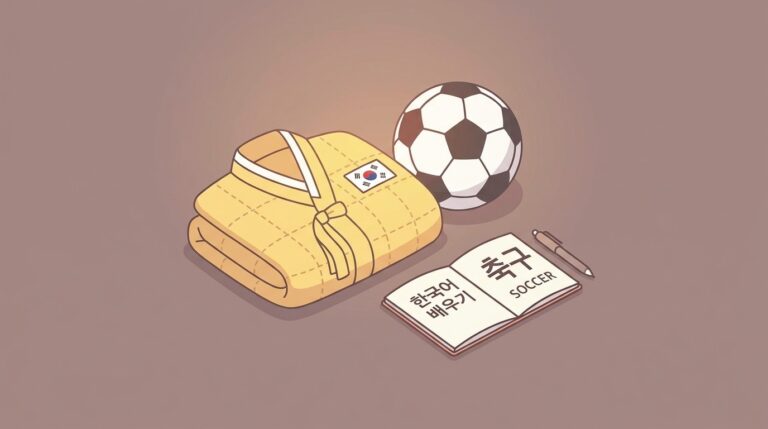
| 깔깔이 (Kkal-kkal-i) | Quilted Army Underjacket | A yellow/brown quilted jacket given to soldiers. It is famous for being incredibly warm and comfortable. Many Koreans keep theirs for years to wear as pajamas at home. |
| 군대리아 (Gundaeria) | Military DIY Burgers | A portmanteau of “Gundae” and “Lotteria” (a Korean fast-food chain). Soldiers make these using strawberry jam, salad, and a patty. It evokes deep nostalgia (and mixed digestive memories). |
| 짬밥 (Jjambap) | Military Food / Seniority | Originally referring to army food, it is now widely used in corporate offices to refer to one’s years of experience (e.g., “내가 여기서 먹은 짬밥이 몇 년인데!” – Do you know how many years of experience I have here!). |
Phase 8: Traveler’s Survival Kit
Even if you aren’t serving in the military, these sports and activity expressions will protect you in any active situation in Korea.
Survival Expressions
- “패스 주세요!” (Paeseu ju-se-yo!)
- Meaning: Pass me the ball!
- Pro Tip: Use this loudly on the futsal court to show you are ready and active.
- “다치지 않게 조심하세요!” (Da-chi-ji ank-ge jo-sim-ha-se-yo!)
- Meaning: Please watch out so you don’t get hurt!
- Pro Tip: Essential phrase before any friendly match to show sportsmanship and care.
- “나이스 샷!” (Na-i-seu syat!)
- Meaning: Nice shot! (Or Nice try!)
- Pro Tip: Koreans shout this for almost any sport—soccer, footvolley, golf, or bowling.
📌 Editor’s Travel Note:
If you want to experience the vibrant local sports culture in Seoul, we highly recommend visiting the sports parks along the Han River. You can easily find locals playing soccer, futsal, and basketball late into the night. Check out the Seoul Han River Park Guide for park locations, or look into the Seoul Futsal Field Reservation System if you want to book a field with friends!
Phase 9: Deep Thoughts — “One Step Deeper”
To truly appreciate Gundaesliga, we have to look beyond the humor. South Korea is one of the few developed countries that maintains a compulsory military service system due to its unique geopolitical reality. For young Korean men, this 18-to-21-month period represents a significant pause in their studies or careers.
This shared experience creates an instant, powerful baseline of empathy. When Korean men meet for the first time, asking about which military division they served in is a quick way to establish common ground. It shapes the way they communicate, work in teams, and deal with stress. By participating in these jokes and showing interest, you aren’t just learning slang; you are acknowledging and respecting a profound, collective rite of passage in Korean society.
💬 Your Turn: Does your home country have mandatory military service or a similar shared cultural rite of passage? How do people in your culture build instant connections with strangers? Let us know in the comments below!
Phase 10: FAQ & Avoiding Misunderstandings
Q: Do Korean women really hate military soccer stories?
A: Generally, yes! It is a running joke because military stories can go on forever and exclude those who didn’t serve. However, if you keep your references brief, witty, and self-aware, everyone (including Korean women) will laugh and appreciate your deep cultural knowledge.
Q: Can I use military terms like “Gundaesliga” even if I have never served in the army?
A: Absolutely! In fact, it sounds even funnier and more charming when an international friend uses these terms naturally in casual conversation. It shows you have done your homework on Korean society.
Q: Is Gundaesliga soccer actually dangerous?
A: It can be physically intense. Because the pitches are often dirt or gravel rather than lush green grass, and because soldiers are filled with youthful energy and competitive spirit, scrapes and minor bruises are very common. It’s played with high passion!
🚨 Common Mistakes Warning Board
- Using military rank terms to actual seniors at work: Avoid calling your manager Sodang-nim (Platoon Leader) unless you are in a highly casual, playful setting. It can sound mocking if overused.
- Dismissing military stories too quickly: If an older Korean colleague starts sharing their military memories, don’t roll your eyes. Listening respectfully for a couple of minutes is a huge sign of respect.
- **Confusing







