

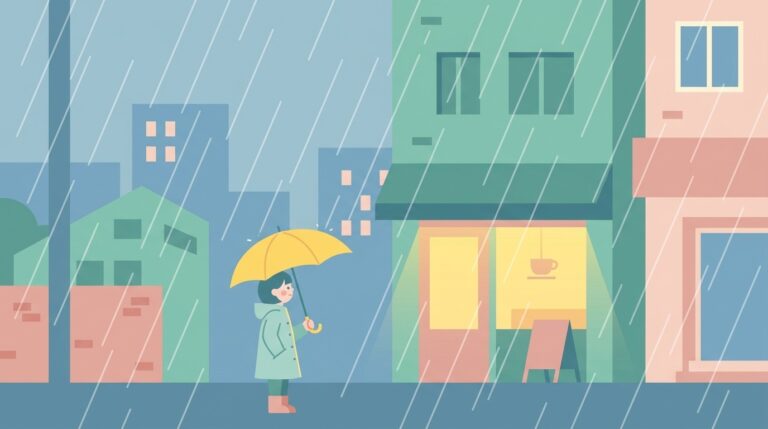
Caught in a K-Drama Rainstorm? Survival Korean Phrases for Heavy Rain and Floods
안녕하세요! (An-nyeong-ha-se-yo!) Hello! It’s your friendly Seoul-savvy Korean tutor from Daily Hangul.
Have you ever watched a romantic K-Drama where the main characters get caught in a sudden summer downpour? They run under a tiny convenience store awning, sharing a single jacket over their heads. It looks incredibly romantic, doesn’t it?
But in reality, Korea’s summer rainy season—called 장마 (Jang-ma)—can bring sudden, massive rainstorms that lead to urban flooding. When the streets of Gangnam turn into shallow rivers, or when your phone starts buzzing loudly with emergency alerts, romance quickly turns into a need for survival.
If you are a beginner (A1) traveler in Korea, hearing loud alarms and seeing Korean warning signs can feel overwhelming. Don’t worry! Your Korean best friend is here to help you navigate this safely. Today, we will learn 3 ultra-simple, life-saving Korean expressions that will keep you safe and sound during heavy rains.
This guide is based on real-life stories from my expat students who survived the historic Seoul rains. Let’s learn how to stay safe together!
Phase 2: 3 Essential Survival Expressions
When water rises or rain pours, you don’t need long, complex grammar. You need short, powerful words. Here are three expressions every beginner must know.
1. 비가 많이 와요 (Bi-ga man-i wa-yo)
- Pronunciation: Bee-gah mahn-ee wah-yo / Sounds like: “Bee” (the insect) + “gah” + “mahn” + “ee” + “wah-yo”
- Meaning: It is raining a lot. / It’s pouring!
- K-Culture Moment: Think of the Oscar-winning movie Parasite (기생충), where the rain starts pouring down relentlessly, flooding the basement home. This is the exact phrase you use when the rain goes from a drizzle to a serious storm.
- Editor’s Insight: Even if you don’t know the word for “flood,” telling someone “비가 많이 와요” with a worried face lets them know the situation is getting serious.
- Situation Spectrum:
- Friends/Casual: ✅
- Coworkers/Semi-formal: ✅
- Elders/Formal: ✅ (This polite ending “-요” (-yo) makes it safe to use with absolutely anyone!)
- 🤔 Think About It: In English, we say “It is raining.” But in Korean, we say “The rain comes” (비가 와요). Why do you think Koreans describe rain as an active visitor coming to us?
2. 조심하세요 (Jo-sim-ha-se-yo)
- Pronunciation: Joe-seem-hah-seh-yo / Sounds like: “Joe” + “seem” + “hah” + “say-yo”
- Meaning: Please be careful.
- K-Culture Moment: You will hear this constantly in daily Korean life. Escalator announcements, subway doors closing, or a kind grandmother warning you about a slippery, wet sidewalk after a heavy rainstorm.
- Editor’s Insight: This is the ultimate caring phrase. Saying “조심하세요” to your Korean friends or Airbnb host during bad weather shows that you deeply care about their safety.
- Situation Spectrum:
- Friends/Casual: ⚠️ (For close friends, you usually drop the “-세요” and say “조심해” (Jo-sim-hae).)
- Coworkers/Semi-formal: ✅
- Elders/Formal: ✅
- 🤔 Think About It: Safety is a shared community value in Korea. How does your culture show concern for others during bad weather?
3. 도와주세요 (Do-wa-ju-se-yo)
- Pronunciation: Doh-wah-joo-seh-yo / Sounds like: “Doh-wah” + “joo-say-yo”
- Meaning: Please help me.
- K-Culture Moment: In any thriller K-Drama, when a character is stuck in an emergency, this is the universal cry for help.
- Editor’s Insight: If you get stuck in a flooded area or lose your way during a heavy storm, do not hesitate to look at someone, make eye contact, and say this clearly and loudly. Koreans are incredibly helpful during emergencies!
- Situation Spectrum:
- Friends/Casual: ✅
- Coworkers/Semi-formal: ✅
- Elders/Formal: ✅ (In an emergency, polite boundaries fade. This polite phrase works perfectly for anyone nearby.)
- 🤔 Think About It: Asking for help can feel hard. But in Korea, asking for help in Korean builds an instant human connection called 정 (Jeong).
Phase 3: Textbook Korean vs. Real-world Korean
Textbooks often teach formal, rigid language written for government officials. Let’s see how real people actually talk when the rain gets crazy!
Situation 1: Describing the Crazy Rain
- 📖 Textbook Korean: “폭우가 내리고 있습니다.” (Phog-u-ga nae-ri-go itt-seub-ni-da.) – “Torrential rain is falling.”
- 🗣️ Real Korean: “비가 진짜 장난 아니에요!” (Bi-ga jin-jja jang-nan a-ni-e-yo!) – “The rain is seriously no joke!”
- 💡 Why is it different? The textbook phrase is what you hear on the 9 o’clock news. In real life, Koreans love using the phrase 장난 아니다 (jang-nan a-ni-da), which means “is not a joke,” to describe anything extreme—like delicious food, beautiful scenery, or scary heavy rain!
Situation 2: Telling Someone to Run/Evacuate
- 📖 Textbook Korean: “신속히 대피하십시오.” (Sin-sog-hi dae-pi-hap-si-o.) – “Please evacuate immediately.”
- 🗣️ Real Korean: “빨리 피하세요!” (Ppal-li pi-ha-se-yo!) – “Hurry, get to safety! / Evacuate quickly!”
- 💡 Why is it different? During a flash flood, nobody uses 5-syllable Chinese-character-based words like “신속히” (promptly). Instead, they shout “빨리” (ppal-li – fast!) and “피하세요” (pi-ha-se-yo – avoid/take shelter!). It is faster, clearer, and saves lives.
Phase 4: K-Culture Deep Dive & Non-Verbal Manners
4-1. “Nunchi” (눈치) in the Rain: Wet Umbrella Etiquette
In Korea, 눈치 (Nunchi)—the art of sensing other people’s feelings and situations—is everything. When it floods or rains heavily, Korean Nunchi shows on the streets and in subways:
* The Umbrella Tilt: When walking on narrow streets, Koreans will tilt their umbrellas away from oncoming pedestrians so they don’t poke anyone in the eye or drip water on them.
* The Vinyl Sleeve: When entering a building, cafe, or subway station, you will see a stand with plastic umbrella sleeves (우산 비닐) or an umbrella dryer machine. Always use them! Walking into a dry building with a dripping wet umbrella is considered a major lack of Nunchi because it makes the floor dangerously slippery for others.
4-2. Understanding “Jangma” (장마) and the Emergency Buzz
During July and August, Korea experiences 장마 (Jangma). If you are traveling during this time, your phone will suddenly make a loud, siren-like screeching noise.
Do not panic! This is a 재난문자 (Jae-nan-mun-ja)—a government emergency alert. Even if it is in Korean, you can easily translate it or look around. If you see locals calmly walking inside buildings or checking their maps, follow their lead. If you see people moving to higher ground, do the same immediately.
Phase 5: Roleplay Scenario – The Gangnam Downpour
Let’s practice! Imagine you are enjoying a sweet honey bread at a cozy cafe in Gangnam. Suddenly, the sky turns black, and water starts filling up the street outside.
Characters:
- Minjun (민준): A friendly cafe staff member wearing a green apron.
- You (A1 Korean Learner): Caught inside the cafe.
- [Scene Start: Rain is beating loudly against the glass window of the cafe. Outside, the street is starting to look like a river.]
-
Minjun: (Looking outside with a worried face) 🎭 손님, 밖에 비가 진짜 장난 아니에요.
(Son-nim, bakk-e bi-ga jin-jja jang-nan a-ni-e-yo.)
“Customer, the rain outside is seriously no joke.” -
You: (Gulping, looking at the rising water) 🎭 저기… 비가 많이 와요.
(Jeo-gi… bi-ga man-i wa-yo.)
“Excuse me… it is raining a lot.” -
Minjun: (Nodding quickly) 🎭 맞아요. 지금 강남역 근처가 홍수 때문에 위험해요.
(Maj-a-yo. Ji-geum Gang-nam-yeog geun-cheo-ga hong-su ttae-mun-e wi-heom-hae-yo.)
“That’s right. Near Gangnam Station is dangerous right now because of the flood.” -
You: (Slightly panicked, pointing outside) 🎭 길에 물이 많아요!
(Gil-e mul-i manh-a-yo!)
“There is a lot of water on the street!” -
Minjun: (Calming you down with hands) 🎭 네, 지금 나가면 안 돼요. 여기 카페 2층에 있으세요.
(Ne, ji-geum na-ga-myeon an dwae-yo. Yeo-gi ka-pe i-cheung-e iss-eu-se-yo.)
“Yes, you shouldn’t go outside right now. Please stay on the 2nd floor of the cafe.” -
You: (Relieved, bowing slightly) 🎭 아, 네. 고맙습니다.
(Ah, ne. Go-map-seub-ni-da.)
“Ah, yes. Thank you.” -
Minjun: (Handing you a warm cup of water) 🎭 조심하세요. 비가 그칠 때까지 기다려요.
(Jo-sim-ha-se-yo. Bi-ga geu-chil ttae-kka-ji gi-da-ryeo-yo.)
“Please be safe. Wait until the rain stops.”
🔀 Decision Point: The Water is Getting Closer!
Suddenly, the water reaches the cafe’s front door step. What do you say to Minjun?
- A) “도와주세요! 물이 와요!” (Do-wa-ju-se-yo! Mul-i wa-yo!)
- B) “배고파요. 밥 주세요.” (Bae-go-pha-yo. Bap ju-se-yo.)
- C) “안녕하세요. 감사합니다.” (An-nyeong-ha-se-yo. Gam-sa-hap-ni-da.)
🏆 Best Choice: A!
- Why: “도와주세요!” (Please help!) is perfect here. Pointing to the water (물이 와요! – The water is coming!) lets the staff know immediately that water is entering the ground floor and you need to move upstairs or find a safe path together.
❌ Bad/Risk Choice: B or C
- Why B: Saying “I’m hungry, please give me food” during a flood emergency will confuse the staff! Save this phrase for when the sun is shining.
- Why C: Saying “Hello, thank you” is too polite and casual. It does not match the urgency of the rising water!
Phase 6: 10-Second Emotion Shadowing Drill
Let’s speak with feeling! In Korean, your tone of voice can convey urgency and politeness at the same time. Try repeating these sentences out loud, paying attention to the pauses (/).
1. [🥺 Worried & Warning]
“비가 / 많이 와요. / 조심하세요!”
(Bi-ga / man-i wa-yo. / Jo-sim-ha-se-yo!)
“It’s raining so much. / Please be careful!”
2. [🚨 Urgent & Pleading]
“여기요! / 물이 많아요. / 도와주세요!”
(Yeo-gi-yo! / Mul-i manh-a-yo. / Do-wa-ju-se-yo!)
“Over here! / There is so much water. / Please help me!”
Phase 7: K-Culture Mini Dictionary
| Word (Korean + Romanization) | English Meaning | Real-world Context |
|---|---|---|
| 장마 (Jang-ma) | Monsoon/Rainy Season | The heavy rain period in Korea, usually from late June to August. Lots of cute rainboots (장화) are worn! |
| 대피소 (Dae-pi-so) | Shelter / Evacuation Center | Safe spots (like subway stations, school gyms, or community centers) during floods or natural disasters. |
| 재난문자 (Jae-nan-mun-ja) | Emergency Alert Text | High-volume alert texts sent to your phone. Essential for weather updates in Korea. |
| 안전 (An-jeon) | Safety | You will see this on construction sites, road signs, and safe zones. Your safety is always #1! |
Phase 8: Traveler’s Survival Kit
Top 3 Survival Phrases
- “지하철역이 어디예요?” (Ji-ha-cheol-yeog-i eo-di-yeo-yo?)
👉 “Where is the subway station?” (Subway stations in Korea are excellent elevated storm shelters!) - “여기는 안전해요?” (Yeo-gi-neun an-jeon-hae-yo?)
👉 “Is this place safe?” (Ask this to any staff member or police officer.) - “괜찮아요?” (Gwaen-chanh-a-yo?)
👉 “Are you okay?” (Ask your Korean friends after a big storm.)
📌 Editor’s Travel Note:
When traveling in Korea, Google Maps can be inaccurate for walking paths. To find emergency shelters or nearest subway stations quickly, download the Naver Map App on Google Play Store or the KakaoMap App. They provide real-time updates and localized safety warnings in English!
Phase 9: Deep Thinking – “One Step Deeper”
In many Western cultures, emergency situations are handled strictly by designated emergency professionals. However, in Korea, you will often see regular citizens stepping in immediately to help clear blocked drains, guide traffic, or share their umbrellas with complete strangers.
This is deeply rooted in the concept of 우리 (Uri – We/Our). Koreans view their community as a large extended family. During a heavy rainstorm or flood, people do not just look out for themselves; they look out for “our” neighborhood.
💬 Your Turn: How does your home country handle sudden emergencies or extreme weather? Do neighbors help each other like in Korea? Let me know in the comments below!
Phase 10: FAQ & Common Mistakes
Q: Can I use “도와줘” (Do-wa-jwo) to ask for help?
A: No, unless you are talking to a very close friend. “도와줘” is informal (반말). To be safe, always use “도와주세요” (Do-wa-ju-se-yo), which is polite and perfect for any situation!
Q: My phone keeps screaming with warnings in Korean. What should I do?
A: Don’t panic! Copy the text into a translation app like Papago. Look for words like 호우 (Heavy rain) or 홍수 (Flood). If you are near a river bank (like the Han River), move away immediately.
Q: What is the number for emergency services in Korea?
A: Just like 911 in the US, you can dial 119 for fire, disaster, and medical emergencies in Korea. They have English translation services available!
🚨 Common Mistake Alert!
- Mistake: Shouting “살려주세요!” (Sal-lyeo-ju-se-yo!) for simple rain help.
- Why it’s wrong: This literally means “Save my life!” (like you are drowning or being chased). If you just dropped your umbrella or are slightly wet, say “도와주세요” instead to avoid causing panic!
Phase 11: Action Missions
- 🥉 Bronze Mission (Mirror Practice): Look in the mirror and practice saying “도와주세요” with an urgent, polite facial expression. Feel the sound roll off your tongue!
- 🥈 Silver Mission (Social Share): Post a picture of a rainy day on your social media and caption it in Korean: “오늘 비가 많이 와요. 조심하세요!”
- 🥇 Gold Mission (Real-world Challenge): Next time it rains in Korea, politely say “조심하세요” to a convenience store clerk or cafe staff as you leave. Watch them smile at your kind heart!
Phase 12: Interactive Quiz Challenge
Test your survival Korean skills!
1. Which phrase should you shout if you are stuck in a rising flood and need help?
- A) 비가 와요 (Bi-ga wa-yo)
- B) 도와주세요 (Do-wa-ju-se-yo)
- C) 안녕히 계세요 (An-nyeong-hi gye-se-yo)
👉 Click here for the Answer & Explanation
Correct Answer: B!
“도와주세요” means “Please help me.” “비가 와요” just means “It’s raining,” and “안녕히 계세요” means “Goodbye!” (You definitely don’t want to say goodbye yet!)






