

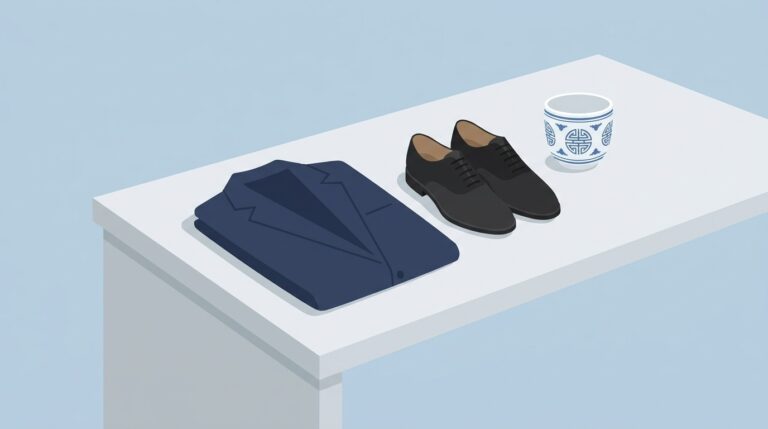
Cracking the TPO Code: Your Ultimate Guide to Korean Business Attire and Etiquette
Phase 1: Empathy & Search Intent (The Yeouido Reality Check)
Imagine this: You’ve flown into Seoul for a high-stakes partnership meeting with a major Korean conglomerate. You’ve watched hours of K-dramas like Misaeng (미생) or What’s Wrong with Secretary Kim (김비서가 왜 그럴까), so you know Korean corporate style is impeccable. You decide to go for that ultra-modern, slightly oversized pastel blazer with ankle-length trousers and sleek lifestyle sneakers. It’s chic, it’s high-fashion, and in London or New York, it screams “creative genius.”
But as you step into the polished marble lobby of a Yeouido high-rise, you notice something. The security guards are in crisp, tailored uniforms. The employees rushing past look like they’ve stepped out of a high-end tailoring house—dark navy and charcoal suits, perfectly ironed white collared shirts, and polished oxfords. Suddenly, your “cool” outfit feels a bit too casual, and you find yourself frantically wondering: Am I underdressed? Is my collar too low? Will they take me seriously?
If you have ever felt that cold sweat of dressing for a foreign corporate culture, you are not alone. In Korea, what you wear isn’t just a personal choice; it’s an active, non-verbal form of respect called TPO (Time, Place, Occasion).
This guide is built on the real-world experiences of hundreds of global executives and expat professionals who navigated the delicate tightrope of Korean corporate fashion. By the end of this post, you won’t just know what to wear; you’ll understand the social psychology behind why Koreans dress the way they do, and you’ll master the precise Korean vocabulary to discuss it like a seasoned insider.
Phase 2: Core Expressions Deep Dive
To navigate the corporate hallways of Seoul, you need to master three foundational linguistic concepts. These aren’t just vocabulary words; they are cultural lenses.
1. 격식을 차리다 (Gyeoksigeul charida)
- Pronunciation: [gy_eok-sik-eul cha-ri-da] / Sound-alike: “Gyuck-seek-ool chah-ree-dah”
- Meaning: Literally “to set the formal structure”; pragmatically used to mean “to dress formally” or “to maintain strict professional decorum.”
- K-Culture Moment: You will hear this frequently in corporate K-dramas when a character transitions from their messy, late-night working-late look to a polished, boardroom-ready outfit before an important pitch.
- Editor’s Insight: Gyeoksik (격식) translates to formality or etiquette. When you charida (set/prepare) it, you are actively signaling to your Korean counterparts: “I value this relationship enough to put effort into my appearance.”
- Situation Spectrum:
- Casual / Social: 🚫 (Using this with close friends makes you sound incredibly stiff and distant.)
- Semi-formal (Co-workers): ⚠️ (Only used when discussing official company events.)
- Formal (Boardroom/Clients): ✅ (The gold standard for describing high-stakes dress codes.)
- 🤔 Think About It: In many Western corporate environments, breaking down formalities is seen as a way to foster creativity. Why do you think Korean business culture still places such a high premium on “setting the formal structure” (격식을 차리다) during first meetings?
2. TPO에 맞추다 (TPO-e matchuda)
- Pronunciation: [T-P-O-e mat-chu-da] / Sound-alike: “T-P-O-eh maht-choo-dah”
- Meaning: Literally “to match the Time, Place, and Occasion.”
- K-Culture Moment: This is a classic “Konglish” (Korean-English) term that has been completely absorbed into the Korean lexicon. Fashion influencers on YouTube and stylists on K-beauty shows constantly analyze outfits based on whether they “match the TPO.”
- Editor’s Insight: Do not assume that because “TPO” is made of English letters, it means the same thing as it does in the West. In Korea, the “O” (Occasion) is heavily influenced by hierarchy. Dressing “above” your rank or dressing too casually in front of a senior VP is considered a major TPO violation.
- Situation Spectrum:
- Casual / Social: ✅ (e.g., “Hey, wear something comfortable, match the TPO!”)
- Semi-formal (Co-workers): ✅
- Formal (Boardroom/Clients): ✅
- 🤔 Think About It: How does the concept of “matching the collective” in TPO challenge the Western ideal of expressing individual personality through fashion?
3. 단정하게 입다 (Danjeonghage ipda)
- Pronunciation: [dan-jeong-ha-ge ip-da] / Sound-alike: “Dahn-jung-hah-gege eep-dah”
- Meaning: “To dress neatly, tidily, and respectably.”
- K-Culture Moment: When K-Pop stars attend official government press conferences or mandatory military discharge ceremonies, the media always praises their “단정한 모습” (neat and respectful appearance).
- Editor’s Insight: Danjeong (단정) is the ultimate aesthetic goal in Korean society. It means nothing is excessive: no loud patterns, no unbuttoned shirts, no messy hair. It is clean, symmetrical, and conservative.
- Situation Spectrum:
- Casual / Social: ⚠️ (Sounds slightly parental, like telling a teenager to clean up.)
- Semi-formal (Co-workers): ✅
- Formal (Boardroom/Clients): ✅
- 🤔 Think About It: Danjeong goes beyond fashion—it reflects an inner state of self-discipline. How does this cultural connection between outer neatness and inner character affect your professional reputation in Korea?
Phase 3: Textbook Korean vs. Real-World Korean
When you study Korean in a traditional classroom, the language of business attire is often presented in a dry, sterile way. Let’s look at how native professionals actually communicate.
Scenario 1: Inquiring about the company dress code
- 📖 Textbook Korean: “정장을 입어야 합니까?” (Jeongjangeul ibeoya hamnikka? / “Must I wear a formal suit?”) – This sounds incredibly robotic, almost like a military interrogation.
- 🗣️ Real Korean: “오늘 복장 규정이 어떻게 되나요? 비캐(비즈니스 캐주얼)도 괜찮을까요?” (Oneul bokjang gyujeongi eotteoke doenayo? Bikae-do gwaenchanheulkkayo? / “What is the dress code today? Is business casual okay?”)
- 💡 Why it’s different: Koreans love efficiency and modern abbreviations. Bikae (비캐) is the ubiquitous shorthand for “Business Casual.” Using this slang immediately shows you understand contemporary Korean office life.
Scenario 2: Advising a colleague on what to wear to a client meeting
- 📖 Textbook Korean: “공식적인 옷을 입으세요.” (Gongsikjeogin oseul ibuseyo. / “Please wear official clothes.”) – This is grammatically correct but culturally empty. It doesn’t tell the listener what the standard of ‘official’ actually is.
- 🗣️ Real Korean: “너무 무겁지 않게, 깔끔하고 단정하게만 입으시면 돼요.” (Neomu mugeopji ankke, kkalkkeumhago danjeonghageman ibuseomyon dwayo. / “Not too heavy, just dress cleanly and neatly.” )
- 💡 Why it’s different: Telling someone not to dress “too heavily” (너무 무겁지 않게) means they don’t need a full, stiff three-piece suit, but the expectation remains that they must be danjeong (단정—neat and respectable). It strikes a realistic, modern balance.
Phase 4: K-Culture Deep Dive & Non-Verbal Manners
4-1. The Art of “Fashion Nunchi” (눈치)
In Korean corporate life, Nunchi (the art of sensing other people’s feelings and reading the room) is your superpower. When it comes to business attire, Nunchi dictates that you should never stand out more than your client or your boss.
- The Non-Verbal Trap of Accessories: In Western corporate cultures, a luxury watch, a bold tie, or designer heels can be seen as signs of success. In Korea, if you are a junior partner or a visiting consultant, wearing accessories that are visibly more expensive than those of the host executive can trigger quiet discomfort. It’s a subtle violation of hierarchical harmony. Keep your accessories elegant but understated.
- The Shoes Rule: Always ensure your socks are flawless. Why? Because many premium traditional Korean restaurants (where high-stakes business dinners, or Hoesik 회식, take place) require you to take off your shoes. If you have a hole in your sock, or if your socks are faded, your immaculate suit won’t save you from embarrassment.
4-2. K-Drama vs. Pangyo Reality
If you watch K-Dramas like Startup, you might think Korean tech hubs like Pangyo (the Silicon Valley of Korea) are filled with CEOs in hoodies and ripped jeans. While tech and creative startups are indeed shifting toward 자유 복장 (jayu bokjang – free dress), the “freedom” is still socially policed. Even “free dress” in Korea leans toward a neat knit sweater, dark denim without rips, and clean, minimalist lifestyle sneakers. True, chaotic grunge is rarely tolerated in a professional setting.
Phase 5: Interactive Yeouido Boardroom Roleplay
Step into the shoes of Alex, a Senior Consultant visiting Seoul to close a joint venture with Daehan Enterprises. Your counterpart is Team Lead Kang (강 팀장), a seasoned corporate veteran who values traditional manners but appreciates global savvy. You are meeting at their headquarters in Yeouido.
[Setting: A high-floor conference room overlooking the Han River. The air is quiet, smelling faintly of green tea and premium leather. Team Lead Kang enters, wearing a perfectly fitted charcoal gray suit.]
- Kang Team Lead: (bowing slightly) “어서 오세요, 알렉스 씨. 먼 길 오시느라 고생 많으셨습니다.”
(Eoseo oseyo, Allekseu ssi. Meon gil osineura gosaeng manheuseotseumnida.)
(Welcome, Alex. Thank you for making the long journey here.) -
Alex: (bowing at the same angle) “초대해 주셔서 감사합니다, 팀장님. 만나 뵙게 되어 영광입니다.”
(Chodaehae jusyeoseo gamsahamnida, timjangnim. Manna boepge doeeo yeongwangimnida.)
(Thank you for inviting me, Team Lead Kang. It is an honor to meet you.) -
Kang Team Lead: (gesturing to a seat, eyes scanning Alex’s attire) “오늘 날씨가 꽤 더운데, 저희 사무실 에어컨이 약하진 않으신가요? 편하게 재킷을 벗으셔도 됩니다.”
(Oneul nalssiga kkwae deounde, jeohui samusireun eeokeoni yakhajin aneusingayo? Pyeonhage jaekiseul beoseusyeodo doemnida.)
(It’s quite warm today, is our office AC cold enough? Please feel free to take off your jacket.) -
Alex: (evaluating the room’s atmosphere. Everyone else is keeping their jackets on.)
What do you do?
🔀 Decision Point!
- Choice A: “Oh, thank God! It is boiling in here!” (Take off your jacket immediately, unbutton the top two buttons of your shirt, and roll up your sleeves.)
- Choice B: “아닙니다, 팀장님. 격식을 차리는 자리인 만큼 재킷을 입고 있겠습니다.” (Animnida, timjangnim. Gyeoksigeul charireun jariin mankeum jaekiseul ipgo ikgetseumnida. / “No, Team Lead. Since this is a formal occasion, I will keep my jacket on.”)
- Choice C: “배려해 주셔서 감사합니다, 팀장님. 회의가 본격적으로 시작되면 말씀하신 대로 하겠습니다.” (Baeryeohae jusyeoseo gamsahamnida, timjangnim. Hoeuiga bongyeokjeogeuro sijakdoemeon malsseumhasin daero hagetseumnida. / “Thank you for your consideration, Team Lead. Once the meeting officially begins, I will do as you suggested.”)
🏆 Choice Analysis
- Best Choice: Choice C! This is pure Nunchi gold. It acknowledges his hospitality (배려 – baeryeo) while demonstrating that you respect the formality of the initial greetings. It allows you to follow his lead naturally.
- Runner Up: Choice B. This is a safe, traditional response. It shows you value gyeoksik (formality), though it might make you look slightly rigid if the room actually warms up.
- The Risk/Bad Choice: Choice A. A massive TPO disaster. Rolling up your sleeves and unbuttoning your collar before the meeting even starts signals a lack of self-discipline (단정하지 못함) and can be interpreted as treating the host company with casual disregard.
Phase 6: 10-Second Emotional Shadowing Drill
Let’s train your muscle memory and emotional delivery. Pay attention to the pauses (/) and the emotional cues.
Drill 1: Inquiring about Dress Code (Polite & Diplomatic)
- Sentence: “오늘 미팅은 / 격식을 차려야 하는 자리인가요?”
- Romanization: Oneul mitingeun / gyeoksigeul charyeoya haneun jariingayo?
- Emotion Target: [🥺 Curious and highly respectful]
- Practice Cue: Imagine you are calling a senior colleague to make sure you don’t embarrass the team at tomorrow’s banquet.
Drill 2: Confirming Business Casual (Friendly yet Professional)
- Sentence: “비캐로 / 입고 가도 / 전혀 문제없겠죠?”
- Romanization: Bikaero / ipgo gado / jeonhyeo munjeeopgetjyo?
- Emotion Target: [😊 Confident, seeking light reassurance]
- Practice Cue: Asking a close colleague in the hallway before heading out to a semi-formal industry seminar.
Phase 7: K-Culture Mini Dictionary
| Word (Hangul / Romanization) | English Equivalent | Cultural Context & Usage |
|---|---|---|
| 비캐 (Bikae) | Business Casual | Shorthand for 비즈니스 캐주얼. It means clean slacks, collared shirts or neat knits, and occasionally smart blazers. No sandals or shorts allowed. |
| 정장 (Jeongjang) | Formal Suit / Attire | The classic dark-colored matching suit set. Reserved for interviews, weddings, funerals, and high-stakes executive meetings. |
| 자유 복장 (Jayu Bokjang) | Free Dress Code | Culturally means “neat casual.” It does not mean wear whatever you want; it means you don’t have to wear a tie, but you must still look respectable. |
| 꼰대 (Kkondae) | Boomer / Rigid Policeman | Originally meant a condescending older person. In corporate fashion, a Kkondae is someone who polices socks, hair length, or dress length with outdated standards. |
Phase 8: Traveler’s Survival Kit (The Seoul Fashion Emergency)
What happens if your luggage gets lost, or your shirt gets stained right before a crucial meeting in Seoul?
Top 3 Survival Phrases
- “근처에 정장이나 정장용 와이셔츠를 살 만한 곳이 있을까요?”
- Geuncheoe jeongjangina jeongjangyong waisyeoteureul sal manhan gosi isseulkkayo?
- Pro Tip: Ask your hotel concierge this. They will likely point you to a nearby department store or a fast-fashion store like SPAO or UNIQLO for an emergency basic dress shirt.
- “스팀다리미 대여가 가능할까요?”
- Seutimdarimi daeyeoga ganeunghalkkayo?
- Pro Tip: “Can I rent a steam iron?” Crucial for smoothing out suitcase wrinkles in your hotel room before you head out.
- “당일 드라이클리닝이 되나요?”
- Dangil deuraikeulliningi doenayo?
- Pro Tip: “Is same-day dry cleaning available?” Vital for emergency coffee spills.
📌 Editor’s Travel Note
If you find yourself in an absolute fashion emergency in Seoul, head straight to Gasan Digital Complex (가산디지털단지) or Munjeong-dong Fashion Street (문정동 로데오거리). These are outlet havens where you can find high-quality Korean corporate wear at a fraction of department store prices.
For easy navigation, do not rely on Google Maps (which is historically inaccurate for walking routes in Korea). Instead, download the Naver Map App on Google PlayStore or search the web via the Naver Search Portal to find the nearest dry cleaners (세탁소 – setakso) or fashion outlets.
Phase 9: Going Deeper — Cultural Reflection
In Western cultures, the post-pandemic era brought about a massive shift toward hyper-casual wear. CEOs present keynotes in t-shirts, and sneakers are ubiquitous in boardrooms. However, in Korea, while the rules have relaxed slightly, the preservation of gyeoksik (격식) remains resilient.
Why? Because in a high-context, collectivist society, fashion is a language of social alignment. By wearing a clean, formal outfit, you are telling the other person: “Your time is valuable to me, and I am showing my respect by preparing myself physically for our encounter.” It is a physical manifestation of harmony (Hwa – 화).
💬 Your Turn!
How does your native business culture view formal attire? Is dressing up seen as a sign of respect, or is it viewed as outdated and rigid? Share your thoughts in the comments below!
Phase 10: FAQ & Common Mistakes
Q: Can men wear business-casual loafers without socks in a Korean corporate setting?
A: Definitely Not. While “sockless loafers” are trendy in Italian menswear, bare ankles are still considered too casual—and sometimes unprofessional—in traditional Korean boardrooms. Always wear dark, solid-colored socks that cover your calves when you sit down.
Q: Is it okay to show tattoos in a business meeting in Korea?
A: It is highly advised to cover them. While tattoo culture is booming among younger generations in Seoul, tattoos are historically associated with counter-culture or organized crime in traditional spaces. To maintain an uninterrupted focus on your business goals, cover any visible tattoos with long sleeves or skin-colored tape.
Q: What is the rule for women’s business skirts in Korea?
A: Conservatism is key. Skirts should ideally sit at or below the knee when standing. Extremely tight skirts or plunge-neck tops are major TPO violations in professional settings.
🚨 The Wall of Shame: Top 3 Corporate Dress Mistakes
- The Ghost Sock: Wearing white athletic socks with a dark navy business suit. (Always match your sock color to your trousers or shoes!)
- The Wrinkle Monster: Wearing a linen blazer to a high-stakes corporate pitch. (Linen wrinkles instantly; in Korea, wrinkles translate to a lack of preparation.)
- The Sandal Slip-up: Wearing open-toed shoes or elegant sandals to a corporate office. (Feet should always be covered in professional spaces.)
Phase 11: Action Missions
- 🥉 Bronze (The Mirror Check): Take a photo of your go-to business casual outfit. Inspect it through the lens of Danjeong (단정). Are there wrinkles? Are your socks matching?
- 🥈 Silver (The Social Share): Post a picture of your professional style on social media and tag it with #DailyHangul and write: “오늘 제 TPO 어때요?” (How is my TPO today?)
- 🥇 Gold (The Nunchi Master): Next time you watch a corporate K-Drama, analyze the dress differences between the Team Lead, the New Hire, and the CEO. Write down how their outfits reflect their corporate hierarchy.
Phase 12: Interactive Quiz Challenge
Test your mastery of Korean business etiquette and vocabulary!
1. Situational Judgment
Which of the following outfits represents the best TPO for a first-time partnership meeting with a conservative manufacturing company in Seoul?
* A) A trendy, bright red linen suit with designer slides.
* B) A neat charcoal gray suit, white dress shirt, navy tie, and polished oxfords.
* C) A black graphic t-shirt, distressed denim jeans, and pristine white sneakers.
2. Fill in the Blank
“아무리 자유 복장이라도 회사에서는 __________하게 입어야 해요.”
(No matter how free the dress code is, you must dress __________ at the office.)
* A) 피곤 (pigon – tiredly)
* B) 단정 (danjeong – neatly/tidily)
* C) 화려 (hwaryeo – flashily/splendidly)
3. True or False
True or False: Since “TPO” is an acronym derived from English, the rules for matching it in Korea are identical to Western corporate standards.
🎉 Click here to reveal the Answer Key & Explanations!
Answers:
- B is correct! A charcoal gray suit with polished oxfords represents the absolute pinnacle of gyeoksik (격식) and respect for a first meeting. A is too flashy and casual (slides are a major no-no), and C is too casual for a conservative partner.
- B is correct! Danjeong (단정) is the cultural standard of neatness and respect expected in any office environment.
- False! While the letters are English, Korean TPO is heavily governed by hierarchical respect, collectivism, and Nunchi. It requires a higher level of conservative presentation than typical Western standards.







