

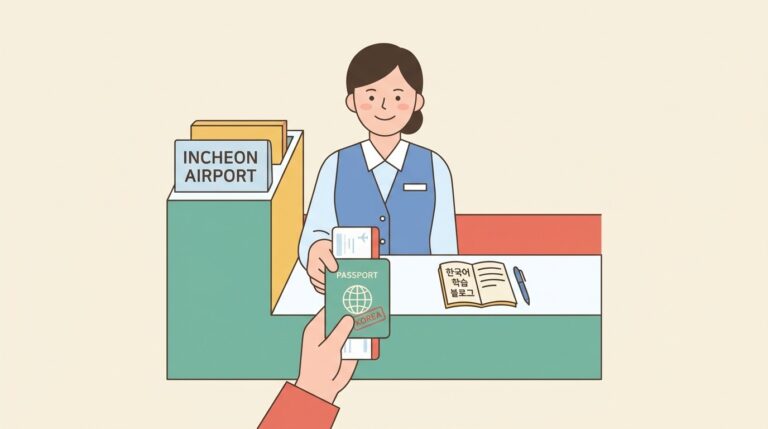
안녕하세요! Welcome to Daily Hangul!
Imagine this: You have just landed at the world-famous Incheon International Airport (인천국제공항). Your ears catch the soft, upbeat melody of a NewJeans song playing from a giant Samsung screen nearby. You are excited, a little tired, and ready to start your ultimate Korean adventure—eating delicious street food in Myeongdong and visiting your favorite K-Drama filming locations.
But first, you have to get through the final boarding gate. A smiling airport agent in a crisp uniform looks at you and says:
“탑승권 주세요.” (Tap-seung-gwon ju-se-yo.)
Your heart does a quick nervous skip. What did they just say? What do you hand them?
Don’t worry! Your Korean best friend is here to help. Today, we are going to master the most critical airport phrase so you can glide through customs like a seasoned K-Traveler.
Phase 2: Core Expressions Deep Dive
1. 탑승권 주세요 (Tap-seung-gwon ju-se-yo)
- Pronunciation: Tap-seung-gwon ju-se-yo (Sound-alike: “Tap-sung-gwon jew-say-yo”)
- Meaning: “Please give me your boarding pass.”
- K-Culture Moment: You will hear this expression in almost every romantic K-Drama airport chase scene. When the main character is trying to stop their lover from flying away, the airport staff calmly says “탑승권 주세요” to check their ticket while the emotional background music swells!
- Editor’s Insight: 주세요 (Ju-se-yo) is your ultimate magic word in Korea. It means “Please give me.” Just place any noun before it to get what you need!
- Situation Spectrum:
- Friends/Casual: ⚠️ (A bit too formal for close friends, but grammatically okay)
- Colleagues/Semi-formal: ✅
- Elders/Formal: ✅
- 🤔 Think About It: In Korean, we show respect to service workers by ending our sentences with “-요 (-yo)”. How does your culture show politeness to airport staff without using extra words?
2. 여권 보여주세요 (Yeo-gwon bo-yeo-ju-se-yo)
- Pronunciation: Yeo-gwon bo-yeo-ju-se-yo (Sound-alike: “Yuh-gwon bo-yuh-jew-say-yo”)
- Meaning: “Please show me your passport.”
- K-Culture Moment: This is the first official Korean sentence you will likely hear when stepping foot into the country at the immigration counter.
- Editor’s Insight: 보여주세요 (Bo-yeo-ju-se-yo) means “Please show me.” If you hear this word, they want to look at something—usually your passport or your mobile ticket.
- Situation Spectrum:
- Friends/Casual: 🚫
- Colleagues/Semi-formal: ✅
- Elders/Formal: ✅
3. 여기 있습니다 (Yeo-gi it-seup-ni-da)
- Pronunciation: Yeo-gi-it-seum-ni-da (Sound-alike: “Yuh-gee eet-seum-nee-da”)
- Meaning: “Here it is.” / “Here you go.”
- K-Culture Moment: Used constantly at duty-free shops when handing over your credit card to buy that trendy Korean cushion foundation.
- Editor’s Insight: To sound super natural and polite, say this while hand over your passport. Always use two hands!
- Situation Spectrum:
- Friends/Casual: 🚫 (Use “여기 있어” instead)
- Colleagues/Semi-formal: ✅
- Elders/Formal: ✅
Phase 3: Textbook Korean vs. Real Korean
When we study textbooks, the phrases can sometimes sound a bit like a robot wrote them. Let’s look at how Koreans actually talk at the gate!
Scenario 1: Finding where to check in
- 📖 Textbook Korean: 탑승 수속 카운터가 어디에 있습니까? (Tap-seung su-sok ka-un-teo-ga eo-di-e it-seup-ni-kka? – “Where is the boarding check-in counter?”)
- 🗣️ Real Korean: 체크인 어디서 해요? (Che-keu-in eo-di-seo hae-yo? – “Where do I do check-in?”)
- 💡 Why it’s different: Koreans value efficiency and speed (“Ppalli-Ppalli” culture). Using the English loanword “체크인 (Check-in)” with a simple “어디서 해요 (where do I do it?)” is much faster and warmer!
Scenario 2: Handing over your documents
- 📖 Textbook Korean: 제 여권과 탑승권을 드리겠습니다. (Je yeo-gwon-gwa tap-seung-gwon-eul deu-ri-get-seup-ni-da. – “I shall present my passport and boarding pass to you.”)
- 🗣️ Real Korean: 여기요! (Yeo-gi-yo! – “Here you go!”)
- 💡 Why it’s different: Saying the long textbook sentence sounds like you are reading a formal speech. A bright, friendly “여기요!” with a warm smile is perfect for daily life.
Phase 4: K-Culture Deep Dive & Non-verbal Manners
4-1. The Magic of Two Hands (두 손)
In Western countries, passing a passport with one hand is completely normal. In Korea, however, handing over items with only one hand can look slightly dismissive. To show instant respect:
* Hold your passport with both hands, or
* Hold the passport with your right hand while lightly supporting your right forearm or wrist with your left hand.
Try this at the boarding gate—the agent’s face will light up with appreciation!
4-2. Incheon Airport Survival
Incheon International Airport is consistently rated one of the best in the world. Once you pass through the boarding gate using your new Korean skills, make sure to visit the cultural experience zones in the terminal where you can try on traditional Korean clothes (Hanbok) for free!
Phase 5: Live Roleplay at the Gate
- The Setting: The boarding gate at Incheon Airport, Terminal 1. The chimes are ringing softly.
- Cast: You (The excited traveler) & Min-ji (The polite airline agent).
- Min-ji: 안녕하세요! 탑승을 시작합니다. (An-nyeong-ha-se-yo! Tap-seung-eul si-jak-hap-ni-da.)
(🎭 Greeting you with a gentle bow) - You: 안녕하세요! (An-nyeong-ha-se-yo!)
- Min-ji: 여권과 탑승권 주세요. (Yeo-gwon-gwa tap-seung-gwon ju-se-yo.)
- You: 아, 네! 여기 있습니다. (Ah, ne! Yeo-gi it-seup-ni-da.)
(🎭 Handing over documents using both hands) - Min-ji: 감사합니다. 음… 좌석이 22A 맞으세요? (Gam-sa-hap-ni-da. Um… jwa-seok-i i-sip-i-A maj-eu-se-yo?)
- You: 네, 맞아요. (Ne, ma-ja-yo.)
- Min-ji: 네, 확인되었습니다. 즐거운 여행 되세요! (Ne, hwa-gin-deot-seup-ni-da. Jeul-geo-un yeo-haeng doe-se-yo!)
- You: 감사합니다! (Gam-sa-hap-ni-da!)
🔀 Decision Point!
Min-ji asks you for your boarding pass. What do you do?
* A) Throw it carelessly on the counter. -> Bad Choice! (This is considered rude in Korea.)
* B) Smile, say “여기 있습니다” (Yeo-gi it-seup-ni-da), and hand it over with two hands. -> Best Choice! (You will receive a warm, bright smile in return.)
* C) Say nothing and just stare at her. -> Awkward Choice! (Let’s practice your speaking!)
Phase 6: 10-Second Emotion Shadowing Drill
Let’s practice speaking with real Korean feelings!
* [😊 Happy & Polite]
여 기 / 있 습 니 다! (Yeo-gi / it-seup-ni-da!)
* [🥺 Requesting gently]
탑 승 권 / 주 세 요. (Tap-seung-gwon / ju-se-yo.)
Phase 7: K-Culture Mini Dictionary
- 여권 (Yeo-gwon): Passport. Your most precious travel document!
- 탑승권 (Tap-seung-gwon): Boarding pass.
- 면세점 (Myeon-se-jeom): Duty-free shop. The magical place at the airport where you can buy K-Beauty cosmetics tax-free.
- 게이트 (Ge-i-teu): Gate. Always check your gate number on your ticket!
Phase 8: Traveler’s Survival Kit
Top 3 Survival Phrases
- 화장실 어디예요? (Hwa-jang-sil eo-di-yeo-yo?) – Where is the restroom?
- 와이파이 돼요? (Wa-i-pa-i dwae-yo?) – Does the Wi-Fi work?
- 감사합니다! (Gam-sa-hap-ni-da!) – Thank you!
📌 Editor’s Travel Note: Google Maps does not work perfectly for walking directions in South Korea! For smooth navigation, download the NAVER Map App before you arrive. It is the ultimate local navigation tool.
Phase 9: Deep Reflection — “One Step Deeper”
Korean customer service is famous for its extreme politeness and speed. This comes from a mixture of 정 (Jeong – warm social connection) and the modern, fast-paced lifestyle of Seoul. When service staff say “주세요,” they do so with a melodic, welcoming tone.
💬 Your Turn: How does the service culture at airports in your country compare to Korea’s ultra-polite and fast service? Let us know in the comments below!
Phase 10: FAQ & Common Mistakes
Q: Can I just say “탑승권” (Tap-seung-gwon) without “주세요” (ju-se-yo)?
A: No. Saying just the noun sounds like a blunt command and can be seen as very rude. Always add “주세요” to keep it polite!
Q: What is the difference between “표” (Pyo) and “탑승권” (Tap-seung-gwon)?
A: “표” (Pyo) is a general word for any ticket (like a bus ticket or cinema ticket). “탑승권” is the specific term for an airport boarding pass.
🚨 Common Mistake Warning!
- The One-Hand Slide: Slapping your passport onto the counter with one hand while looking at your phone.
- Correct Action: Put your phone away for 10 seconds, make eye contact, and hand over your passport with both hands!
Phase 11: Action Mission!
- 🥉 Bronze: Say “여기 있습니다” (Yeo-gi it-seup-ni-da) to yourself in the mirror 3 times while practicing the two-hand gesture.
- 🥈 Silver: Write “여기 있습니다” in the comments of this post!
- 🥇 Gold: The next time you visit a Korean restaurant or business, hand over your payment card with two hands and say “여기 있습니다!”
Phase 12: Interactive Quiz Challenge
🔎 Q1: What does ‘탑승권 주세요’ mean? (Click to reveal answer)
Answer: “Please give me your boarding pass.”
탑승권 (Boarding pass) + 주세요 (Please give me).
🔎 Q2: Which gesture is most polite when handing over your passport? (Click to reveal answer)
Answer: Handing it over with both hands while making polite eye contact!







