

Mastering the Art of the Korean Bow: How to Greet Like a True Local
안녕하세요! (Annyeonghaseyo!) Hello! I am your friendly neighborhood Daily Hangul editor, and today, we are going to talk about something you see in almost every K-Drama, K-Pop video, and street corner in Seoul: the bow.
Imagine this: You walk into a cozy cafe in Hongdae. The barista smiles and bows. You want to bow back, but suddenly you freeze. How low do I go? Do I keep eye contact? Where do my hands go? You end up doing a quick, awkward head-nod that feels more like a sneeze than a polite greeting.
Don’t worry! We have all been there. Bowing is the ultimate secret handshake of Korean culture. When you do it right, it acts as an instant bridge, turning you from a simple tourist into a highly respected guest. Today, you will learn the exact physical rules and phrases to bow confidently and naturally. This guide is based on real-world feedback from hundreds of beginner students just like you who successfully unlocked their K-etiquette skills!
Phase 2: Three Core Bowing Expressions
Let’s master the three most common phrases that always go hand-in-hand with a polite bow.
1. 안녕하세요 (Annyeonghaseyo)
- Pronunciation: Ahn-nyeong-ha-seh-yo / Sound Analogy: Think of saying ‘On-young-ha-say-yo’ with a soft, melodic flow.
- Meaning: “Are you at peace?” (Real-world: “Hello/How are you?”)
- K-Culture Moment: Think of your favorite K-Pop idols entering a TV show. They stand in a perfect line, bow deeply, and shout this together with bright smiles!
- Editor’s Insight: This is the ultimate, gold-standard greeting. Always use this with a gentle 15-to-30-degree bow when greeting shop owners, taxi drivers, or people older than you.
- Situation Spectrum:
- Friends (Casual): 🚫 (A simple hand wave ‘안녕’ is better!)
- Coworkers (Semi-formal): ✅
- Bosses/Elders (Formal): ✅
- 🤔 Think About It: Unlike the English “Hi!”, “안녕하세요” is a question asking if the other person is at peace. Why do you think Korean culture places such high value on peace and harmony during a first greeting?
2. 안녕히 계세요 (Annyeonghi gyeseyo)
- Pronunciation: Ahn-nyeong-hee gyeh-seh-yo / Sound Analogy: ‘An-young-he-gay-say-yo’.
- Meaning: “Please stay peacefully.” (Real-world: “Goodbye” – said when you are leaving and the other person is staying.)
- K-Culture Moment: In K-Dramas, when a character politely leaves a family dinner at their partner’s house, they stand by the door, bow nicely, and say this to the parents.
- Editor’s Insight: Be careful! If both you and the other person are leaving, or if they are leaving and you are staying, you must say 안녕히 가세요 (Annyeonghi gaseyo) which means “Please go peacefully.”
- Situation Spectrum:
- Friends (Casual): 🚫
- Coworkers (Semi-formal): ✅
- Bosses/Elders (Formal): ✅
- 🤔 Think About It: Why does Korean have two different ways to say “Goodbye” depending on who is staying and who is going? How does this show Korean culture’s focus on space and hospitality?
3. 감사합니다 (Gamsahamnida)
- Pronunciation: Gahm-sah-hahm-nee-dah / Sound Analogy: ‘Kam-sa-ham-ni-da’.
- Meaning: “I do gratitude.” (Real-world: “Thank you.”)
- K-Culture Moment: An actor receiving a prestigious award at the Baeksang Arts Awards holding their trophy, bowing deeply to the crowd, and repeating this expression with tears of joy.
- Editor’s Insight: Always pair this with a slight bow when receiving change at a convenience store or when a waiter serves your delicious food.
- Situation Spectrum:
- Friends (Casual): ⚠️ (Better to use ‘고마워’ to close friends)
- Coworkers (Semi-formal): ✅
- Bosses/Elders (Formal): ✅
- 🤔 Think About It: Bowing while saying thank you physically lowers your head below the other person’s eye level. How does this physical act show humility?
Phase 3: Textbook Korean vs. Real-Life Korean
Sometimes, school textbooks make us sound like robots. Let’s look at how Koreans actually behave in everyday life.
Situation 1: Leaving a local convenience store
- 📖 Textbook Korean: “안녕히 계십시오.” (Annyeonghi gyesipsio – Extremely stiff, military-style goodbye)
- 🗣️ Real Korean: “감사합니다~ 수고하세요!” (Gamsahamnida~ sugohaseyo! – “Thank you~ keep up the good work!”)
- 💡 Why is it different? Koreans love efficiency and warmth. A friendly, musical “Thank you!” paired with a quick 15-degree head bow feels much more alive and polite than a stiff, formal phrase.
Situation 2: Greeting a restaurant owner
- 📖 Textbook Korean: “안녕하십니까?” (Annyeonghasimnikka? – Super formal “Hello”)
- 🗣️ Real Korean: “안녕하세요!” (Annyeonghaseyo! – Warm, friendly “Hello”)
- 💡 Why is it different? Unless you are in a corporate boardroom or a military camp, “안녕하세요” paired with a gentle, smiling nod is the perfect balance of respect and warmth.
⚠️ Bottom Note: As an A2 learner, stick to “안녕하세요” and “감사합니다”. You will sound polite, modern, and perfectly natural!
Phase 4: K-Culture Deep Dive & Non-Verbal Manners
4-1. The Body Language of Bowing
When bowing in Korea, your eyes and hands tell a story just as much as your mouth does!
* The Eye Contact Mistake: In Western cultures, eye contact shows confidence. In Korea, looking directly into an elder’s eyes while bowing can look defiant or aggressive. Keep your eyes down as you bend your neck and waist.
* Where do my hands go? Keep your hands gently folded in front of you (near your stomach) or flat against your thighs. Never keep your hands in your pockets while bowing!
* Angle Guide:
– 15 degrees (Nod): For quick interactions (cashiers, delivery drivers, quick pass-bys).
– 30 degrees (Standard): For teachers, elders, bosses, and when greeting guests.
– 45 degrees (Deep): For formal apologies, showing deep respect, or performing traditional holidays.
4-2. The “Nunchi” (눈치) Factor
Nunchi is Korea’s superpower of reading the room. When you walk into a quiet tea house, don’t bow and shout your greeting. Use your nunchi to match the quiet atmosphere with a soft, silent bow. On the other hand, inside a busy, loud Korean BBQ restaurant, match the energy with a bright, energetic bow and a loud “안녕하세요!”
Phase 5: Interactive Bowing Roleplay
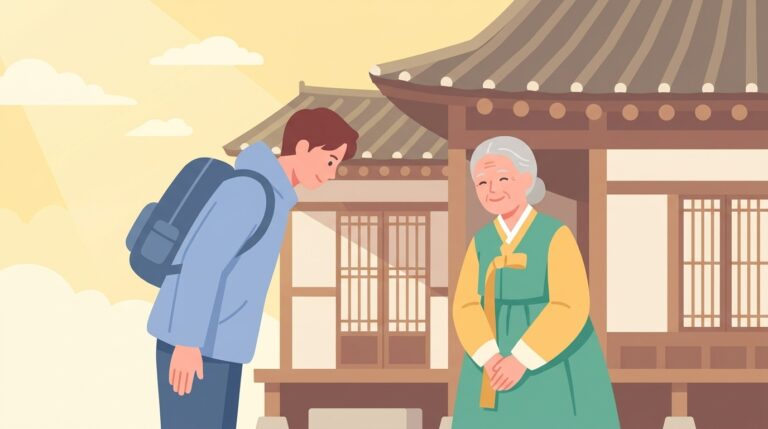
Let’s put this into practice! You are checking into a cozy homestay in Hanok Village, Jeonju. You meet the owner, a warm elder lady named Mrs. Kim.
(ALT Text: Warm flat design illustration of an elderly Korean woman in front of a traditional Hanok house, welcoming a guest with a gentle smile.)

- Turn 1 (Mrs. Kim): “어머, 어서 와요! 반가워요.” (Eomeo, eoseo wayo! Bangawoyo.)
🎭 (Smiles brightly, opens the wooden gate, and gives you a welcoming nod) - Turn 2 (You): “안녕하세요! 만나서 반가워요.” (Annyeonghaseyo! Mannaseo bangawoyo.)
🎭 (You stand straight and prepare your greeting) - Turn 3 (Mrs. Kim): “먼 길 오느라 힘들었죠? 이쪽으로 와요.” (Meon gil oneura himdeureotjyo? Ijjogeuro wayo.)
🎭 (Points gently toward the beautiful wooden living room) - Turn 4 (You): “우와, 한옥이 정말 예뻐요!” (Uwa, hanogi jeongmal yeoppeoyo!)
🎭 (Looking around with amazed, wide eyes) - Turn 5 (Mrs. Kim): “고마워요. 시원한 매실차 한잔 줄게요. 여기 앉아요.” (Gomawoyo. Siwonhan maesilcha hanjan julgeyo. Yeogi anjayo.)
🎭 (Hands you a cold glass of traditional plum tea) - Turn 6 (You): “와, 감사합니다!” (Wa, gamsahamnida!)
🎭 (You want to accept the glass. What is the best physical gesture?) - Turn 7 (Mrs. Kim): “맛있게 마셔요. 짐은 여기 두고 편히 쉬어요.” (Masitge masyeoyo. Jimeun yeogi dugo pyeonhi swieoyo.)
🎭 (Pats your shoulder gently and smiles) - Turn 8 (You): “네, 편히 쉴게요.” (Ne, pyeonhi swilgeyo.)
🎭 (Taking a delicious sip of the sweet plum tea) - Turn 9 (Mrs. Kim): “필요한 것 있으면 언제든 말해요. 그럼 쉴게요!” (Piryo-han geot isseumyeon eonjedeun malhaeyo. Georeom swilgeyo!)
🎭 (Stands up to leave you to rest) - Turn 10 (You): “감사합니다, 안녕히 가세요!” (Gamsahamnida, annyeonghi gaseyo!)
🎭 (You perform a final polite bowing gesture)
🔀 Decision Point!
In Turn 6, when Mrs. Kim hands you the cup of plum tea, what do you do?
* Choice A: Grab the cup with one hand, look her straight in the eyes, and say “고마워!” (Gomawo!).
* Choice B: Receive the cup with both hands, bow your head slightly, and say “감사합니다.” (Gamsahamnida).
* Choice C: Bow down to a full 90 degrees while keeping both hands behind your back.
💡 Analysis:
- Best Choice: Choice B! Receiving objects with two hands is a sign of deep respect in Korea. Pairing this with a light head bow and “감사합니다” makes you look incredibly polite and culturally aware!
- Bad Choice: Choice A. Saying “고마워” is casual slang only for close friends. Grabbing with one hand and making intense eye contact will make you seem demanding or impolite.
- Awkward Choice: Choice C. A 90-degree bow is way too dramatic for a casual tea check-in, and keeping hands behind your back can look cold or secretive.
Phase 6: 10-Second Emotion Shadowing Drill
Let’s practice the flow and music of Korean words. Focus on the emotional markings and the / pause signs!
- [😊 Friendly and Energetic]
안녕하/세요~! / 반갑습니다!
(Ahn-nyeong-ha / se-yo~! / Ban-gaps-umnida!)
Real-world tip: Say the ‘요~’ slightly longer to sound warm and inviting! -
[🥺 Soft and Respectful]
감사/합니다. / 잘 먹겠습니다!
(Gahm-sah / hahm-nee-da. / Jal meok-get-seumnida!)
Real-world tip: Bow your head right on the pause/for perfect timing. -
[😤 Confident and Polite]
안녕히 / 계세요! / 또 올게요~!
(Ahn-nyeong-hee / gyeh-seh-yo! / Tto ol-ge-yo~!)
Real-world tip: Say this cheerfully as you walk out the door of a restaurant.
Phase 7: K-Culture Mini Dictionary
| Word | Meaning | Cultural Insight |
|---|---|---|
| 예의 (Yeeui) | Etiquette / Manners | The backbone of Korean society. Having yeeui means showing respect to others through actions, bowing, and proper language. |
| 존댓말 (Jondaetmal) | Polite/Formal Language | The grammatical system of showing respect. It goes hand-in-hand with bowing. |
| 정 (Jeong) | Social Warmth / Affection | The warm, sticky feeling of connection between people. A polite bow is the first spark to ignite jeong! |
| 인사 (Insa) | Greeting / Bow | In Korea, insa is not just a greeting; it’s a lifestyle. Kids are taught how to do insa properly from age two! |
Phase 8: Traveler’s Survival Kit
Top 3 Survival Phrases for Bowing Moments
- 안녕하세요! (Annyeonghaseyo!) – Hello! (Perfect for entering any shop, hotel, or taxi).
- 감사합니다! (Gamsahamnida!) – Thank you! (Say this while receiving your food or buying a train ticket).
- 죄송합니다. (Joesonghamnida.) – I am sorry. (Pair this with a quick bow if you accidentally bump into someone on a crowded subway).
📌 Editor’s Travel Note
When traveling around Seoul, you will walk and bow a lot! Keep your journey stress-free by downloading the official Naver Map Application for flawless walking directions, and don’t forget that there is no tipping culture in Korea. A polite bow and a warm “감사합니다” is the best and only tip you need to give!
Phase 9: One Step Deeper — The Roots of the Bow
Why do Koreans bow? Historically, bowing was a way to show that you carry no weapons and that you humble your ego before another person. In Western cultures, equality is shown by looking straight at each other and shaking hands. In Korea, respect is shown by temporarily lowering yourself. It is not about submission; it is a beautiful physical dance of mutual respect.
💬 Your Turn: How do people show deep respect in your hometown? Do you shake hands, hug, or bow? Let me know in the comments below!
Phase 10: FAQ & Avoiding Mistakes
Q: Can I just nod my head instead of bowing my waist?
A: Yes, but context matters. A quick head nod is perfectly fine for casual situations like grabbing a coffee or passing a security guard. However, when meeting someone for the first time or talking to an elder, you should bend slightly from your waist for true politeness.
Q: Should I shake hands and bow at the same time?
A: It depends, but usually no. Doing both at the same time can look incredibly awkward (often called the “broken folding chair” look!). If someone offers a hand, take it with two hands while giving a very soft, slight nod of your head. Keep it simple!
Q: What if I bow to someone younger than me?
A: It is actually a lovely gesture! While not strictly required, bowing slightly to young service workers, cashiers, or children shows that you are a gentle, respectful person with great yeeui.
🚨 Common Bowing Mistakes (Top 3)
- Hands in pockets: Never bow with your hands in your pockets. It looks incredibly lazy and dismissive.
- The Staring Bow: Staring directly at the person’s face while bending down looks like you are ready to fight. Look down!
- The Bow and Shake: Bowing so low while shaking hands that your heads almost bump. Keep your distance!
Phase 11: Action Missions
- 🥉 Bronze Mission: Stand in front of a mirror. Practice a clean, 15-degree waist bow with your hands gently folded in front of you. Keep your eye level down. Do it three times!
- 🥈 Silver Mission: Watch a K-Drama scene and spot how characters bow. Do they bow differently to their boss compared to their parents? Share what you observed in our community group!
- 🥇 Gold Mission: Next time you visit a local Korean restaurant or grocery store, look the cashier in the eyes, smile, then bow your head 15 degrees and say “감사합니다!” (Gamsahamnida!). Watch their face light up!
- 🎮 K-Culture Mission: Find a video of a K-Pop group greeting their fans. Count how many seconds they hold their bow. Write the group’s name and the bow duration in the comments!
Phase 12: Interactive Quiz Challenge
Test your new K-etiquette skills below!
1. You are leaving a local restaurant. The owner is staying inside. What do you say as you bow?
Click here to check the answer!
Answer: “안녕히 계세요!” (Annyeonghi gyeseyo)
Explanation: Since the owner is staying in the shop, you must tell them to “stay peacefully” (계세요).
2. True or False: You should look directly into the eyes of an elder while bowing to show your honesty.
Click here to check the answer!
Answer: False!
Explanation: Direct eye contact during a bow is considered impolite in Korea. Look down toward the floor to show modesty and respect.
3. Which bowing angle is best when you accidentally step on someone’s foot in the busy Seoul subway?
Click here to check the answer!
Answer: A quick 15-degree bow with a soft “죄송합니다” (Joesonghamnida).
Explanation: In a busy, moving subway, a quick and agile 15-degree bow is perfect to apologize without blocking the crowd!






