

The Secret Behind Tapping the Elevator ‘Close’ Button 20 Times: Cracking Korea’s ‘Pali-Pali’ Culture
Phase 1: Welcome to the Speed-Run Capital of the World!
안녕하세요! (Annyeonghaseyo!) Hello there, my dear language and culture explorer! It’s your favorite Korean tutor and local guide from Daily Hangul.
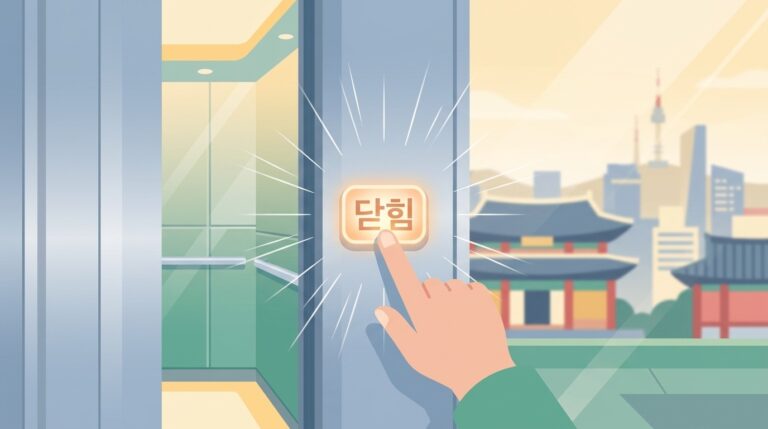
Imagine this: You are standing inside a sleek elevator in a glittering skyscraper in Gangnam, Seoul. The doors slide open. A stylish young professional rushes in, eyes locked on the control panel. Before they even step fully inside, their index finger is already vibrating against the ‘닫힘’ (Dachim – Close) button. Tap-tap-tap-tap-tap!
If you have watched any modern K-Dramas, you have definitely seen this. In the hit workplace drama Misaeng (Incomplete Life), characters practically run to elevators, treating the close button like a gaming controller.
At first, you might think, “Are they mad at me? Am I too slow?”
Take a deep breath! They aren’t mad at you at all. This is your very first, up-close encounter with one of Korea’s most famous cultural DNAs: 빨리빨리 (Pali-Pali) Culture—the legendary “hurry-hurry” mindset. Learning how to navigate this cultural speed-run won’t just save you awkward stares; it will make your Korean friends look at you in absolute awe, saying, “Wow, you are basically Korean now!”
This guide is packed with real-world insights built from years of helping students just like you go from feeling overwhelmed to feeling like a true Seoulite. Let’s dive in!
Phase 2: Three Essential Speed Expressions
To sound like a local when things are moving at lightspeed, you need these three power expressions in your linguistic toolkit.
1. 빨리빨리 (Pali-pali)
- Pronunciation: [ppal-li-ppal-li] / Sound-alike: Think of the English word “Polly” but with a very sharp, tense ‘P’ sound at the start: “PPAHL-lee PPAHL-lee”.
- Meaning: Hurry hurry! / Chop-chop!
- K-Culture Moment: Think of a classic K-Drama scene where two friends are running late for a K-Pop concert. One is struggling in high heels while the other looks back, waving their arm frantically, shouting: “빨리빨리 와!” (Pali-pali wa! – Hurry up and come!)
- Editor’s Insight: While it sounds intense, “빨리빨리” is rarely meant to be mean. It is more of a rhythmic social cheer to keep everyone synchronized.
- Situation Spectrum:
- Friends & Casual: ✅ (Perfect for teasing slow friends)
- Co-workers & Semi-formal: ⚠️ (Use with caution; can sound demanding)
- Bosses & Elders: 🚫 (Never use this with superiors; it sounds rude!)
- 🤔 Think About It: Why do you think a culture that values politeness so highly developed such a direct, urgent phrase? Does your native language have a word you use this frequently?
2. 문 좀 닫아주세요 (Mun jom dada-juseyo)
- Pronunciation: [mun jom da-da-ju-se-yo] / Sound-alike: “Moon jom dah-dah-joo-seh-yo”.
- Meaning: Please close the door.
- K-Culture Moment: You are in a crowded elevator carrying delicious, steaming hot boxes of Korean Fried Chicken. Someone is holding the door for a slow walker, but the delicious smell is escaping. You politely ask to close up.
- Editor’s Insight: Adding “좀” (jom – a little/please) softens the command. It turns a blunt order into a polite, warm request.
- Situation Spectrum:
- Friends & Casual: ✅
- Co-workers & Semi-formal: ✅
- Bosses & Elders: ✅
- 🤔 Think About It: Notice how the subject “you” is missing from this sentence. Korean is a highly context-dependent language. Why do you think leaving out pronouns makes a sentence sound more polite in Korea?
3. 급하다 (Geup-hada)
- Pronunciation: [geup-ha-da] / Sound-alike: “Gup-hah-dah” (Make the ‘g’ sound light and breathy).
- Meaning: To be in a rush / To be urgent.
- K-Culture Moment: You are trying to catch the last subway train home after a late-night barbecue session in Hongdae. You tell your friend: “나 지금 되게 급해!” (Na jigeum doe-gae geup-hae! – I am in a huge rush right now!)
- Editor’s Insight: Use this expression to explain why you are pressing that elevator button so fast. It instantly grants you social immunity because everyone in Korea understands the pain of being in a rush!
- Situation Spectrum:
- Friends & Casual: ✅ (Use “나 급해” – Na geup-hae)
- Co-workers & Semi-formal: ✅ (Use “저 지금 좀 급해요” – Jeo jigeum jom geup-hae-yo)
- Bosses & Elders: ✅ (Use “제가 지금 급해서요” – Je-ga jigeum geup-hae-seo-yo)
- 🤔 Think About It: How does expressing your internal state (“I am in a rush”) rather than commanding others (“Hurry up”) change the mood of a conversation?
Phase 3: Textbook Korean vs. Real-World Korean
When you study with traditional textbooks, you learn a very sanitized, slow-motion version of Korean. In the fast-paced streets of Seoul, those textbook sentences might make you sound like a vintage robot. Let’s compare!
Scenario 1: Telling someone to hurry up
- 📖 Textbook Korean: “어서 서두르십시오.” (Eoseo seodureusip-sio – Please hurry up.)
- 🗣️ Real-World Korean: “빨리요!” (Ppal-li-yo! – Quickly!) or “언능요!” (Eonneung-yo! – Chop chop! – with a cute regional accent flavor)
- 💡 Why is it different? The textbook version is too formal and long. By the time you finish saying “서두르십시오”, the train has already departed! Real Korean slices off the grammar fat for maximum speed.
Scenario 2: Explaining that you are busy/rushed
- 📖 Textbook Korean: “저는 현재 시간이 부족합니다.” (Jeo-neun hyeon-jae si-gan-i bu-jok-ham-ni-da – I currently lack time.)
- 🗣️ Real-World Korean: “바빠 죽겠어요!” (Bappa juk-get-seo-yo! – I’m so busy I could die!)
- 💡 Why is it different? Koreans love using extreme hyperbole like “~죽겠다” (juk-get-da – to die) to express stress, hunger, or busyness. It shows high passion and emotional honesty, whereas the textbook version sounds like an academic report.
Phase 4: K-Culture Deep Dive & Non-Verbal Manners
4-1. The Art of “Elevator Nunchi” (눈치)
In Korea, non-verbal cues are just as important as spoken words. When you enter an elevator, there is a silent choreography at play:
- The Gatekeeper Role: If you are standing closest to the button panel, congratulations! You have been drafted into service. It is your cultural duty to press the ‘열림’ (Yeollim – Open) button when someone is walking toward the elevator, and the ‘닫힘’ (Dachim – Close) button the millisecond their trailing foot clears the threshold.
- The Polite Eye-Roll: If you press the close button while seeing someone walking far away, you might receive a cold stare. This is bad 눈치 (Nunchi – situational awareness). The sweet spot is holding the ‘Open’ button with one hand while giving a polite nod, then smoothly transitioning to the ‘Close’ button.
4-2. Why the Rush? The Roots of “Pali-Pali”
To truly appreciate this culture, we must look at Korea’s history. Following the Korean War in the mid-20th century, South Korea transformed from one of the poorest nations to a global economic powerhouse in just a few decades—a phenomenon known as the “Miracle on the Han River”.
This rapid development was powered by a collective societal drive to build, learn, and grow as fast as possible. Today, this manifests as 10-minute grocery deliveries, ultra-fast internet, and yes—tapping the elevator close button to save exactly 1.5 seconds. It is not impatience; it is a shared rhythm of modern survival and efficiency!
Phase 5: The Gangnam Rush Hour Roleplay
Let’s put your knowledge to the test! You are an intern at a top marketing agency in Seoul. It is 8:58 AM. You must reach the 14th floor by 9:00 AM, or you will be late on your very first week!
- Setting: The bustling lobby of a high-tech office tower near Gangnam Station. The elevator doors are about to close.
- Cast:
- You (The Intern): Eager, nervous, and clutching a iced americano.
- Manager Kim (김 과장님): Your energetic, coffee-deprived supervisor.
1. Manager Kim: (Shouting from the lobby entrance) 아! 잠깐만요! (Ah! Jam-kkan-man-yo!)
                 🎭 [Waving his briefcase wildly while running toward the closing elevator]

2. You: (Gasps) 어! 과장님! (Eo! Gwa-jang-nim!)
        🎭 [Quickly hovering your hand over the control panel]

3. You: (Pressing 'OPEN' frantically) 열림 버튼 누를게요! (Yeollim beoteon nureul-ge-yo!)
        🎭 [Holding the door open with a reassuring smile]

4. Manager Kim: (Slipping inside, panting) 아이구, 고마워요! 진짜 살았네. (Aigu, go-ma-wo-yo! Jin-jya sar-an-ne.)
                 🎭 [Wiping sweat from his forehead and adjusting his tie]

5. You: (Nodding politely) 아닙니다, 괜찮습니다! 많이 더우시죠? (An-im-ni-da, gwen-chan-seum-ni-da! Mani deo-u-si-jyo?)
        🎭 [Slightly bowing your head in respect]

6. Manager Kim: (Checking his watch) 와, 벌써 59분이네. 우리 오늘 지각하면 안 되는데... (Wa, beol-sseo o-sip-gu-bun-i-ne. Uri o-neul ji-gak-ha-meon an doe-neun-de...)
                 🎭 [Biting his lip nervously, staring at the floor numbers]

7. You: (Tapping the 'CLOSE' button immediately) 네, 제가 문 닫을게요! 빨리 올라가야죠. (Ne, je-ga mun dad-eul-ge-yo! Ppal-li ol-la-ga-ya-jyo.)
        🎭 [Pressing the close button with swift, confident finger movements]

8. Manager Kim: (Impressed) 역시 센스 있네! 우리 신입사원 최고다! (Yeok-si ssen-seu in-ne! Uri sin-ip-sa-won choe-go-da!)
                 🎭 [Giving you a warm, proud pat on the shoulder]

9. You: (Smiling) 과장님, 오늘 회의 준비 다 끝냈습니다! (Gwa-jang-nim, o-neul hoe-ui jun-bi da kkeut-naet-seum-ni-da!)
        🎭 [Standing tall and showing your proactive attitude]

10. Manager Kim: (Laughing) 좋아, 빨리 올라가서 한판 붙어봅시다! (Jo-ha, ppal-li ol-la-ga-seo han-pan but-eo-bop-si-da!)
                  🎭 [The elevator dings as you both arrive safely at the 14th floor at exactly 9:00 AM]
🔀 Decision Point: What do you say when someone is running toward the elevator?
- A. “그냥 타세요!” (Geu-nyang ta-se-yo!)
- Feedback: This means “Just get in!” While not inherently rude, it sounds a bit blunt and lacks the warm caring vibe of a helpful junior.
- B. “빨리빨리 타세요!” (Ppal-li-ppal-li ta-se-yo!)
- Feedback: Danger Zone! Saying “Hurry up and get in!” to a senior coworker sounds like you are scolding them for being slow. Avoid!
- C. “문 잡고 있을게요! 천천히 오세요!” (Mun jap-go isseul-ge-yo! Cheon-cheon-hi o-se-yo!)
- Feedback: Double Gold Star! ⭐⭐ This means “I’ll hold the door! Come slowly!” It shows incredible Nunchi, respect, and emotional warmth (Jeong).
Phase 6: 10-Second Emotional Shadowing Drill
Let’s practice speaking with real Korean emotion. Pay attention to the pauses (/) and the emotional cues!
- [😤 Impatient & Rushed – Tapping the button]
- “아, 진짜 / 왜 이렇게 / 안 닫혀!”
- Pronunciation: [Ah, jin-jya / wae i-reok-hae / an da-chyeo!]
- Meaning: “Ah, seriously, why isn’t it closing!”
- [😊 Soft & Reassuring – Holding the door for an elder]
- “어르신, / 천천히 / 타세요. / 괜찮습니다!”
- Pronunciation: [Eo-reu-sin, / cheon-cheon-hi / ta-se-yo. / Gwen-chan-seum-ni-da!]
- Meaning: “Please take your time, sir/ma’am. It is totally fine!”
Phase 7: K-Culture Mini-Dictionary
| Word | English | Everyday Context Tip |
|---|---|---|
| 빨리빨리 (Pali-pali) | Hurry, hurry | Used as a general life speed-boost word, from food delivery to study schedules. |
| 현기증 (Hyeongigeung) | Dizziness | Used playfully online as “현기증 난단 말이에요” (I’m getting dizzy waiting!). |
| 센스 (Ssenseu) | Social wits / Tact | If you press the elevator button quickly for others, you have great “Ssenseu”! |
| 정 (Jeong) | Social bonding / Warmth | The warm feeling that makes you hold the elevator door for a stranger even when you are late. |
Phase 8: Traveler’s Survival Kit
If you find yourself lost in a bustling subway station or high-rise mall in Seoul, keep these three lifesavers ready!
Survival Cards
- 먼저 가세요 (Meon-jeo ga-se-yo)
- Meaning: Please go ahead of me.
- Pro Tip: Use this if you are struggling with your luggage and don’t want to block the elevator entrance for fast-moving locals.
- 잠시만요 (Jam-si-man-yo)
- Meaning: Just a moment / Excuse me.
- Pro Tip: Shout this politely if you are trying to squeeze through a crowd to exit an elevator.
- 올라가요? (Ol-la-ga-yo?)
- Meaning: Is this going up?
- Pro Tip: Ask this to the people inside the elevator before stepping in to make sure you are headed the right way.
📌 Editor’s Travel Note: Don’t rely on global map apps in Korea; they don’t update well due to security laws. For seamless travel, download the Naver Map Application and KakaoT for hailing taxis. They are optimized for the fast-paced Korean lifestyle!
Phase 9: Deep Reflection — “One Step Deeper”
To understand a language, we must understand its soul. The “Pali-Pali” culture is often critiqued by outsiders as stressful or anxiety-inducing. However, looking deeper, it is a testament to shared communal effort. In Korea, being fast is a form of consideration. By doing your job quickly, you prevent delaying others.
It is a beautiful system of mutual respect disguised as speed. The next time you see someone tapping that close button, see it not as impatience, but as their passion to make the most of every precious second of life.
💬 Your Turn: Does your culture value speed, or do you prefer a slow, relaxed approach to daily life? Share your thoughts in the comments below!
Phase 10: FAQ & Avoiding Misunderstandings
Q: Is hitting the close button repeatedly considered rude in Korea?
A: Generally, No. While it might look impatient in Western cultures, in Korea, it is extremely common. However, if someone is actively running towards the elevator and you smash the close button to shut them out, that is considered rude!
Q: Does pressing the button multiple times actually make the door close faster?
A: It depends! In older elevators, yes, the system processes the input immediately. In newer, high-tech elevators, it doesn’t change the mechanical speed, but it definitely acts as a stress-relief button for the impatient brain!
Q: What should I do if I accidentally press ‘Close’ instead of ‘Open’?
A: Don’t panic! Just bow slightly and say “죄송합니다!” (Joe-song-ham-ni-da – I am sorry!) and immediately hold the door open.
🚨 Three Common Mistakes to Avoid
- Saying “빨리!” to service staff: Never yell “Ppal-li!” to restaurant servers or taxi drivers. It is highly disrespectful.
- Standing in front of the door blocking exits: Always step aside to let people exit the elevator before you try to step in.
- Staring blankly at the panel: If you are closest to the buttons, do not ignore them. Take charge of the open/close operations!
Phase 11: Daily Hangul Action Missions!
- 🥉 Bronze Mission (Mirror Practice): Look in the mirror and practice saying “문 좀 닫아주세요” five times with a polite smile.
- 🥈 Silver Mission (Social Challenge): Share a post on your social media about a time you felt rushed this week, using the hashtag #바빠죽겠다!
- 🥇 Gold Mission (Real-world Challenge): Next time you step into an elevator with someone, take the “Gatekeeper” spot, control the buttons with perfect Nunchi, and greet them with a polite nod!
- 🎮 K-Culture Treasure Hunt: Watch one episode of a slice-of-life K-Drama (like Hospital Playlist or Incomplete Life) and count how many times characters press the elevator close button or say “빨리”!
Phase 12: Interactive Quiz Challenge
1. Which of the following is the most polite way to tell a coworker that you are in a hurry?
- A) 나 빨리 갈래 (Na ppal-li gal-rae)
- B) 저 지금 좀 급해서요 (Jeo jigeum jom geup-hae-seo-yo)
- C) 야! 빨리빨리! (Ya! Ppal-li-ppal-li!)
👉 Click to reveal the Answer & Explanation!
Correct Answer: B
Explanation: Option B uses the polite level of speech (해요체) and softens the statement with “좀” (a little). Option A is too casual, and Option C is rude to use with coworkers!
2. Fill in the blank: “Elevators in Korea are a place where you must show high ________ (situational awareness) by holding the door for others.”
👉 Click to reveal the Answer & Explanation!
Correct Answer: 눈치 (Nunchi)
Explanation: Nunchi is the Korean art of sensing other people’s feelings and needs without them having to speak.
3. True or False: You should shout “빨리빨리!” to your Korean boss if they are walking slowly.
👉 Click to reveal the Answer & Explanation!
Correct Answer: False! ❌
Explanation: Never use “빨리빨리” with superiors. It sounds demanding and highly unprofessional. Instead, wait patiently or politely say “천천히 오십시오” (Please take your time).







