

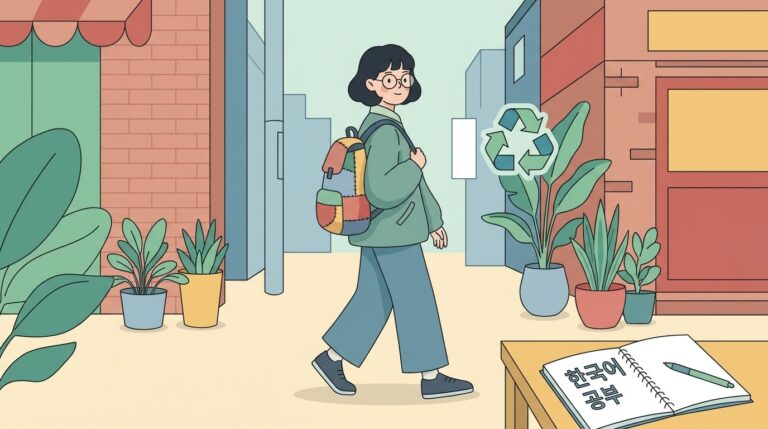
Shop Green in Seoul: How to Buy Upcycled Products in Korean Like a Conscious Local
안녕하세요! Welcome back to another edition of Daily Hangul, your premium guide to mastering not just the Korean language, but the heartbeat of contemporary Korean lifestyle. I’m your senior editor and cultural navigator.
Have you ever walked through the ultra-hip streets of Seongsu-dong (성수동) and noticed those sleek bags made from old Hanriver tarps or military tents? Or perhaps you’ve watched K-dramas where characters passionately sort their recyclables like it’s a competitive sport? In Korea, eco-consciousness is no longer a niche hobby—it is a major cultural movement.
However, many intermediate learners (B2 level) struggle when they want to shop ethically. They know the basic word for trash (쓰레기 – sseu-re-gi) and recycling (재활용 – jae-hwal-yong), but using these words in a boutique can sound accidentally rude or clumsy. You wouldn’t want to point at a gorgeous $100 upcycled bag and ask, “Is this made of trash?”
Today, we are going to learn how to express your eco-friendly values in natural, sophisticated Korean, allowing you to connect deeply with Seoul’s thriving green creators.
Phase 2: Deep Dive into 3 Core Green Expressions
To sound like a conscious consumer in Korea, you need to move past beginner textbook vocabulary. Here are three key expressions that will elevate your shopping game.
1. 이거 새활용 제품이에요? (Is this an upcycled product?)
- Pronunciation: I-geo sae-hwal-yong je-pum-i-e-yo?
- Sound-alike guide: “Ee-gaw sah-hwal-yong jay-pum-ee-eh-yo?”
- Meaning:
- Literal: “Is this a new-utilization product?”
- Real-world Nuance: “Is this an upcycled product?”
- K-Culture Moment: In modern K-Beauty and fashion spaces, the word 새활용 (sae-hwal-yong) has largely replaced the English loanword “upcycling” in local campaigns. It’s a beautiful portmanteau of 새 (new) and 재활용 (recycling).
- Editor’s Insight: If you ask “이거 재활용 제품이에요?” (Is this recycled?), it sounds like the item is made of processed paper or plastic pellets. By using 새활용, you acknowledge the creative, artistic value of turning discarded materials into something highly aesthetic.
- Situation Spectrum:
- Casual (Friends): ✅ 이거 새활용 제품이야?
- Semi-formal (Boutique Clerks): ✅ 이거 새활용 제품이에요?
- Formal (Business/Presentations): ✅ 이것은 새활용 제품입니다.
- — Think About It: Notice how Korean blends pure Korean words (새) with Sino-Korean words (활용 – utilization) to create trendy neologisms. How does your language distinctively separate “recycling” from “upcycling”?
2. 요즘 가치소비를 하려고 노력 중이에요. (I’m trying to practice value-based consumption these days.)
- Pronunciation: Yo-jeum ga-chi-so-bi-reul ha-ryeo-go no-ryeok jung-i-e-yo.
- Sound-alike guide: “Yo-jeum gah-chee-so-bee-reul ha-ryaw-go no-ryawk joong-ee-eh-yo.”
- Meaning:
- Literal: “These days, I am in the middle of trying to do value-spending.”
- Real-world Nuance: “I am trying to practice ethical/conscious shopping lately.”
- K-Culture Moment: You will hear this phrase constantly on Korean lifestyle vlogs and celebrity interviews. Gen Z and Millennials in Korea use 가치소비 (ga-chi-so-bi) to describe buying products that align with their personal, social, and environmental values.
- Editor’s Insight: This is a very sophisticated phrase. Saying this to a local shop owner instantly communicates that you aren’t just looking for cheap souvenirs, but that you support their environmental mission.
- Situation Spectrum:
- Casual: ✅ 나 요즘 가치소비 하려고 노력 중이야.
- Semi-formal: ✅ 요즘 가치소비를 하려고 노력 중이에요.
- Formal: ☑ᄀ (Slightly too personal for formal speeches; instead use: 가치소비를 지향합니다 – I aim for value consumption.)
3. 쓸모없던 것의 아름다운 재탄생이네요! (It’s a beautiful rebirth of something that was once useless!)
- Pronunciation: Sseul-mo-eop-deon geot-ui a-reum-da-un jae-tan-saeng-i-ne-yo!
- Sound-alike guide: “Sseul-mo-up-dun gut-ui ah-reum-da-oon jay-tahn-sang-ee-neh-yo!”
- Meaning:
- Literal: “It is the beautiful rebirth of a useless thing!”
- Real-world Nuance: “What a stunning way to give discarded materials a second life!”
- K-Culture Moment: This is the ultimate compliment you can give to an upcycling designer in places like Seongsu-dong or Insadong. It shows deep artistic appreciation.
- Editor’s Insight: The structure ~던 것 (-deon geot) refers to a past state that has now changed. It highlights the transformation process of the material.
- Situation Spectrum:
- Casual: ✅ 쓸모없던 것의 아름다운 재탄생이네!
- Semi-formal: ✅ 쓸모없던 것의 아름다운 재탄생이네요!
- Formal: ☑ᄀ (Usually expressed with exclamation in casual/semi-formal settings)
Phase 3: Textbook Korean vs. Real Korean
Let’s compare what traditional classrooms teach you versus how modern eco-conscious Koreans actually talk.
Situation 1: Explaining what your upcycled item is made of
- ‖ Textbook Korean: 이 가방은 쓰레기로 만들어졌습니다. (I ga-bang-eun sseu-re-gi-ro man-deul-eo-jyeot-seup-ni-da.)
- Why it’s awkward: It literally translates to “This bag is made of trash.” It sounds dirty, unappealing, and overly clinical.
- ᄉ Real Korean: 이 가방은 버려지는 원단을 새활용한 거예요. (I ga-bang-eun beor-yeo-ji-neun won-dan-eul sae-hwal-yong-han geo-ye-yo.)
- Why it’s better: “This bag is upcycled from discarded fabrics.” It focuses on the specific material (원단 – fabric) and uses the elegant verb 새활용하다.
Situation 2: DECLINING a plastic bag politely
- ‖ Textbook Korean: 비닐봉지를 원하지 않습니다. (Bi-nil-bong-ji-reul won-ha-ji ans-seup-ni-da.)
- Why it’s awkward: “I do not desire a plastic bag.” It sounds robotic, aggressive, and overly formal.
- ᄉ Real Korean: 봉투는 괜찮아요. 장바구니 있어요. (Bong-tu-neun gwen-chan-a-yo. Jang-ba-gu-ni is-seo-yo.)
- Why it’s better: “I’m fine without a bag. I have a shopping tote.” It flows naturally and politely declines while giving a constructive reason.
Phase 4: K-Culture Deep Dive & Non-verbal Manners
4-1. The Body Language of Conscious Shopping
When shopping in Korea’s indie eco-shops, how you handle items matters.
* The Two-Handed Appreciation: Upcycled products in Korea are often regarded as semi-artworks because each piece has a unique pattern (e.g., different sections of a billboard). When inspecting them, pick them up gently with both hands, especially if the creator or shopkeeper is watching. It shows respect for their labor.
* The Card Hand-Off: When paying, always hand over your credit card or cash with both hands, accompanied by a slight, polite nod.
4-2. The “Green Seoul” Cultural Wave
Did you know that K-pop superstars like BTS and BLACKPINK have worn upcycled outfits for global climate summits? BTS famously wore custom suits made from biodegradable fabrics by a Korean upcycling brand at the UN General Assembly.
This top-down influence has made green living highly trendy in Korea. Visiting spots like the Seoul Upcycling Plaza (서울새활용플라자) has become a popular weekend date activity. By mastering these terms, you are tapping directly into the modern Korean lifestyle zeitgeist.
Phase 5: Interactive Roleplay Scenario
Setting: You are inside a beautifully lit, plant-filled upcycling boutique in Seongsu-dong. Soft lo-fi music plays in the background, and the air smells like fresh eucalyptus.
Cast: You (An eco-conscious traveler) and Ji-min (The passionate shop designer).
Ji-min: 가 (Smiling warmly, bowing slightly) 안녕하세요! 편하게 둘러보세요.
        (An-nyeong-ha-se-yo! Pyeon-ha-ge dul-reo-bo-se-yo.)
        "Hello! Please feel free to look around."

You: 가 (Nodding and pointing gently to a rugged, stylish backpack) 감사합니다. 혹시 이거 새활용 제품이에요?
     (Gam-sa-hap-ni-da. Hok-si i-geo sae-hwal-yong je-pum-i-e-yo?)
     "Thank you. By any chance, is this an upcycled product?"

Ji-min: 가 (Eyes lighting up with excitement) 네, 맞아요! 소방관들이 사용하던 폐소방호스로 만든 가방이에요.
        (Ne, ma-ja-yo! So-bang-gwan-deul-i sa-yong-ha-deon pye-so-bang-ho-seu-ro man-deul-gwa-bang-i-e-yo.)
        "Yes, that's right! It's a bag made from discarded fire hoses used by firefighters."

You: 가 (Touching the texture of the bag) 와, 대단하네요! 쓸모없던 것의 아름다운 재탄생이에요.
     (Wa, dae-dan-ha-ne-yo! Sseul-mo-eop-deon geot-ui a-reum-da-un jae-tan-saeng-i-e-yo.)
     "Wow, amazing! It's a beautiful rebirth of something that was useless."

Ji-min: 가 (Grinning widely) 알아봐 주셔서 정말 기뻐요! 소방관분들을 지원하는 데 수익금의 일부가 쓰여요.
        (Ar-a-bwa ju-shyeo-seo jeong-mal gi-ppeo-yo! So-bang-gwan-bun-deul-eul ji-won-ha-neun de su-ik-geum-ui il-bu-ga sseu-yeo-yo.)
        "I'm so glad you recognize that! A portion of the proceeds goes to supporting firefighters."

You: 가 (Reaching for your wallet) 너무 멋지네요. 저 요즘 가치소비를 하려고 노력 중이거든요. 이걸로 살게요!
     (Neo-mu meot-ji-ne-yo. Jeo yo-jeum ga-chi-so-bi-reul ha-ryeo-go no-ryeok jung-i-geon-deun-yo. I-geol-ro sal-ge-yo!)
     "That is so cool. I'm actually trying to practice value-based consumption these days. I'll take this one!"
가 Decision Point: The Checkout
Ji-min asks: “봉투에 넣어드릴까요?” (Bong-tu-e neo-eo-deu-ril-kka-yo? / Should I put it in a bag for you?)
- A: “네, 쓰레기 봉투에 넣어주세요.” (Ne, sseu-re-gi bong-tu-e neo-eo-ju-se-yo.)
- ☑ᄀ Risk Choice: You just asked her to put your beautiful new bag into a “trash bag” (garbage bag). Super awkward!
- B: “아니요, 괜찮아요. 장바구니가 있어서 그냥 가져갈게요.” (A-ni-yo, gwen-chan-a-yo. Jang-ba-gu-ni-ga is-seo-seo geu-nyang ga-jyeo-gal-ge-yo.)
- ✅ Best Choice: Polite, natural, and proves you are practicing the “value-based consumption” you just boasted about!
- C: “봉투는 절대 싫어요!” (Bong-tu-neun jeol-dae sil-heo-yo!)
- ☑ᄀ Harsh Choice: “I absolutely hate bags!” Too aggressive. Korean politeness favors softer declines.
Phase 6: 10-Second Shadowing Drill
Let’s add some emotional soul to your speaking. Practice pausing at the slashes / and match the emotional guide in the brackets!
- [ᄉ Amazed and Inspired]
- “와! / 진짜 힙하다! / 이게 새활용 / 제품이라니 / 안 믿겨요!”
- (Wa! / Jin-ja hip-ha-da! / I-ge sae-hwal-yong / je-pum-i-ra-ni / an mit-gyeo-yo!)
- [ᄉ Soft and Determined]
- “조금 비싸도 / 지구한테 / 덜 미안하니까 / 가치소비 할래요!”
- (Jo-geum bi-ssa-do / ji-gu-han-te / deol mi-an-ha-ni-kka / ga-chi-so-bi hal-lae-yo!)
Phase 7: K-Culture Mini-Dictionary
| Word | Romanization | Cultural Insight |
|---|---|---|
| 새활용 | Sae-hwal-yong | The native Korean equivalent of “upcycling.” It carries a highly positive, trendy design connotation. |
| 가치소비 | Ga-chi-so-bi | Value consumption. Reflects the modern Korean social trend of boycotting unethical brands and supporting eco-conscious, local creators. |
| 용기내 챌린지 | Yong-gi-nae chael-rin-ji | A double-meaning pun campaign. 용기 means both “courage” and “container.” The campaign encourages people to “bring their own containers” to restaurants instead of using single-use plastics. |
| 플로깅 | Peul-lo-ging | Plogging (jogging + picking up trash). Very popular weekend group activity along the Han River. |
Phase 8: Traveler’s Survival Kit
If you are visiting a market or eco-store in Korea tomorrow, keep these three phrases handy:
- 이거 어떤 재료로 만들었어요? (I-geo eo-tteon jae-ryo-ro man-deul-eot-seo-yo?)
- “What materials was this made from?”
- 포장은 최소한으로 해주세요. (Po-jang-eun choe-so-han-eu-ro hae-ju-se-yo.)
- “Please keep packaging to a minimum.”
- 영수증은 안 주셔도 돼요. (Yeong-su-jeung-eun an ju-shyeo-do dwae-yo.)
- “You don’t need to give me a receipt.” (Many stores now send digital receipts to save paper).
ᄒ Editor’s Travel Note:
When looking for trendy zero-waste or upcycling shops in Seoul, do not search on Google Maps (which has limited database updates in Korea). Instead, search for “제로웨이스트숍” (Zero Waste Shop) or “새활용” directly on the Naver Map App, which is the most reliable navigation tool used by locals.
Phase 9: Deep Thoughts — “Going a Step Deeper”
Korea underwent incredibly rapid economic development, transitioning from a war-torn nation to a technological giant in mere decades. With this rapid growth came massive consumption. However, the collective mindset of Korean society has pivoted remarkably fast toward environmental preservation. Korea now has some of the strictest food waste and plastic sorting laws in the world.
This collective drive stems from a cultural concept of shared community space. When you practice 가치소비 (value-based consumption) in Korea, you are not just making a personal statement; you are participating in a communal effort to protect the shared domestic landscape.
ᄋ Your Turn: how does your country’s culture approach upcycled or recycled products? Is it seen as a hip lifestyle choice like in Korea, or is it still developing? Let us know in the comments below!
Phase 10: FAQ & Common Mistakes
Q: Can I use the English word “Upcycling” (업사이클링) in Korea?
A: Yes! Most young Koreans and boutique owners understand 업사이클링 (eop-sa-i-kleung). However, using the local term 새활용 (sae-hwal-yong) shows a much deeper level of language proficiency and instantly warms up the conversation.
Q: Is upcycled fashion considered expensive in Korea?
A: Generally, yes. Because upcycling requires manual labor (collecting, washing, cutting, and sewing unique materials), items are priced as designer goods. Asking for a discount (깎아주세요) on upcycled items is considered bad etiquette.
Q: How do I tell a clerk I brought my own shopping bag?
A: Simply show your bag and say: “개인 장바구니 있어요!” (Gae-in jang-ba-gu-ni is-seo-yo! – “I have a personal shopping bag!”).
ᄒ Common Mistakes Warning:
- Mistake: Calling an upcycled bag a “쓰레기 가방” (Trash bag).
- Correction: Use “새활용 가방” (Upcycled bag) or “친환경 가방” (Eco-friendly bag).
- Mistake: Declining a receipt by saying “영수증 버려주세요” (Throw away my receipt).
- Correction: Say “영수증 괜찮아요” (I’m fine without a receipt) to prevent them from printing it in the first place.
Phase 11: Action Missions
- ᄋ Bronze (The Mirror Challenge): Stand in front of a mirror and practice saying: “요즘 가치소비를 하려고 노력 중이에요.” three times with a proud, confident smile.
- ᄋ Silver (The Social Media Challenge): Take a picture of an item you own that was upcycled or reused. Post it on Instagram or your social channel with the hashtag #가치소비 and #새활용.
- ᄋ Gold (The Real-world Seoul Mission): Next time you visit an indie boutique in Seongsu-dong, Insadong, or Hongdae, ask the clerk: “이거 혹시 새활용 제품이에요?” and see their eyes light up!
Phase 12: Interactive Quiz
Test your eco-Korean skills!
1. Which term refers specifically to “Upcycling” rather than raw recycling?
- A) 재활용
- B) 새활용
- C) 분리배출
2. Fill in the blank: “요즘 ________를 하려고 노력 중이에요.” (I’m trying to practice value-based consumption these days.)
- A) 과소비 (Over-spending)
- B) 가치소비 (Value-based consumption)
- C) 무지출 (Zero-spending)
3. True or False: Declining a plastic bag by saying “봉투는 절대 싫어요!” is the most polite way to show you care about the planet.
- A) True
- B) False
ᄒ Click here to reveal the Answers & Explanations!
- Answer: B (새활용). While A (재활용) means basic recycling, B is the beautiful term for creative upcycling.
- Answer: B (가치소비). Value-based ethical consumption. A is overspending, and C is a trend of spending absolutely zero cash.
- Answer: B (False). It is way too aggressive! It is much more polite to say “봉투는 괜찮아요” (I’m fine without a bag).







