

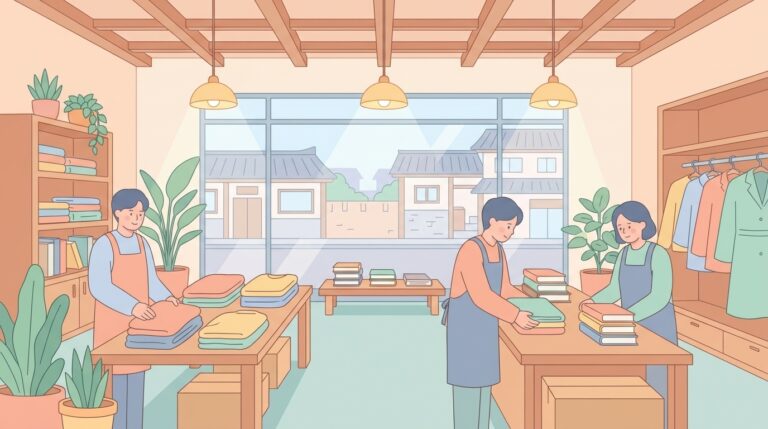
Giving Back in Seoul: Master the Art of Donating and Sharing at Beautiful Store
안녕하세요! Welcome back to another cozy session with Daily Hangul. I’m your chief editor and senior tutor, your trusted guide to not just speaking Korean, but truly living and feeling the culture like a local.
If you have lived in Korea for a while, or if you’ve been binge-watching slice-of-life K-dramas like Hometown Cha-Cha-Cha or Our Blues, you have probably noticed something beautiful: Koreans love the concept of 나눔 (nanum – sharing). Whether it is sharing a massive plate of side dishes or setting up weekend neighborhood flea markets, community warmth (정 – Jeong) is the invisible thread that ties Korean society together.
But here is a common hurdle: many advanced (C1) learners who want to do something meaningful—like donating their gently used clothes, books, or K-pop collections before moving apartments—freeze when they step into a local charity shop like 아름다운 가게 (Aremdaun Gage – Beautiful Store). You might wonder: “Do I say I am throwing this away? Or am I gifting it? What is the polite, advanced way to explain my charitable intentions without sounding like I’m just dumping trash?”
Today, we are going to dive deep into the sophisticated vocabulary of volunteering and donation, explore the legendary 아나바다 (Anabada) movement, and arm you with the linguistic tools to navigate a Korean sharing market with confidence and grace. Let’s get started!
Phase 2: Deep-Dive into 3 Essential Expressions
To sound like a culturally fluent C1 speaker, you must move beyond basic verbs like 주다 (juda – to give) or 버리다 (beorida – to throw away). Here are three highly nuanced expressions used in the world of Korean philanthropy.
1. 기증하다 (gijeong-hada)
- Pronunciation: [gijeong-hada] / Sounds like “gi-jung-ha-da”
- Meaning: To donate items/goods formally (as opposed to 기부하다 [gibu-hada], which usually refers to donating money or assets).
- K-Culture Moment: You will often see this on news segments or reality shows like I Live Alone when celebrities package their cherished items for charity auctions or local community centers.
- Editor’s Insight: Saying “이거 기증하려고요” (I’d like to donate this) immediately signals to the store coordinator that you understand the formal, respectful nature of giving secondhand goods. It elevates your intention from “getting rid of clutter” to “offering a gift.”
- Situation Spectrum:
- Friends/Casual: ⚠️ Too formal; use “나눔하다” (to share) instead.
- Colleagues/Semi-formal: ✅
- Superiors/Formal: ✅
- 🤔 Think About It: Why does Korean distinguish so sharply between donating money (기부) and donating physical objects (기증)? Reflect on how your native language categorizes these acts of charity.
2. 수익금이 좋은 곳에 쓰이다 (su-ik-geumi joeun gose sseu-i-da)
- Pronunciation: [su-ik-geumi joeun gose sseu-i-da] / Sounds like “soo-eek-geumi jo-eun go-seh ssee-ee-da”
- Meaning: “The proceeds are used for a good cause/place.”
- K-Culture Moment: This phrase is proudly displayed on banners at weekend 나눔 장터 (nanum jangteo – sharing markets) and charity bazaars organized by local ward offices (구청).
- Editor’s Insight: This passive construction (쓰이다 – to be used) is highly elegant. Instead of focusing on who is spending the money, it focuses on the beautiful destination of the funds. Using this phrase shows deep respect for the organization’s mission.
- Situation Spectrum:
- Friends/Casual: ✅
- Colleagues/Semi-formal: ✅
- Superiors/Formal: ✅
- 🤔 Think About It: Notice the phrase “좋은 곳” (a good place). In Korean, abstract warmth is often localized as a “place” (곳). How does your culture linguistically frame the destination of charity funds?
3. 나눔을 실천하다 (nanumeul silcheon-hada)
- Pronunciation: [nanumeul silcheon-hada] / Sounds like “nah-num-eul sheel-chun-ha-da”
- Meaning: To put the act of sharing into practice.
- K-Culture Moment: This is a favorite phrase of K-pop idols when they do annual winter coal-briquette delivery volunteering (연탄 봉사) or donate their concert profits.
- Editor’s Insight: 실천 (silcheon) means turning thoughts or philosophies into concrete action. When you use this term, you are framing donation not as a one-time chore, but as an active lifestyle choice.
- Situation Spectrum:
- Friends/Casual: ⚠️ Slightly poetic/grand for casual chats.
- Colleagues/Semi-formal: ✅
- Superiors/Formal: ✅
Phase 3: Textbook Korean vs. Real-World Korean
Let’s compare the sterile sentences found in standard textbooks with the vibrant, natural expressions used by native Koreans standing at the donation counter.
Situation 1: Offering your box of donations at the counter
- 📖 Textbook Korean: “이 물건들을 기증하고 싶습니다.” (I want to donate these items.)
- 🗣️ Real-World Korean: “안 쓰던 물건들인데, 기증 동참하려고 몇 개 가져와 봤어요.” (These are things I don’t use anymore, so I brought a few to participate in the donation drive.)
- 💡 Why the difference? Saying “기증 동참하다” (to join/participate in donating) sounds incredibly warm and cooperative. It frames you as a partner in their social mission rather than just a customer dropping off cargo.
Situation 2: Inquiring about where the money goes
- 📖 Textbook Korean: “이 상점의 이익은 어디에 사용됩니까?” (Where is the profit of this shop used?)
- 🗣️ Real-World Korean: “혹시 판매 수익금은 어디로 후원되나요?” (By any chance, where are the sales proceeds sponsored/donated to?)
- 💡 Why the difference? “이익” (profit) can sound cold and overly commercial. Using 판매 수익금 (sales proceeds) paired with 후원되다 (to be sponsored/donated) sounds vastly more professional, soft, and appropriate for a non-profit context.
Phase 4: K-Culture Deep Dive & Non-Verbal Manners
4-1. Nunchi (눈치) and Body Language at the Donation Counter
When you donate items at 아름다운 가게 or participate in a 나눔 장터, your physical presence speaks louder than your words.
* The Two-Handed Hand-off (두 손으로 전달하기): When handing over your donation box, always support the bottom of the box with both hands and bow your head slightly. This shows that you value the items you are giving away, respecting the future owner.
* Humility in Inspection: The volunteer (활동가) will inspect your items to ensure they are resellable (no stains, working electronics). Stand by patiently. If they point out an item they cannot accept, do not get defensive. Simply say with a soft smile: “아, 확인해 주셔서 감사합니다. 이건 제가 다시 가져갈게요.” (Ah, thank you for checking. I’ll take this back with me.)
4-2. The Cultural DNA of “아나바다” (Anabada)
To truly understand Korean thrift and donation culture, you must learn about the 아나바다 운동 (Anabada Movement).
아 - 아껴 쓰고 (Save/Use sparingly)
나 - 나눠 쓰고 (Share/Donate)
바 - 바꿔 쓰고 (Exchange/Barter)
다 - 다시 쓰기 (Reuse/Recycle)
Originally launched by the Korean government during the painful 1997 IMF Asian Financial Crisis to encourage national resource conservation, Anabada has evolved into a modern, trendy eco-lifestyle. Today, it lives on through massive neighborhood flea markets, localized apps, and beautifully curated charity shops. When you donate, you aren’t just recycling; you are participating in a historical nationwide movement of solidarity.
Phase 5: Interactive Roleplay Scenario
Setting: It is a crisp Saturday afternoon in Insadong. You are standing inside the cozy Beautiful Store (아름다운 가게) Anguk Branch. The shop is filled with the warm scent of recycled paper and the soft hum of retro indie music playing in the background. You are holding a sturdy shopping bag filled with pristine Korean language textbooks and winter coats.
Cast:
- Ji-young (지영): A kind-faced, middle-aged volunteer wearing a green apron, busy sorting books behind the counter.
- You (Alex): A culturally savvy expat looking to practice “나눔” before your upcoming move.
Dialogue:
- Ji-young: 🎭 (Looks up with a bright, welcoming smile) “안녕하세요! 어서 오세요. 혹시 오늘 구경하러 오셨나요, 아니면 기증하러 오셨나요?”
- You: 🎭 (Smiling warmly, stepping closer to the counter) “안녕하세요! 저 오늘 물건 기증 좀 하려고 가져왔거든요. 처음이라 어떻게 해야 하는지 여쭤보려고요.”
- Ji-young: 🎭 (Clapping her hands softly in appreciation) “아, 정말요? 너무 감사하죠! 어떤 물건들을 가져오셨어요?”
- You: 🎭 (Lifting the bag gently with both hands) “여기 깨끗하게 입었던 겨울 아우터 몇 벌이랑, 공부할 때 보던 깨끗한 책들이에요. 상태가 다 괜찮아서 좋은 분들께 전달되면 좋겠어요.”
- Ji-young: 🎭 (Taking the bag gently) “우와, 책들이 정말 새것 같네요! 옷도 드라이클리닝까지 다 해서 가져오셨나 봐요. 세심하게 신경 써 주셔서 정말 감동이에요.”
- You: 🎭 (Blushing slightly with a humble wave of your hand) “아니에요, 당연히 깨끗하게 해서 드려야죠. 작은 보탬이라도 되었으면 좋겠네요.”
- Ji-young: 🎭 (Nodding enthusiastically) “그럼요! 저희 매장에서는 이 판매 수익금을 전부 어려운 이웃이나 환경 보호 단체에 후원하고 있어요. 아주 큰 도움이 됩니다.”
- You: 🎭 (Beaming) “아, 수익금이 그렇게 좋은 곳에 쓰인다니 가져오길 정말 잘했다는 생각이 드네요.”
- Ji-young: 🎭 (Typing quickly on her tablet) “자, 기증 등록을 도와드릴게요. 혹시 소득공제용 기부금 영수증이 필요하신가요?”
- You: 🎭 (Pondering the option…)
🔀 Decision Point: What do you say to Ji-young?
- Option A: “아뇨, 저는 외국인이라 소득공제 같은 건 전혀 안 주셔도 괜찮아요.”
- Option B: “아, 외국인도 기부금 영수증 발급이 가능한가요? 가능하다면 연말정산용으로 신청하고 싶어요.”
- Option C: “귀찮은데 영수증은 그냥 버려 주세요.”
💡 The Editor’s Verdict:
- Best Choice: Option B! Asking politely about eligibility for tax deduction (연말정산 / 소득공제) is highly sophisticated C1 behavior. Foreigners who pay taxes in Korea are indeed eligible for tax benefits on donations! Ji-young will be deeply impressed by your understanding of the local administrative system.
- Risky/Awkward Choice: Option A. While polite, it falsely assumes foreigners can’t get tax benefits.
- Worst Choice: Option C. Saying “귀찮은데” (It’s a hassle) sounds dismissive and ruins the beautiful, warm atmosphere you just built with Ji-young.
Phase 6: 10-Second Emotional Shadowing Drill
To make your Korean sound authentic, you must inject emotion and rhythm. Practice pausing at the / marks and match the emotional cues in the brackets!
- [🥺 Softly and sincerely – pouring out your heart]
“이게 / 제 소중한 추억이 담긴 물건인데, / 좋은 분께 / 전달되면 좋겠어요.”
(This is an item filled with my precious memories; I hope it gets delivered to a wonderful person.) -
[😊 Brightly and warmly – full of community spirit]
“작은 보탬이지만, / 꼭 필요한 곳에 / 쓰이길 바랍니다!”
(It’s a small contribution, but I hope it is used exactly where it is needed!)
Phase 7: K-Culture Mini Dictionary
| Word (Korean/Romanization) | English Translation | Cultural Context & Usage |
|---|---|---|
| 아나바다 (Anabada) | Save, Share, Swap, Reuse | The classic thrift movement in Korea that defined sustainability long before it became a global trend. |
| 활동가 (Hwaldong-ga) | Activist / Volunteer | In organizations like Beautiful Store, volunteer staff are respectfully referred to as “활동가” rather than just “알바” (part-timers). |
| 기부금 영수증 (Gibugeum Yeongsujeung) | Donation Receipt | A crucial document for annual tax adjustments (연말정산) in Korea. |
| 착한 소비 (Chakhan Sobi) | Ethical/Good Consumption | The act of buying items from social enterprises, knowing the money supports marginalized communities. |
Phase 8: Traveler’s Survival Kit
Even if you are just visiting Korea for a short time, you can still experience this warm culture! Here are 3 quick-fire phrases to use at any outdoor flea market or sharing bazaar.
Survival Phrases
- “이거 직접 만드신 거예요?” (Igeo jikjeop mandusin geoyeyo?)
- Tip: Great for artisan charity booths. “Did you make this yourself?” It strikes up a lovely conversation.
- “좋은 일 하시는 거라 잔돈은 안 주셔도 돼요!” (Joeun il hasineun geora jandon-eun an jusyeodo dwaeyo!)
- Tip: When buying a small 1,000 KRW item at a charity market, tell them: “Since you are doing good work, you don’t need to give me back the change!”
- “수익금 기부하시는 매장이 맞나요?” (Su-ik-geum gibuhasineun maejang-i mannayo?)
- Tip: “Is this shop one that donates its proceeds?” Perfect when seeking out ethical shops in Seoul.
📌 Editor’s Travel Note: To locate the nearest charity shop, open your Naver Map App and search for “아름다운가게” (Beautiful Store) or “나눔장터” (Sharing Market). Doing so will guide you directly to authentic neighborhood hubs far away from typical tourist traps!
Phase 9: Deep Thought — “한 발 더 깊이” (A Step Deeper)
In our fast-paced, hyper-digitalized world, South Korea has gained a reputation for being ultra-modern. Yet, underneath the neon lights of Seoul lies a deeply rooted agrarian philosophy of collective survival. For centuries, Korean villages relied on 품앗이 (Pumasi – mutual labor sharing) and 두레 (Dure – cooperative farming circles).
When the economic foundations shook in 1997, Koreans didn’t turn inward; they lined up for miles to donate their personal gold jewelry to save the national economy. Today’s Beautiful Store and weekend sharing markets are simply the modern digital-age iterations of these ancient communal safety nets. It teaches us that sharing isn’t merely an act of pity or noblesse oblige; it is an act of communal preservation.
💬 Your Turn: How does your home country view the act of secondhand donation? Is it seen purely as recycling, or is there a deeper communal philosophy attached to it? Let us know in the comments below!
Phase 10: FAQ & Common Mistakes
Q: Can foreigners receive tax benefits (소득공제) for donating to Korean charities?
A: Yes! If you are a registered foreign resident paying income tax in Korea, you can input your Foreigner Registration Number (외국인등록번호) when donating. The donation record will link directly to your National Tax Service (국세청) Hometax profile for year-end tax adjustments.
Q: What kinds of items are NOT accepted at Beautiful Store?
A: Generally, items that cannot be sold immediately. This includes heavily stained or torn clothing, opened cosmetics, used bedding, broken electronics, and school textbooks with heavy writing/underlining in pen.
Q: Can I request a home pickup for my donation box?
A: Yes, absolutely! If you have more than 3 large boxes of items, you can apply for a free home courier collection through the official Beautiful Store Website.
🚨 Common Mistakes Warning Board
- Don’t say: “이 쓰레기 기부하고 싶어요.” (I want to donate this trash.)
- Correction: Even if you are joking, calling your donations “쓰레기” (trash) is highly offensive to the volunteers. Use “안 쓰는 물건” (items I don’t use) instead.
- Don’t say: “얼마에 팔 거예요?” (How much are you going to sell this for?)
- Correction: Asking for the specific resale price of your donated goods at the counter is considered impolite. Trust the shop’s pricing team to value it fairly.
Phase 11: Action Mission & Participation
- 🥉 Bronze (Room Challenge): Sort through your wardrobe today. Find three items you no longer wear but are in pristine condition. Take a picture of them and write a caption in Korean practicing: “안 쓰는 옷들인데, 조만간 기증하러 가야겠어요!”
- 🥈 Silver (Network Challenge): Share your photo on Instagram or Twitter, tag @DailyHangul, and use the hashtag #아나바다실천 to show your global green initiative.
- 🥇 Gold (Real-World Challenge): Visit a local Beautiful Store this week. Buy a book or a mug, or donate your sorted items. Use at least one phrase we learned today with the 활동가 (volunteer) at the counter!
Phase 12: Interactive Quiz Challenge
Test your cultural and linguistic savvy below!
🔍 Q1. Scenario: Which of these items is perfect for donating to a sharing market?
- A) A vintage winter coat that you only wore twice, neatly dry-cleaned.
- B) A frying pan with a heavily scratched Teflon coating.
- C) A high school workbook filled with pencil notes and graded answers.
Answer: A
Explanation: Donated goods must be in immediate resellable condition. Scratched cookware or written-on workbooks cannot be purchased by others.
✍️ Q2. Fill-in-the-blank: Fill in the missing verb to make a sophisticated sentence.
“작은 정성이지만 이 판매
수익금이 사회의
___________ 곳에 쓰였으면 좋겠습니다.”
Answer: 좋은 (joeun – good)
Explanation: “수익금이 좋은 곳에 쓰이다” is the classic, polite formula for wishing that the proceeds are used for a warm, noble, and altruistic cause.
정답 확인! (True or False Culture Quiz)
Q: The “아나바다” movement was created in 2020 to tackle COVID-19 economic hardships.
- Answer: False!
Explanation: The movement was actually born in 1997 during the IMF Asian Financial Crisis, showcasing Korea’s long-standing resilient communal spirit.







