

Say Goodbye to Freezing: 3 Simple Words to Keep Your Korean Conversations Flowing
Phase 1: Empathy (Your Korean Journey Starts Here!)
안녕하세요! (An-nyeong-ha-se-yo!) Hello there! I’m your senior editor and friendly neighborhood Korean tutor from Daily Hangul.
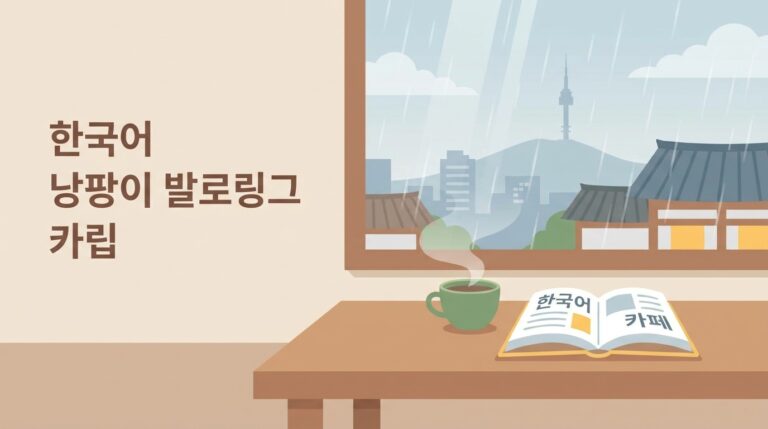
Picture this: You are sitting in a charming, hidden cafe in Hapjeong, Seoul. The rain is softly tapping on the window. You’ve been studying Korean diligently for months. Suddenly, a friendly local sits next to you, points at your book, and asks:
“한국어 공부해요? 한국어 진짜 잘하시네요!” (Are you studying Korean? Your Korean is so good!)
Your heart races. Your palms sweat. You want to reply, but your brain completely freezes. Every grammar rule you learned evaporates. You end up nodding awkwardly and looking down at your drink.
Does this sound familiar?
If you have ever felt paralyzed at the thought of speaking Korean in public, please know this: you are not alone, and it is absolutely not your fault.
Many of my students—including Sarah, an exchange student from Chicago—struggled with this exact “Korean Freeze.” She knew hundreds of vocabulary words but couldn’t hold a conversation for more than five seconds. The secret to breaking this barrier isn’t memorizing more complex grammar; it is mastering the art of the conversational bridge.
By the end of this guide, you will possess the exact tools to keep any Korean conversation alive, naturally and confidently, even if you only know a handful of words!
Phase 2: The “Magic Three” Conversational Bridges
To keep a conversation going, you don’t need long sentences. You just need natural reactions. In Korea, being a good listener who reacts enthusiastically is highly valued. Here are the three most powerful words to keep your Korean friend talking.
1. 진짜요? (Jinjja-yo?)
- Pronunciation: [jin-jja-yo] / Sound-alike: “Jean-ja-yo” (with a soft ‘j’ sound like in ‘jeans’)
- Meaning: “Really?” or “Is that so?”
- K-Culture Moment: Think of any K-Drama where the female lead hears a surprising piece of juicy gossip over a hot bowl of Ramyun (라면). She opens her eyes wide and gasps, “진짜요?!”
- Editor’s Insight: This is the ultimate conversation saver. When you don’t know what to say next, raising your pitch slightly at the end (진짜요?⤴) shows you are deeply engaged in what the other person is saying. It encourages them to keep sharing.
- Situation Spectrum:
- Friends & Casual settings: ✅ (You can drop the ‘요’ and say 진짜? [jin-jja] to close friends!)
- Workplace / Semi-formal: ✅
- Formal / Elderly: ⚠️ (Use 정말이십니까? [Jeong-mal-i-sip-ni-ka] or 그렇습니까? [Geu-reot-seup-ni-ka] instead)
- 🤔 Think About It: In many Western cultures, asking “Really?” too often might make you sound skeptical. In Korea, however, 진짜요? is a sign of warm interest and empathy. How does your native culture express active listening?
2. 맞아요! (Maj-ayo!)
- Pronunciation: [ma-ja-yo] / Sound-alike: “Mah-jah-yo” (rhymes with “plaza-yo”)
- Meaning: “That’s right!” or “Exactly!”
- K-Culture Moment: Watch any Korean variety show like Running Man. When someone makes an excellent point, all the cast members nod vigorously in unison, clapping their hands and shouting, “맞아, 맞아!” (Ma-ja, ma-ja!)
- Editor’s Insight: Agreeing with someone is the fastest way to build friendship (Jeong, 정) in Korea. Saying 맞아요! with a bright smile makes you instantly likable. It shows you are on the same page.
-
Situation Spectrum:
- Friends & Casual settings: ✅ (Use 맞아! [ma-ja] with close friends)
- Workplace / Semi-formal: ✅
- Formal / Elderly: ⚠️ (Use 맞습니다 [mat-seup-ni-da] for high respect)
- 🤔 Think About It: Korean social harmony (called Hwa, 화) values agreement and unity. By using 맞아요, you are participating in this beautiful cultural dance of matching the other person’s energy.
3. 잘 모르겠어요. (Jal mo-reu-ges-seo-yo.)
- Pronunciation: [jal mo-reu-get-seo-yo] / Sound-alike: “Jahl moh-roo-get-so-yo”
- Meaning: “I’m not quite sure” or “I don’t really know.”
- K-Culture Moment: When a lost tourist asks an idol on a reality travel show for directions, they often scratch their head politely and say, “아, 죄송해요. 저도 잘 모르겠어요…” (Ah, sorry. I don’t really know either…)
- Editor’s Insight: Instead of a cold “I don’t know” (몰라요 [mol-la-yo]), adding 잘 (well) and ~겠~ (softener) makes this phrase sound incredibly polite, gentle, and humble. It protects the feelings of both speakers.
-
Situation Spectrum:
- Friends & Casual settings: ✅ (Use 잘 모르겠어 [jal mo-reu-ges-seo])
- Workplace / Semi-formal: ✅
- Formal / Elderly: ✅ (Perfect for all situations!)
- 🤔 Think About It: Why does Korean have so many ways to soften direct statements? It’s because avoiding direct rejection or abrupt answers is a cornerstone of Korean manners.
Phase 3: Textbook Korean vs. Real-World Korean
When practicing speaking, relying strictly on textbook phrases can make you sound like a robot from the 1990s. Let’s look at how native Koreans actually speak today.
Situation 1: When someone compliments your Korean
- 📖 Textbook Korean: 아닙니다. 아직 멀었습니다. (No, I still have a long way to go.) – Too stiff and overly dramatic!
- 🗣️ Real-World Korean: 감사합니다! 아직 공부하고 있어요~ (Thank you! I am still studying~) – Friendly, polite, and natural.
- 💡 Why the difference? Modern Koreans appreciate humble attitudes, but a simple, happy “Thank you!” followed by a gentle explanation of your learning journey feels much warmer and invites further conversation.
Situation 2: When you want someone to repeat what they said
- 📖 Textbook Korean: 다시 말씀해 주시겠습니까? (Would you please speak again?) – Sounds like you are in a formal court of law!
- 🗣️ Real-World Korean: 죄송해요, 다시 한 번만 말씀해 주세요! (Sorry, could you say that just one more time?) – Polite, easy to understand, and widely used.
- 💡 Why the difference? Adding 한 번만 (just once) softens the request, making it sound like a friendly favor rather than a demanding command.
Phase 4: K-Culture Deep Dive & Non-Verbal Etiquette
Speaking a language is only 50% about the words. The other 50% is about how you move your body and read the room!
4-1. The Magic of 눈치 (Nunchi) and Body Language
In Korea, Nunchi (the art of sensing other people’s feelings and vibes) is everything. When practicing your speaking:
* The Head Tilt and Nod: When listening, tilt your head slightly and nod rhythmically. This shows you are actively paying attention, even if you don’t understand every single word.
* Eye Contact: Avoid intense, unblinking eye contact, as it can sometimes feel confrontational in Korean culture. Instead, make soft, friendly eye contact, occasionally looking slightly down or away when thinking.
4-2. The “Two-Handed” Respect Code
If you are speaking over food or drinks (perhaps enjoying some delicious Tteokbokki at a local spot), always use two hands when passing or receiving items, such as tissues, water, or cups. This simple non-verbal gesture instantly shows that you respect the local culture, making Koreans even more excited to chat with you!
Phase 5: Interactive Roleplay Scenario
Let’s play a game! You are in a beautifully decorated cafe in Hongdae. An indie song by Bolbbalgan4 is playing softly in the background. A friendly Korean student named Minjun (민준) sits next to you and notices your Korean textbook.
- Minjun (민준): [🎭 Pointing at your book with a warm smile] 혹시… 한국어 공부하세요?
(Hok-si… Han-guk-eo gong-bu-ha-se-yo? / By any chance… are you studying Korean?) -
You: [🎭 Smiling, nodding gently] 네! 한국어 공부하고 있어요.
(Ne! Han-guk-eo gong-bu-ha-go is-seo-yo. / Yes! I am studying Korean.) -
Minjun (민준): [🎭 Surprised and impressed] 와, 발음이 정말 좋으시네요!
(Wa, bal-eum-i jeong-mal jo-eu-si-ne-yo! / Wow, your pronunciation is really good!) -
You: [🎭 Laughing softly, waving your hand slightly to be modest]
아니에요, 감사합니다! 아직 잘 못해요.
(A-ni-e-yo, gam-sa-hap-ni-da! A-jik jal mot-hae-yo. / No, thank you! I’m not very good yet.) -
Minjun (민준): [🎭 Nodding encouragingly] 아니에요, 진짜 잘하세요! 한국 여행 좋아하세요?
(A-ni-e-yo, jin-jja jal-ha-se-yo! Han-guk yeo-haeng jo-ah-ha-se-yo? / No, really, you are good! Do you like traveling in Korea?) -
You: [🎭 Eyes lighting up] 네! 한국 여행 진짜 좋아해요. 맛있는 것도 많아요.
(Ne! Han-guk yeo-haeng jin-jja jo-ah-hae-yo. Mat-it-neun geot-do manh-a-yo. / Yes! I really like traveling in Korea. There is also a lot of delicious food.) -
Minjun (민준): [🎭 Curious] 어떤 음식을 제일 좋아해요?
(Eo-tteon eum-sik-eul je-il jo-ah-hae-yo? / What food do you like the most?) -
You: [🎭 Thinking for a second] 저는 떡볶이를 진짜 좋아해요! 매워요, 하지만 맛있어요.
(Jeo-neun tteok-bok-ki-reul jin-jja jo-ah-hae-yo! Mae-wo-yo, ha-ji-man mat-it-seo-yo. / I really like Tteokbokki! It’s spicy, but delicious.) -
Minjun (민준): [🎭 Laughing] 오! 떡볶이를 아시네요! 홍대에 정말 매운 떡볶이 맛집이 있어요. 혹시 매운 거 아주 잘 드세요?
(O! Tteok-bok-ki-reul a-si-ne-yo! Hong-dae-e jeong-mal mae-un tteok-bok-ki mat-jib-i is-seo-yo. Hok-si mae-un geo a-ju jal deu-se-yo? / Oh! You know Tteokbokki! There is a really spicy Tteokbokki place in Hongdae. Do you eat spicy food very well?)
🔀 Decision Point: How do you respond to Minjun?
- Option A: “아니요, 못 먹어요.” (No, I can’t eat it.)
- Option B: “진짜요? 저는 매운 거 잘 모르겠어요… 조금 무서워요!” (Really? I don’t really know about spicy food… I’m a little scared!)
- Option C: “맞아요! 저 매운 음식 잘 먹어요. 도전하고 싶어요!” (Exactly! I eat spicy food well. I want to challenge myself!)
💡 Choices Analysis:
- Best Choice: Option B or C!
- Option B is wonderfully natural! It uses our magic phrases (진짜요?, 잘 모르겠어요) and adds a touch of cute humor (조금 무서워요 – I’m a little scared) that will make Minjun laugh.
- Option C is fantastic if you are a spicy food lover! It shows enthusiasm and adventurous spirit.
- Bad Choice: Option A. While grammatically correct, it is a bit too direct and shuts down the conversation quickly. Try to avoid short “No” answers to keep the friendly vibe going!
Phase 6: 10-Second Emotional Shadowing Drill
Don’t just speak with your voice; speak with your feelings! Practice these emotional expressions out loud. Pay attention to the pause markers (/).
- [😊 Excited & Bright]
- “진짜요? / 대박!”
- Jin-jja-yo? / Dae-bak!
- “Really? / Awesome!”
- [🥺 Modest & Gentle]
- “아니에요~ / 아직 잘 모르겠어요.”
- A-ni-e-yo~ / a-jik jal mo-reu-get-seo-yo.
- “No, not at all~ / I don’t quite know yet.”
- [😤 Confident & Happy]
- “맞아요! / 저도 그렇게 생각해요!”
- Maj-ayo! / Jeo-do geu-reoh-ge saeng-gak-hae-yo!
- “Exactly! / I think so too!”
Phase 7: K-Culture Mini Dictionary
| Word (Hangul + Romanization) | Meaning | Real-World Context & Usage |
|---|---|---|
| 인싸 (In-ssa) | Insider / Social Butterfly | Someone who is popular, active, and makes friends easily. Use it to praise a friendly person! |
| 티키타카 (Tiki-taka) | Conversation Chemistry | Inspired by the fast football passing style. Used when two people have quick, witty, and fun conversational chemistry. |
| 리액션 (Ri-aek-syeon) | Reaction / Active Listening | The art of giving facial expressions and verbal feedback while listening to show respect. |
| 수다 (Su-da) | Casual Chitchat | To chat and gossip with friends over coffee or food. “수다 떨다” means “to have a chat.” |
Phase 8: Traveler’s Survival Kit
If you are traveling in Korea right now, tuck these three lifesavers into your mental pocket!
Survival Expressions Top 3
- 여기요! (Yeo-gi-yo!)
- Meaning: “Over here, please!” (To call a waiter in a restaurant)
- Pro-Tip: Raise your hand slightly. Don’t be shy; in Korea, calling out loud is the standard way to get service!
- 추천해 주세요! (Chu-cheon-hae ju-se-yo!)
- Meaning: “Please recommend something!”
- Pro-Tip: Perfect for cafes or restaurants when you don’t know what is best on the menu.
- 이거 어떻게 해요? (I-geo eo-tteoh-ge hae-yo?)
- Meaning: “How do I do this?”
- Pro-Tip: Use this at subway ticket machines, convenience store self-checkouts, or when renting a bicycle.
📌 Editor’s Travel Note
- Navigation Essential: Google Maps does not work well in Korea due to security laws. Make sure to download the Naver Map App for Android or the Naver Map App for iOS before you land. It is highly accurate and has a full English interface!
- Payment Tip: Korea is almost completely cashless. Always keep a debit card or a T-money transportation card handy. Small street-food stalls might prefer cash, but 99% of cafes only accept card payments.
Phase 9: One Step Deeper — Cultural Reflection
In Western cultures, conversations are often viewed as a tennis match where each player takes turns hitting the ball back and forth with new information. However, in Korea, conversation is more like a musical duet.
Korean conversational structure places a heavy emphasis on nurturing the relationship rather than just exchanging data. This is why active listening reactions (리액션) and modest agreements (맞아요, 진짜요) are so crucial. By showing modesty and matching your partner’s energy, you build trust and comfort (Jeong).
💬 Your Turn: How does this compare to your hometown’s communication style? Do people value direct, fast answers, or do they also appreciate soft agreements and modest reactions? Let me know in the comments below! I read every single one.
Phase 10: FAQ & Common Mistakes (FAQ Schema Optimized)
Q: Is it okay to use “반말” (informal Korean) when I practice speaking with strangers?
A: Generally, No. Even if you are the same age, it is polite to start with 존댓말 (polite language ending in ~요 or ~니다). Using 반말 right away can feel a bit too sudden and occasionally rude. Stick to polite language until you both agree to speak casually!
Q: What should I do if my pronunciation is bad and people don’t understand me?
A: Don’t panic! Koreans love when foreigners make an effort to speak the language. If they don’t understand, simply smile, show them the word on your phone screen, or use a translation app. They will appreciate your effort enormously.
Q: Why do Koreans sometimes nod and say “Ne” (Yes) when I say something negative?
A: In Korean, “네” (Ne) often means “I agree with what you said,” rather than just a simple “Yes.” For example, if you say, “This is not spicy,” and they agree, they might say “Ne” (meaning, “Yes, you are right, it is not spicy”).
🚨 Common Mistakes Tracker
- Mistake 1: Calling an older female server “언니” (Unnie) if you are male, or “누나” (Noona) if you are female.
- Correct Action: Keep it safe and polite by calling them 이모님 (I-mo-nim / Auntie) or simply calling out 사장님! (Sa-jang-nim! / Owner!).
- Mistake 2: Nodding your head without saying anything when someone compliments you.
- Correct Action: Always reply with a bright 감사합니다! (Gam-sa-hap-ni-da! / Thank you!). Modesty is great, but gratitude is better!
- Mistake 3: Speaking too fast to sound natural.
- Correct Action: Slow down! Clear pronunciation is much more beautiful and understandable than rushed, blurry words.
Phase 11: Action Missions
Are you ready to take your Korean speaking to the next level? Here is your weekly challenge!
- 🥉 Bronze (At-Home Challenge): Record a 15-second voice memo on your phone using the three magic expressions (진짜요?, 맞아요!, 잘 모르겠어요) with emotional shadowing. Listen to your own voice and check your pitch!
- 🥈 Silver (Network Challenge): Go to your favorite social media platform or a language exchange app. Write a short post introducing your favorite Korean food using: “저는 [Food Name]을/를 진짜 좋아해요!”
- 🥇 Gold (Real-World Challenge): The next time you visit a Korean restaurant, supermarket, or cafe, look the staff in the eye, smile, and say “감사합니다! 수고하세요!” (Thank you! Keep up the good work!) when leaving.
-
🎮 K-Culture Mission: Watch one episode of a K-Drama or a Korean variety show on YouTube this week. Count how many times you hear the characters say 진짜? or 맞아!. You’ll be surprised by how often they use them!
Phase 12: Interactive Quiz Challenge
1. Match the Vibe!
Which reaction is best when your Korean friend tells you they just bought tickets to a Blackpink concert?
* A) 잘 모르겠어요.
* B) 진짜요?! 대박!
* C) 맞아요.
🔍 Reveal the Answer & Explanation
Correct Answer: B!
Sharing exciting news deserves an enthusiastic “진짜요?! 대박!” (Really?! Awesome!). Saying “잘 모르겠어요” (I don’t know) or “맞아요” (That’s right) would sound indifferent and cool down the fun atmosphere!
2. Fill in the Blank!
Complete the natural response to a compliment:
- Korean Friend: “한국어 진짜 잘하시네요!” (Your Korean is really good!)
- You: “아니에요, ______________! 아직 공부하고 있어요.”
🔍 Reveal the Answer & Explanation
Correct Answer: 감사합니다 (Gam-sa-hap-ni-da / Thank you)!
It is the perfect balance of politeness, gratitude, and natural speaking flow.
3. True or False?
In a Korean restaurant, you should shout “여기요!” (Yeo-gi-yo!) to get the server’s attention.
* True
* False
🔍 Reveal the Answer & Explanation
Correct Answer: True!
Shouting “여기요!” gently but clearly is the standard, polite, and expected way to call a waiter in Korea. Don’t be shy; speak up proudly!
Happy learning, and keep practicing! Remember, every little mistake is just a step closer to fluency. You’ve got this! 화이팅 (Hwai-ting)!







