

No Coffee on the Bus? How to Survive Korea’s Public Transit Food Rules
Phase 1: Empathy (Welcome to the Real Seoul!)
안녕하세요! (An-nyeong-ha-se-yo!) It’s your favorite senior editor from Daily Hangul, your friendly local guide to mastering both the Korean language and its fascinating culture.
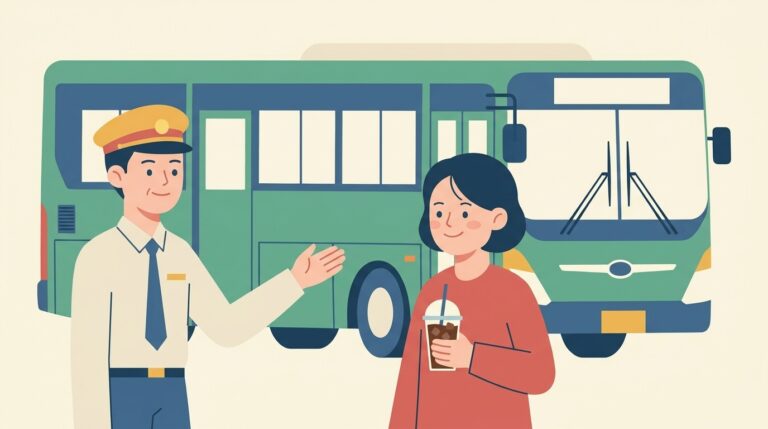
Imagine this: You are walking through the trendy streets of Hongdae. You just bought a beautifully layered, ice-cold strawberry latte. You see your bus pulling up across the street. You run, tap your transportation card, and step inside with a bright smile. Suddenly, the bus driver looks at your cup, shakes their head, and says: “이거 가지고 탈 수 없어요” (I-geo ga-ji-go tal su eop-seo-yo).
You freeze. People behind you are waiting. Your face turns red. Do you throw away your expensive drink? Do you get off the bus?
Don’t worry! This is a classic “K-travel shocker” that almost every foreigner experiences. In 2018, Seoul officially banned open food and drinks on public buses to prevent messy spills and burns. Today, we are going to learn how to handle this exact situation like an absolute local, using sweet, natural Korean phrases that will turn an awkward moment into a warm connection with native speakers.
Phase 2: 3 Core Expressions Deep Dive
Let’s master the three most critical expressions you need to know when navigating public transport with food or drinks.
1. 음료 반입 금지 (Eum-ryo Ban-ip Geum-ji)
- Pronunciation: [eum-ryo bahn-eep geum-jee] / Sounds like: “Oom-ryo bahn-eep geum-jee”
- Meaning: No drinks allowed inside (Strictly: “Beverage Entry Prohibited”).
- K-Culture Moment: You will see this written on bright stickers near the front doors of Seoul buses or on posters at subway station entrances.
- Editor’s Insight: This is a very formal, written sign. You won’t hear people say this out loud in casual conversation, but knowing how to read it will save you from getting stopped at the door!
- Situation Spectrum:
- Casual: ⚠️ (Too formal to say to friends)
- Semi-formal: ✅ (Used in public signs)
- Formal: ✅ (Official transit law term)
- 🤔 Think About It: Why do you think Korean signs use Hanja (Sino-Korean characters) like ‘반입’ (Ban-ip – bringing in) and ‘금지’ (Geum-ji – prohibition) instead of pure Korean words? It makes the public rule sound highly official and urgent!
2. 가지고 탈 수 없어요 (Ga-ji-go Tal Su Eop-seo-yo)
- Pronunciation: [gah-jee-goh tahl soo up-suh-yoh] / Sounds like: “Gah-jee-go tahl soo up-suh-yo”
- Meaning: You cannot get on with this (holding it).
- K-Culture Moment: This is the exact phrase a polite but firm bus driver or subway staff member will say to you if you try to board with an open cup of coffee or a stick of street food.
- Editor’s Insight: The word ‘가지고’ means “holding/carrying” and ‘탈 수 없어요’ means “cannot board.” It is polite but leaves no room for negotiation.
- Situation Spectrum:
- Casual: ✅ (You can say to a friend: “이거 가지고 탈 수 없어”)
- Semi-formal: ✅ (Standard polite form used by bus drivers)
- Formal: ✅
3. 다 마시고 탈게요! (Da Ma-si-go Tal-ge-yo!)
- Pronunciation: [dah mah-shee-goh tahl-geh-yoh] / Sounds like: “Dah mah-shee-go tahl-geh-yo!”
- Meaning: I will drink it all and then get on!
- K-Culture Moment: This is your magic shield! If you want to show respect and quickly resolve the situation, you can step back and say this with a warm smile.
- Editor’s Insight: The suffix ‘-게요’ (-ge-yo) shows your strong, polite intention to do something immediately. It makes you sound incredibly cooperative and sweet!
- Situation Spectrum:
- Casual: ✅ (Drop the ‘-요’ to tell your friend: “나 이거 다 마시고 탈게!”)
- Semi-formal: ✅ (Perfect for talking to bus drivers)
- Formal: ⚠️
Phase 3: Textbook Korean vs. Real Korean Showcase
When we study textbooks, we learn grammatically perfect sentences that sometimes sound like a robot wrote them. Let’s look at how to sound like a real Seoulite!
Situation 1: Asking if a closed bottle of water is okay
- 📖 Textbook Korean: 이 밀폐된 물병을 버스에 휴대해도 괜찮습니까? (Is it acceptable to carry this sealed water bottle on the bus?)
- 🗣️ Real Korean: 뚜껑 닫으면 탈 수 있어요? (Can I get on if the cap is closed?)
- 💡 Why is it different? Koreans value speed and efficiency. Instead of long words like ‘밀폐된’ (sealed/airtight), locals simply use the active verb ‘뚜껑 닫으면’ (if I close the lid) to get straight to the point.
Situation 2: Explaining your cup is completely empty
- 📖 Textbook Korean: 이것은 빈 플라스틱 컵입니다. (This is an empty plastic cup.)
- 🗣️ Real Korean: 이거 다 마신 거예요. (This is already finished. / It’s empty.)
- 💡 Why is it different? Explaining that you already drank the beverage (다 마신 것) naturally tells the driver that there is zero risk of spilling liquid on other passengers.
Phase 4: K-Culture Deep Dive & Unwritten Manners
4-1. The Power of “Nunchi” (눈치) on the Subway
While buses have strict legal bans on open cups, the Seoul Subway is a bit of a grey area. You won’t get arrested for holding a coffee on the subway, but this is where 눈치 (Nunchi – the Korean art of reading the room) comes in.
If you board a packed Subway Line 9 during rush hour with a hot, lidless cup of coffee, you will experience the silent power of 눈총 (nun-chong – invisible eye-bullets) from commuters. In Korea’s high-density society, physical consideration for others (배려 – bae-ryeo) is highly valued. Spilling coffee on someone’s expensive outfit is considered a social disaster.
4-2. What is Actually Allowed?
To make your travel easy, here is the official survival standard:
* NO: Open plastic cups with straws, take-out hot coffee cups, open cans, hot food like tteokbokki on sticks.
* YES: Closed tumblers, bottles with screw-on caps, tightly sealed bags containing delivery food (like fried chicken you are bringing home to eat).
Phase 5: Interactive Roleplay Scenario
Let’s test your real-world skills! You are standing at a bus stop in the rain next to your Korean friend, Min-ho.
Setting: A bustling bus shelter near Hongdae. The green bus number 7011 is approaching.
Cast: You (holding a delicious, half-full bubble tea) and Min-ho (your protective local friend).
- Min-ho: (🎭 Pointing at your cup with wide eyes) “어? 너 그거 버블티 들고 타려고?”
(Uh? Are you planning to get on holding that bubble tea?) - You: “응! 왜? 이거 뚜껑 다 밀봉되어 있잖아.”
(Yeah! Why? The lid is completely sealed.) - Min-ho: (🎭 Shaking his head quickly) “아니야, 빨대 꽂혀 있는 건 일회용 컵이라서 버스 안 돼.”
(No, since it has a straw in it, it’s a disposable cup so the bus won’t let you on.) - You: “진짜? 아, 한국 버스는 진짜 엄격하구나.”
(Really? Ah, Korean buses are truly strict.) - Min-ho: (🎭 Looking at the arriving bus) “맞아. 저기 버스 온다! 어떡할 거야?”
(Right. Here comes the bus! What are you going to do?)
🔀 Decision Point!
What is your next move?
- Option A: Slip the cup into your tote bag, pretend you have nothing, and try to walk past the driver.
- Option B: Tell Min-ho, “다 마시고 탈게!” (I’ll drink it fast and ride!), step back, let the bus go, and wait for the next one.
- Option C: Run to the bus door, show the driver the drink, and say “기사님, 한 입만 드셔보실래요?” (Driver, do you want a sip?) to make them happy.
💡 Action Analysis:
- If you chose A: 🚫 Risk! If the cup leaks inside your bag, your phone is ruined. Plus, if the driver spots the straw sticking out of your bag, they will politely ask you to step off, which is super embarrassing.
- If you chose B: ✅ Best Choice! This shows incredible respect. You get to enjoy your sweet boba tea in peace, and because Seoul buses run every 5-10 minutes, you won’t be late!
- If you chose C: 🤪 Oh Dear! While hilarious, offering a stranger a sip of your half-drunk boba tea during a busy commute will create a massive silence of confusion. Stick to drinking it yourself!
Phase 6: 10-Second Emotional Shadowing Drill
Let’s practice speaking with real Korean emotion! Use the slashes / to pause and mimic the emotional tags.
- [😤 Firmly but Politely – When explaining to a friend]
- “이거 / 가지고 / 탈 수 / 없대요.”
- i-geo / ga-ji-go / tal su / eop-dae-yo.
- (They say we can’t board holding this.)
- [😊 Cheerful & Cooperatively – To the bus driver]
- “죄송해요! / 다 마시고 / 탈게요!”
- joe-song-hae-yo! / da ma-si-go / tal-ge-yo!
- (I’m sorry! I’ll finish drinking and board [the next one]!)
Phase 7: K-Culture Mini Dictionary
| Word (Hangul / Romanization) | English Meaning | Local Context & Usage |
|---|---|---|
| 테이크아웃 (Te-i-keu-a-ut) | Take-out / To-go cup | Standard term used in cafes. Drivers call disposable plastic cups “테이크아웃 잔” (takeout cups). |
| 일회용품 (Il-hoe-yong-pum) | Single-use / Disposable items | Korea is deeply passionate about environmental protection. Using reusable tumblers gets you a discount! |
| 텀블러 (Teom-beul-leo) | Reusable Tumbler | If you carry your drink in a sealed tumbler, you can ride any bus or subway without a single worry. |
| 정류장 (Jeong-ryu-jang) | Bus Stop | Most Seoul bus stops have designated recycling bins where you can quickly discard your cups. |
Phase 8: Traveler’s Survival Kit
Top 3 Savior Cards for Your Phone
Card 1: Asking if a closed container is okay
“텀블러에 넣었는데 괜찮아요?”
(Teom-beul-leo-e neo-eon-neun-de gwen-cha-na-yo?)
Pro Tip: Show your tumbler to the driver while saying this. They will almost always nod happily!
Card 2: Asking for a trash can
“근처에 쓰레기통이 어디에 있어요?”
(Geun-cheo-e sseu-re-gi-tong-i eo-di-e is-seo-yo?)
Pro Tip: Useful because trash cans can be surprisingly hard to find on Seoul streets.
Card 3: Telling a friend you’ll catch up
“나 먼저 가, 나 이거 마시고 다음 꺼 탈게!”
(Na meon-jeo ga, na i-geo ma-si-go da-eum kkeo tal-ge!)
Pro Tip: Perfect conversational slang to use with your Korean travel buddies.
📌 Editor’s Travel Note
When traveling in Seoul, do not rely on Google Maps, as its transit updates can be delayed. Instead, download the official local navigation tool via the Naver Map App Download Page. To stay updated on the latest transit rules, you can check the Seoul Metropolitan Government Transit Guide.
Phase 9: Deep Reflection — “One Step Deeper”
Why did Korea implement such strict rules? In Western countries, holding a travel mug or eating a quick sandwich on a bus is quite common.
However, Korea is a highly collectivist society that places huge emphasis on 공동체 의식 (gong-dong-che ui-sik – community mindset). The interior of a Seoul city bus is considered a shared public living room. Because Seoul traffic is notoriously fast and involves sudden stops, a single spilled cup of sweet coffee doesn’t just dirty the floor—it can ruin another hard-working commuter’s clothes, leading to arguments. Understanding this shows you don’t just speak the language, but you respect the heart of the culture.
💬 Your Turn: How does your hometown handle food on public transport? Is it strictly banned, or is eating a full meal acceptable? Let us know in the comments below!
Phase 10: FAQ & Common Mistakes
Q: Can I carry a closed can of soda on a Seoul bus?
A: Yes! As long as the can is unopened and sealed, you are allowed to board. The rule only targets open drinks that run the risk of spilling.
Q: What about small snacks, like a bag of potato chips?
A: No. If the bag is open and you are actively eating them, the driver can deny boarding. If the bag is sealed and tucked inside your backpack, it is 100% fine.
Q: Is the subway rule exactly the same as the bus rule?
A: No, but ethically yes. Legally, there is no hard fine for bringing an open drink onto the subway, but practically, it is highly discouraged during crowded hours.
🚨 The 3 Most Common Foreigner Mistakes:
- Trying to hide the cup: Drivers have massive rear-view mirrors and will spot you. It is better to be upfront and polite.
- Leaving empty cups on the bus seats: This is considered highly rude (비매너 – bi-mae-neo). Always take your trash with you.
- Panicking and throwing the cup on the street: Littering carries heavy fines. Use the recycling bins at the bus stop instead.
Phase 11: Action Missions for Your Journey
- 🥉 Bronze (At-Home Challenge): Look in the mirror and practice saying: “죄송합니다, 다 마시고 다음 버스 탈게요!” until it rolls off your tongue naturally.
- 🥈 Silver (Social Challenge): Take a photo of your favorite Korean cafe drink, post it on social media, and write: “버스 타기 전에 다 마셔야 해요!” (Must drink it all before boarding the bus!) to educate your fellow travelers.
- 🥇 Gold (Real-Life Mission): Next time you travel in Seoul, bring a personal tumbler and use it at a local coffee shop. Not only will you get a green discount, but you will also glide onto the bus like a total transit pro!
Phase 12: Interactive Quiz Challenge
Let’s test your survival brains!
1. Situation Quiz
You have a paper bag containing a hot, fragrant box of Korean Fried Chicken that you just picked up. Can you board a Seoul bus?
🔍 Click to reveal the answer!
Yes! As long as the food is sealed inside a box and tucked securely in a tied plastic bag, you can board. The driver only stops you if you are actively holding a piece of chicken in your hand ready to eat it!
2. Fill-in-the-Blank
Fill in the missing word: “이거 가지고 ( ) 수 없어요.”
🔍 Click to reveal the answer!
탈 (tal) – which means “to board/ride”. The full phrase means “You cannot board while carrying this.”
3. True or False
True or False: If you get caught with an open iced coffee on a Seoul bus, you will be fined 100,000 KRW immediately.
🔍 Click to reveal the answer!
False! There is no immediate cash fine for passengers. However, the driver has the full legal right to refuse to start the bus until you step off or discard the drink.
Safe travels, and keep practicing your Korean daily with Daily Hangul!







