

Speak Like a Local This Chuseok: Your Ultimate A2 Korean Holiday Guide
Phase 1: Share the Warmth (Empathy & K-Drama Open)
안녕하세요! (Annyeonghaseyo!) I’m your Daily Hangul editor and your local cultural guide.
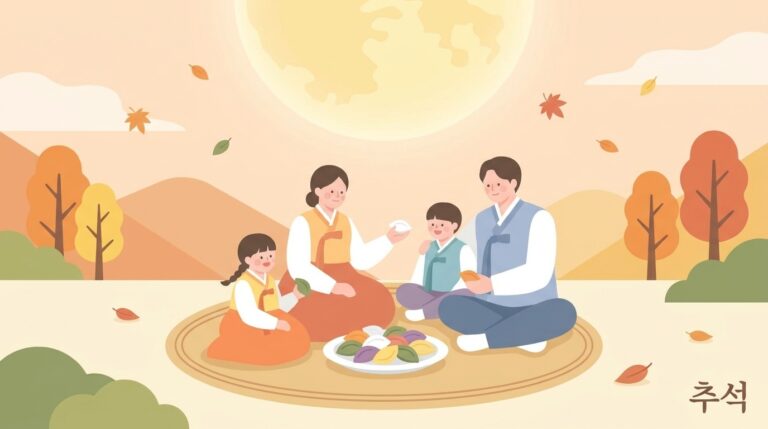
Imagine this: You’re watching a cozy K-Drama. The characters are wearing beautiful pastel-colored Hanbok (traditional clothing), laughing, and arranging pretty, crescent-shaped rice cakes on a plate under a massive, glowing full moon. You want to text your Korean friend to ask about their holiday plans, but your mind goes blank. You ask yourself, “How do I ask about Chuseok without sounding like a robotic textbook?”
If you’ve ever felt stuck trying to talk about Korean holidays, you are not alone! Many of my students at the A2 level feel nervous about using the wrong honorifics with their friends or colleagues during festive times.
Learning to speak naturally about 추석 (Chuseok)—Korea’s Thanksgiving—is your golden ticket to winning the hearts of your Korean friends, coworkers, or in-laws. It shows you don’t just study Korean grammar; you truly care about their culture. Let’s master this together!
Phase 2: Core Expressions Deep Dive
Here are three essential phrases you can use right away to talk about Chuseok.
1. 추석에 뭐 해요? (Chuseok-e mwo haeyo?)
- Pronunciation: [Choo-seok-ey mwo hae-yo?] / Sounds like: “Choo-suck-eh mo head-yo” without the ‘d’ sound.
- Meaning: What are you doing on Chuseok?
- K-Culture Moment: This is the ultimate icebreaker! In K-Dramas like Hometown Cha-Cha-Cha, you’ll hear neighbors casually asking each other about their holiday plans over the fence.
- Editor’s Insight: This is a safe, friendly, and polite (존댓말 – jondaetmal) sentence. It’s perfect for coworkers, classmates, and friends.
- Situation Spectrum:
- Casual (Friends): ✅ (Change to: “추석에 뭐 해?”)
- Semi-formal (Coworkers): ✅
- Formal (Elders/Bosses): ⚠️ (Better to use: “추석에 뭐 하세요?”)
- 🤔 Think About It: Why do Koreans ask this instead of just saying “Happy Chuseok”? In Korea, holidays are deeply active and family-oriented. Asking what someone is doing shows real personal interest in their family journey!
2. 맛있는 거 많이 드세요! (Masineun geo mani deuseyo!)
- Pronunciation: [Ma-si-neun geo ma-ni deu-se-yo] / Sounds like: “Mah-shee-noon go mah-nee deu-say-yo”
- Meaning: Please eat lots of delicious food!
- K-Culture Moment: Food is the love language of Korea. If you watch any family-themed K-Drama, the grandmother’s primary goal is always to stuff everyone’s plates with delicious food.
- Editor’s Insight: Because Chuseok is all about feasts, wishing someone eats well is actually more common and heartwarming than a simple “have a good day.”
- Situation Spectrum:
- Casual (Friends): ✅ (Change to: “맛있는 거 많이 먹어!”)
- Semi-formal (Coworkers): ✅
- Formal (Elders/Bosses): ✅ (Highly recommended! It sounds sweet yet respectful.)
- 🤔 Think About It: In English, we say “Enjoy your meal!” but in Korean, we wish for them to eat “a lot” (많이). This reflects Korea’s history of sharing food generously during harvest times.
3. 즐거운 한가위 보내세요! (Jeulgeoun hangawi bonaeseyo!)
- Pronunciation: [Jeul-geo-un han-ga-wi bo-nae-se-yo] / Sounds like: “Jool-goh-oon han-gah-wee bo-nay-say-yo”
- Meaning: Have a joyful Hangawi (Chuseok)!
- K-Culture Moment: You will see this phrase written on beautiful banners hanging across streets and on K-Pop idols’ social media holiday greeting videos.
- Editor’s Insight: Hangawi is the archaic, beautiful native Korean name for Chuseok. Using this word makes you sound incredibly fluent and culturally aware!
- Situation Spectrum:
- Casual (Friends): ⚠️ (Slightly too formal, but acceptable.)
- Semi-formal (Coworkers): ✅
- Formal (Elders/Bosses): ✅ (Perfect for holiday cards or texts.)
- 🤔 Think About It: Han means “big” and gawi means “the middle of autumn.” Isn’t it poetic how the language preserves these ancient terms?
Phase 3: Textbook Korean vs. Real Korean
When you open a classic textbook, the phrases can sometimes sound a bit outdated or overly formal. Let’s compare!
Situation 1: Asking if they are traveling to their hometown
- 📖 Textbook Korean: 귀향하십니까? (Gwihyanghasimnikka? – Are you returning to your hometown?)
- 🗣️ Real Korean: 고향에 내려가요? (Gohyang-e naeryeogayo? – Are you going down to your hometown?)
- 💡 Why is it different? The textbook uses a heavy, Sino-Korean word (귀향). Real Koreans use the physical direction “down” (내려가다) because historically, traveling to hometowns meant leaving Seoul and traveling south to the provinces.
Situation 2: Wishing someone a happy Chuseok
- 📖 Textbook Korean: 추석을 축하합니다. (Chuseok-eul chukhahamnida. – Congratulations on Chuseok.)
- 🗣️ Real Korean: 연휴 잘 보내세요! (Yeonhyu jal bonaeseyo! – Have a great long weekend/holiday!)
- 💡 Why is it different? You don’t really “congratulate” someone on a seasonal holiday. Instead, Koreans focus on wishing them a restful and happy yeonhyu (long weekend/holiday period).
Phase 4: K-Culture Deep Dive & Non-verbal Manners
4-1. Nunchi (눈치) & Body Language
When wishing someone a happy Chuseok in person, a stiff handshake won’t cut it!
* The Soft Bow: When saying “즐거운 한가위 보내세요,” lower your head and shoulders slightly (about 15 to 30 degrees). Keep your hands folded neatly in front of your stomach.
* The Two-Hand Gift Rule: If you are giving a Chuseok gift set (like Spam, cooking oils, or high-end fruit), never hand it over with one hand. Always use both hands to present it, with a gentle smile.
4-2. The Real Chuseok Culture Code
- K-Food (송편 – Songpyeon): These half-moon-shaped rice cakes are stuffed with sweet sesame seeds, chestnuts, or red beans. Legend says if you shape songpyeon beautifully, you will marry a beautiful person or have a beautiful baby!
- K-Travel (귀성길 – Gwiseonggil): The mass exodus. Millions of Koreans travel at the same time, turning highways into giant parking lots. If your Korean friend says they are driving home, offer them some sympathy with: “운전 화이팅!” (Unjeon hwaiting! – Good luck with the driving!)
Phase 5: Interactive Roleplay Scenario
Setting: It is Thursday evening, the day before the Chuseok holiday begins. You are packing your bag at the office. Your friendly Korean coworker, Minjun, walks over to your desk.
The Dialogue
- Minjun: 🎭 (Stretching his arms with a tired but happy smile) “아, 드디어 내일부터 추석 연휴네요!”
(Ah, deudeieo naeil-buteo Chuseok yeonhyu-neeyo! / Ah, finally the Chuseok holiday starts tomorrow!) - You: 🎭 (Smiling warmly) “네! 민준 씨, 추석에 뭐 해요?”
(Ne! Minjun-ssi, Chuseok-e mwo haeyo? / Yes! Minjun, what are you doing on Chuseok?) - Minjun: 🎭 (Sighing playfully) “저는 내일 고향에 내려가요. 차가 많이 막힐 것 같아요.”
(Jeoneun naeil gohyang-e naeryeogayo. Chaga mani makhil geot gatayo. / I am going down to my hometown tomorrow. I think there will be a lot of traffic.) - You: 🎭 (Showing sympathy with wide eyes) “아, 귀성길이 힘들겠어요. 운전 화이팅!”
(Ah, gwiseonggil-i himdeulgesseoyo. Unjeon hwaiting! / Oh, the drive home must be tough. Good luck driving!) - Minjun: 🎭 (Gratefully chuckling) “고마워요! 참, 부모님이랑 송편도 많이 만들 거예요.”
(Gomawoyo! Cham, bumonim-irang songpyeon-do mani mandeul geoyeyo. / Thanks! Oh, and I’ll make a lot of songpyeon with my parents.) - You: 🎭 (Enthusiastically) “와, 부러워요! 맛있는 거 많이 드세요!”
(Wa, beureowo-yo! Masineun geo mani deuseyo! / Wow, I’m jealous! Please eat lots of delicious food!) - Minjun: 🎭 (Smiling) “네, 많이 먹고 올게요. 우리 연휴 끝나고 만나요!”
(Ne, mani meokgo olgeyo. Uri yeonhyu kkeutnago mannayo! / Yes, I will eat a lot and come back. Let’s meet after the holiday!) - You: 🎭 (Waving warmly) “네! 즐거운 한가위 보내세요!”
(Ne! Jeulgeoun hangawi bonaeseyo! / Yes! Have a joyful Hangawi!) - Minjun: 🎭 (Bowing politely) “네, 고마워요. 연휴 잘 보내세요!”
(Ne, gomawoyo. Yeonhyu jal bonaeseyo! / Yes, thank you. Have a great holiday!)
🔀 Decision Point: Minjun asks you, “추석 연휴에 계획이 있어요?” (Do you have plans for the Chuseok holiday?)
- Option A: “아니요, 계획 없어요. 그냥 자요.” (Aniyo, gyehoek eopseoyo. Geunyang jayo.)
- Editor’s Verdict: ⚠️ Too blunt! It sounds a bit sad or cold, even if it’s true.
- Option B: “친구 집에 초대받았어요! 같이 맛있는 거 먹을 거예요.” (Chingu jibe chodae-badasseoyo! Gachi masineun geo meogul geoyeyo.)
- Editor’s Verdict: ✅ Best Choice! It sounds positive and gives your coworker a great, warm mental image of your holiday.
- Option C: “추석 축하해요!” (Chuseok chukhahaeyo!)
- Editor’s Verdict: 🚫 Awkward! As we learned, we don’t really congratulate people on Chuseok.
Phase 6: 10-Second Emotion Shadowing Drill
Let’s practice saying these with native rhythm and real emotion! Put your heart into it!
- [😊 With bright, cheerful energy]
맛있는 거 / 많이 / 드세요!
(Ma-si-neun geo / ma-ni / deu-se-yo!) - [🥺 With supportive sympathy]
아, / 고향 내려가요? / 운전 / 화이팅!
(Ah, / go-hyang nae-ryeo-ga-yo? / un-jeon / hwai-ting!) - [✨ With polite, warm wishes]
즐거운 / 한가위 / 보내세요!
(Jeul-geo-un / han-ga-wi / bo-nae-se-yo!)
Phase 7: K-Culture Mini Dictionary
| Keyword | Meaning | Real-world Context |
|---|---|---|
| 한가위 (Hangawi) | Old name for Chuseok | Used in formal greeting cards, commercial slogans, and formal texts. |
| 송편 (Songpyeon) | Half-moon rice cakes | The absolute representative food of Chuseok. You will see these everywhere in supermarkets! |
| 성묘 (Seongmyo) | Visiting ancestral graves | Family members visit graves to clear weeds and pay respects. |
| 귀성길 (Gwiseonggil) | The road back home | The famous heavy traffic jam period right before Chuseok starts. |
Phase 8: Traveler’s Survival Kit
If you are traveling in Korea during Chuseok, write these down!
Survival Phrases:
- 추석에 영업해요? (Chuseok-e yeong-eop-haeyo?)
- Meaning: Are you open during Chuseok? (Crucial because many local shops close!)
- KTX 표 남았어요? (KTX pyo nam-asseoyo?)
- Meaning: Are there any KTX tickets left? (Tickets sell out months in advance!)
- 연휴에 문 여는 약국이 어디예요? (Yeonhyu-e mun yeoneun yakguk-i eodi-yeyo?)
- Meaning: Where is a pharmacy that is open during the holiday?
📌 Editor’s Travel Note: Download the Naver Map App to check holiday operating hours for restaurants, and use KORAIL Talk to check for any last-minute canceled train tickets! Note: Train schedules and open hours are subject to seasonal changes.
Phase 9: One Step Deeper — Cultural Insight
Traditionally, Chuseok was a time when the whole extended family gathered to perform ancestral rites (차례 – charye). However, modern Korean society is changing rapidly. Many young Koreans now prefer to use the long holiday to travel abroad or simply stay home to catch up on sleep and Netflix. It has sparked a friendly generational debate in Korea between traditional family duties and the modern need to recharge.
💬 Your Turn: Does your country have a holiday similar to Chuseok where everyone travels home? How do you say “Happy Holidays” in your language? Tell us in the comments!
Phase 10: FAQ & Common Mistakes
Q: Can I say “Happy Chuseok” in English to my Korean friends?
A: Yes! Many younger Koreans will easily understand and appreciate “Happy Chuseok!” However, trying it in Korean (즐거운 한가위 보내세요) will make them smile much wider!
Q: Is Chuseok the same date every year?
A: No. Chuseok is on the 15th day of the 8th month of the lunar calendar. This means the date changes on the solar calendar every year, usually falling in September or October.
Q: Should I bring a gift if I am invited to a Korean home during Chuseok?
A: Absolutely. A nice box of fruit (like premium pears) or a practical gift set (like Spam or luxury cooking oil) is highly appreciated.
🚨 Common Mistakes Alert!
- Mistake 1: Saying “추석 축하해” (Chuseok chukhahae).
- Fix: Use “즐거운 추석 보내세요” (Jeulgeoun Chuseok bonaeseyo).
- Mistake 2: Handing a gift over with one hand.
- Fix: Always use both hands to show respect.
Phase 11: Action Mission
- 🥉 Bronze: Record yourself saying “맛있는 거 많이 드세요!” with high energy on your phone.
- 🥈 Silver: Text a Korean friend or your language exchange partner: “추석에 뭐 해요? 즐거운 한가위 보내세요!”
- 🥇 Gold: Go to a Korean supermarket or restaurant, buy some Songpyeon, and say: “추석 연휴 잘 보내세요!” to the owner.
- 🎮 K-Culture Mission: Watch a K-Drama holiday episode (like in Reply 1988) and try to spot the characters eating Songpyeon!
Phase 12: Interactive Quiz Challenge
Test your Chuseok skills!
1. Which phrase is best for wishing your boss a happy Chuseok?
- A) 추석 축하해!
- B) 즐거운 한가위 보내세요!
- C) 맛있는 거 많이 먹어!
Reveal Answer & Explanation
Correct Answer: B
Explanation: B uses polite honorifics (~보내세요) and the beautiful, respectful term 한가위. A is awkward, and C uses informal language (반말) which is rude to a boss!
2. What is the traditional Chuseok food shaped like a half-moon?
- A) 김밥 (Gimbap)
- B) 떡국 (Tteokguk)
- C) 송편 (Songpyeon)
Reveal Answer & Explanation
Correct Answer: C
Explanation: Songpyeon is the signature Chuseok half-moon rice cake! Tteokguk is eaten on New Year’s Day (Seollal).
3. True or False: You should hand a gift to a Korean elder using only your right hand to show respect.
Reveal Answer & Explanation
Correct Answer: False
Explanation: You must always use both hands when giving or receiving items from an elder in Korea to show proper respect!
“,







