

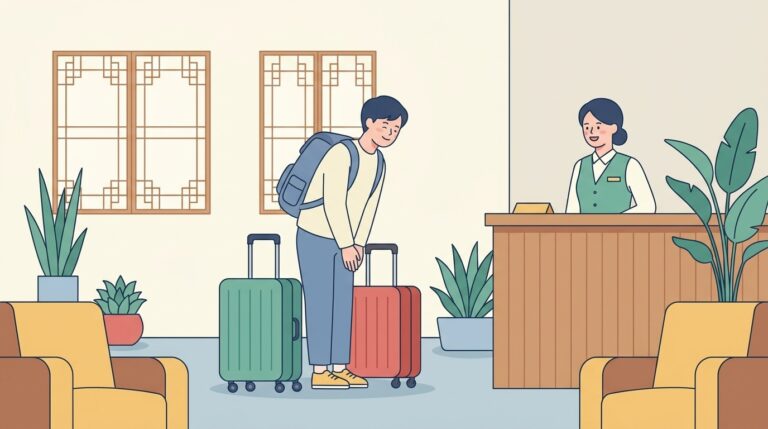
Don’t Drag Your Heavy Bags! Ask This One Magic Korean Question at Your Hotel
안녕하세요! (An-nyeong-ha-se-yo! – Hello!) I am your lead editor and your Korean best friend at Daily Hangul.
Imagine this: You have just landed at Incheon International Airport. The air is crisp, the city lights of Seoul are calling your name, and you are buzzing with excitement! You grab your bags and head straight to your cozy hotel in Hongdae. But wait… you arrived at 10:00 AM, and check-in isn’t until 3:00 PM.
Do you drag your massive, 20-kg suitcase over the beautiful cobblestone streets of Bukchon Hanok Village? Do you awkwardly navigate the busy crowds of a trendy cafe while bumping into tables with your giant bag?
Absolutely not!
Today, we are going to learn the ultimate survival phrase that will unlock hands-free freedom for your K-adventure. By the end of this guide, you will be able to confidently walk up to any hotel front desk in Korea and ask them to watch your bags like a true local.
Phase 2: Deep Dive into 3 Core Expressions
Let’s look at the three most useful ways to ask to store your luggage. These are simple, polite, and perfect for absolute beginners (A1 level).
1. 짐 맡겨도 되나요? (Jim mat-gyeo-do doe-na-yo?)
- Pronunciation: Jeem maht-gyuh-doh dweh-nah-yo?
(Sound Analogy: “Jeem” rhymes with “team”. “Mat-gyeo” sounds a bit like “mat” + “gyeo” as in the first syllable of “yawn”.) - Meaning: Can I leave my luggage here?
- K-Culture Moment: This is the most common phrase you’ll hear K-Drama characters use when they arrive at a charming countryside guesthouse (like in Hometown Cha-Cha-Cha) before going on a romantic walk by the sea.
- Editor’s Insight: This is your golden key. It is polite, natural, and gets straight to the point without sounding too stiff.
- Situation Spectrum:
- Friends & Casual: ⚠️ (Slightly too polite for close friends, but okay)
- Hotel Staff / Strangers: ✅ (Perfect!)
- Formal / Business: ✅ (Very safe)
- 🤔 Think About It: In Korean, the word 되나요? (doe-na-yo?) literally means “Is it okay/possible?” Notice how Korean sentences often end with this soft, questioning tone to show respect and avoid sounding demanding.
2. 체크인 전에 짐 맡길 수 있을까요? (Che-keu-in jeon-e jim mat-gil su isseu-kka-yo?)
- Pronunciation: Cheh-keu-een juhn-eh jeem maht-geel soo ee-seul-kah-yo?
- Meaning: Can I leave my luggage before check-in?
- K-Culture Moment: Think of a modern K-Pop star arriving early at a luxury hotel in Gangnam for a photoshoot, politely asking the front desk staff for assistance.
- Editor’s Insight: This phrase uses the English loanword 체크인 (che-keu-in), making it super easy for you to remember! 전에 (jeon-e) means “before”.
- Situation Spectrum:
- Friends & Casual: 🚫
- Hotel Staff / Strangers: ✅ (Highly polite and clear)
- Formal / Business: ✅
3. 체크아웃 후에 짐 맡겨도 돼요? (Che-keu-at hu-e jim mat-gyeo-do dwae-yo?)
- Pronunciation: Cheh-keu-out hoo-eh jeem maht-gyuh-doh dweh-yo?
- Meaning: Can I leave my luggage after check-out?
- K-Culture Moment: That sad but beautiful final day of your trip. You’ve checked out, but your flight isn’t until night. You want to eat one last bowl of hot Tteokbokki without your suitcase rolling away!
- Editor’s Insight: 후에 (hu-e) means “after”. This is slightly softer and more conversational than expression #2, but still wonderfully polite.
- Situation Spectrum:
- Friends & Casual: ✅
- Hotel Staff / Strangers: ✅
- Formal / Business: ✅
Phase 3: Textbook Korean vs. Real Korean
When we open a standard dusty grammar book, we often see phrases that sound like they were written by a robot from 1995. Let’s look at the difference!
Situation 1: Asking the front desk clerk to keep your bags
- 📖 Textbook Korean: “제 수하물을 보관해 주시겠습니까?” (Je su-ha-mul-eul bo-gwan-hae ju-si-get-seub-ni-ka?)
- 🗣️ Real Korean: “짐 좀 맡아주실 수 있으세요?” (Jim jom mat-ah-ju-sil su isseu-se-yo? – Could you please watch my bags?)
- 💡 Why is it different? The textbook uses “수하물” (su-ha-mul), which is a very formal Sino-Korean word for cargo/baggage. Real humans use 짐 (jim), which means “stuff” or “bags.” Adding 좀 (jom), meaning “please” or “a little,” instantly softens your request and makes you sound friendly!
Situation 2: Confirming if luggage storage is available
- 📖 Textbook Korean: “여기에 수하물 위탁 서비스가 있습니까?” (Yeo-gi-e su-ha-mul wi-tak seo-bi-seu-ga it-seub-ni-ka?)
- 🗣️ Real Korean: “혹시 짐 보관돼요?” (Hok-shi jim bo-gwan-dwae-yo? – By any chance, is luggage storage possible?)
- 💡 Why is it different? Koreans love efficiency and softness. 혹시 (Hok-shi) means “by any chance” and is the ultimate polite opener. 보관돼요? (bo-gwan-dwae-yo?) is short, modern, and natural.
Phase 4: K-Culture Deep Dive & Non-Verbal Manners
4-1. The Body Language of Trust
When you ask to leave your bags, remember that body language speaks louder than words in Korea.
1. The Two-Hand Handshake: When the hotel clerk hands you your luggage tag (claim check), always receive it with both hands. You can place your left hand gently under your right wrist or forearm. This is a sign of deep respect.
2. The Polite Nod: A slight head bow (about 15 degrees) while saying “감사합니다” (Gam-sa-ham-ni-da – Thank you) will instantly make the staff smile and want to give you the best room later!
4-2. The “No-Theft” Culture in Korea
One of the first things foreigners notice when traveling in Korea is the unbelievable safety. People leave their expensive MacBooks on cafe tables while going to the restroom for 15 minutes!
When you leave your luggage at a Korean hotel lobby, you might notice they just cover the bags with a simple net or leave them near the desk. Don’t worry! Your bags are extremely safe. Korean society values trust, and CCTV cameras are everywhere.
Phase 5: Interactive Roleplay Scenario
Let’s step into a game!
The Setting: A beautiful Hanok-style boutique hotel in Bukchon. The lobby smells like sweet ginger tea. Soft, acoustic K-Indie music plays in the background. A kind receptionist named Min-su is smiling behind the desk.

- Min-su (Staff): 어서 오세요! 무엇을 도와드릴까요?
(Eo-seo o-se-yo! Mu-eot-eul do-wa-deu-ril-kka-yo?)
“🎭 [Smiling warmly, bowing slightly] Welcome! How can I help you?” -
You (Traveler): 안녕하세요! 저… 혹시 짐 맡겨도 되나요?
(An-nyeong-ha-se-yo! Jeo… hok-shi jim mat-gyeo-do doe-na-yo?)
“🎭 [Politely nodding, holding your suitcase handle] Hello! Uh… by any chance, can I leave my luggage here?” -
Min-su (Staff): 아, 네! 가능합니다. 체크인 예정이신가요?
(Ah, ne! Ga-neung-ham-ni-da. Che-keu-in ye-jeong-i-sin-ga-yo?)
“🎭 [Nodding enthusiastically] Oh, yes! That is possible. Do you have a reservation for check-in?” -
You (Traveler): 네, 맞아요. 오늘 세 시에 체크인해요.
(Ne, ma-ja-yo. O-neul se si-e che-keu-in-hae-yo.)
“🎭 [Smiling, pointing at the clock] Yes, that’s right. I check in today at three o’clock.” -
Min-su (Staff): 네, 이름이 어떻게 되세요?
(Ne, i-reum-i eo-tteo-ke doe-se-yo?)
“🎭 [Opening the computer booking system] Great, what is your name?” -
You (Traveler): 제 이름은 [Your Name] 이에요.
(Je i-reum-eun [Your Name] i-e-yo.)
“🎭 [Saying your name clearly] My name is [Your Name].” -
Min-su (Staff): 네, 예약 확인되었습니다! 짐은 모두 몇 개인가요?
(Ne, ye-yak hwa-gin-doe-eot-seub-ni-da! Jim-eun mo-du myeot gae-in-ga-yo?)
“🎭 [Looking at your luggage] Okay, reservation confirmed! How many bags do you have in total?”
🔀 Decision Point: How do you answer?
- Option A: “두 개요!” (Du gae-yo! – Two bags!)
- Option B: “이거요.” (I-geo-yo. – This one.)
- Option C: “I have two bags, please.”
Click here to see the Best Choice!
- Best Choice is Option A! “두 개요!” (Du gae-yo!) uses the native Korean counter for items (개 – gae) coupled with the polite sentence ending 요 (yo). It is polite, short, and perfectly accurate!
- Option B is okay if you only have one bag and point at it, but “이거요” (I-geo-yo) can sound a bit childish.
- Option C is perfectly fine because most Korean hotel staff speak great English, but hey, we are here to practice our awesome Korean!
Phase 6: 10-Second Emotion Shadowing Drill
Let’s practice speaking with real Korean emotion! Try to copy the rhythm. The slash / means a tiny pause.
1. [😊 Friendly & Hopeful]
- “저… / 혹시 / 짐 맡겨도 되나요?”
- Jeo… / hok-shi / jim mat-gyeo-do doe-na-yo?
- Rhythm Tip: Keep the “Jeo…” a little long, like you are politely seeking their attention.
2. [💖 Enthusiastically Grateful]
- “우와, / 정말 / 감사합니다!”
- U-wa, / jeong-mal / gam-sa-ham-ni-da!
- Rhythm Tip: Put energy into “U-wa” (Wow) to show how relieved you are to get rid of your heavy bags!
Phase 7: K-Culture Mini Dictionary
| Word | Pronunciation | English Meaning | Cultural Insight |
|---|---|---|---|
| 짐 (Jim) | Jeem | Bag, Luggage | Not just suitcases! Any heavy bag or package you carry can be called “짐”. |
| 보관 (Bo-gwan) | Boh-gwan | Storage / Keeping | You will see this word at subway station locker systems: “물품보관함” (Mul-pum bo-gwan-ham). |
| 체크인 (Che-keu-in) | Cheh-keu-een | Check-in | Phonetically matches the English word, making it instantly recognizable to any hotel host. |
| 친절 (Chin-jeol) | Cheen-juhl | Kindness | Hospitality is huge in Korea. Staff pride themselves on being “친절” (kind). |
Phase 8: Traveler’s Survival Kit
Top 3 Extra Survival Phrases
- 여기 이름표 있어요. (Yeo-gi i-reum-pyo it-eo-yo.)
- Meaning: Here is the name tag/luggage tag.
- Pro Tip: Use this when returning to collect your bags!
- 몇 시까지 와야 해요? (Myeot si-kka-ji wa-ya hae-yo?)
- Meaning: By what time should I come back?
- 영수증 주세요. (Yeong-su-jeung ju-se-yo.)
- Meaning: Please give me a receipt/claim check.
📌 Editor’s Travel Note:
When exploring Korea, download Naver Map instead of Google Maps. Google Maps doesn’t work well for walking directions in Korea due to security laws. Naver Map will show you exactly which subway exit has elevators so you don’t have to carry your heavy luggage up 100 stairs!
Phase 9: Deep Think — “One Step Deeper”
In English, we say “Can I leave my luggage?” notice how we use “I” and “my” constantly.
However, in Korean, you will notice that people rarely say 나 (na – I) or 내 (nae – my) in daily requests. The sentence “짐 맡겨도 되나요?” literally translates to: “Is bag-leaving possible?”
Korean culture is deeply context-based and community-oriented. Since you are the one standing there with a suitcase, it is obvious whose bag it is! Skipping the pronouns makes the language flow naturally and sound much warmer.
💬 Your Turn: How does your native language handle polite requests? Do you use pronouns, or do you skip them like Koreans do? Let me know in the comments below!
Phase 10: FAQ & Avoiding Common Mistakes
Q: Can I leave my bags at Guesthouses or Hanok stays too?
A: Yes! Most hosts are incredibly kind and will store your bags in their private living rooms or office areas if a formal luggage room is not available.
Q: Is there a fee for hotel luggage storage in Korea?
A: Usually No. For registered guests, almost all hotels in Korea offer this service completely free of charge before check-in and after check-out.
Q: What if they don’t have space?
A: No problem. You can use the digital lockers inside major subway stations. They are very cheap and accept credit cards or T-money transit cards!
🚨 Common Traveler Mistakes
- Mistake 1: Handing your luggage tag with only one hand.
- Correct Action: Use two hands to show respect to the hotel worker.
- Mistake 2: Saying “바기지” (ba-gi-ji) for baggage.
- Correct Action: In Korea, “바가지” (ba-ga-ji) actually means “a plastic scoop/bowl” or “getting ripped off”! Always use 짐 (jim).
Phase 11: Action Mission!
- 🥉 Bronze (At-Home Challenge): Stand in front of your mirror, hold a backpack, and say “저, 혹시 짐 맡겨도 되나요?” with a big smile three times!
- 🥈 Silver (Social Challenge): Write down “짐 맡겨도 되나요?” in your travel notepad or post it on your Instagram story to show your friends you are prepping for your Korea trip!
- 🥇 Gold (Real-World Challenge): On your next trip to Korea, use this exact phrase at your hotel lobby before the receptionist even asks for your passport. Watch their face light up!
Phase 12: Interactive Quiz Challenge
Let’s test what you’ve learned today!
1. Which word means “Luggage” in natural Korean?
- A) 바가지 (ba-ga-ji)
- B) 수하물 (su-ha-mul)
- C) 짐 (jim)
Reveal Answer
Answer: C) 짐 (jim)
While “수하물” is used at airport check-in counters, “짐” is the warm, natural, everyday word used by real people at hotels!
2. Fill in the blank:
“체크인 ______ 짐 맡길 수 있을까요?” (Can I leave my bags before check-in?)
* A) 후에 (hu-e)
* B) 전에 (jeon-e)
Reveal Answer
Answer: B) 전에 (jeon-e)
“전에” means before, while “후에” means after.
Have a safe and happy hands-free trip to Korea! Next time you travel, keep your head high and your bags safely tucked away at the front desk.
다음에 또 만나요! (Dae-um-e tto man-na-yo! – See you next time!)







