

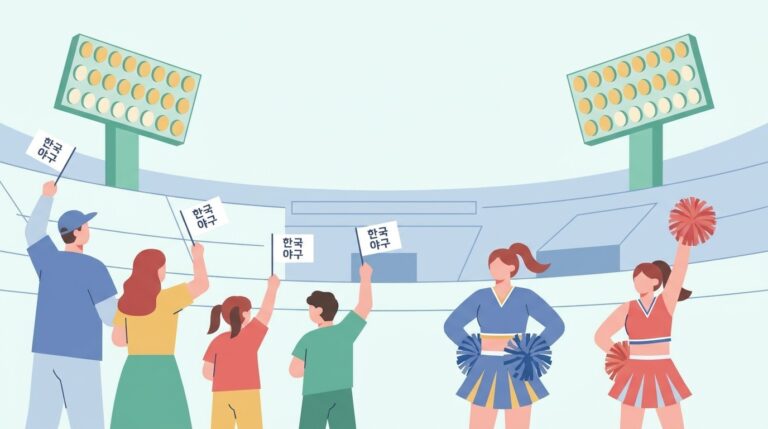
Dive into the Fever: Master the Ultimate Korean Baseball Cheering and Cheerleader Culture!
Phase 1: Welcome to the Loudest Party in Seoul!
Hello there, fellow Korean culture lovers! I’m your Chief Editor from Daily Hangul, your trusted Korean friend and cultural navigator.
Have you ever watched a K-Drama where the main characters escape their daily worries by heading to a packed baseball stadium, shouting at the top of their lungs while eating crispy fried chicken? Or maybe you’ve seen viral TikToks of Korean cheerleaders performing synchronized, high-octane K-Pop dances on a stage right in front of the seats, making the entire stadium shake with energy.
If you go to a Korean baseball game expecting a quiet, contemplative afternoon of analyzing strikes and balls, you are in for a massive shock! Korean baseball is less of a silent sport and more of an open-air, three-hour rock concert.
Many of my intermediate students tell me: “I went to Jamsil Stadium, but I felt so left out because I couldn’t join the chants or understand what the cheerleaders were shouting!”
Don’t worry! Today, we are going to unlock the magic behind 치어리더 공연 (Cheerleader performances) and the legendary 응원 열기 (cheering fever). By the end of this guide, you’ll not only know what to say, but you’ll also feel the collective “Jeong” (정) that makes Korean baseball culture one of a kind. Let’s dive in!
Phase 2: Core 3 Cheering Expressions You Must Know
1. 떼창 (Ttechang)
- Pronunciation: [Tte-chang] / Sound-alike: “Tteh-chahng” (Imagine shouting “Teh” with a tense, double ‘t’ sound, followed by “chang” like the beginning of “champion”).
- Meaning: Group singing; chanting in unison.
- K-Culture Moment: This is the ultimate peak of any Korean public gathering, from BTS concerts to the 8th inning of a Doosan Bears or LG Twins game. When 20,000 people sing a player’s theme song in perfect unison, it is called a “Ttechang.”
- Editor’s Insight: “Ttechang” represents the core of Korean collectivism. It is not about how well you sing; it is about merging your voice with thousands of strangers to create a wall of sound.
- Situation Spectrum:
- Friends/Casual: ✅ (Perfect for screaming with friends)
- Colleagues/Semi-formal: ✅ (Great for company bonding outings)
- Superiors/Formal: ★★★ (Keep it respectful, but even bosses join the Ttechang!)
- 서 Think About It: Unlike Western stadiums where cheering is often reactive to the play, Korean cheering is proactive and continuous. Why do you think Korean society thrives on this highly structured, collective vocal participation?
2. 머리 위로 손! (Meori wiro son!)
- Pronunciation: [Meo-ri wi-ro son!] / Sound-alike: “Muh-ree wee-roh sohn!”
- Meaning: Hands over your head! (Put your hands up!)
- K-Culture Moment: The 응원단장 (Cheering Director) stands on the stage, grabs the microphone, and yells this right before a major drop in a K-Pop remix.
- Editor’s Insight: When you hear this, you don’t just raise your hands; you clap them in a rhythmic three-beat pattern. If you keep your hands down, you might block the view of the passionate fan behind you!
- Situation Spectrum:
- Friends/Casual: ✅
- Colleagues/Semi-formal: ✅
- Superiors/Formal: ✅ (Everyone does it!)
- 서 Think About It: This phrase literally translates to “Hands to above head.” Notice how Korean drops the subject (You) and focuses purely on the action. It makes the command feel like an immediate, shared invitation.
3. 아파트! (Apartment / A-pa-teu)
- Pronunciation: [A-pa-teu] / Sound-alike: “Ah-pah-teu” (Say it quickly with crisp ‘p’ and ‘t’ sounds).
- Meaning: Apartment (The title of a legendary 1982 song by Yoon Soo-il, now a classic stadium anthem).
- K-Culture Moment: During late innings, when the team needs a rally, the stadium speakers blast this retro synth-pop song. Everyone links shoulders and rocks back and forth, shouting “Apartment!” at the top of their lungs.
- Editor’s Insight: You might think, “Why are they singing about housing?” It’s a nostalgic anthem of urban community. Today, it’s also highly relevant due to Ros and Bruno Mars’ global hit “APT.”, but the stadium version remains the ultimate classic!
- Situation Spectrum:
- Friends/Casual: ✅
- Colleagues/Semi-formal: ✅
- Superiors/Formal: ✅
- 서 Think About It: Singing a retro song from the 1980s unites generations. Grandfathers, parents, and Gen-Z kids all link arms. How does your culture bridge generational gaps through sports music?
Phase 3: Textbook Korean vs. Real Korean
Situation 1: Expressing Your Hopes for the Team
- 개 Textbook Korean: “우리 팀이 이기기를 바랍니다.” (I hope our team wins.)
- 사 Real Korean: “제발 삼진! 가자, 홈런 하나 날려버려!” (Please, strikeout! Let’s go, blast a home run!)
- ᅡ Why the Difference? In the heat of the stadium, nobody uses long, polite passive forms. Short, punchy, active verbs like “날려버려” (blast/blow it away) are used to inject maximum energy into the atmosphere.
Situation 2: Ordering Food at the Stadium
- 개 Textbook Korean: “야구장에서 치킨과 맥주를 먹을 것입니다.” (I will eat chicken and beer at the baseball stadium.)
- 사 Real Korean: “야구장은 역시 치맥이지! 세팅하자!” (Baseball is all about Chimaek after all! Let’s set it up!)
- ᅡ Why the Difference? “치맥” (Chimaek) is a cultural institution. Using the phrase “역시 ~이지” (~ is indeed the best) shows that you understand the unquestionable rule of Korean stadium dining. “세팅하자” (Let’s set it up) refers to unpacking the food containers on your narrow stadium desk or lap.
Phase 4: K-Culture Deep Dive & Non-Verbal Etiquette
4-1. Nunchi (눈치) and Body Language in the Cheering Zone
If you sit in the 응원석 (Cheering Section – usually blocks 206-208 in Jamsil), standing up is not optional—it is mandatory during your team’s turn to attack! Here is how to keep your Nunchi sharp:
* The Attack vs. Defense Rule: When your team is batting, you stand up, dance, and chant. When your team is defending (pitching), you sit down, eat your chicken, and chat.
* The Cheering Stick Etiquette: If you buy plastic cheering sticks (막대풍선), do not hit them right next to someone’s ear. Keep your claps synchronized to the drummer’s beat.
4-2. The Cultural Synergy of K-Pop & K-Baseball
Did you know that Korean cheerleaders are celebrities in their own right? Many of them have massive Instagram followings and Fancams on YouTube with millions of views. They perform choreography to the latest K-Pop hits (like NewJeans, aespa, or IVE) during cleaning breaks. By participating, you are experiencing K-Pop and sports culture colliding in a unique local space.
Phase 5: Interactive Stadium Roleplay Scenario
The Setting
It’s the bottom of the 8th inning at Jamsil Baseball Stadium. The score is tied 4-4. The stadium lights are flashing, and the smell of spicy tteokbokki and fried chicken fills the air. You are sitting next to Minjun, your passionate Korean friend who is wearing a team jersey and holding a cheering balloon.
Cast
- Minjun (민준): A hardcore baseball fanatic who loses his voice at every game.
- You (The Reader): An intermediate learner experiencing the magic of the cheering section for the first time.
Dialogue
- 민준: (🎭 Shouting over the loud music) “우와! 드디어 기회가 왔다! 대타 나왔어!”
(Wow! Finally, the chance has come! A pinch hitter is up!) - You: “대타? 누군데? 분위기 장난 아니다!”
(Pinch hitter? Who is it? The atmosphere is no joke!) - 민준: “우리 팀 해결사 김현수 선수잖아! 자, 응원봉 들고 일어서!”
(It’s our team’s savior, Kim Hyun-soo! Quick, grab your cheering sticks and stand up!) - You: “나 아직 노래 다 못 외웠는데 어떡하지?”
(I haven’t memorized all the songs yet, what should I do?) - 민준: (🎭 Laughing warmly) “걱정 마! 내가 하는 대로 그냥 따라 해! 눈치껏!”
(Don’t worry! Just copy what I do! Use your Nunchi!) - 응원단장 (On Speaker): “자, 잠실의 함성을 보여줍시다! 머리 위로 손!”
(Now, let’s show them the roar of Jamsil! Hands over your head!) - 민준: (🎭 Clapping the sticks rhythmically) “위! 러브! 현수! 김! 현! 수!”
(We! Love! Hyun-soo! Kim! Hyun! Soo!) - You: “위! 러브! 현수! 김! 현! 수! 대박, 진짜 스트레스 다 풀려!”
(We! Love! Hyun-soo! Kim! Hyun! Soo! Daebak, this really relieves all my stress!) - 민준: “이제 다음 타자니까, 목소리 더 크게 내야 해! 목 안 쉬면 집 못 간다!”
(Next batter is up, so you have to shout even louder! If you don’t lose your voice, you can’t go home!) - You: “좋아, 뼈를 묻어보자! 다음 응원은 뭐야?”
(Alright, let’s go all out! What’s the next cheer?)
🔀 Decision Point: What do you say when the batter hits a huge fly ball?
- Choice A: “공이 아주 멀리 날아갑니다!” (The ball is flying very far!)
- Choice B: “넘어간다! 홈런! 제발 제발!” (It’s going over! Home run! Please, please!)
- Choice C: “경기 규칙에 따르면 저것은 아웃인가요?” (According to the rules, is that an out?)
🏆 Best Choice: B
- Why: “넘어간다!” (It’s going over!) is the emotional, localized phrase that fans scream as they watch a ball fly toward the outfield wall. Shouting “제발” (please) adds that perfect touch of dramatic desperation that every local fan feels.
⚠️ Bad/Risk Choice: A & C
- Why: Choice A sounds like a robotic sports commentator, while Choice C breaks the energetic momentum of the game to ask an academic question. Save the rule analysis for the inning break!
Phase 6: 10-Second Emotional Shadowing Drill
Let’s practice shouting with real Korean passion! Pay attention to the pauses (/) and the emotional cues.
- [😊 Filled with pure excitement]
“와, / 응원 열기 / 진짜 미쳤다! / 대박!”
(Wa, / eung-won yeol-gi / jin-jja mi-cheot-da! / dae-bak!)
“Wow, the cheering energy is absolutely crazy! Amazing!” -
[😤 Determined and powerful]
“머리 위로 손! / 끝까지 / 소리 질러!”
(Meo-ri wi-ro son! / kkeut-kka-ji / so-ri jil-reo!)
“Hands over your head! Scream until the very end!” -
[🥺 Desperate but hopeful]
“제발 / 홈런 하나만 / 날려주세요!”
(Je-bal / hom-reon ha-na-man / nal-ryeo-ju-se-yo!)
“Please, just blow one home run over the wall!”
Phase 7: K-Culture Mini-Dictionary
- 응원단장 (Eungwon-danjang)
- Translation: Cheering Director / Leader
- Nuance: The energetic leader who stands on the stage with a microphone, directing the crowd’s chants and movements. They are the absolute maestro of the stadium’s energy.
- 막대풍선 (Makdae-pungseon)
- Translation: Inflatable cheering sticks
- Nuance: The plastic stick balloons you inflate and bang together to create a loud clapping sound. Essential gear for any stadium rookie.
- 견제 (Gyeonje)
- Translation: Check/Pick-off play
- Nuance: When the opposing pitcher tries to throw to first base to catch a runner, the crowd collectively screams a synchronized “boo” chant (e.g., “야!” or “우~~”), which is incredibly funny and intimidating.
- 뒷풀이 (Dwitpuri)
- Translation: After-party
- Nuance: Gathering with friends after the game at a nearby outdoor restaurant to drink, eat, and discuss the game’s highlights.
Phase 8: Traveler’s Survival Kit
Survival Expressions TOP 3
- “티켓 어디서 끊어요?” (Tiket eodi-seo kkeun-eo-yo?)
- Tip: “Where do I get the tickets?” Use this when looking for the physical box office at the stadium.
- “이 자리 주인 있나요?” (I ja-ri ju-in in-na-yo?)
- Tip: “Is this seat taken?” Perfect when you need to navigate tight seating in the outfield.
- “맥주 한 박스 더 주세요!” (Maek-ju han bak-seu deo ju-se-yo!)
- Tip: “One more pack of beer, please!” Perfect for when the game goes into extra innings.
📌 Editor’s Travel Note
To secure tickets to high-profile games, download the 인터파크 티켓 앱 (Interpark Ticket App) or 티켓링크 앱 (Ticketlink App) beforehand. For navigation to Sajik Stadium in Busan or Jamsil in Seoul, always use 네이버 지도 앱 (Naver Map App) instead of Google Maps for real-time subway exit details and crowding updates.
Phase 9: Deepening Thought — “One Step Deeper”
The high-octane collective cheering in Korea is not just about sports; it is a manifestation of 신명 (Shinmyeong)—a traditional Korean concept of deep, collective joy and emotional release. In a highly competitive society where people work and study long hours under heavy stress, the baseball stadium serves as a rare democratic space where social hierarchies vanish. Whether you are a CEO or a college student, you link shoulders, share food, and scream for the same goal.
💬 Your Turn: Does your country have a sports culture that brings absolute strangers together like this? How do you release stress in your hometown? Let us know in the comments below!
Phase 10: FAQ & Common Mistakes (FAQ Schema)
Q: Do I need to support a specific team to enjoy the game?
A: Not at all! Even if you are neutral, sitting in the home team’s cheering section (응원석) and following the cheerleader’s choreography is incredibly fun. Just wear neutral clothes (avoid wearing the opposing team’s colors in that zone!).
Q: Can I bring outside food and drinks into Korean stadiums?
A: Yes! Unlike many Western stadiums that ban outside food, Korean stadiums allow you to bring in your own boxes of chicken, gimbap, and even beer (as long as the beer is in plastic cups or cans under a certain size limit for safety).
Q: What if I don’t know any player’s name?
A: Don’t worry. The cheering songs are short, repetitive, and displayed on the giant electronic scoreboard (전광판) with easy lyrics. Just read the screen and mimic the sounds!
🚨 Common Mistakes Alert!
- Mistake 1: Standing up to cheer during the defense inning.
- Correct Action: Sit down, relax, and eat your food while your team pitches. Save your energy for the attack!
- Mistake 2: Wearing a red jersey in the home cheering section of a rival blue team.
- Correct Action: Keep your outfit neutral if you are sitting in a specific team’s cheering zone.
- Mistake 3: Not buying your cheering gear before entering.
- Correct Action: Stop by the official merchandise shops outside the stadium gates to buy a cheap head-band or cheering sticks to feel fully immersed.
Phase 11: Action Missions
- 🥉 Bronze (At-Home Challenge): Search “K-baseball cheerleader fancam” on YouTube, find a cheer song, and practice saying “머리 위로 손!” while clapping along.
- 🥈 Silver (Network Challenge): Post a screenshot of your favorite K-baseball cheering moment on Instagram, tag your friends, and write: “야구장은 역시 치맥이지!”
- 🥇 Gold (Real-World Challenge): Plan a trip to Jamsil or Sajik stadium, book an outfield or cheering zone seat, and successfully order 치맥 by yourself!
Phase 12: Interactive Quiz Challenge
Click here to test your K-Baseball knowledge!
1. What does the term “떼창 (Ttechang)” refer to?
- A) Throwing trash on the field
- B) Singing/chanting in unison as a crowd
- C) Eating chicken fast
-
Answer: B. “떼창” is the beautiful, powerful collective crowd singing that defines Korean live events!
2. Fill in the blank: “야구장은 역시 _______이지!”
- Answer: 치맥 (Chimaek – Chicken & Beer).
3. True or False: You should stand up and scream loudly when your team is defending (pitching).
- Answer: False! You should sit down and eat your snacks during defense, and save your vocal chords for when your team bats.
Thank you for learning with Daily Hangul! Keep raising your tension, and see you at the stadium!
(Keep practicing, keep shining!)







